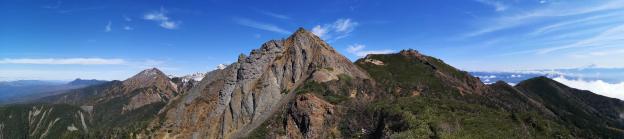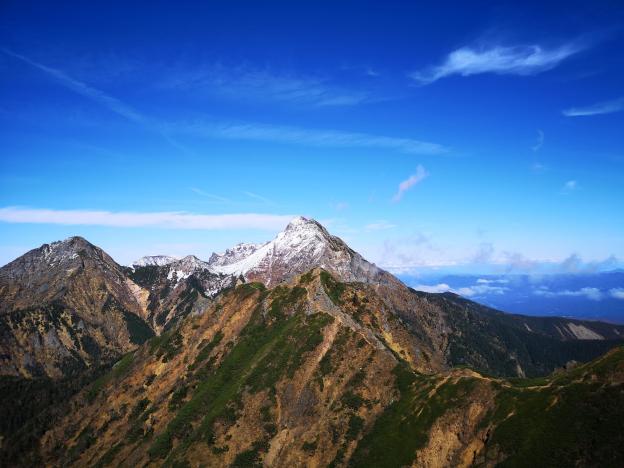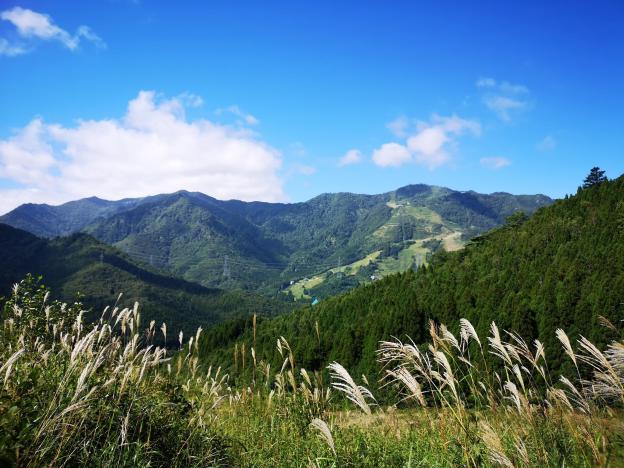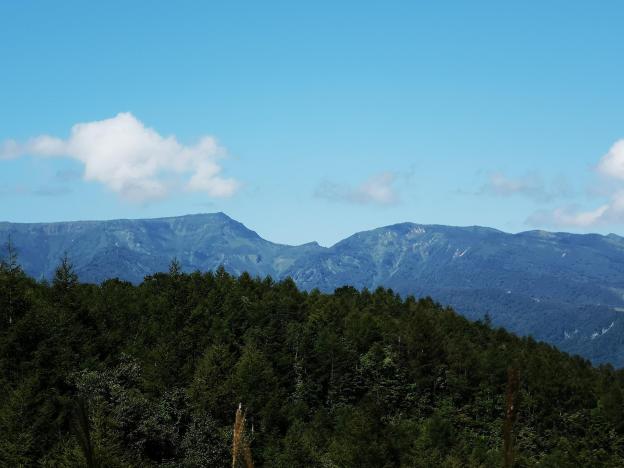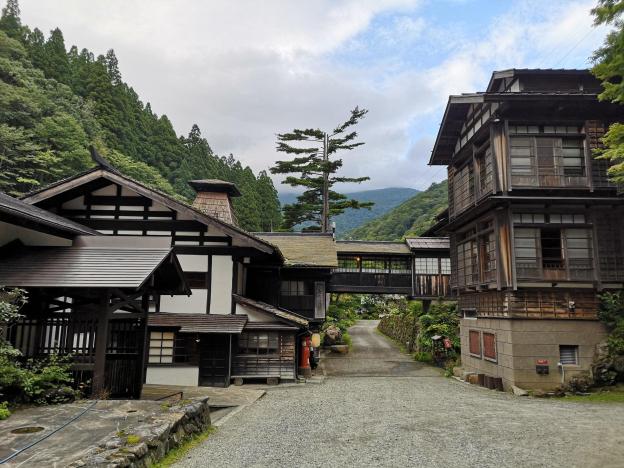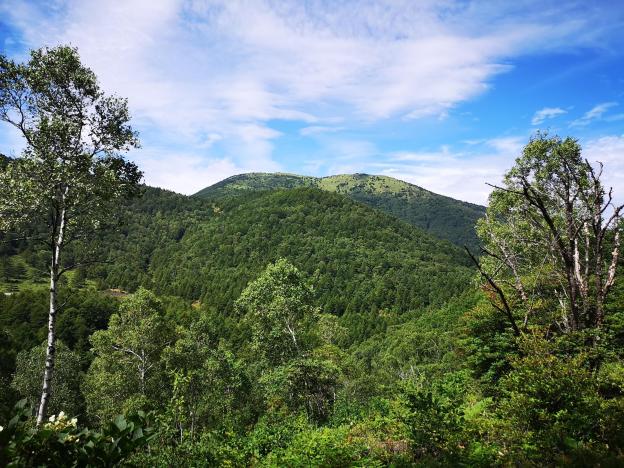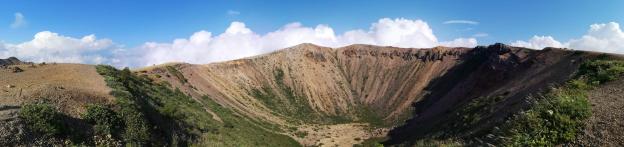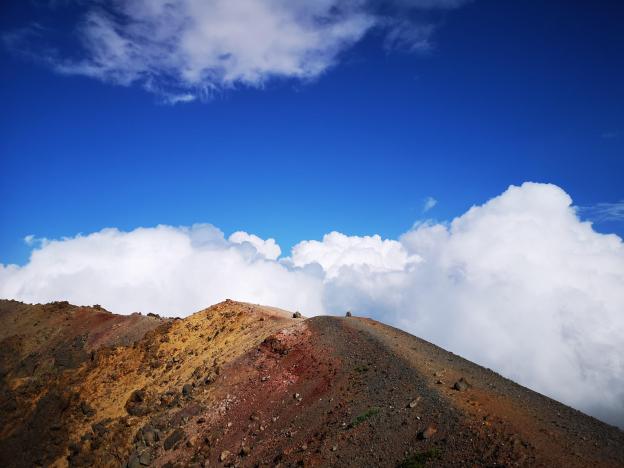
Mt Atago (394m), Akaboko (409m) & Kasumi Hills, Ome City, Tokyo Prefecture, Saturday, February 1, 2020


While trying to find some new hikes to do in the Tokyo area, I came across the Kasumi Hills (kasumi kyuryo 霞丘陵) in my guidebook. Starting from Higashi-Ome station, it ended at Iwakura Onsen 岩蔵温泉, halfway between Ome and Hanno cities. It seemed like the perfect hike except that it was only three hours long. After studying my Okutama hiking map, I saw that it was possible to extend it by hiking some minor peaks South of Ome city.

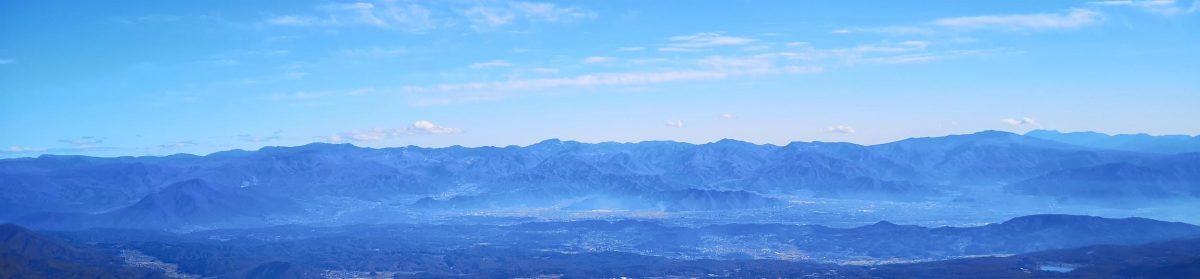
Ome city and the Okutama mountains

At 9am on a sunny morning, I got off at Miyanohira station on the Ome line. Each carriage was decorated with a Flying Squirrel or musasabi ムササビ theme. The hiking trail started on the other side of the Tama river, across Wada bridge, and was indicated by a signpost. Soon, I was walking along a path that went through a thick bamboo forest alongside a small creek, then climbed to the top of a low ridge. There, another signpost told me to turn right. Before that, I decided to investigate the path heading left. It turned out to be a very nice, not-on-my-map, alternate start to the hike, from Shinmei Shrine 神明神社.
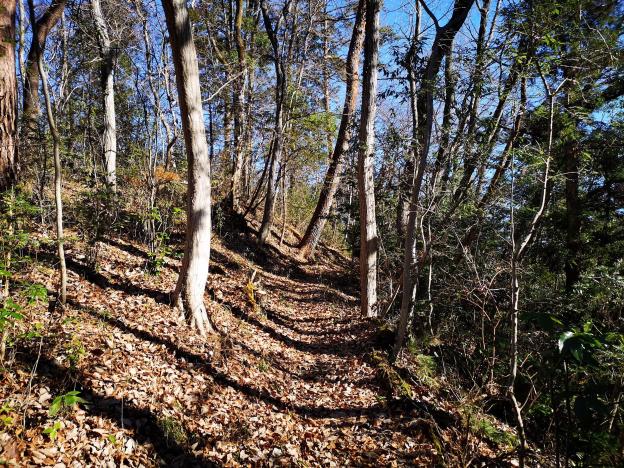
Another path leading to the start of the hike

I retraced my steps and started to head up the ridge. Very soon, I reached another junction and a viewpoint of the Okutama mountains. The main trail continued to the left. I turned right instead, going downhill, then back up, reaching the top of Mt Atago 愛宕山 at 10h30. This section isn’t signposted, and I had to figure it out from Google Maps. The view is mostly obstructed by trees – even standing on a tree stump I couldn’t make out much.

Top of Mt Atago marked by a huge tree

Although the path continued down towards Ume no Koen, I returned to the previous junction, and took the path heading left. I was a little behind schedule so I picked up the pace and, consequently completely missed a great viewpoint that was indicated on my map. The path continued through beautiful and peaceful forest. It was hard to believe I was still inside Tokyo prefecture.

Beautiful scenery at the edge of Tokyo

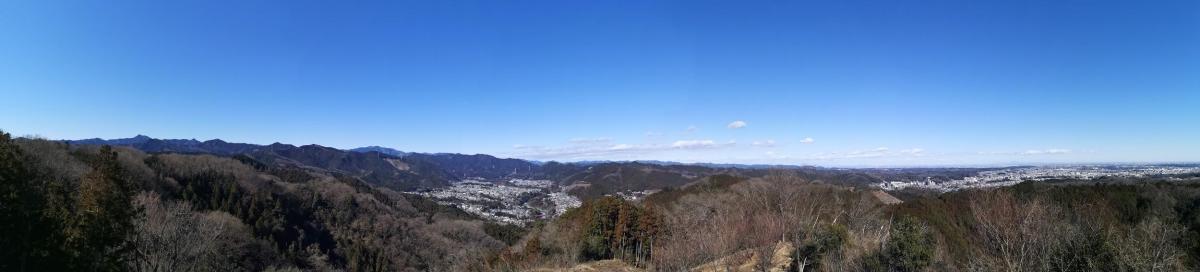
It took me less than an hour to reach Tengu Rock or Tengu-iwa 天狗岩 , a spectacular viewpoint of the Tama river valley and Ome city. It was also the perfect place for an early lunch. No sooner had I set off again, that I reached another amazing viewpoint, Akaboko 赤ぼっこ. I could see the Okutama mountains to the left, the Oku-Musashi mountains in the center, and the skyscrapers of central Tokyo to the right.

This slideshow requires JavaScript.

View from Akaboko

I resumed hiking at 12h45, now very much behind schedule. I had planned to reach Ome city, and start the second half of my hike around 1pm. I half walked, half ran down the mountain; fortunately the trail was wide and not too steep. I recrossed the Tama river at 13h45. It took me another hour of road walking to reach Shiofune-Kannon-ji Temple, famous for its Azalea flowers in May.
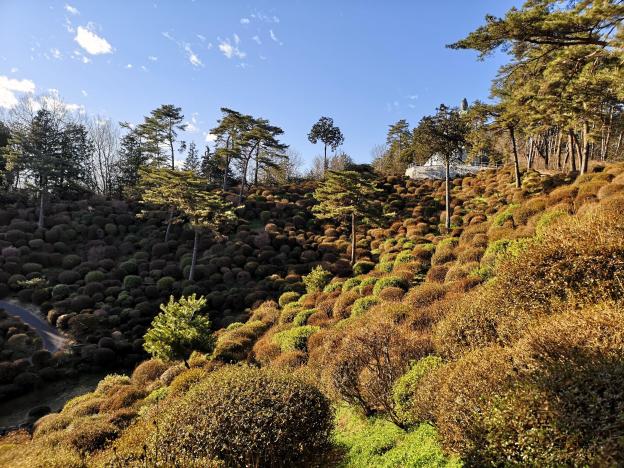
This popular flower garden was almost empty in the middle of winter

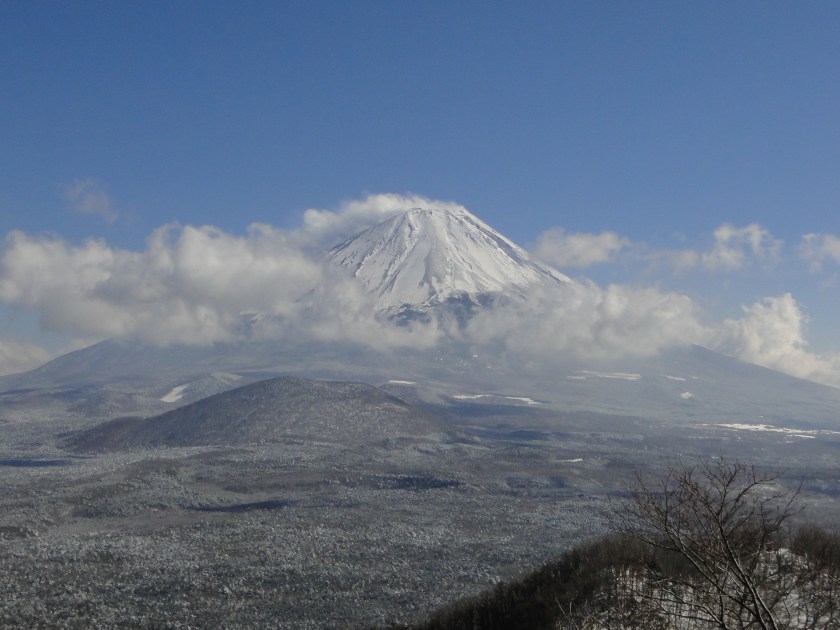
Even in winter, it’s worth a visit. I saw a couple of giant cedars, the tallest one rising up to 43m high! All the buildings had impressive thatched roofs. There is also a huge statue of Kannon at the highest point of the park. I made my way up there, and was rewarded with a view of Mt Fuji, just before it wrapped itself up in clouds. The Kasumi Hills 霞丘陵 hiking trail started just behind the statue, sandwiched between Ome Golf Club and Ome City. I had lost track of time and it was already 3h30.
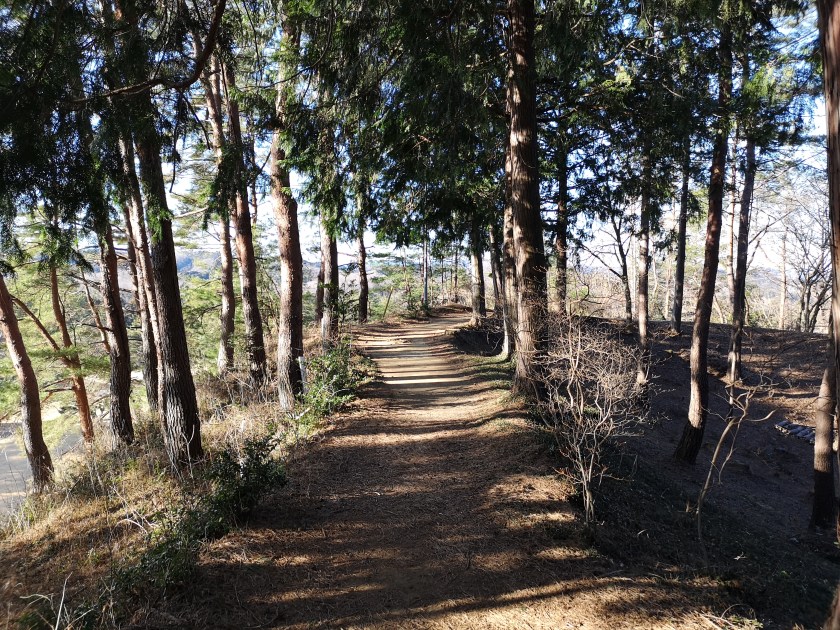
IMG_20200201_152413

Start of the Kasumi Hills hiking trail

I jogged along the easy to follow and well signposted path. I soon reached a road near an athletic park, which took me to Iwakura-kaido Avenue. I needed another hour to do the last part of the hike through Shichikoku-toge 七国峠 (meaning “seven country pass”), but since the onsen was closed to day-trippers after 5pm, I decided to leave it for another day, and follow the road directly to the hot spring. I was able to take a hot bath at the very charming Mamada Ryokan before heading back home.

The signposts were decorated with these painted stones

Mt Nakimushi (1103m), Nikko City, Tochigi Prefecture, Friday, January 3, 2020

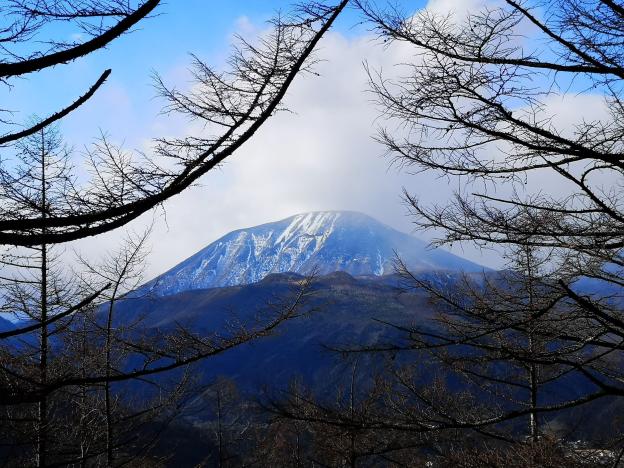
Mt Nyoho in a veil of clouds

For my first hike of 2020, I decided to head to Nikko. Not only is access easy thanks to the JR Nikko line, but since it’s a major sightseeing spot with a famous shrine, most places are open during the Japanese new year. The mountain I chose can be reached on foot from the train station, so I didn’t need to depend on any buses. Sadly, a French woman disappeared while hiking it a few years ago, and I saw several missing posters during the hike.

A glimpse of Mt Nantai through the trees

I arrived in Nikko at 10am, but since it was a short hike, I took my time getting ready, and only set off a little before 11am. It was a nice day and the view of Kirifuri Highland covered in the snow from Nikko city was quite spectacular. The start of the hike climbed relentlessly through thick forest. Less than an hour later, I reached the minor peak of Mt Konosu 神ノ主山 (842), and there was a glimpse of the surrounding mountains through a break in the trees.

A steep climb just before the top (left) and a steep descent just after (right)

It took me another hour of determined climbing to reach the top of Mt Nakimushi 鳴虫山 (meaning crying insect). There should have been a good view of the main peaks of Nikko from the top, but today they were hidden behind the clouds. It was pretty cold at the top – despite the sunny weather, a few snowflakes floated down. After a quick lunch, I started to head down a steep staircase on the other side of the mountain just after 1pm.

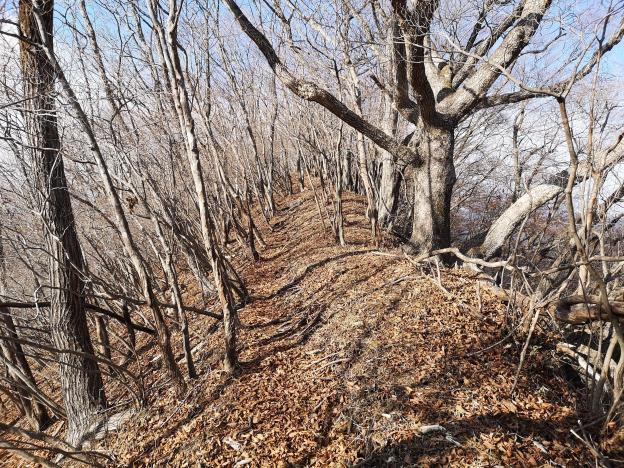
Sunny ridge on the way down

It took me about an hour and a half to reach the base of the mountain. I saw few people during the hike, and it was very quiet and peaceful. Although it’s not a difficult hike, the mountain is very steep on both sides of the path. Also, there are many points where one can easily lose the trail. There were warnings in Japanese and English, but they seemed fairly new. Having hiked the path myself, I can understand a little better how someone could go missing there.

Returning to Nikko station along the Daiya river

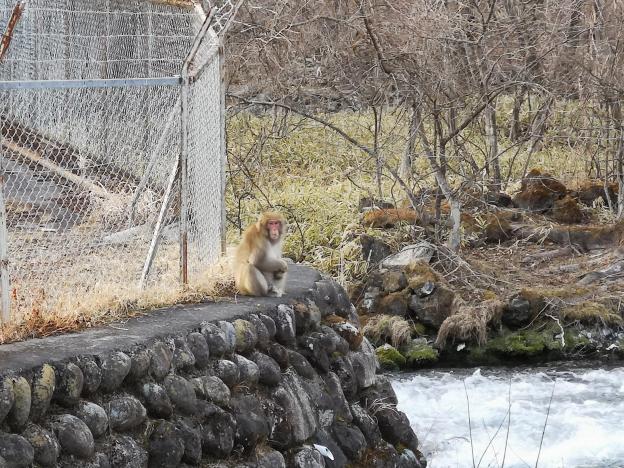
After reaching the base of the mountain, I walked along a narrow road to the nearby Yashio Hot Spring. I saw a monkey on the way. I am not sure if that brings good luck, but I’d like to think so. After a nice hot bath, I decided to walk back to Nikko station since it was still early. It took less than an hour following the river, and by 5pm I was on the express train back to Tokyo.

First monkey sighting of 2020

Watch a video of a wild monkey in Nikko

NEXT UP: Mt Ozawa in Gunma

Toryu Valley & Mt Omine (1062m), Chichibu City, Saitama Prefecture, November 2019

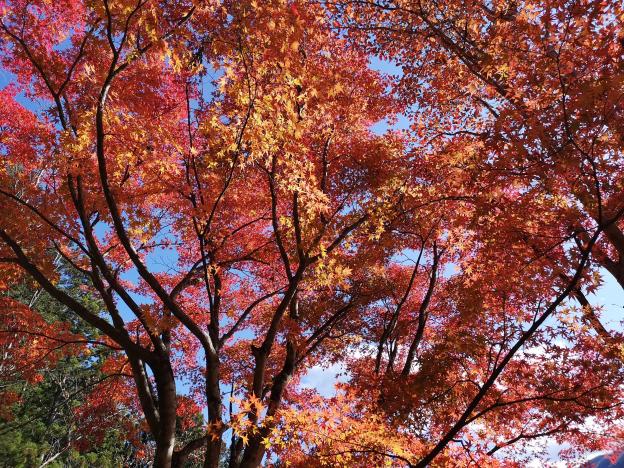
Autumn colours along Toryu-Kei

In mid-November, I went on a day-trip to check out the autumn colours in the Oku-Chichibu area. It had been one month since the devastation brought by Typhoon Hagibis, also known as Typhoon #19, and there was a risk that some trails would be damaged or even closed. However, there are many great places to visit in the area, and I was confident I would find somewhere to walk among the autumn leaves.

IMG_20191114_112648

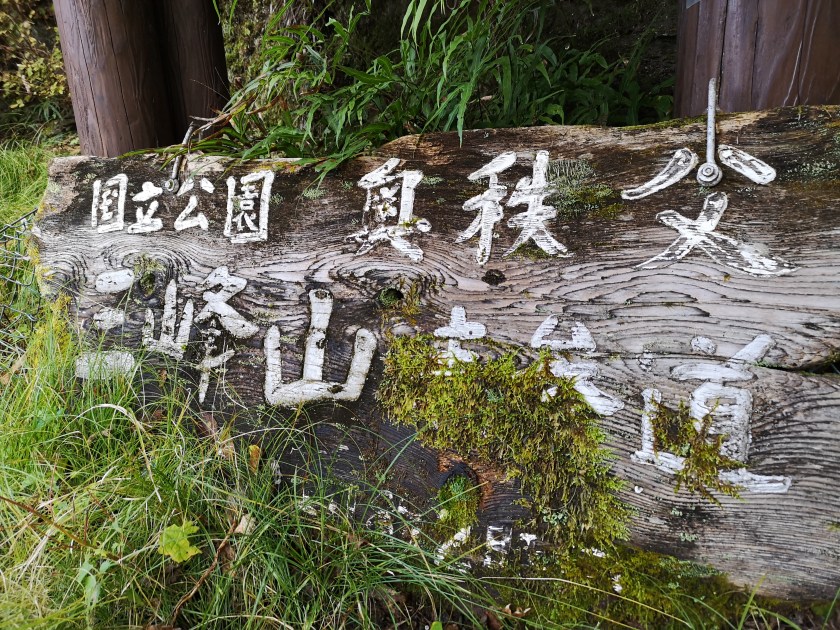
Sign reminding me that I was inside the Oku-Chichibu National Park

I drove from Seibu-Chichibu station, past Mitsumine-Guchi station, to Toryu Bridge 登竜橋 where I left the car. Past the bridge, it’s possible to walk along the Arakawa river in both directions. I first headed downstream; the path had been partly washed away in several places, and was also obstructed by several fallen trees. Since the path was a dead-end, I quickly gave up, walked back past the bridge, and followed the river upstream.

View from Toryu Bridge

First, I followed a gently climbing road past some ancient gravestones. After a few minutes there was a sign for a trail through the forest on the right. This led back down to the river, round a cliff on a wooden walkway, and finished at Ryumon Waterfall 竜門の滝. I retraced my steps to the start of the wooden walkway, and then followed another path further upstream, a few meters above the rushing river. There was a lot of damage here due to the typhoon. The trail was so washed away, that I soon gave up again. In conclusion, it’s impossible to hike along most of the Toryu valley at the moment. On the way back, I followed the road a little further, and it led to the start of the trail to Mitsumine Shrine. Apparently, this trail is open and undamaged.

Entrance to the trail for Mitsumine Shrine

Afterwards, I drove another twenty minutes, past the turn-off for Mitsumine Shrine, all the way to the Irikawa river valley. I was going to leave the car at the Irikawa Camping Ground and explore the river upstream. However, the access road was closed due to typhoon damage, and it wasn’t possible to reach the start of the trail. I had to fallback on plan C: completely avoid river valleys, and drive to nearby Tochimoto Plaza 栃本広場 where I could hike Eastwards along a low ridge sandwiched between two lakes.

Beautiful autumn colours in “deep Chichibu”

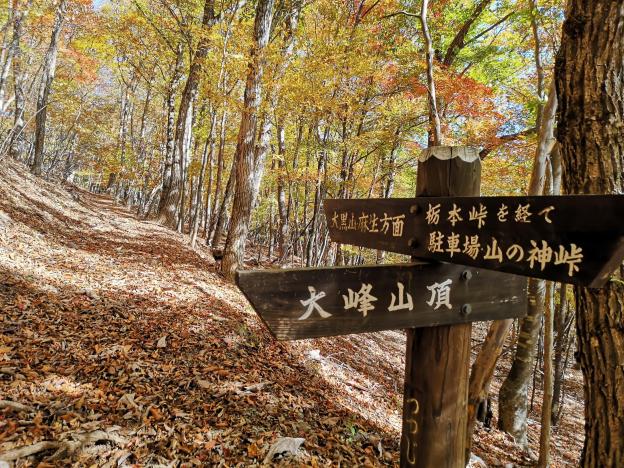
This time I was lucky. The path was easy to hike with no damage at all; the autumn leaves were still at their peak. It took me about thirty minutes to reach the top of Mt Omine 大峰山 completely in by trees. Even the little viewing platform wasn’t high enough to see over them. The path continued along the ridge, but since it was now downhill through a thick cedar forest, and I had get back to the car, I decided not to go any further. Luckily, it was possible to take a slightly different path back, with occasional glimpses of Oku-Chichibu-Momiji lake through the trees.

Easy hiking through the forest

I drove a different way back, following a very picturesque road with good views towards Mt Wanakura. I got back to Seibu-Chichibu station before 4pm where I was able to enjoy a nice hot bath, and taste some local sake inside the station, before taking the brand new and futuristic looking Laview Limited Express train back to Tokyo. After the heavy rains and strong winds that hit the Kanto area last October,  I think that most hiking trails in Tokyo, Saitama and Tochigi prefecture are still hikable, except the ones following river valleys. Those ones may be closed for a while, but hopefully they’ll be restored sometime in the future.

View of Mt Wanakura in the late afternoon

Mt Sanpobun (1422m) & Panoramadai (1300m), Fujikawaguchiko Town, Yamanashi Prefecture, Saturday, November 30, 2019

Hiking in the Fuji Five Lakes Area
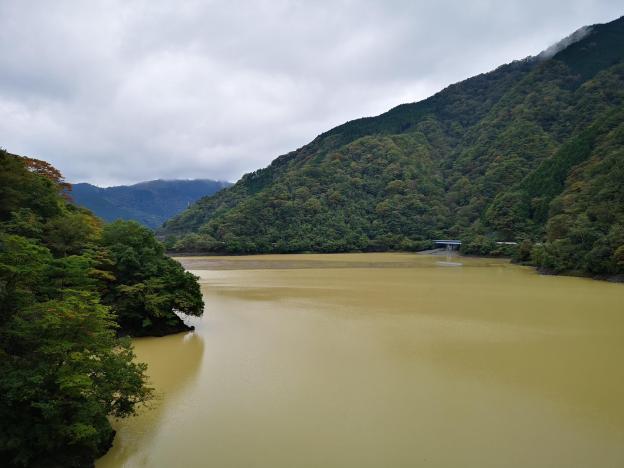
This is one of my favourite areas to hike in the late autumn and early winter since the views of Mt Fuji are so beautiful. Also, since April 2019, there is a direct limited express between Shinjuku and Kawaguchiko that I really wanted to try. It’s the same deal as the Chuo line limited express – all seats are reserved only. However, for the Fuji train, there were no seats to be had on the day itself, and I had to stand most of the way. Although it’s convenient, I probably won’t be using this train again.

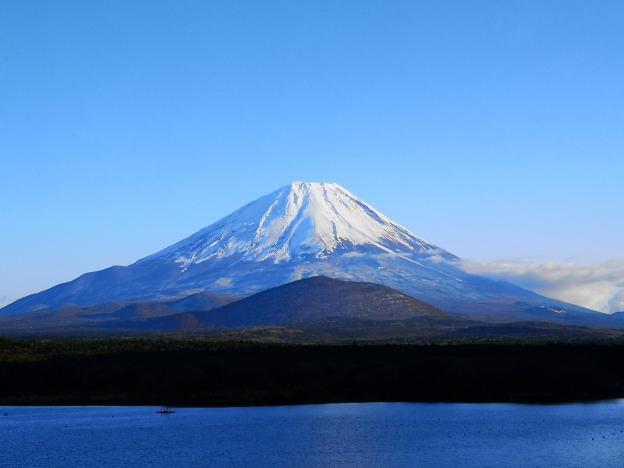
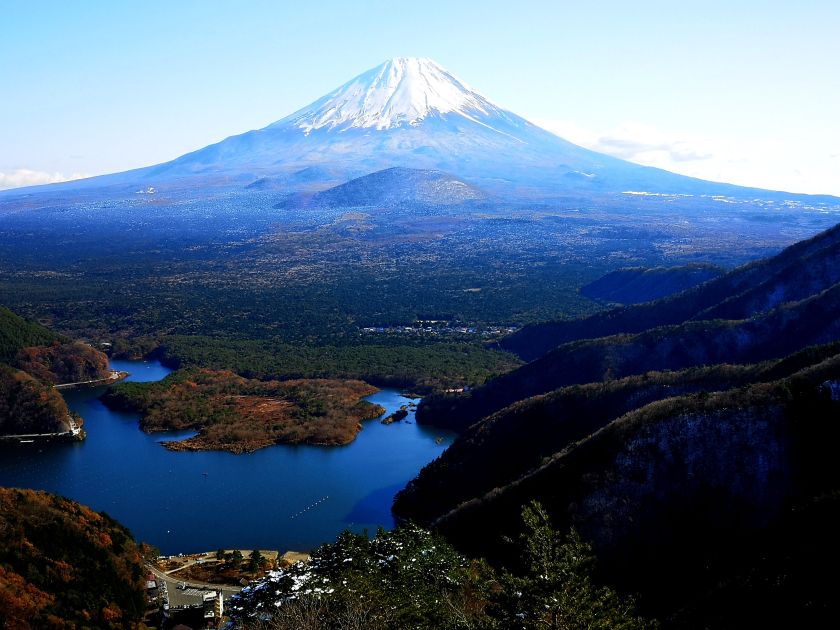
View of Mt Fuji from Yamadaya Hotel

I got off at Fuji station, boarded the bus for Motosu lake, and got off at Yamadaya Hotel next to Shoji lake. The view of Mt Fuji rising from behind the lake was stunning. Originally I wanted to hike all the way to Mt Ou and end at lake Saiko, but considering the fresh layer of snow that covered the higher reaches of the mountain, I decided to shorten the hike, and make a loop back to my starting point. The fact that the Yamadaya hotel also allowed day-trippers to use their hot spring bath was also a factor in that decision.

Already hiking in the snow in November

I started up the hiking path quite late in the day – at 11h15. I had hiked up this path once before in February 2013 in the snow, and there was snow again this time. I met many people coming down – apparently this is a popular hike. I reached Panoramadai パノラマ大 one hour later, and had an early lunch. Six years ago I continued down to lake Motosu on the other side. This time, I retraced my steps to follow the ridgeline Northwards. There were less people, and the path went up and down more steeply. Fortunately, the snow layer was thin, but I had to be careful not to slip on the descending parts. I was glad I had chosen the shorter hike and that I didn’t have to rush!

DSC07059
View of Shoji lake and Mt Ou in February 2013
DSC07071
View of Mt Fuji and Aokigahara forest in February 2013

There was a great view of Mt Fuji and Shoji lake, a few meters to the right of the path, just before Shoji pass – I nearly missed it even though it was marked on my map. After that, the path climbed steadily. I reached an area with a small shrine that seemed like the top but wasn’t. It took another five minutes along a level path to reach the true summit of Mt Sanpobun 三方分山. It was surrounded by trees, but there was a nice view of Mt Fuji on the South side.


IMG_20191130_132712b
The best view of the hike was near Shoji Pass
IMG_20191130_141126
View from the top of Mt Sanpobun

It was past 2pm and time to head down. On the way, I had some good views of the ridge leading up to Mt Ou – hopefully I can hike it another time. The whole mountainous area spreading North-East, and bound by the Fujikyuko and Chuo lines, is known as the Misaka mountain range. One hour later, I emerged from the forest near the base of the lake. There was an interesting shrine with a couple of very large cedar trees. According to the sign, they were 1200 years old, 10 meters in circumference, and 40m high! A short walk brought me back to my starting point where I was able to take a nice bath with a good view of Mt Fuji in the late afternoon light.

Next up: Mt Iwadono in Yamanashi Prefecture

Mt Gongen (2715m) & Mt Amigasa (2524m), Hokuto City & Fujimi Town, Yamanashi & Nagano Prefectures, Thursday, October 23, 2019

Hiking on Mt Yatsugatake 八ヶ岳

I was hoping to climb one last big mountain in 2019, before the arrival of snow, and I had had my eye on the two Southernmost peaks in the Yatsugatake range for a while. Even though they are the closest to Tokyo, right between Yamanashi and Nagano, they’re challenging to climb as a day trip from Tokyo – Mt Tengu, further North, was possible thanks to the Hokuriku shinkansen. In the end, I decided to stay the night in Kofu and drive to the mountain; this way I could leave at dawn, and finish around sunset. I had to travel to Yamanashi and back by highway bus, since the trains weren’t running as usual due to damage by typhoon Hagibis. This was a blessing in disguise, since the bus costs half the price of the train, so I could recoup some of the cost of the hotel and the car.

Looking back at the pointy tip of Mt Gongen from Mitsugashira

On Thursday morning, the sky above Kofu city was foggy, but as I drove West along the highway, blue skies appeared overhead. As Yatsugatake came into sight, I got a shock: the top was white with snow! As I drew closer, I saw with relief that it was only the highest peak, Mt Aka (2899m), that was covered in snow, and today’s hike would be snow-free. I reached the Kannondaira parking lot (1560m) just before 8am – there were quite a few cars, even on a weekday. The first part of the hike, a gently rising trail through forest that was still green, was fairly easy. After half an hour, I reached a clearing with a good viewpoint of Mt Fuji sporting a brand new snow cap – a good place for breakfast.

Snow-capped Mt Fuji – the morning mists haven’t fully dissipated yet

The trail continued through thick forest, and after another half an hour I reached the turn-off for my first peak. A steep climb straight up the side of the mountain, with occasional views through the forest of the Kofu valley behind me, brought me to the bare and rocky top of Mt Amigasa 編笠山 at 10h30. The 360 degree view was one of the best I’ve ever seen while hiking.

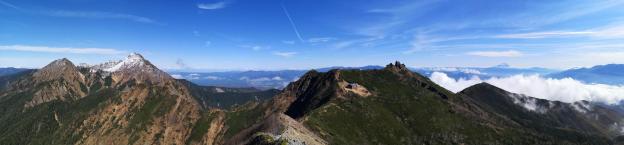
From left to right I could see Mt Fuji, the Minami Alps, the Chuo Alps, Mt Ontake, Mt Norikura and the Kita Alps – all the highest were covered with snow. I could also see the entire Yatsugatake range stretching North, with in the center the matterhorn-like peak of Mt Aka. There were so many great pictures from this hike, that it was impossible to share them all here.

Today’s mountain is the highest point on the far right, but lower than Mt Aka in the center

After a quick bite, I set off downhill just after 11am, towards a saddle where the Seinen Hut was located, just 20 minutes away. The last part was full of giant boulders, and it took some time since I had to step carefully from boulder to boulder, following painted yellow arrows. After that, I was climbing again through forest. Suddenly, I was above the treeline at around 2600m; there was a sharp drop on my left, and an impressive rocky outcrop towering in front of me.

Fortunately, there was a switchback path on the right, with helpful chains in several places. It looped around the back, and led up to what I thought was the highest point. Noticing that there was no summit marker, I turned around – the true top was behind me, five minutes away and just a little higher. Looking left, I could the impressive “kiretto” or mountain ridge, leading to Mt Aka.

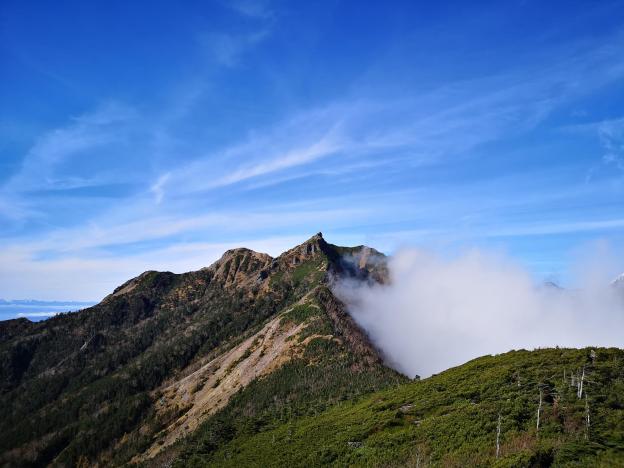
The “kiretto”, on the right, leading up to the highest point of the Yatsugatake

Originally I had planned to go up and down the same way. However, I had made good time climbing up, so I decided to take a different and longer route down. I hurried past another hut to the highest point of my hike, Mt Gongen (権現岳 gongendake) – in fact the highest mountain climbed in 2019. I couldn’t actually get to the very highest point since it consisted of a bunch of huge boulders, but I got as high as I felt safe doing, and had the rest of the lunch while enjoying the view of Mt Fuji in the distance. Since a boulder was in a way, I couldn’t get a perfect 360 degree view. The weather was still sunny, with almost no wind. Despite the high altitude, and proximity of the snowline 200m higher, I was perfectly fine wearing just a base layer. At one point a cargo plane, probably from the Japan Self-Defense Force, flew past the summit (see video at the end).

Perfect view of Mt Fuji from the top of Mt Gongen

I had to set off fairly quickly if I wanted to complete the hike before dark, around 5pm. First I headed down and back up again to Mitsugashira 三ツ頭 (2580m). Looking back, the view of snow-covered Mt Aka, wrapped in mist was breath-taking. By now, it was nearly 2pm and I needed at least a couple of hours to get back to my car, so I pulled myself away from the view, and descended into the forest. This was one of the nicest and easiest downhill hikes I’ve ever done. There were good views of my first peak, with orange larch trees around the base. One hour and a half later, I reached the Yatsugatake crossing path (“oudan hodo” 八ヶ岳横断歩道), part of a trail that circles the entire mountain range –  something to try one day. From there, it was another thirty minutes back to the parking area along a mostly level trail, although the last meters were steep uphill – pretty tough after what was nearly an 8 hour hike! Fortunately, there was a hot spring at the base of the mountain, so I could have a good soak before making the long trip back to Tokyo.

Although it’s called the red peak, today it was partly white

I believe this was a JIETAI plane flying past the summit

NEXT UP: Mt Ihai (Mt Ashitaka) in Shizuoka

Mt Gongen (1019m), Yamakita Town, Kanagawa Prefecture, Sunday, October 20, 2019

Hiking in the Tanzawa Mountains 丹沢山地

This was my first hike since typhoon Hagibis, which hit the Kanto area the previous week. Not only did it flood many low-lying areas, but it also damaged mountain roads and hiking trails. According to the latest update from the Nishi-Tanzawa visitor center, all trails in their vicinity were open, but this was before the heavy rains that hit the Kanto area again two days before my hike.

The Sunday forecast was supposed to be good, but when I got to Shin-Matsuda station it was definitely overcast. Oddly enough I was the only person to board the bus for Nishi-Tanzawa, a popular hiking destination, especially in the Autumn season. The reason soon became clear – Friday’s rain had caused a landslide along the road, preventing the bus from reaching the visitor center, the starting point for most hikes. Fortunately for me, I was getting off before that, at Tanzawa Lake. The bus ride was along a river, and I noticed that the water was brown and muddy. Further upstream there was a sign saying that water was being released from the dam at Tanzawa lake.

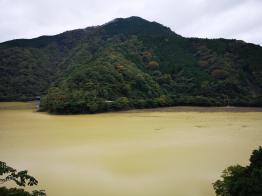
Once, I got off the bus, I was shocked to see the amount of debris, mostly tree branches, floating on the lake. The lake colour was muddy-brown like the river; hopefully it will regain its normal colour soon. On the bright side, it seemed that my target mountain was just low enough to stay clear of the clouds. Before I set off, I dropped by Ochiaikan 落合館 a nice little hotel where I took a bath after hiking Mt Ono three years earlier, to confirm whether they still allowed daytrippers to take a bath (“higaeri nyuyoku” 日帰り入浴). I was told yes, and I said I would be back around 4pm.

Tanzawa lake: May 2016 (left) and Oct 2019 (right)

I had to walk counter-clockwise alongside the lake for about forty minutes to reach the start of the trail. Along the way, I saw a small parking area full of cars and cameras mounted on tripods nearby. I asked one person what they were hoping to photograph. He replied “taka” which according to my dictionary is a falcon or a hawk. Always curious about the local wildlife, I would have liked to stick around to catch a glimpse of the bird, but I was running late, so I had to move on.

Wood debris floating on Tanzawa lake

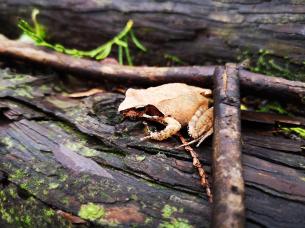
I reached the start of the trail a little before noon, and started climbing immediately. The trail climbed steeply through cedar forest. From the start it was hard to follow – this wasn’t a popular trail, and according to my guidebook, this hike is mainly done in the spring because of certain flowers that grow higher up. I got a nice surprise on the way – a small light-green frog hopped onto the path. Further up, it was the turn of a light-grey one. I have occasionally seen toads while hiking, but I had never seen a frog till this year. Earlier in the month I had also seen a couple of frogs along the Nakasendo in Nagano prefecture. I had read that the frog population was declining, but perhaps it’s making a rebound?

Frogs posing for pictures along the trail

I’m not sure whether it was because of the recent typhoon, but bright green cedar leaf branches were scattered all over the trail. I had never seen so many before, but they were effective at making the muddy trail underneath less slippery. As I gained altitude, the path became less steep, and the forest less dense, helping me spot two young deer dash away ahead of me. At times, the path was hard to follow, and I often had to rely on the “pink ribbons” to find the correct way.

The hiking path was covered with cedar leaf branches

I reached the flat top of Mt Mitsuba ミツバ山 (834m) just before 1pm. There was an opening in the trees a few meters to the South, but everything was in the clouds beyond the next ridge. In good weather, I imagine one could see Mt Fuji. After a quick break, I continued to climb along the ridgeline. Eventually, I saw mist to my right, so I figured that the top was in the cloud after all. Curiously enough, the left side remained clear for a while, before being engulfed in cloud as well.

This sign was kind of funny so I left it as it was

I reached the lonely summit of Mt Gongen 権現山 before 1pm. According to my map, there weren’t any views, just as well since there wouldn’t have been any because of the mist. This mountain’s name is fairly common: purely by coincidence, the next mountain I climbed, just 3 days later, had the same name. I didn’t even realise it until I went through my photos. After a quick lunch, I set off immediately. Since I had climbed fairly quickly, I hoped to descend equally quickly, and catch an earlier bus back, especially since the weather was poor.

Mysterious and quiet forest at the top

The path down (heading left – the path going past the top is a shortcut leading back down to Tanzawa lake) was as hard to follow as the one going up. There were steps built into the steep slope, but they lacked maintenance. It seems that this path has fallen out of favour among the hiking community, and I can’t recommend it, unless one is seeking absolute solitude. On the way down I had some glimpses of Nakagawa onsen 中川温泉 in the valley below, an aging hot spring town I had stayed at a couple of years ago.

I lost quite a bit of time looking for the trail, at one point heading down a steep valley by mistake and having to climb back up, and I ended up missing the earlier bus, as well as the next one, arriving at the bus stop just below Nakagawa Onsen, at around 4h30. Even though sunset was at 5pm, it got quite dark hiking in the forest after 4pm. I might even have spotted the elusive “taka” taking off from a branch at one one point, but it might have been just a crow.

I finally arrived back at Tanzawa lake just before 5pm, and was looking forward to a hot bath, only to discover that the hotel was closed! However, after knocking at the door, the owner arrived, and kindly let me have a quick bath – since they didn’t see me arrive at 4pm, they thought I had changed my plans, and decided to lock up for the day. After a quick bath, I caught the last bus back to Shin-Matsuda station.

NEXT UP: Mt Gongen in Yamanashi Pref. (Yatsugatake)

Mt Daigenta (1764m) & Mt Mikuni (1636m), Yuzawa & Minakami Towns, Niigata & Gunma Prefectures, Saturday, September 14, 2019

Hiking in the Mikuni Mountains 三国山脈

This update should belong to the Tokyo Wide Pass update for Silver week 2019, but since the second hike of that holiday fell through due to a combination of bad weather and a poorly-marked trail, I only managed one hike (a repeat of this year’s Golden Week). I was excited about this hike since it connects two prefectures, and two consecutive stations on the Joetsu Shinkansen. The staff at the ticket window were good enough to confirm that I wanted a return on the same day from a different shinkansen station! It’s also entirely within the Joshin’etsukogen National Park.

Gunma view from the top of the ridge connecting Mt Daigenta and Mt Mikuni

After arriving at Echigo-Yuzawa station in Niigata prefecture, I hopped on the bus headed for Naeba Prince Hotel, getting off at Asakai, a few minutes past the stop for Mt Sennokura. My plan was to hike up the ridge leading South from Mt Tairapyo, so that I could pick up my hike from 2017, about half an hour past the Tairapyo Mountain Hut. My map indicated that the hike went up through the ski resort but that the start of the trail was hard to find. I found something that seemed like a trail and headed up it, but after climbing for nearly thirty minutes, it turned out to be a deadend.

A hint of autumn, looking Westwards to Niigata

I was now faced with two options. Either head back down, and follow the road to the start of the trail of Mt Mikuni (where I had expected to end up) and go and back down from there. Or, cut across the hillside in the hope of coming across the actual trail. I chose the second one, following a very faint overgrown track through thick bushes at the edge of the forest covering the mountainside, thinking all the time that if this doesn’t work out, I’ll have to walk back the same way. Finally I gave up on the bushwacking, and started to climb directly up through the forest. It was pretty steep, but there was less vegetation to slow me down.

The ridgeline I was hiking up

After about ten minutes of climbing straight up the side of the mountain, using the thin trees as handholds, I spotted some rope to the right. I moved towards it, and discovered the path. My joy at finding the path, was tempered by the fact that it headed straight up the mountainside at roughly the same gradient I had been doing just before – the rope was there to help pull yourself up. The path continued for what seemed like forever. I finally reached a minor summit with a view of the remaining way to the top ridge. I had just started out, and I was already exhausted!

The instantly recognizable shape of Mt Naeba, as seen halfway up the ridge

After a short descent, the path continued to climb relentlessly. At precisely noon, I emerged at the high point, more than two hours after setting out, and completely knackered. This was after all my first big ascent since the start of the summer. I admired the great 360 degree view – Niigata to the West and Gunma to the East – then dropped my pack, and headed towards Mt Daigenta 大源太山 about 15 minutes away.

In the foreground Mt Azumaya (climbed May 2017) and in the background Mt Mitsumine (climbed May 2019).

From the top there were good views of Mt Sennokura playing hide and seek in the clouds. Further to the right, Mt Tanigawa was stubbornly sitting inside a big cloud. After a quick bite, I headed back to pick up my pack and started southwards along the ridgeline towards Mt Mikuni visible in the distance. Since I lost time finding the start of the trail, it was now impossible to catch the earlier bus which would have given me some time to use the hot spring at Sarugakyo Onsen. I had been there once before after descending from Mt Azumaya two years earlier and was looking forward to visiting again. Now I had to race to catch the last bus back.

Around 2000m, Autumn has arrived…

After some ups and downs, with spectacular views, especially towards Gunma prefecture, I reached the flat top of Mt Mikuni 三国山 just after 2pm. The name translates as “three country mountain”. In modern times, it sits on the border of two prefectures, but during the Edo period, it probably sat at the junction of three areas. From the top, I was able to see for the first time Mt Inatsutsumi, although Mt Shirasuna beyond was lost in the clouds. I could also see the end of the hike, straight down the side of the mountain to Mikuni Pass, and then further down the valley to Hoshi onsen 法師温泉, a secret hot spring.

Mt Ono (left) and Mt Haruna (right)

The path down to Mikuni pass consisted mostly of wooden steps – perfect for running down since I still wasn’t 100% sure I would be able to catch my bus. In no time, I reached the pass, where I turned left into the forest. Soon I reached a road, beyond which was the path to Hoshi Onsen, the last part of which followed a river. I reached the end of the hike with ten minutes to spare. Since there was no time for a bath, I used the Tokyo Wide Pass to go from Jomo Kogen back to Echigo-Yuzawa (just ten minutes), where there is a hot spring in the station.

Hoshi Onsen, a place I would like to stay at someday

NEXT UP: Mt Konara in Yamanashi Prefecture

Mt Sajiki (1915m), Mt Murakami (1746m) and Mt Kakuma (1980m), Gunma Prefecture, Sunday, September 1st 2019

Continuing my tour of Japan’s National Parks, I next visited the Joshin-Etsu-Kogen National Park in Gunma prefecture. Despite the poor weather forecast, I decided to risk taking the shinkansen to Ueda city. There, I rented a car and drove up the Western part of Mt Asama. I had been there a few years ago to climb Mt Yunomaru and Mt Eboshi, but there were a few more peaks that had remained unclimbed.

The balding top of Mt Yunomaru, climbed in November 2015

From Ueda station, I could see that the mountains were in the clouds, and on the way up I encountered thick mist. Fortunately, I broke through it before I reached Yunomaru Kogen above 1700m, and I even had some sun after I parked my car. I immediately rushed up the hiking trail, since I knew that the blue sky that had opened up overhead wouldn’t last. The path was quite nice, and I reached the top of Mt Sajiki 棧敷山 at exactly 11 o’clock. I had an excellent view of Mt Azuma and Mt Kusatsu-Shirane, hundred famous mountains I had already climbed.

Mt Azuma, climbed at the end of May 2012

I retraced my steps for a few minutes, and turned left to take an alternative path down. I soon reached a lookout point towards Yunomaru Kogen. At this point, the weather had become overcast, but luckily the clouds were quite high, and I could make out the Japanese Alps in the distance. The path then descended quite steeply. After it bottomed out, I was walking in a spooky, dark forest . I soon arrived at an intersection for the small brother of Mt Sajiki – I decided to check it out. I soon reached the top of Mt Kosajiki 小棧敷山 but the views were limited. Fortunately, it didn’t take me long to get back to my car.

The highest point of Mt Asama

I drove on to my next target at Kazawa Kogen 鹿沢高原. This time, I simply had to go up and down the same trail. I walked as fast as I could up the relatively easy path and reached the summit of Mt Murakami 村上山 just before noon. I was greeted by a vast panorama of Western Gunma, centered on Tashiro Lake. The views were wider than the previous summit and it was a good place to enjoy some lunch.


Mt Kusatsu-Shirane and Tashiro Lake

I quickly made my way back down and drove back up to Kazawa Onsen 鹿沢温泉. It was 2h30 and I had one more peak to climb, but I had to be back by 4h30 for the last entry at the hot spring. I raced up and reached the top of Mt Kakuma 角間山 a little after 3h30. Nearing 2000m, the vegetation had become alpine. While I was taking pictures of the view, it suddenly started raining, which for once was a good thing, since it forced me to head back down rather quickly. I half ran back the same way, and made it to the onsen with a few minutes to spare.


View Westwards from the top of Mt Kakuma

NEXT UP: Hiking from Yanagisawa Pass to Shirasawa Pass (Yamanashi Prefecture)

Mt Higashi-Azuma (1975m), Fukushima City, Fukushima Prefecture, Sunday, August 25 2019

After a one-month break, I’ve resumed my hiking activities, despite an ankle that hadn’t really healed. I needed something easy to allow me to get back into the groove, and also at a high elevation, since it was still quite hot and humid. With the weather forecast looking good, I decided to take the shinkansen all the way to Fukushima city, and then drive up the Eastern side of Mt Azuma, a hyakumeizan inside the Bandai-Asahi National Park about 230 km North of Tokyo.

Technically, the highest point is the Western summit about ten-kilometers away, so summiting the Eastern summit doesn’t really count towards increasing my tally of hundred famous mountains, stuck at 81 since last July. Although there is a bus from Fukushima city, the return is quite early, and doesn’t allow enough time to hike to the top and back.


Part I: Usagi-daira – Toriko-daira – Mt Higashi-Azuma

The top of Mt Higashi-Azuma in good weather

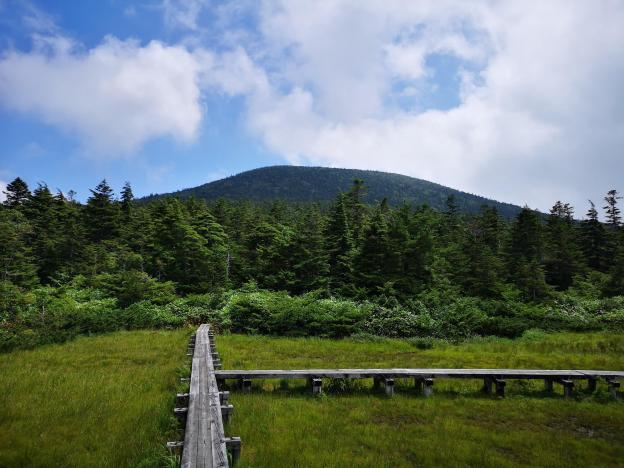
After parking my car at the free parking at Usagidaira 兎平, just a few minutes from the huge paying parking in front of the Jododaira visitor center, I set off on a small path that went through the campsite on the other side of the road. Apart from a few nice sections, I didn’t enjoy it very much. The path was tricky to walk, and was in dire need of maintenance. It was a relief when I finally reached Toriko-daira 鳥小平 with its wooden walkways and many dragonflies.

Here I turned right instead of going straight

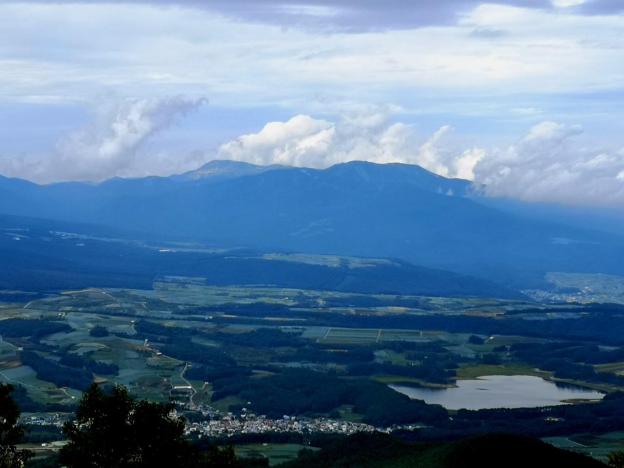
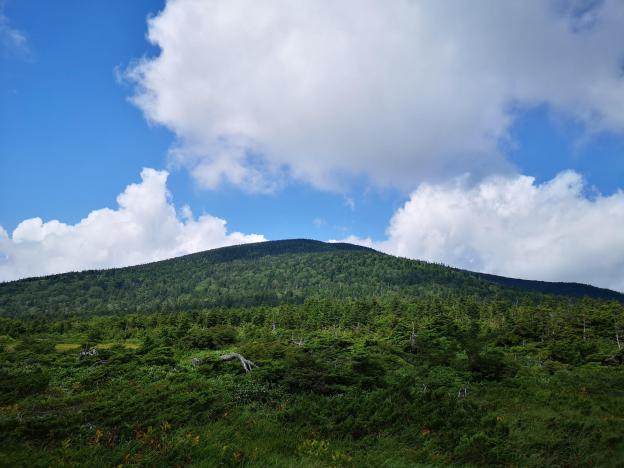
Instead of heading up Mt Takayama straight ahead, I turned right, crossed the Bandai-Azuma Skyline, and slowly started climbing. Shortly, I reached a kind of plateau where I had great views of the summit, as well as a small lake. I was at the same height as the clouds and it was fascinating to watch them drift by. I soon resumed my climb. As I gained more altitude, the weather started to worsen, and by the time I reached the observation point near the top, I was, to my great despair, in the cloud with almost no visibility.

I continued somewhat dejected towards the highest point, but by now it had started raining. I took refuge under the trees just a few meters short of the summit. I put on my rain gear and proceeded to have some lunch. I was hoping the rain would let up, but it only seemed to pound down harder. The wind was blowing, and it felt cold even though it was still August. Finally I gave up and made a dash for the exposed summit of Higashi-Azuma 東吾妻山. I took a quick summit pic, and immediately headed down the other side.

Blue skies and clouds reflected in a pond

I was glad I had put on my rain clothes, as they soon got soaking wet, partly due to the rain, and partly from brushing against wet vegetation. The rain eventually stopped and the sun came out, but I had already descended too far to return to the summit. I didn’t like the path down very much: lots of roots and rock, making it tricky with my bad ankle.


Part 2: Uba-ga-hara – Kama-Numa Pond

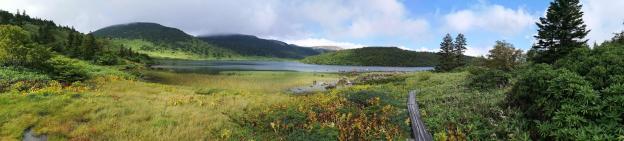
A beautiful lake high up in the mountains

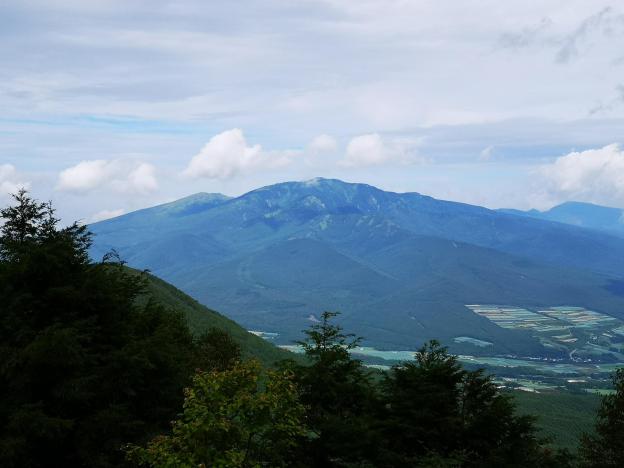
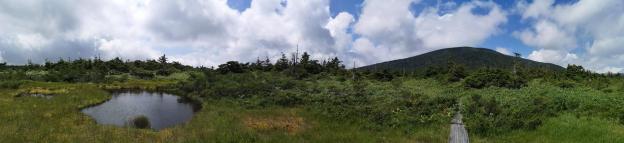
Eventually, I emerged at Uba-ga-hara 姥ケ原 where I was faced with a crossroads. I decided to head straight rather than head back straight to Jododaira. Very quickly, I reached Kama-Numa Pond 鎌沼池 which was quite a breath-catching sight. The dark blue water and light sky perfectly complemented the light green grassy rocks near the shore, and the dark green forested hills opposite. Definitely a landscape that would be worth painting.

The path leading down and back to the visitor center

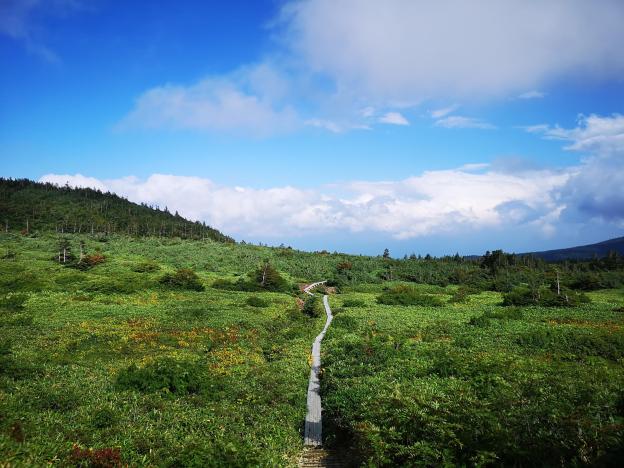
Initially I thought I would walk clockwise around the lake, but my footsteps somehow took me counter-clockwise. I hope to come back some day and climb the remaining peaks on the other side of the lake. Eventually I left the lake behind me, and started to head back towards the visitor center. The weather had completely recovered. Descending in the sunshine, it was hard to believe that only one hour earlier I was sheltering from the wind and the rain near the summit!


Part 3: Jododaira – Mt Azuma-Kofuji

Spectacular view of “small Fuji” on the side of Mt Azuma

I was behind schedule, so I started to hurry towards Jododaira 浄土平. Although I had come by car, according to signs I had seen on the way up, the road back to Fukushima city closed at 5pm, so I had to make sure I was gone by them. My pace slowed somewhat after I started getting some jaw-dropping views of Mt Azuma-Kofuji 吾妻小富士, the mini-volcano sprouting from the side of Mt Azuma like a pimple. I definitely wanted to walk around the rim!

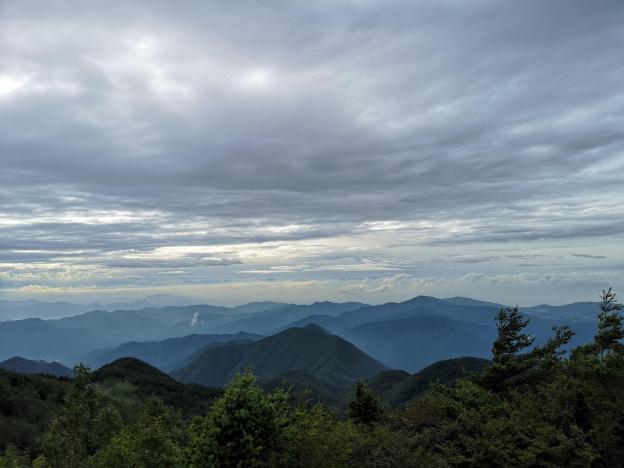
Walking above the clouds…

Although some sections had steps and walkways, a lot didn’t, so my ankle suffered some more. To my right, steam was venting out of the side of Mt Issaikyo. It was with great relief that I finally reached the visitor center. I took off my rain gear, and then rushed up the side of the mini-volcano and was standing at the edge of the crater less than five minutes later. I managed to walk around it in less than half an hour, enjoying the stunning views in every direction. It’s a pretty easy walk and anyone can do it. I managed to be back at the car before 4h30 and was happily driving back to the train station by 5pm. On the way, I had a quick bath at the very nice public onsen Attakayu.

Next up: Hiking at Yu no Maru, on Mt Asama (Nagano prefecture)


Clouds rolling by at nearly 2000m elevation

Karikomi Lake, Nikko City, Tochigi Prefecture, Sunday, July 21, 2019

The very long rainy season had put a premature end to the first half of the 2019 hiking season…but I was determined to get one more hike in before the hot and busy (for me) summer arrived – my next chance would probably not be till September. Since I was a little out of shape, I chose a short and easy one in Nikko, hoping that the overcast skies, and voting for the national elections, would keep the crowds away. I was looking forward to visiting the Oku-Nikko area since I hadn’t been there since my climb of Mt Nyoho two years ago.

Lake Karikomi and Mt Taro in the background

I took advantage of the more expensive, but direct Tobu Nikko line train – being able to sit and sleep during the 2 hour trip was definitely worth the express surcharge. In Nikko there was a light drizzle. I didn’t fancy walking in the rain but I couldn’t turn back now. Going up “Irozaka slope”, the bus was enveloped in thick mist. Fortunately, once we emerged at Chuzenji lake, we were above the mist and I could see the lake and mountain sides – the sky overhead was overcast and the peaks were in the cloud though.

Today’s hike was through green mossy forest

I got off at the very last stop, Yumoto-onsen. This small, somewhat run-down, onsen town town seemed totally deserted, 11am on a Sunday morning. Was the town in decline or was my timing bad, I wondered to myself. I made my way to the start of the hiking path behind the town, also the source of it’s hot springs. There is a wooden observation path, and two small pools of bubbling water – not the most exciting tourist attraction but it’s always cool to see hot water coming out of the ground.

See the hot spring water bubbling up and hear the birds chirping near Karikomi lake

The path climbed for a few minutes, then crossed a road, before heading along the side of small forested valley. Despite being at 1500m, the air felt unpleasantly heavy – very different from my previous hike 2 weeks earlier, and one thousand meters lower. It took me less than an hour to reach a pass, where I took a short break. Afterwards, the hiking was mostly level and along a broad easy-to-walk path. I took off my bear bell so that I could enjoy the intense chirping of birds.

A signpost in the forest

After some descending along wooden staircases through a thick moss covered forest, I arrived at Karikomi Lake (刈込湖) just before one o’clock. After checking out the view and having a quick lunch, I set off along the path through beautiful forest, passing another small lake, and finally arriving in a wide grassy valley. Since I needed to catch the 3pm bus from the Astoria Hotel I couldn’t linger and I powered up the mountainside opposite and over another pass, with Mt Taro on my left, a 300 famous mountain that I have yet to climb.

A grassy field suddenly appeared

A hidden valley in the middle of the Nikko National Park

From there it was a quick and easy thirty minute descent to the hotel – I had to overtake a very big group of elementary school children on the way. I made the bus but had to forego the onsen, otherwise I would miss the last express train back, and that would mean getting to Tokyo really late. By the way, this place would have snagged fourth place on my list of places to go when it’s hot and humid, except that the traveling time is too long for a daytrip – seven hours for only four hours of hiking.

On the shore of Karikomi Lake