The very long rainy season had put a premature end to the first half of the 2019 hiking season…but I was determined to get one more hike in before the hot and busy (for me) summer arrived – my next chance would probably not be till September. Since I was a little out of shape, I chose a short and easy one in Nikko, hoping that the overcast skies, and voting for the national elections, would keep the crowds away. I was looking forward to visiting the Oku-Nikko area since I hadn’t been there since my climb of Mt Nyoho two years ago.
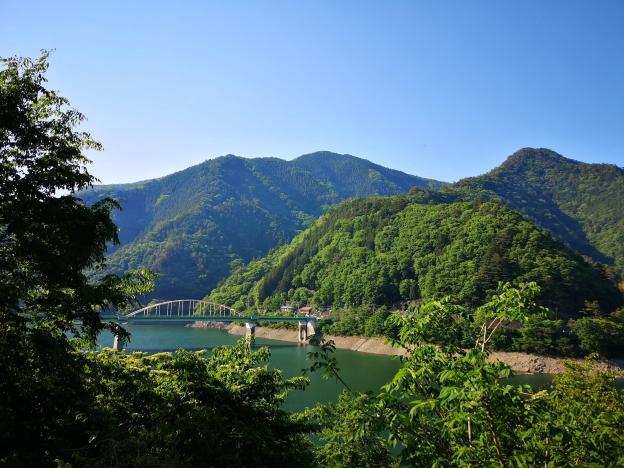
Lake Karikomi and Mt Taro in the background
I took advantage of the more expensive, but direct Tobu Nikko line train – being able to sit and sleep during the 2 hour trip was definitely worth the express surcharge. In Nikko there was a light drizzle. I didn’t fancy walking in the rain but I couldn’t turn back now. Going up “Irozaka slope”, the bus was enveloped in thick mist. Fortunately, once we emerged at Chuzenji lake, we were above the mist and I could see the lake and mountain sides – the sky overhead was overcast and the peaks were in the cloud though.
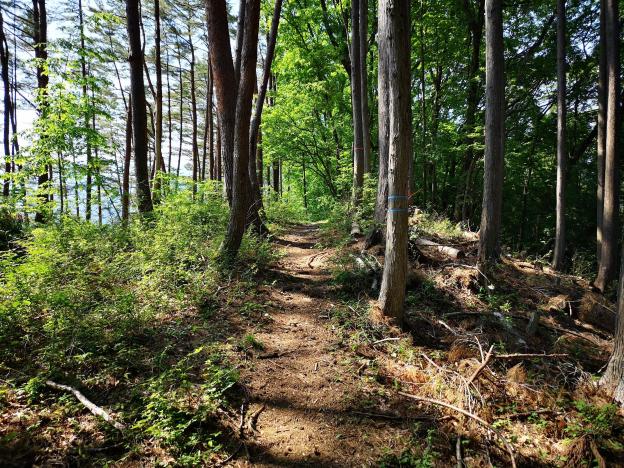
Today’s hike was through green mossy forest
I got off at the very last stop, Yumoto-onsen. This small, somewhat run-down, onsen town town seemed totally deserted, 11am on a Sunday morning. Was the town in decline or was my timing bad, I wondered to myself. I made my way to the start of the hiking path behind the town, also the source of it’s hot springs. There is a wooden observation path, and two small pools of bubbling water – not the most exciting tourist attraction but it’s always cool to see hot water coming out of the ground.
See the hot spring water bubbling up and hear the birds chirping near Karikomi lake
The path climbed for a few minutes, then crossed a road, before heading along the side of small forested valley. Despite being at 1500m, the air felt unpleasantly heavy – very different from my previous hike 2 weeks earlier, and one thousand meters lower. It took me less than an hour to reach a pass, where I took a short break. Afterwards, the hiking was mostly level and along a broad easy-to-walk path. I took off my bear bell so that I could enjoy the intense chirping of birds.
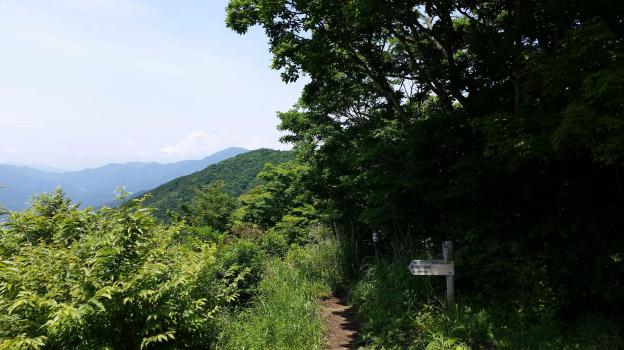
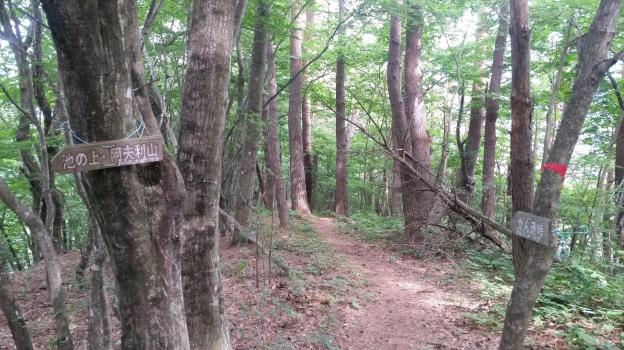
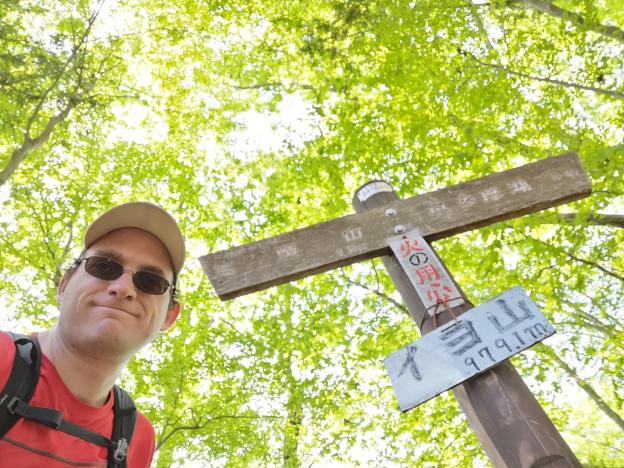
A signpost in the forest
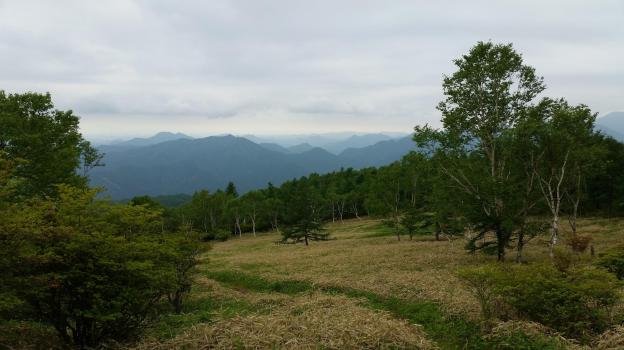
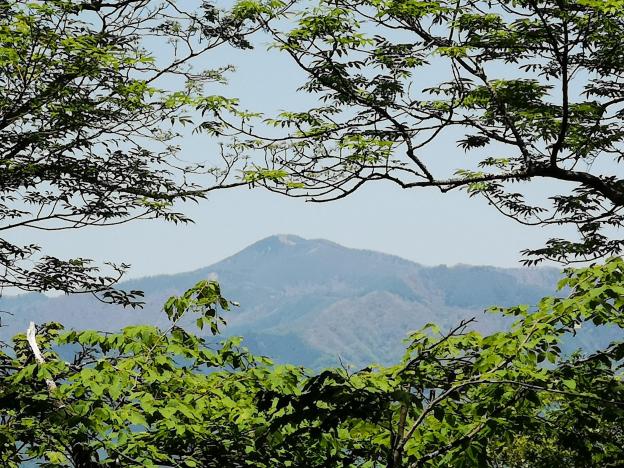
After some descending along wooden staircases through a thick moss covered forest, I arrived at Karikomi Lake (刈込湖) just before one o’clock. After checking out the view and having a quick lunch, I set off along the path through beautiful forest, passing another small lake, and finally arriving in a wide grassy valley. Since I needed to catch the 3pm bus from the Astoria Hotel I couldn’t linger and I powered up the mountainside opposite and over another pass, with Mt Taro on my left, a 300 famous mountain that I have yet to climb.
A grassy field suddenly appeared
A hidden valley in the middle of the Nikko National Park
From there it was a quick and easy thirty minute descent to the hotel – I had to overtake a very big group of elementary school children on the way. I made the bus but had to forego the onsen, otherwise I would miss the last express train back, and that would mean getting to Tokyo really late. By the way, this place would have snagged fourth place on my list of places to go when it’s hot and humid, except that the traveling time is too long for a daytrip – seven hours for only four hours of hiking.
These aren’t day trips, but they are Tokyo hikes, so I decided to include them in this blog. The Izu islands 伊豆諸島 are a group of islands Southeast of Tokyo prefecture – the furthest are the Ogasawara islands, a 24-hour ferry ride away! Last year, my mother visited Japan again, and together we made a visit to the closest island, Izu-Oshima 伊豆大島, and Kozushima Island 神津島, about 60km South of Oshima.
Mt Mihara (758m), Oshima Town, Tokyo Prefecture, Monday October 22
The impressive crater of Mt Mihara
I’ve had my eye on Mt Mihara 三原山 for a while, every since I first spotted it during one of my hikes along the Izu peninsula. It’s also an active volcano which last erupted in 1990, and thus has a spectacular crater. Although there are night ferries from Takeshiba pier to Oshima, I felt that it was wiser to take a daytime ferry and spend the night in Motomachi, the main town, so that we could leave refreshed the next day.
The final climb from the end of the road is not so high
We were very lucky with the blue-sky weather. The views of the Izu peninsula and Mt Fuji from the Mihara Sancho Guchi bus stop were fantastic. At 9h30 we set off for the summit, and from the start we had great views of the flat mountain top. First, we hiked on a level road through shoulder-high (for me) vegetation. We saw a couple of tiny deer dart into the bushes. It wasn’t until I wrote this article that I found out that they are in fact called “Reeves’s muntjac” and they are not native to the island.
Very soon the road started the climb up the side of the volcano, and in no time we reached the top of the wide caldera. From there it was a fairly easy loop walk around the crater. There was an option to walk down towards the crater, but we decided to skip it since we were on a tight schedule.
An easy hiking path on an active volcano
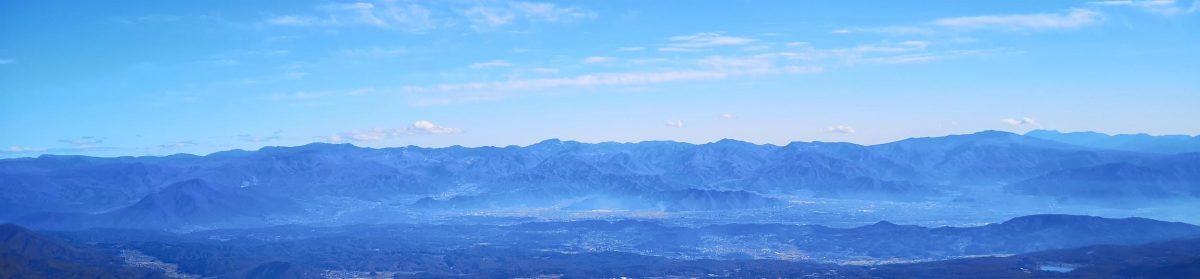
There were beautiful views inwards of the smoking crater, as well as outwards of the Pacific ocean, and the other Izu islands to the South. Although it wasn’t particularly cold, it got windy at the higher points of the caldera. We reached the highest point on the Southern side just before 11am, and after a quick summit photo, we completed our loop of the caldera, and retraced our steps back to the start of the trail. All in all, in was a quick and easy hike with fantastic views.
Heading down with views of Mt Amagi (left) and snow-capped Fuji (right)
Mt Tenjo (572m), Kozushima Town, Tokyo Prefecture, Tuesday October 23
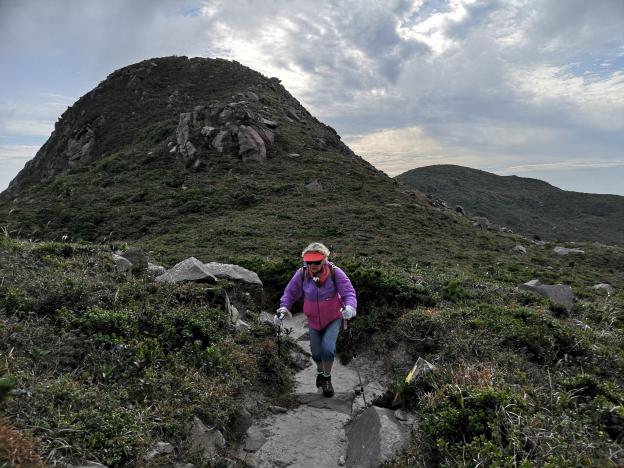
The following day we took the slow ferry two hours South to Kozu island. The highest point is Mt Tenjo 天上山, another volcano and a Kanto hundred famous mountain. The very friendly owner of La Familia hotel gave us a lift to the start of the trail. The first part consisted of a switchback along a steep slope divided into ten stations. As we climbed, the views of Kozushima and the ocean got better and better. Once we reached the end of the steep bit, we were hit with cold gusts of wind, a little surprising considering how many kilometers South of Tokyo we were.
Climbing and climbing…
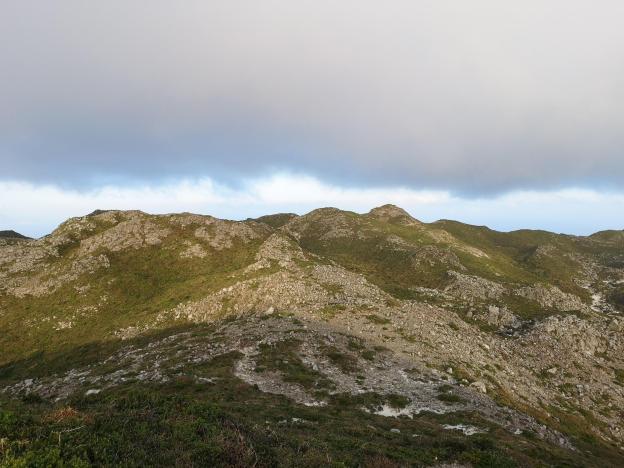
Once we had bundled up, we took in the surrounding landscape. We seemed to arrive at a sort of plateau covered with a mix of low bushes and grass, punctuated with a number of low rounded summits. Without a map, it would have been hard to know which way to go. The hotel owner of La Familia, had kindly drawn a loop trail on a map, and we followed it religiously. There were a lot more clouds today and thus less sunshine, but fortunately no rain.
Fantastic landscape near the top of Mt Tenjo
First we headed to the center of the plateau to one of Mt Tenjo’s two sand deserts. Apparently, Kozu island residents think that the sands of Mt Tenjo form the only true desert of Japan, not the Tottori sand dunes. I’ve been to both, and both have merits. After some snapping some photos, we set off for the second sand desert, at the Southern end of the top plateau, where, from certain angles, you could think that you are really walking in the desert.
Walking through Tokyo’s desert
A few minutes away, there was a good viewpoint to the South. It was fun to watch a boat zip around a rocky island below in the distance. We were only 500 meters high, but it felt much higher since we were directly above the sea. We then set off Northwards, following the Eastern edge of the plateau. The path started to rise slightly, and we reached what is known as one of Tokyo’s top hundred views 新東京百景展望地. The view of the Tokyo islands we had passed the day before by ferry, sitting like white and green gems in the middle of the blue ocean, was indeed stunning.
Looking Southwards
After pulling ourselves away from the view, we set off for the true summit of Mt Tenjo, which we reached just before 4pm, a relatively late time in the shorter days of Autumn. There we could take in the entire plateau we had spent the whole afternoon traversing. More than half a kilometer below, was the village of Kozu island – it looked so far away, and we had to walk all the way back down!
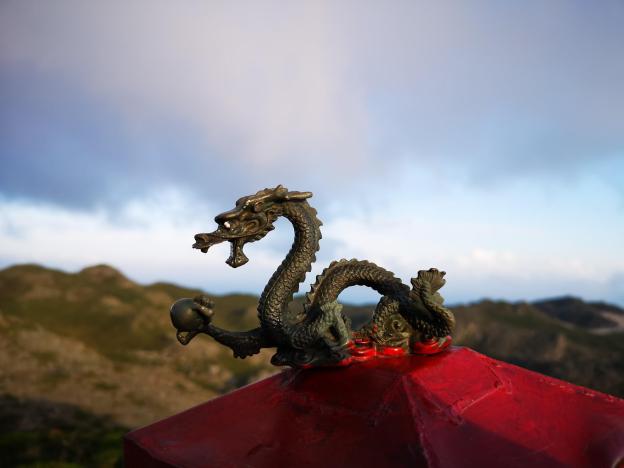
Dragon on top of Mt Tenjo’s summit marker
A well marked path
Going down and down
We were the only hikers on the mountain
We set off hurriedly as the sun slowly approached the horizon to the West. A different switchback path took us down, and soon we were walking under forest cover at the base of the volcano. Darkness was falling quickly and trail was getting harder to follow. Finally, just when I was considering taking out my headlight, we reached a road at around 5h30. Thirty minutes later we reached our hotel, where we were rewarded with a couple of cold beers.
Nearing sunset
Two beers (and a turtle) for two tired hikers
Check out the howling wind and desolate landscapes of the Izu islands
Despite the long rainy season this year, I managed to squeeze in a short hike on a cloudy, rain-free day. Although the elevation of the walk was relatively low – between 400m and 200m – the temperature and humidity were also low for July, so conditions were quite pleasant throughout the day. In general, this hike is best attempted in the spring and autumn.
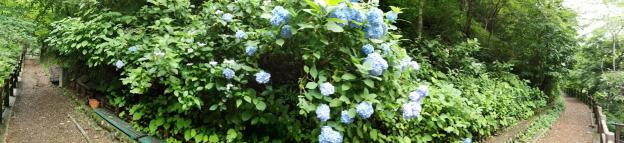
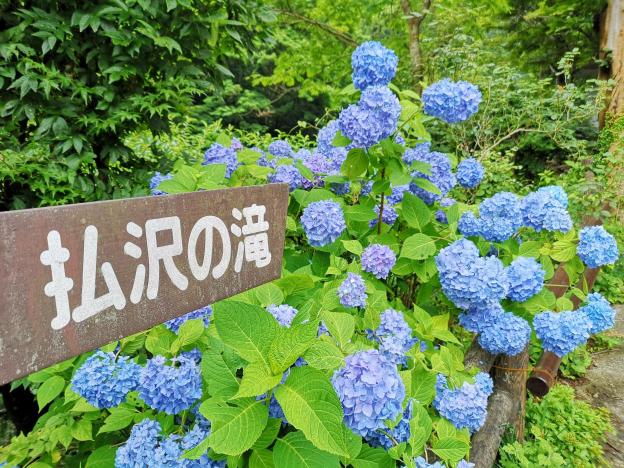
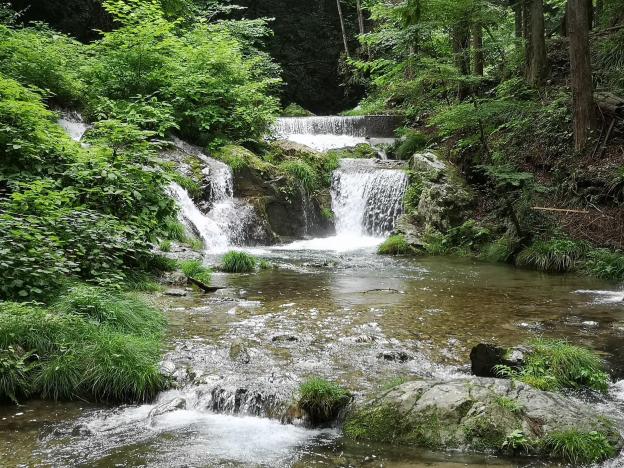
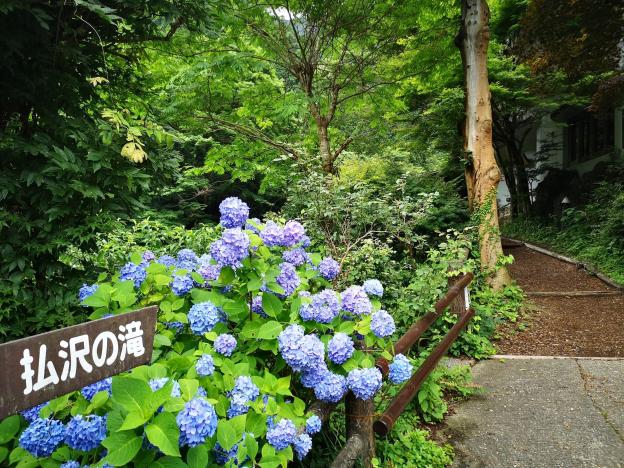
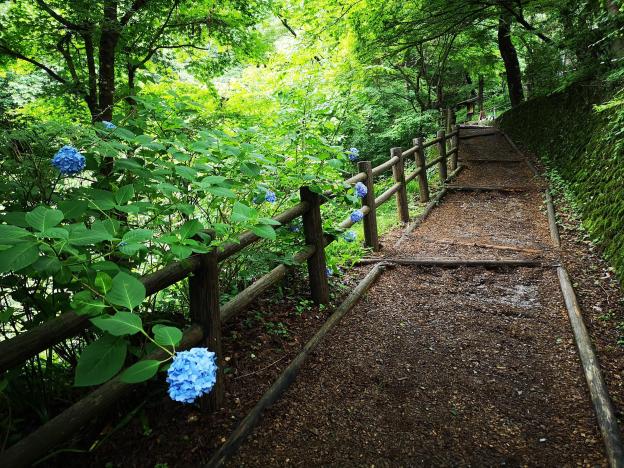
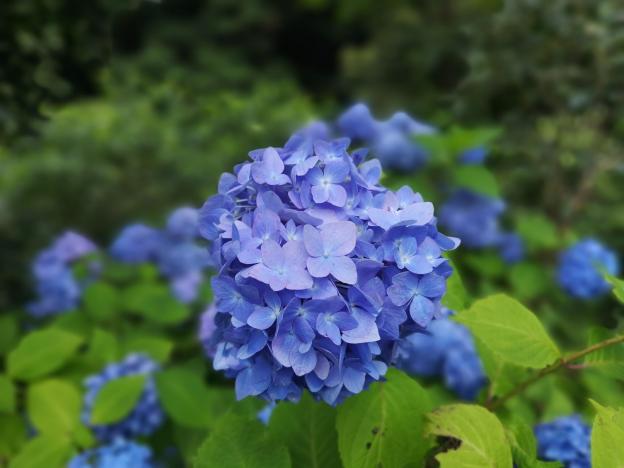
I had last been to Hossowa falls 払沢の滝, one of the hundred famous waterfalls in Japan, located inside the Chichibu-Tama-Kai National Park, after hiking Mt Sengen 浅間山 a few years ago. Then, Autumn was in full swing and I got to see some beautiful autumn leaves along the short trail to the waterfall. This time, the surrounding trees were lush with green leaves, and hydrangea flowers (ajisai アジサイ) were still in full bloom. The river and small falls leading up to the waterfall were wider and bigger that I had remembered, perhaps due to the high amount of rain that had fallen in recent weeks.
Smaller falls on the way to the main attraction
I had set off late and so I arrived at the Hossawa Falls entrance bus stop 払沢の滝入口, just after noon, and promptly started up the narrow climbing road to the left of Hinohara Tofu – their tofu donut makes an excellent snack! I soon reached an information board that showed the details of the whole area, and another one showing the location of 13 (!) waterfalls in the area of Hinohara Village, Hossawa falls being the most impressive one.
Entrance to the path to the waterfalls
Hossowa waterfall is located at the Eastern base of a narrow ridgeline wedged between the Kita Aki river to the North, and the Minami Aki river to the South. The latter is the longer of the two, and takes its source at the base of Mt Mito. The Kita Aki river joins the Minami Aki river just before the falls. Further downstream, it joins up with the Yozowa river (coming down from Mt Mitake to the North), and finally becomes the Akigawa river (which later merges with the Tamagawa further East).
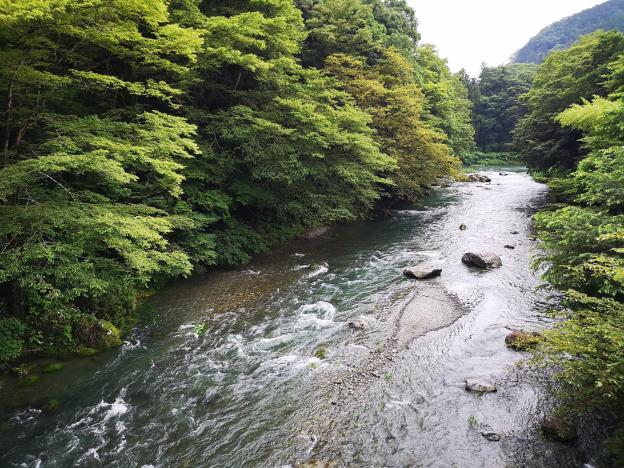
The Minami Aki river after merging with the Kita Aki river
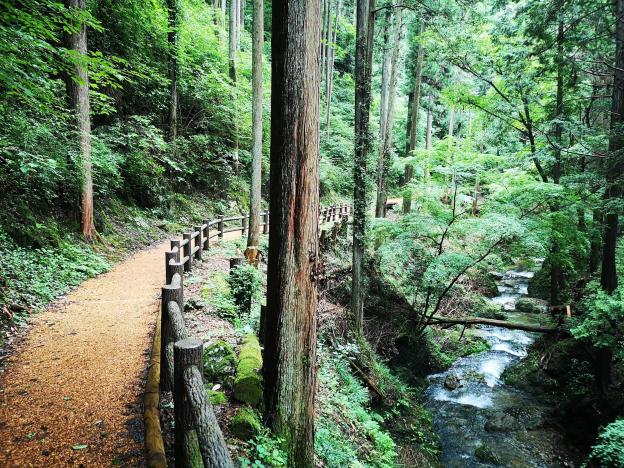
Since I was taking many photos of the river and flowers, it took me nearly half an hour to reach the waterfall, along an easy-to-walk path with no steep inclines. Along the way there were good views of the rushing stream below.
Not a real hiking trail but more of a walking path
On the left, a ravine, on the right, a cliff
There is a wooden sloping section that can get slippery when wet – someone took a tumble just as I was approaching! According to Wikipedia, the total length of the falls is 60m, divided into four sections – it was indeed an impressive sight to behold. You can get relatively close to the base pool, but the best shots can be obtained next to the stream, a little further away. After comparing with photos from my previous visit, I can confirm the falls are much bigger in the rainy season than in the autumn.
You can even feel the wind blowing from the force of the falling water
The return was much faster, and it only took me 15 minutes to get back to the main road. There were few people on a weekday, but I expect there would be a lot more people visiting on the weekend. There is also a cafe at the start of the path but it was closed on Friday.
Racing the stream on the return
Watch out for this interesting chap on the way back
Once back at the Tofu shop, I made my way back to Musashi-Itsukaichi station, sometimes following the main road, and sometimes following smaller and quieter roads on the other side of the river. The various bridges offered nice views of the Minami Aki river. The parts on the left side of the river made for a pleasant ramble through nice countryside with occasional glimpses of the river through the trees.
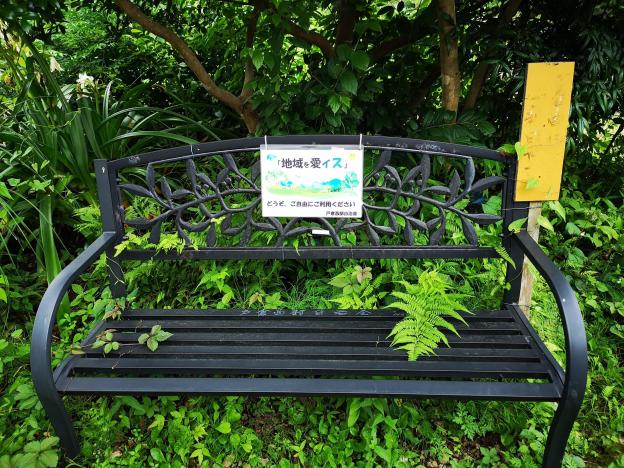
The sign says “Have a seat!”
Just before Sawato Bridge 沢戸橋, about two kilometers from the station, I stumbled upon a small path heading down on the right. According to the information board, it was the Akigawa Kyuryo Trail 秋川丘陵コース, a very nice discovery! I crossed the Bonbori river on a small wooden bridge, and then followed a very nice hiking path along the right side of the Akigawa river.
Careful not to take a tumble into the river!
Too soon the path joined up with the road again. There a small detour away from the river was needed, but soon I was walking next to the Akigawa again with good views of the surrounding hills. I reached the train station just after 5pm. Hopefully, I’ll be able to return sometime and continue hiking East along the Akigawa!
As the 2019 rainy season drags on, the past two weekends have been washouts. Fortunately, this gave me time to revisit some of my hikes during the same period two years ago. All four hikes are quite long since I was taking advantage of the longer summer days, and none are featured in my guidebooks. Considering the continuing gloom of this year, I realise how lucky I was with the weather!
This hike starts from Matsuhime Pass (1250m). I first headed Northwest towards Mt Omatei 大マテイ山 (written like this) less than one hour away. It was featured in my best hikes of the Kanto area guidebook, so I wanted to check it out. It was an easy and peaceful walk through beautiful forest, with a good view of Mt Fuji on the way.
Still lots of snow on Fuji in June
I then retraced my steps to the pass, and continued Southeast towards Mt Narakura 奈良倉山 only thirty minutes away. There was another view of Mt Fuji, but by now it was hidden in the clouds. The trail, which had veered southwards, had become a pleasant forest road. On the other hand, dark black clouds had suddenly appeared overhead – fortunately they didn’t lead to any rain.
I saw some pheasants on this hike, a sign of a seldom hiked trail
After another hour of solitary hiking I reached a junction where I turned left (East) at Nishihara Pass – I had been here once before when coming from the opposite direction from Mt Gongen. One hour later I was at the top of Mt Tsubo 坪山. The last part of the hike was down to Saihara village 西原村 where I had hiked recently.
End of the hike – Saihara Village
There are 3 trails heading down from the summit. Unfortunately I could only find two of them, and I ended up going down the wrong one. Originally I wanted to go straight but I went down a much steeper path, heading North. The silver lining was that I could walk along the river at the bottom of the beautiful river valley to the bus stop for a while longer!
Mt Nyoho (2483m), Nikko City, Tochigi Prefecture, Saturday, June 17, 2017
This is a really long day hike from Tokyo, and I only recommend it if you are fit and the days are long – it took me four hours to reach the top and four hours to walk down. I saw only three people during the entire hike. The starting point, Sanbonmatsu (1500), just North of Chuzenji Lake, could be included as a good place for hiking when it’s hot and humid in Tokyo, if it didn’t take such a long time to reach from Tokyo (approximately 4 hours).
The first part of the hike was rather boring, following a road through the forest. At one point I saw a solitary monkey. It took me around two hours to reach the junction with Mt Nantai. By this time, the blue skies had turned into mist. Another hour of mostly flat walking took me to a rocky river valley, where the real climbing started.
Climbing hard from here
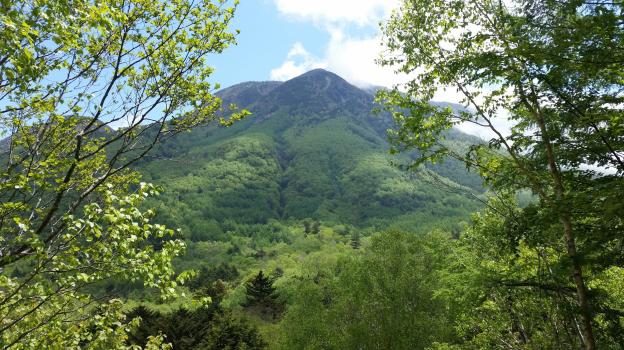
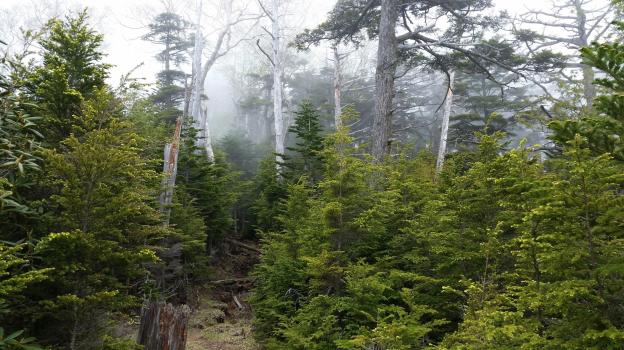
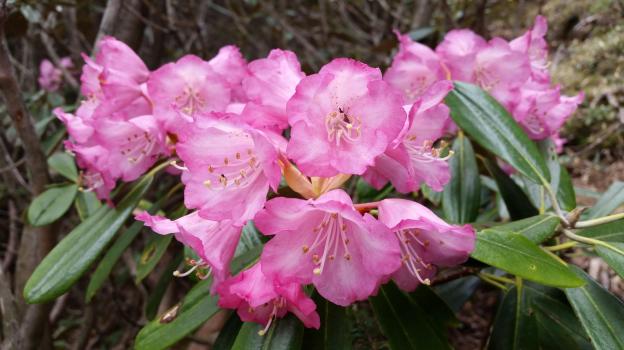
Although the climb was tough, steep and shrouded in thick mist, the surrounding forest was wild and beautiful – is it possible that I had left Tokyo only this morning? I put on my bear bell, which I rarely do, since I saw no other people and the vegetation was still thick above 2000m.
It was shakunage season!
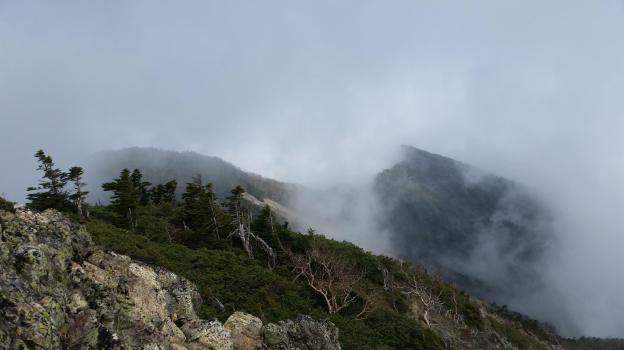
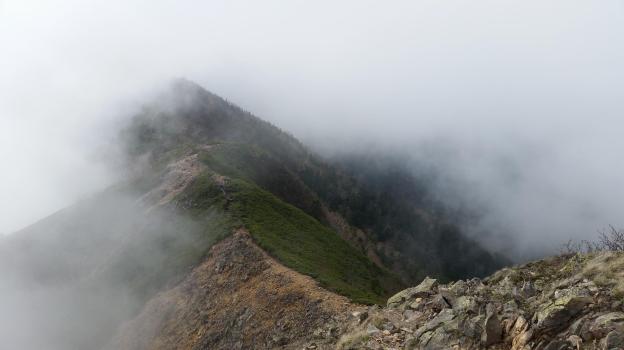
I reached a lonely emergency hut after an hour, and I was at the summit of Mt Nyoho 女峰山, a two-hundred famous mountain, just after 2pm. The very last part was above the tree line, and through some very impressive steep and rugged volcanic landscape. Unfortunately the mist was still in. I waited as long as I could, but despite giving some signs of lifting, it never did in the end.
Nyoho summit landscape I
Nyoho summit landscape II
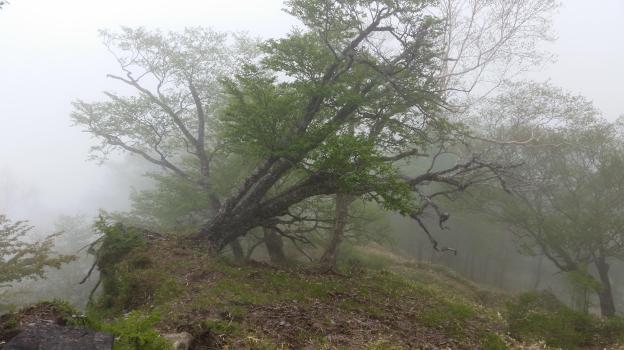
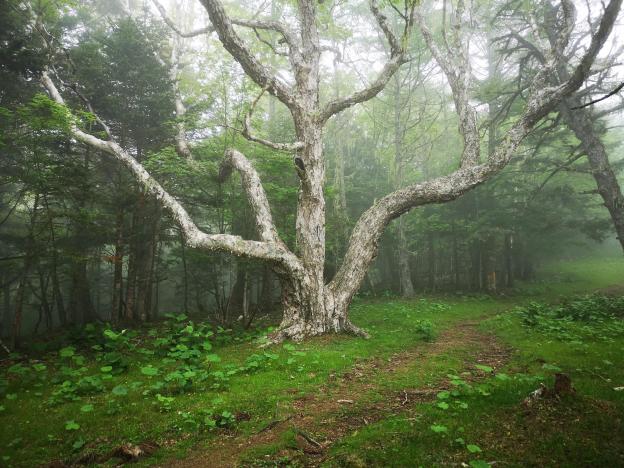
I finally headed down, back to the hut, where I continued along a different path through thickening mist. My plan was to walk all the way down to Nikko city, 1800m below, but I hadn’t realised what I little frequented path I was taking. It was an eerie descent: mostly silent, with fantastically shaped trees popping into view at various points.
Fantastic tree I
Fantastic tree II
Fantastic tree III
Finally, I was below the cloud cover, and a wide view of Nikko city and the surrounding mountains emerged. The path flattened somewhat. I was no longer alone – deer scattered before me. Another hour and a half of walking brought me to the Nikko Toshogu shrine complex, from where it was another twenty minutes to the train station.
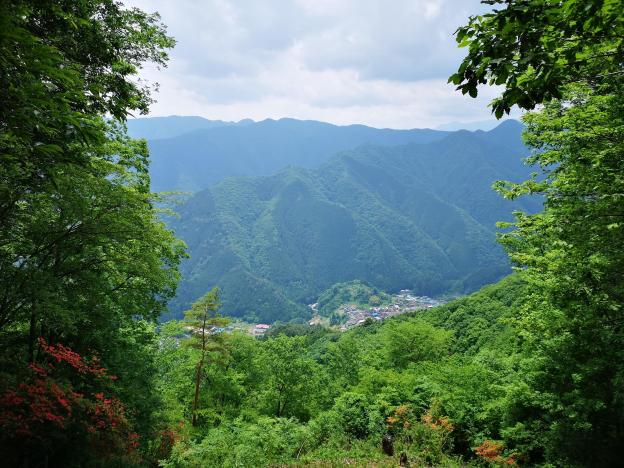
This is another long hike of my own creation. Basically I wanted to link Michizaka Zuido Iriguchi with Akiyama hot spring. I had been to both places before, but I wanted to hike the ridge connecting them, since it overlooks the valley of Doshi village. I had hiked the opposite ridge when I crossed the entire Nishi Tanzawa mountains in one day. The village of Doshi, which I have never been to, is a place of great fascination to me.
It’s about the same distance from Tokyo as Chichibu, yet it’s impossible to visit as a day trip using public transport due to poor bus connections. So every chance I get to peek at it from the surrounding mountains, makes me feel like I am getting a glimpse of a hidden valley. I must always remind myself not to end my hike along the valley containing doshi valley because it would require hitchhiking to get back to nearby Tokyo.
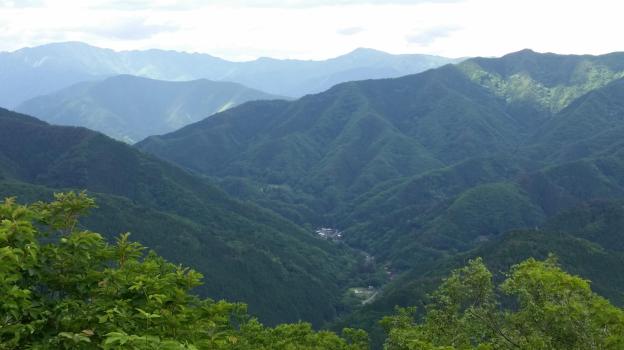
The “hidden valley” with Fuji hidden in the clouds on the right
The day I chose for the hike was a very hot and humid day, and although the climb to the top of Mt Imakura 今倉山, which I had climbed before, was short, it was also tough. Luckily, from there it was mostly going down, albeit with one steep climb on the way. The ridge was narrow but shady on this beautiful sunny day. Half an hour after leaving the summit I got my first views of “doshi valley” and Mt Fuji peaking through the clouds as an additional bonus.
The path near the top of Mt Nabatake
Thirty more minutes of easy hiking brought me to the top of Mt Nabatake 菜畑山. A steep descending slope, followed by an equally steep one going up, brought me to the drawn-out summit of Mt Akakura 赤鞍ヶ岳. From there it was a gentle downward sloping ridge. The vegetation had changed from wild to tame – you could sense the proximity of human habitation.
As I dropped below one thousand meters, I started feeling the heat and humidity more. At Gando Pass 厳道峠 I turned right. I could have continued straight, but I wanted to explore the connecting to path to Mt Afuri – I had seen the other end I few years ago after climbing that mountain. The first part was disappointing – a fairly steep and difficult to navigate descent, followed by a shorter but equally steep ascent.
Turn left here
However, after that I was hiking through beautiful forest – squirrels and pheasants darted left and right into the bushes. The second half of the trail certainly lived up to its promise. Too soon I reached the road at the end of Mt Afuri, from where it was another hour of hiking till the (very welcome) hot spring bath. I was fortunate to spot a Japanese badger crossing the road at one point.
Mother and chick pheasant running for cover
Mt Kita-Okusenjo (2601m) & Mt Kokushi (2592m), Yamanashi City & Kawakami Villages, Yamanashi & Nagano Prefectures, Saturday, July 8, 2017
This is another ridgewalk connecting two prefectures of my own creation. Since the return is via Shinkansen, it’s a bit pricey, unless you have a Tokyo Wide Pass. The starting point is from Odarumi Pass (2365m), the 2nd highest place you can reach by bus from Tokyo as a daytrip. I had been there once before when climbing Mt Kinpu (the day Mt Ontake erupted). This time, I headed due West under a grey overcast sky. Very soon, I reached the trail for Mt Kita-Okusenjo 北奥仙丈山, branching southwards, the highest peak of the entire Okuchichibu mountain range. Unfortunately because of the clouds, the view wasn’t so great.
I didn’t linger since insects were swarming, so I retraced my steps and continued to Mt Kokushi 国師ヶ岳, a 300-hundred famous mountain, which I reached just before 11am. Afterwards, the path descended somewhat, then flattened while turning Northeast. It was a long forested ridge, with few views, and I reached the base of Mt Kobushi, two and a half hours later. I saw very few people, and it was a very enjoyable ramble.
One of the few Southward views I got on this solitary hike
Since I had been up Mt Kobushi before, and thunderstorms were threatening, I decided to skip going to the summit, and descend immediately via the upper reaches of the Chikuma river. This river is the longest and widest river in Japan (known as the Shinano river in its lower reaches). Soon after I started descending, I reached the source of the Chikuma: just a signpost and a trickle of water through the forest, around 2000 meters high. Very soon, the trickle of water became a mountain stream.
The Chikuma river at mountain stream stage
It was a very enjoyable two-hour walk along a beautiful river valley in what was now Nagano prefecture. Eventually I reached the car park from where it was another hour of walking to the bus stop. However, a group of young people kindly picked me up on the way and dropped me off at Shinano-Kawakami station on the Komi line.
Check out the humble beginnings of the longest river in Japan
After my foray into the very southern part of the Southern Alps the previous weekend, I decided to go back and do one of the few higher mountains in the Minami Alps that can be done as a day trip from Tokyo. I had been wanting to climb this one for a while but since it requires a car, I kept putting it off (it can be done via public transport but you’d have to stay the night before in the area). The weather wasn’t perfect but I decided to risk it anyway, and I was glad I had!
It was my first time experiencing the new “all seats reserved” Chuo line, and overall, I felt that it was an improvement over the previous system. At least I was guaranteed a seat, which is essential when traveling all the way out to Kofu, where I had reserved a shared car. The trip up to the parking lot at Ikenochaya 池の茶屋 (1860m) was mostly uneventful – the road was pretty bad in some parts, but I had seen worse. I snagged the second to last parking spot. Under a thick cover of clouds, and the odd drop of rain, I was ready to set out at 11h15.
Super easy hiking for the first thirty minutes
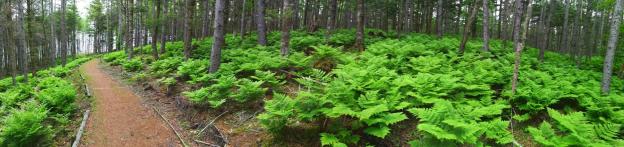
The first part of the hike was incredibly easy to hike – a gently sloped series of switchbacks leading to a viewpoint of Mt Kitadake which was unfortunately entirely in the clouds. Rain was falling intermittently, but I didn’t mind since the surrounding vegetation, mostly ferns, was a very beautiful shade of light green. Soon the path started to descend via a series of log staircases. The amount of descent started to alarm me – I should be going up a mountain not down – but my guidebook and the numerous signposts reassured me that I was on the right trail.
Looking back up this long log staircase
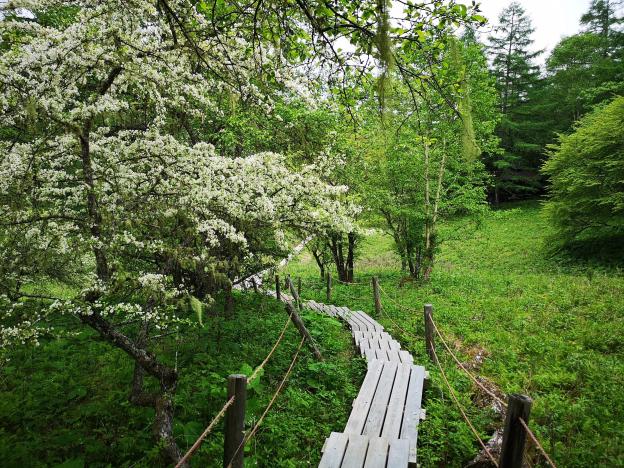
The path soon bottomed out and I was rising again, gently, through beautiful typical Southern Alps forest scenery. At this point I got a bit confused. I pride myself on my sense of direction, but here I will admit I lost track a bit. The path did what I thought was a loop, yet I never crossed my previous path. Eventually I arrived at a flattish area with a wooden walkway, and white flowers that ressembed sakura, but which were in fact oxalis.
An unexpected flower observation section on the hike
Apparently the area is famous for its irises, but they weren’t in bloom yet. In no time, I reached the top of Mt Hadaka (meaning Mt Naked). I was supposed to see the main peaks of the Southern Alps and Mt Fuji but in reality I saw nothing. However the temperature was pleasant, even a little cool, and there was no wind, so I settled down for some lunch.
At first sight I thought these were some really late blooming mountain sakura
The next section was through amazingly beautiful forest, full of massive camphor trees and moss-covered undergrowth. At one point I spotted a solitary juvenile Kamoshika (Japanese serow), passively munching some grass (see video). I arrived at the top of Mt Kushigata 櫛形, a two-hundred famous mountain, a little after 2h30, where there was a relatively new summit marker, a few meters from the old weather-worn one. The clouds were still in, so no view, but it was very peaceful and quiet. I had not seen anybody in the past hour and a half.
Most of the hike scenery and trail was like this
I set off for the final part of the hike back to the parking area. The mist had rolled in, providing some very nice photo opportunities. At the car park, my car was the only one left – time to head back! Heading down the mountain, the sun broke few in a few places, I was able to get some nice views of the valley below. Instead of taking the train directly back to Tokyo, I got off at Isawa Onsen, less than ten minutes away. It’s a great place to have a hot spring bath, and I got to taste some Yamanashi wines at the wine server in the tourist office below the train station – a great way to finish a Yamanashi hike!
I was itching to head somewhere new. A place I hadn’t explored yet. June is the best time of the year to head faraway since the days are long. I decided to head South to Shizuoka prefecture, since it had rained all day the day before and therefore there were bound to be good views of Mt Fuji. It was also the location of a good station to station hike I had recently found in my Shizuoka prefecture hiking guide book. I used the Tokaido line to go all the way to Atami, where I changed to a local line for the final part of the trip to Yui station, halfway between Numazu and Shizuoka cities.
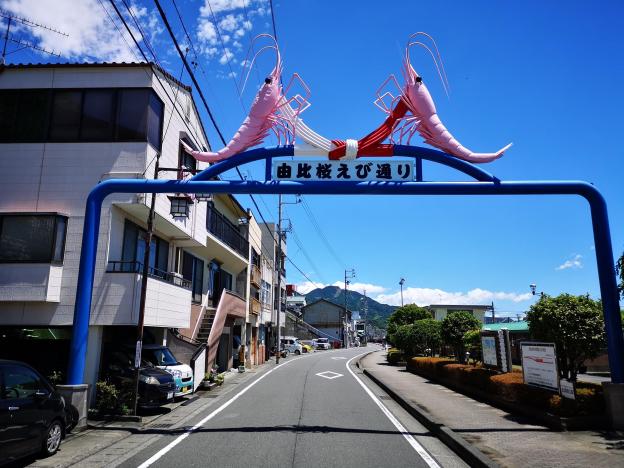
Yui, 3 hours from Tokyo station, is apparently the capital of Sakura Ebi or Sakura Shrimp fishing in Japan. It also used to be on the Tokaido, the ancient pathway that linked Tokyo and Kyoto. I had one small problem after stepping out of the train station just after ten thirty: it was a lot hotter than I had expected. The sun was pounding down from above. Normally I wouldn’t attempt a hike from sea level in June, but the last few days had been unseasonably cool so I thought I could risk it.
Welcome to the town of Sakura Ebi
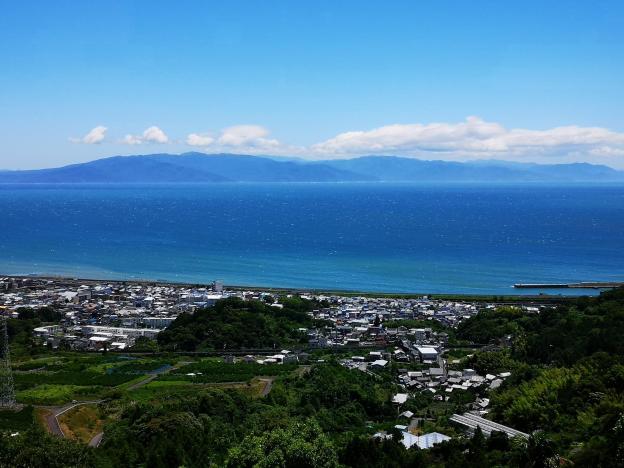
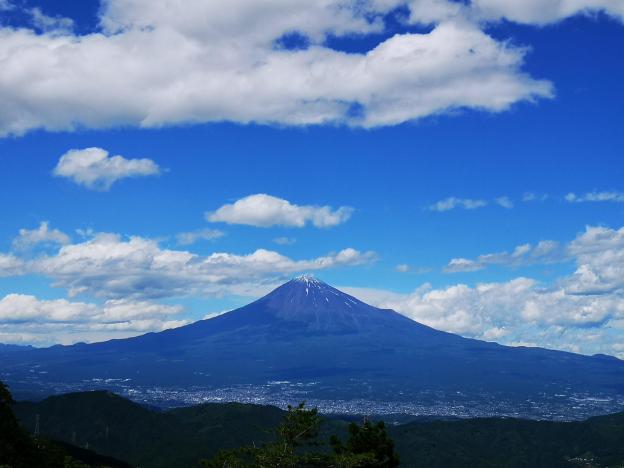
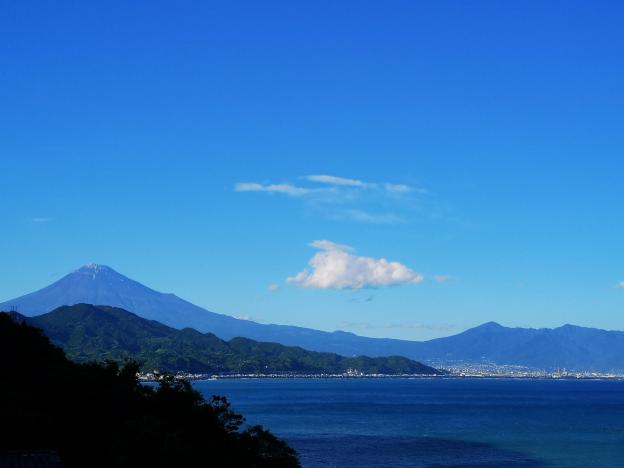
I set out as quickly, hoping to gain altitude and some coolness as soon as possible. The hike is well signposted, and soon I found myself walking up a narrow road with great views of Suruga Bay behind me. Mt Fuji was still in the clouds. After a little more than an hour a reach a flat area with some fields, toilets and a signboard. Shortly after, I spotted a hiking trail going straight up the mountainside. Although, it wasn’t mentioned in my guide book, I was glad for the opportunity to leave the road.
First good views East towards Izu one hour after setting out
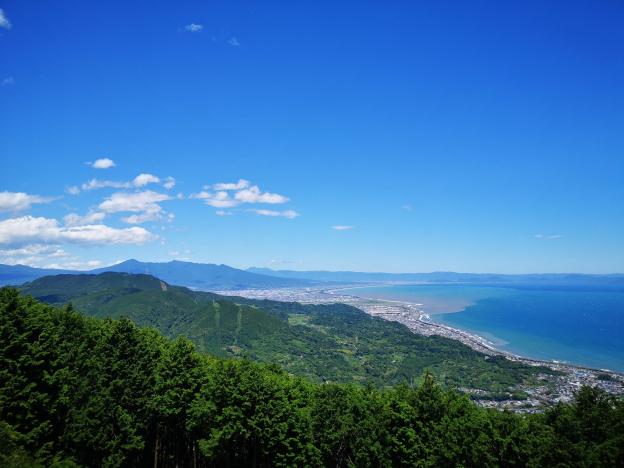
The trail had suffered a bit from the recent rains but climbed steadily through the forest. Eventually I emerged into an open area with great views of Suruga Bay, Izu peninsula, and Mt Fuji, slowly emerging from the clouds. After a short break, I set off again. Instead of climbing the path started to follow the contour of the mountainside – the surrounding vegetation reminded me very much of hiking on the Izu peninsula opposite, also part of Shizuoka prefecture.
Beautiful views North towards Numazu City
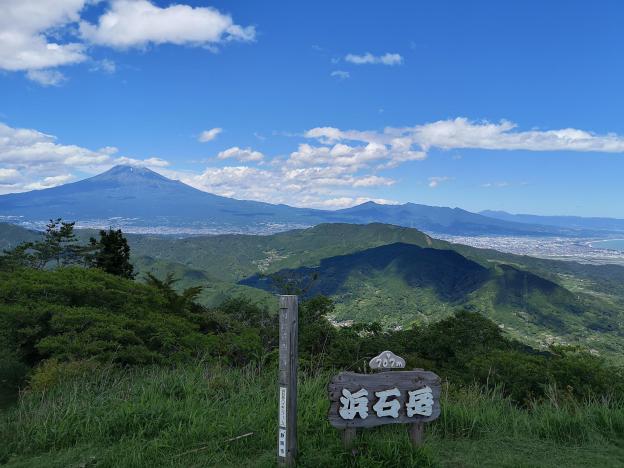
Just when I was starting to worry that I was on the wrong path, I saw a signpost that confirmed that I was on the right trail. The summit was just a short way away. The vegetation started to thin and finally I reached a bald grassy hill, behind which I could just make out the top of Mt Fuji, clear of clouds! I rushed the final few meters and snapped a few photos before clouds rolled in and covered Fuji’s summit from view. The summit of Mt Hamaishi 浜石岳 is famous for its great views and I wasn’t disappointed. I could see from left to right, Shizuoka city, the Southern part of the Southern Alps, Mt Fuji, Mt Ashitaka, Hakone, and the Izu peninsula. I probably say this often, but it was one of the best views I had ever seen in Japan, especially on a day trip from Tokyo.
The majestic beauty of Mt Fuji from the top of Mt Hamaishi
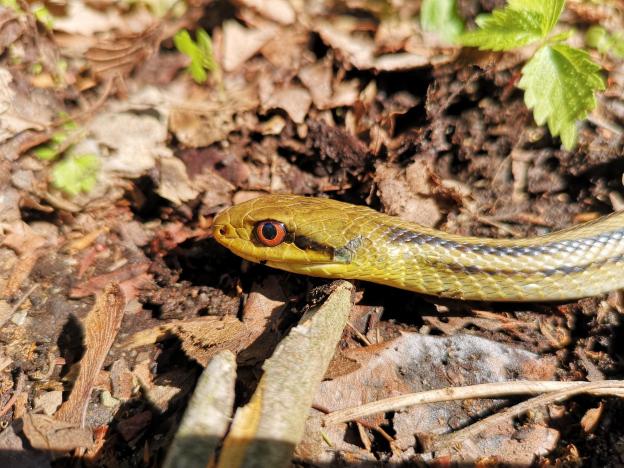
After nearly an hour, I was able to drag myself away from the amazing views. I had to head back down to the signpost I had seen earlier. I decided to run since I was behind schedule, and nearly stepped on a large snake! Fortunately the snake jumped out of the way and retreated into the bushes. I wasn’t sure whether it was poisonous or not, but I was a lot more cautious from that point forward. At the signpost I had passed earlier, my path continued straight, following a different way down, Southwards. The forest I was walking through reminded me somewhat of the Southern Alps, not surprising in fact, since, looking at a map, Mt Hamaishi sits at the very end of the end of the Southern Alps (not sure whether it’s geographically part of it).
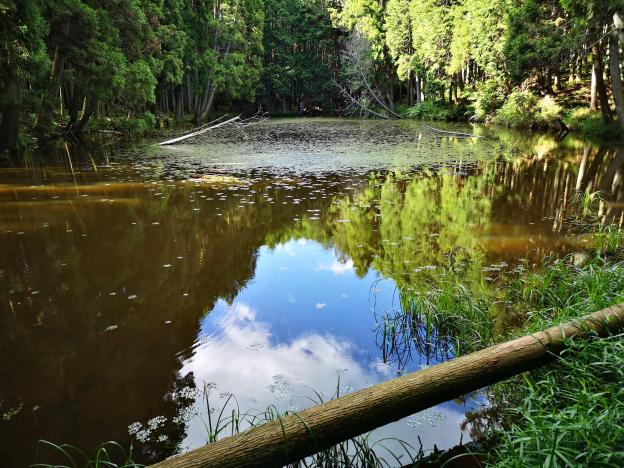
Blue sky and clouds reflected in Tachibana Pond
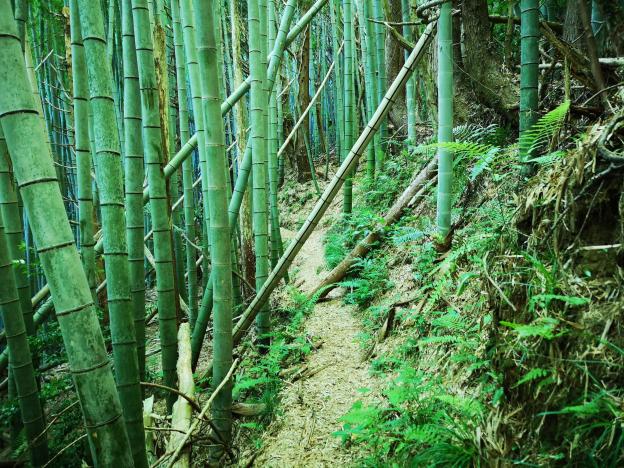
Soon I reached a signpost for Tachibana Pond, a short way from the main trail. It was amazing to see such a beautiful pond in the middle of the forest. After tearing myself away from the second great view of the day, I continued down the mountain. This incredibly beautiful part of the hike took two and a half hours, and I saw absolutely no one. At one point I crossed a spooky bamboo forest – even though it wasn’t a windy day, the bamboo trees swished and swayed as if I were in the midst of a storm. Finally I popped out at the Satta Pass viewpoint, just above the ocean. From there, it was another 45 minutes of fast walking back to the station, that would get me back to Tokyo.
Spooky bamboo trail
Check out the snake that was crossing the trail just below Mt Hamaishi
Enjoy the sounds of the bamboo forest swaying in the wind
I decided to return to the same area as the previous week, and do a portion of the Mitosan-Takosan ridge that I had never hiked before. It contains no major summits, but since it was featured in my Tokyo prefecture hiking book, I thought it would be make a nice ramble. Also, the weather was cooler, so I could start later and lower down. This time I was hiking South and East of Mt Mito, as opposed to the West and North the week before.
Iris season has started!
I took the bus from Uenohara station, but one hour later than the week before. Since the bus didn’t go all the way to Matsuhime pass, I was the only passenger. I got off at Gobara, in the charming village of Saihara 西原村. At 10:40 on a Saturday Morning it was completely deserted, and I wondered where everybody was. The hike was fairly well-signposted, and soon I was climbing up the side of the valley through forest.
Easy-to-hike: I passed a mountain biker coming down around here
It was cloudy and sunny but temperature-wise, perfect for hiking. The climb up was surprisingly beautiful: the path was easy to hike, and the surrounding forest felt wild and untouched – exactly what I crave for in a hike. Apart from a mountain biker, I saw no-else on the climb up. Halfway up, there was a nice viewpoint of Nishihara village, and the ridge I had hiked down from Matsuhime toge, 3 years ago.
After an hour and a half I reached Nishihara pass, and other hikers. I made a quick roundtrip to the top of Mt Makiyose 槇寄山 (1188) less than a minute away. I had been there once before when I had hiked down from Mt Mito years ago. I had a quick bite since there were a couple of benches and admired the view to the South – I could make out the shape of Mt Gongen, another peak climbed years ago.
I then retraced my steps and followed the ridge Southeast. The forest was beautiful and peaceful, with few people. I couldn’t quite decide if the area reminded me of the mountains directly south of the Chuo line, or of the ridge on the opposite of the Akigawa river valley. In any case, the ridge was wide and easy to walk, very unlike the section further down, around Mt Shoto, where it gets really narrow and tricky.
An enjoyable hike in the late spring
Eventually I reached another pass, Kazuma Pass, with benches and a viewpoint to the South. This was the point I had left the ridge on my previous hike down from Mt Mito, so from now on it was new territory. The weather had turned definitely cloudy, not a big problem in the pleasant June temperature. It was past one, so I sat down for the second part of my lunch.
The long ridge leading to the top of Mt Gongen
Another hour of hiking brought me to the top of Mt Maruyama 丸山 – no view unfortunately. I didn’t linger, and the path which had been fairly level up to now, started to descend. Oddly enough, English translations on the signposts appeared around here – I guess I was officially in Tokyo territory. I emerged at Asama Pass, and joined up with the “Kanto Fureai no Michi” about one hour later. I had been here when I climbed Mt Shoto. I had now officially hiked the entire ridge from Mt Mito to Mt Takao.
The sun made it through the clouds from time to time
From here, I turned left and started to head down to the Akigawa river valley and the bus stop for Musashi-Itsukaichi Station. I was one hundred meters from the stop and five minutes before the bus was scheduled to arrive, when it suddenly careened around a corner at top speed! I ran desperately after it waving my hand, but once I reached the bus stop, I wasn’t allowed to board! It turned out that it was a “zouhatsu” 増発 or extra bus which runs in the high season. Another, half empty, bus came along a few seconds later – I guess the Nishitokyo bus company likes its passengers to travel comfortably!
Temperatures were unseasonably hot at the end of May – up to 35 degrees in Tokyo – so it made sense to start my hike from a higher point. I decided to take the bus from Uenohara station to Tsuru Pass 鶴峠, squarely inside Yamanashi prefecture at nearly 900m. On the way, I passed through the charming village of Saihara, one of the area’s hidden wonders. This hike is an original hike not featured in any of my guidebooks. It’s main purpose is to connect two bus stops without passing any major summits on the way (although a detour via Mt Mito can be made).
Once I got off the bus, just below the pass, I couldn’t believe how hot it was at 10am. Luckily it was a dry heat. To reach the start of the hike, I had to cross the road and take a hard-to-spot ascending path. There is another path going up to the left, towards Mt Narakura 奈良倉山 (1349m) which I climbed from the other side the year before. After barely a few minutes, I came across part of a deer leg lying across the path. Just the foreleg, with fur and hoof at the end. “Some animal must have killed the deer and left just this part here” I thought to myself. “…but what animal??”
Pleasant May hiking in the Chichibu-Tama-Kai National Park
Shortly after, the path for Mt Mito 三頭山 branched to the right, and hugged the side of the mountain to the right. It was very peaceful until two ladies popped out of the forest above me – they had mistakenly continued straight along the previous road. After confirming they were now on the correct path, I soon left them behind. The trail gradually rose through the forest. There were few views but I was glad to be in the shade on this hot day.
One of the rare views along the way: Mt Kumotori
After one hour of pleasant and mostly solitary hiking, I reached the junction for Mt Mito and hesitated : should I continue along what had been up to now a nice, quiet and mostly flat path, or should I climb up to the top of Mt Mito, which I had submitted twice before, and where there was bound to be tons of people? I chose the former option, and I was quite glad I did, because it soon became obvious that I wasn’t just following a hiking path. It was actually an old road that had probably been in use for generations; some sections had been propped up with stones. I had already hiked a similar road in the same area a few years before.
It was thrilling to follow the remnants of an old road high up a mountain
After another hour, I reached a second junction with Mt Mito. Here I turned left and headed down the mountain towards lake Okutama and into Tokyo prefecture. I had also entered the Chichibu-Tama-Kai National Park, although there were no markers or signs to indicate this; I only realised this while writing this blog post – a real shame! The descent was gentle at first, but soon there were some steep bits with ropes; these are fine for climbing, but going down them can be quite a pain!
The author posing on a minor summit on the way down to Okutama lake
Soon, Okutama lake came into view and, after a couple of ups and downs, I finally emerged onto a road circling the lake, nearly two hours after I had started down. Here, my plan was to take something called a floating bridge “ukihashi” 浮橋 across the lake, but I was informed via a sign that it was closed at the moment. Nonetheless, I decided to check it out. While following the road, I saw a green snake. After some prodding with a branch, I realised that it was dead, despite looking very much alive. Apparently, it had been hit by a vehicle moving at high speed, and only suffered a “nick” to a part of the body, which was enough to kill it.
Even dead, the snake looked very much alive!
After a while I reached some steps leading towards the lake, and very soon I was able to lay eyes on the floating bridge. It had been detached from the shore I was on, and thus ended in the middle of the lake. The reason given was strong winds. Just opposite, was my bus stop. Now, in order to reach it, I had to circle round, a detour of about half an hour. I wandered back despondly, and decided to continue along the path circling the lake in the opposite direction since I had an hour to kill till the next bus.
The floating bridge floating in the middle of the lake
I was glad I did, because I got to see monkeys, lots of them, resting, playing and feeding in the trees. Eventually, one of them was sitting next to the path and I didn’t dare go further. In any case, I was quite content to take photos and videos. Soon my time was up, and I had to rush back along the road in order to catch the bus back to Okutama station. The views of the mountains surrounding the lake were beautiful – I don’t often get to see this area in perfect weather. It was pretty hot around the lake in the late afternoon, and it felt nice to sit inside the air conditioned bus!
View of deep blue Okutama lake under a light blue sky
Monkey in the way!
If you like monkeys, check out this compilation video
A Kanto hundred famous mountain, this one has been on my list for a long time. For some odd reason, this hike isn’t featured in any of my hiking books, nor on any of my hiking maps. Fortunately I was able to find access information, and a basic hiking map online. It’s possible to do this as a station to station hike starting from Gokan station but the connection to the Joetsu line isn’t very good in the early morning hours. Since the return is via the Jomo Kogen shinkansen station, I decided instead to use the Tokyo wide pass during golden week, and start and finish there.
A good view of Mt Akagi from the North
Mt Mitsumine 三峰山 is a rectangular shaped mountain bordered by cliffs on the Eastern side. From Jomo Kogen station it looks like a ship. The official start of the trail is the parking area near Kawachi Shrine. I was surprised to see crowds of people at the shrine – they seemed to be celebrating some event. Just above is a jump-off point for paragliding. I’ve seen quite of few of these in Japan, but for the first time I got there while people were actually jumping off!
The jump-off spot for paragliders
I sat down for an early lunch and watched while these brave people jumped off one after the other, with Mt Akagi, Mt Komochi, Mt Onoko and Mt Haruna in the background. I was joined by a group of children. They weren’t as patient as me, and one of them yelled “hurry up” (hayaku) while the paraglider was waiting to jump! Finally the last one had jumped and I continued on my way. I was now on top part of the “rectangle” so it was mostly pleasant forest walking on a level path.
Some nice and easy flat-walking
At one point I reached a fork in the road and I had to make a choice: continue straight or make a detour via a couple of lakes or “numa”. I decided to check out the lakes since I wasn’t pressed for time. I wasn’t disappointed since the lakes were quite pretty. I was surprised to see some quite large fish swimming in the second one.
After returning to the main path, I found myself walking quite close to steep cliffs on my right side. There were occasional views of Mt Hotaka still covered in snow. The path bent left, then right, and after short climb a reached the highest point with a great view of the snow-covered Tanigawa range directly to the North. My map showed a path leading from the summit down to Jomo Kogen station. This was Kanto hundred best #90.
Mt Hotaka still wearing its winter coat
Unfortunately it wasn’t a real path, and soon I was walking down the mountainside from yellow bit of rope to yellow bit of rope (used here instead of the usual pink ribbons). It was fairly hard to follow and I can’t recommend this to inexperienced hikers in Japan (if you don’t get the pink ribbon reference…) It seems most people do this hike by car and do a round trip to the summit. Plus, the weather had changed from sunny to overcast and I started to worry that it would soon start to rain.
It was still sakura season in Gunma
Eventually I emerged onto a forest road which soon turned into a road. On the way, I heard loud croaking noises coming from some water puddles – it was full of rather large-sized frogs. Unfortunately they were very shy and quickly hid under the mud. The end of the hike followed the road all the way back to Jomo Kogen station. Before heading back to Tokyo, I made a brief detour to Echigo-Yuzawa station where I could take advantage of the hot spring bath inside the station.
I had been to Mt Sengen in May 2016 as a half day hike, and to Ranzan in December 2016 as a short bike ride. Since then, the hiking trail has been lengthened to connect both areas so it seemed like a good idea to return to there. I believe that Ogawamachi town makes an excellent base for hiking due to its close location to Tokyo (70 minutes by direct train from Ikebukuro) and proximity to the Higashi-Chichibu mountain area.
The hike starts from behind the Mt Sengen Miharashi no Oka Koen (view hill park) that is best reached by a short taxi ride (about 1200 yen) from the station. Otherwise it’s nearly a one hour hike. Before leaving, make sure to try a tofu donut from the small store opposite the station. The park has an observation tower with great views, and a roller slide.
View of Ogawamachi from Mt Sengen View Hill Park
The path to Mt Sengen (仙元山) follows the top ridge through beautiful forest with occasional views of Tsuki River on the left. The summit marker is reached soon after passing a jump off spot for paragliders. It’s a mostly flat place in the forest with an opening to the West. Afterwards the hike continues southwards with a number of small ups and downs. Along the way are the ruins of Aoyama castle – there isn’t much to see but you can imagine that a fine castle must have existed in such a good location.
Beautiful forest on the approach of Mt Sengen
The well-marked path first continues South, then bends to the East, passing several minor peaks along the way, eventually reaching Okura castle ruins. As before there isn’t much left to see, but there is a good lunch spot with log seats and an Eastward view, on top of the slight rise on the right side. Beyond that, the path gradually descends before reaching a road, where one needs to go left for the bridge over Tsuki river and the entrance path to the path for the Ranzan river valley.
Walking the path to Ranzan Keikoku
After crossing the bridge, there is a small trail that leads right down to the river on the right side. It’s worth heading over there since the views up and down the river are very pretty. However it’s a dead end so – the path to Ranzan is above, behind the parking area. It’s an easy-to-walk straight path that leads to the base of Mt Ohira, a short climb with a nice view. However it’s worth continuing straight along the path till reaching the river side – this is the highlight of the Ranzan river valley 嵐山渓谷. It’s a nice place to take a break.
A peaceful place to take a break
To finish the hike, take the path heading eastwards following the river downstream. Eventually it leads to a road – Musashi-Ranzan train station on the Tobu line is less than 30 minutes away. It’s also possible to catch a bus back (use Google maps).
See what it is like going down a roller slide with a view!



































You must be logged in to post a comment.