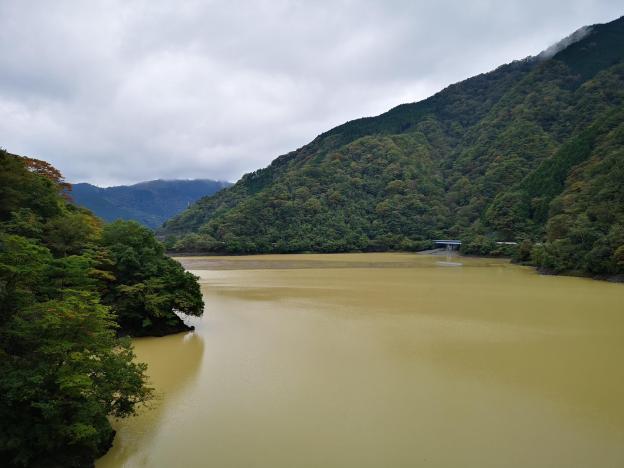
Karikomi Lake, Nikko City, Tochigi Prefecture, Sunday, July 21, 2019

The very long rainy season had put a premature end to the first half of the 2019 hiking season…but I was determined to get one more hike in before the hot and busy (for me) summer arrived – my next chance would probably not be till September. Since I was a little out of shape, I chose a short and easy one in Nikko, hoping that the overcast skies, and voting for the national elections, would keep the crowds away. I was looking forward to visiting the Oku-Nikko area since I hadn’t been there since my climb of Mt Nyoho two years ago.

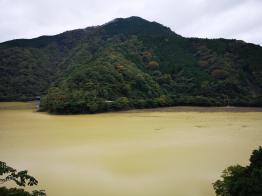
Lake Karikomi and Mt Taro in the background

I took advantage of the more expensive, but direct Tobu Nikko line train – being able to sit and sleep during the 2 hour trip was definitely worth the express surcharge. In Nikko there was a light drizzle. I didn’t fancy walking in the rain but I couldn’t turn back now. Going up “Irozaka slope”, the bus was enveloped in thick mist. Fortunately, once we emerged at Chuzenji lake, we were above the mist and I could see the lake and mountain sides – the sky overhead was overcast and the peaks were in the cloud though.

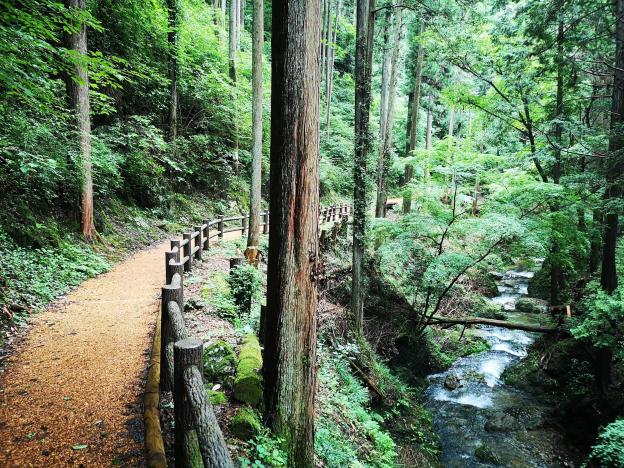
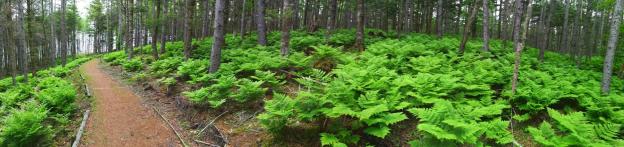
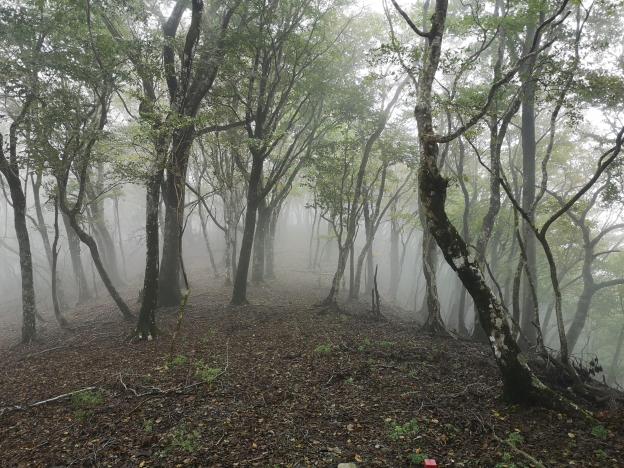
Today’s hike was through green mossy forest

I got off at the very last stop, Yumoto-onsen. This small, somewhat run-down, onsen town town seemed totally deserted, 11am on a Sunday morning. Was the town in decline or was my timing bad, I wondered to myself. I made my way to the start of the hiking path behind the town, also the source of it’s hot springs. There is a wooden observation path, and two small pools of bubbling water – not the most exciting tourist attraction but it’s always cool to see hot water coming out of the ground.

See the hot spring water bubbling up and hear the birds chirping near Karikomi lake

The path climbed for a few minutes, then crossed a road, before heading along the side of small forested valley. Despite being at 1500m, the air felt unpleasantly heavy – very different from my previous hike 2 weeks earlier, and one thousand meters lower. It took me less than an hour to reach a pass, where I took a short break. Afterwards, the hiking was mostly level and along a broad easy-to-walk path. I took off my bear bell so that I could enjoy the intense chirping of birds.

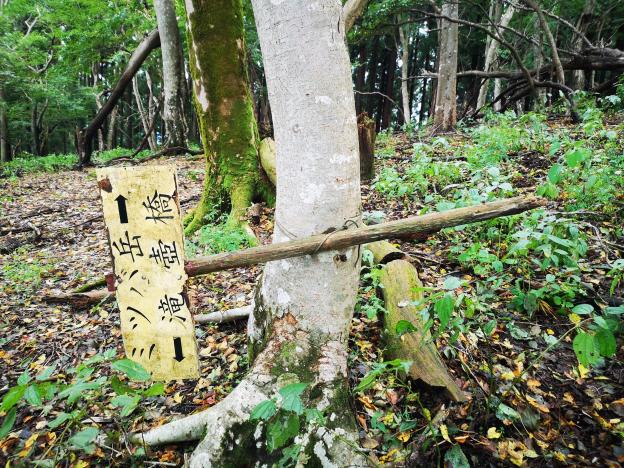
A signpost in the forest

After some descending along wooden staircases through a thick moss covered forest, I arrived at Karikomi Lake (刈込湖) just before one o’clock. After checking out the view and having a quick lunch, I set off along the path through beautiful forest, passing another small lake, and finally arriving in a wide grassy valley. Since I needed to catch the 3pm bus from the Astoria Hotel I couldn’t linger and I powered up the mountainside opposite and over another pass, with Mt Taro on my left, a 300 famous mountain that I have yet to climb.

A grassy field suddenly appeared

A hidden valley in the middle of the Nikko National Park

From there it was a quick and easy thirty minute descent to the hotel – I had to overtake a very big group of elementary school children on the way. I made the bus but had to forego the onsen, otherwise I would miss the last express train back, and that would mean getting to Tokyo really late. By the way, this place would have snagged fourth place on my list of places to go when it’s hot and humid, except that the traveling time is too long for a daytrip – seven hours for only four hours of hiking.

On the shore of Karikomi Lake

Hossawa Falls to Musashi-Itsukaichi Station, Hinohara Village, Tokyo Prefecture, Friday, July 5, 2019

Despite the long rainy season this year, I managed to squeeze in a short hike on a cloudy, rain-free day. Although the elevation of the walk was relatively low – between 400m and 200m – the temperature and humidity were also low for July, so conditions were quite pleasant throughout the day. In general, this hike is best attempted in the spring and autumn.

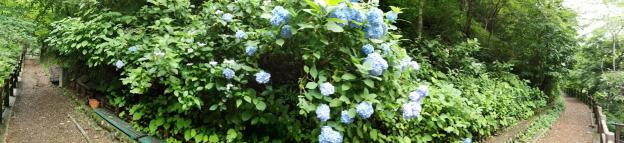
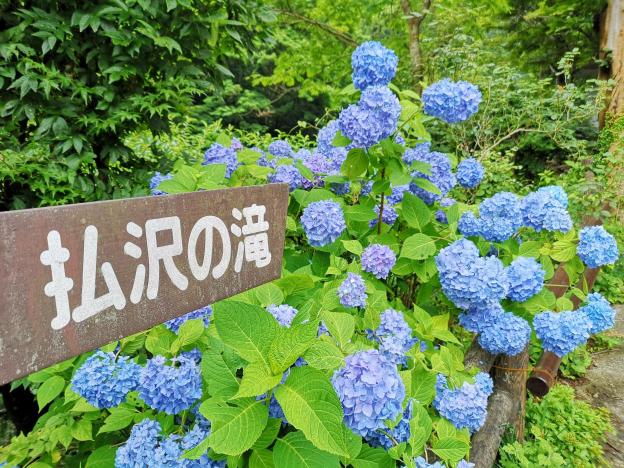
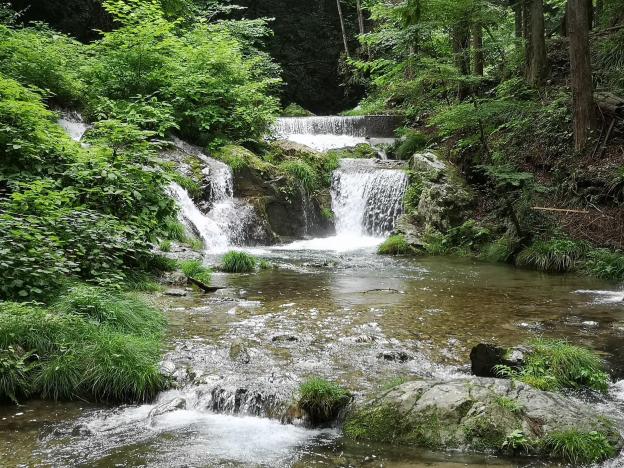
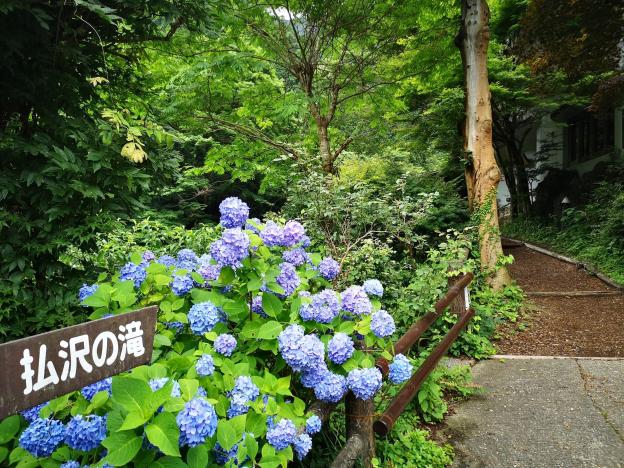
I had last been to Hossowa falls 払沢の滝, one of the hundred famous waterfalls in Japan, located inside the Chichibu-Tama-Kai National Park, after hiking Mt Sengen 浅間山 a few years ago. Then, Autumn was in full swing and I got to see some beautiful autumn leaves along the short trail to the waterfall. This time, the surrounding trees were lush with green leaves, and hydrangea flowers (ajisai アジサイ) were still in full bloom. The river and small falls leading up to the waterfall were wider and bigger that I had remembered, perhaps due to the high amount of rain that had fallen in recent weeks.

Smaller falls on the way to the main attraction

I had set off late and so I arrived at the Hossawa Falls entrance bus stop 払沢の滝入口, just after noon, and promptly started up the narrow climbing road to the left of Hinohara Tofu – their tofu donut makes an excellent snack! I soon reached an information board that showed the details of the whole area, and another one showing the location of 13 (!) waterfalls in the area of Hinohara Village, Hossawa falls being the most impressive one.

Entrance to the path to the waterfalls

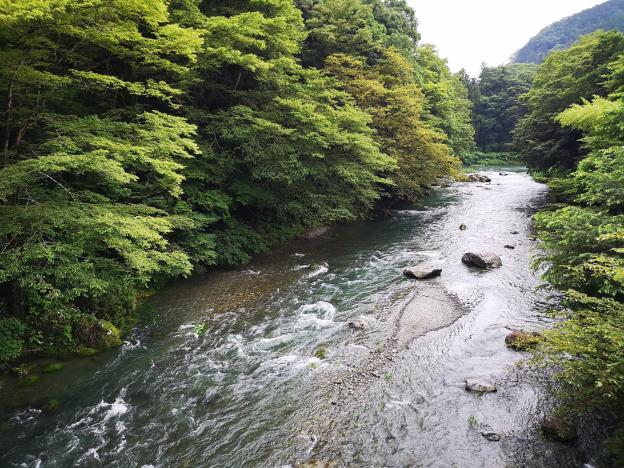
Hossowa waterfall is located at the Eastern base of a narrow ridgeline wedged between the Kita Aki river to the North, and the Minami Aki river to the South. The latter is the longer of the two, and takes its source at the base of Mt Mito. The Kita Aki river joins the Minami Aki river just before the falls. Further downstream, it joins up with the Yozowa river (coming down from Mt Mitake to the North), and finally becomes the Akigawa river (which later merges with the Tamagawa further East).

The Minami Aki river after merging with the Kita Aki river

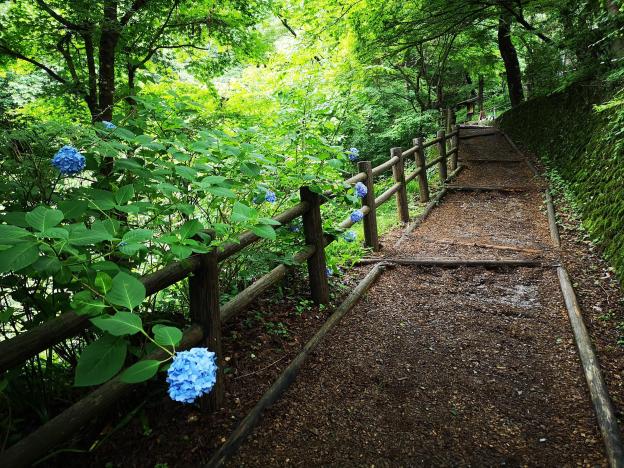
Since I was taking many photos of the river and flowers, it took me nearly half an hour to reach the waterfall, along an easy-to-walk path with no steep inclines. Along the way there were good views of the rushing stream below.

Not a real hiking trail but more of a walking path

On the left, a ravine, on the right, a cliff

There is a wooden sloping section that can get slippery when wet – someone took a tumble just as I was approaching! According to Wikipedia, the total length of the falls is 60m, divided into four sections – it was indeed an impressive sight to behold. You can get relatively close to the base pool, but the best shots can be obtained next to the stream, a little further away. After comparing with photos from my previous visit, I can confirm the falls are much bigger in the rainy season than in the autumn.

You can even feel the wind blowing from the force of the falling water

The return was much faster, and it only took me 15 minutes to get back to the main road. There were few people on a weekday, but I expect there would be a lot more people visiting on the weekend. There is also a cafe at the start of the path but it was closed on Friday.

Racing the stream on the return

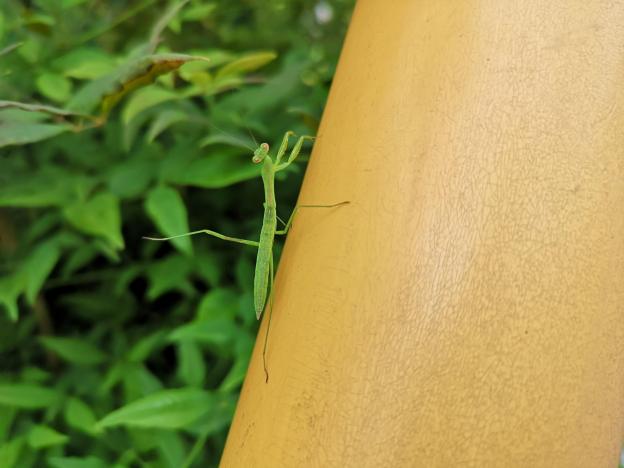
Watch out for this interesting chap on the way back

Once back at the Tofu shop, I made my way back to Musashi-Itsukaichi station, sometimes following the main road, and sometimes following smaller and quieter roads on the other side of the river. The various bridges offered nice views of the Minami Aki river. The parts on the left side of the river made for a pleasant ramble through nice countryside with occasional glimpses of the river through the trees.

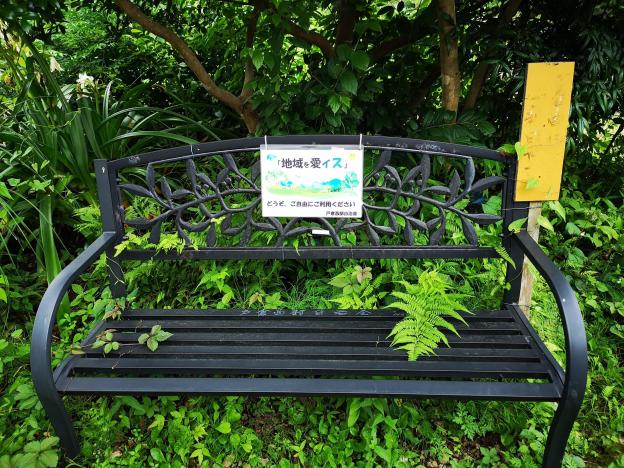
The sign says “Have a seat!”

Just before Sawato Bridge 沢戸橋, about two kilometers from the station, I stumbled upon a small path heading down on the right. According to the information board, it was the Akigawa Kyuryo Trail 秋川丘陵コース, a very nice discovery! I crossed the Bonbori river on a small wooden bridge, and then followed a very nice hiking path along the right side of the Akigawa river.

Careful not to take a tumble into the river!

Too soon the path joined up with the road again. There a small detour away from the river was needed, but soon I was walking next to the Akigawa again with good views of the surrounding hills. I reached the train station just after 5pm. Hopefully, I’ll be able to return sometime and continue hiking East along the Akigawa!

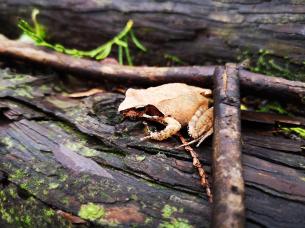
I found this little fella along the path

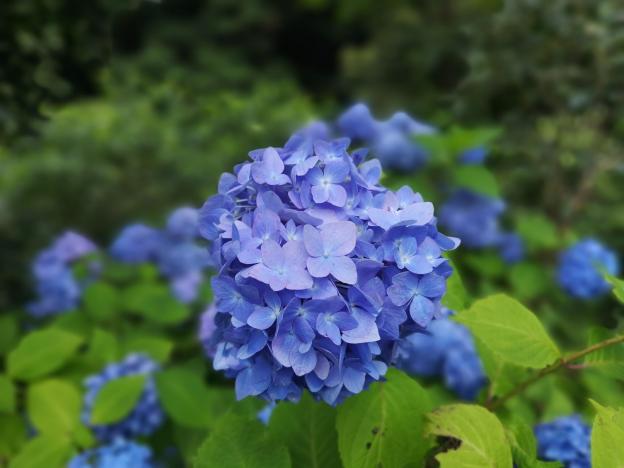
The “ajisai”, the symbol of Japan’s rainy season

Check out the power of water

Mt Kushigata (2052m), Minami Alps, Yamanashi Prefecture, Saturday, June 22, 2019

After my foray into the very southern part of the Southern Alps the previous weekend, I decided to go back and do one of the few higher mountains in the Minami Alps that can be done as a day trip from Tokyo. I had been wanting to climb this one for a while but since it requires a car, I kept putting it off (it can be done via public transport but you’d have to stay the night before in the area). The weather wasn’t perfect but I decided to risk it anyway, and I was glad I had!

It was my first time experiencing the new “all seats reserved” Chuo line, and overall, I felt that it was an improvement over the previous system. At least I was guaranteed a seat, which is essential when traveling all the way out to Kofu, where I had reserved a shared car. The trip up to the parking lot at Ikenochaya 池の茶屋 (1860m) was mostly uneventful – the road was pretty bad in some parts, but I had seen worse. I snagged the second to last parking spot. Under a thick cover of clouds, and the odd drop of rain, I was ready to set out at 11h15.

Super easy hiking for the first thirty minutes

The first part of the hike was incredibly easy to hike – a gently sloped series of switchbacks leading to a viewpoint of Mt Kitadake which was unfortunately entirely in the clouds. Rain was falling intermittently, but I didn’t mind since the surrounding vegetation, mostly ferns, was a very beautiful shade of light green. Soon the path started to descend via a series of log staircases. The amount of descent started to alarm me – I should be going up a mountain not down – but my guidebook and the numerous signposts reassured me that I was on the right trail.

Looking back up this long log staircase

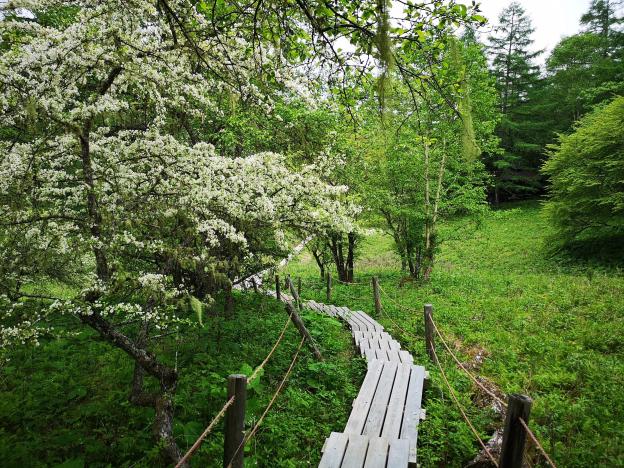
The path soon bottomed out and I was rising again, gently, through beautiful typical Southern Alps forest scenery. At this point I got a bit confused. I pride myself on my sense of direction, but here I will admit I lost track a bit. The path did what I thought was a loop, yet I never crossed my previous path. Eventually I arrived at a flattish area with a wooden walkway, and white flowers that ressembed sakura, but which were in fact oxalis.

An unexpected flower observation section on the hike

Apparently the area is famous for its irises, but they weren’t in bloom yet. In no time, I reached the top of Mt Hadaka (meaning Mt Naked). I was supposed to see the main peaks of the Southern Alps and Mt Fuji but in reality I saw nothing. However the temperature was pleasant, even a little cool, and there was no wind, so I settled down for some lunch.

At first sight I thought these were some really late blooming mountain sakura

The next section was through amazingly beautiful forest, full of massive camphor trees and moss-covered undergrowth. At one point I spotted a solitary juvenile Kamoshika (Japanese serow), passively munching some grass (see video). I arrived at the top of Mt Kushigata 櫛形, a two-hundred famous mountain, a little after 2h30, where there was a relatively new summit marker, a few meters from the old weather-worn one. The clouds were still in, so no view, but it was very peaceful and quiet. I had not seen anybody in the past hour and a half.

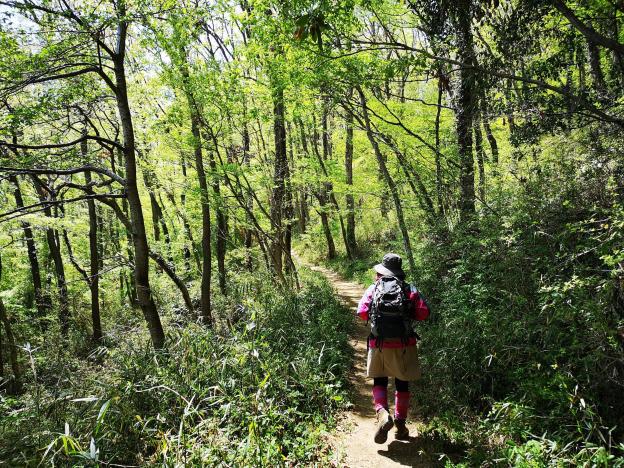
Most of the hike scenery and trail was like this

I set off for the final part of the hike back to the parking area. The mist had rolled in, providing some very nice photo opportunities. At the car park, my car was the only one left – time to head back! Heading down the mountain, the sun broke few in a few places, I was able to get some nice views of the valley below. Instead of taking the train directly back to Tokyo, I got off at Isawa Onsen, less than ten minutes away. It’s a great place to have a hot spring bath, and I got to taste some Yamanashi wines at the wine server in the tourist office below the train station – a great way to finish a Yamanashi hike!

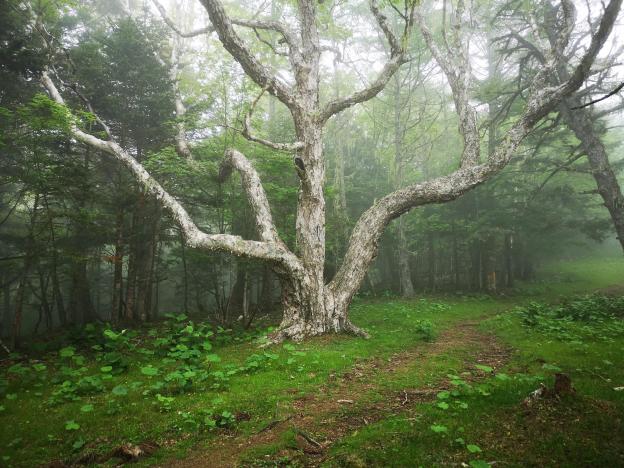
Tree in the mist number 1

Tree in the mist number 2

Have you ever seen a Kamoshika while hiking?

Mt Sengen (299m) & Ranzan River Valley, Ogawamachi City, Saitama Prefecture, Saturday April 20, 2019

I had been to Mt Sengen in May 2016 as a half day hike, and to Ranzan in December 2016 as a short bike ride. Since then, the hiking trail has been lengthened to connect both areas so it seemed like a good idea to return to there. I believe that Ogawamachi town makes an excellent base for hiking due to its close location to Tokyo (70 minutes by direct train from Ikebukuro) and proximity to the Higashi-Chichibu mountain area.

The hike starts from behind the Mt Sengen Miharashi no Oka Koen (view hill park) that is best reached by a short taxi ride (about 1200 yen) from the station. Otherwise it’s nearly a one hour hike. Before leaving, make sure to try a tofu donut from the small store opposite the station. The park has an observation tower with great views, and a roller slide.

View of Ogawamachi from Mt Sengen View Hill Park

The path to Mt Sengen (仙元山) follows the top ridge through beautiful forest with occasional views of Tsuki River on the left. The summit marker is reached soon after passing a jump off spot for paragliders. It’s a mostly flat place in the forest with an opening to the West. Afterwards the hike continues southwards with a number of small ups and downs. Along the way are the ruins of Aoyama castle – there isn’t much to see but you can imagine that a fine castle must have existed in such a good location.

Beautiful forest on the approach of Mt Sengen

The well-marked path first continues South, then bends to the East, passing several minor peaks along the way, eventually reaching Okura castle ruins. As before there isn’t much left to see, but there is a good lunch spot with log seats and an Eastward view, on top of the slight rise on the right side. Beyond that, the path gradually descends before reaching a road, where one needs to go left for the bridge over Tsuki river and the entrance path to the path for the Ranzan river valley.

Walking the path to Ranzan Keikoku

After crossing the bridge, there is a small trail that leads right down to the river on the right side. It’s worth heading over there since the views up and down the river are very pretty. However it’s a dead end so – the path to Ranzan is above, behind the parking area. It’s an easy-to-walk straight path that leads to the base of Mt Ohira, a short climb with a nice view. However it’s worth continuing straight along the path till reaching the river side – this is the highlight of the Ranzan river valley 嵐山渓谷. It’s a nice place to take a break.

A peaceful place to take a break

To finish the hike, take the path heading eastwards following the river downstream. Eventually it leads to a road – Musashi-Ranzan train station on the Tobu line is less than 30 minutes away. It’s also possible to catch a bus back (use Google maps).

See what it is like going down a roller slide with a view!

Mt Ontake (230m) & Mt Amabiki (409m), Sakuragawa City, Ibaraki Prefecture, Sunday April 7, 2019

This is most likely my final Ibaraki hike till autumn. I purposely chose a low hike so that I could check out cherry blossoms trees on the way, and a shorter one since I had skipped the previous week due to Hanabi. The hike starts from Iwase station on the Mito line and follows the “Kanto Fureai no Michi”, a network of trails through the Kanto area (I followed another portion during my previous hike in Chiba). This is the last portion of the ridgeline stretching North of Mt Tsukuba and Mt Kaba (one can continue to Mt Kaba for a longer hike).

An example of the well-maintained trail on this hike

Outside the station there was a sign informing me that I was inside the Mt Tsukuba area Geopark. Apparently there are about 30 such geoparks in Japan. There is also a cycle rental shop near the station since the Tsukuba Ring Ring Cycling Road passes nearby, and the hike uses it to get back to the station. Around this time of the year it is lined with cherry blossom trees in full bloom.

Outside the station I turned right, walked through the town for a short while before turning right again and crossing the railway track. The road than led straight up the hillside to the start of the trail with an information board. There are 2 trails but apparently they join up so I took the right one. Very soon I reached the top of Mt Ontake 御嶽山 where there is a nice little “azumaya” with a good view of the valley I just came up, framed with sakura. The top also has a small shinto shrine.

Mt Tomiya, not in my guidebook, but can be hiked

After a short break, I continued along a pretty path through the forest. At one point, a yellow-furred Japanese stoat or weasel “itachi” darted across the path and disappeared into the trees, only the third one I’ve ever seen while hiking. So far, all “Kanto Fureai” paths I have walked have always been well maintained and easy to walk, with nice surroundings. After a while, I reached a long staircase (just as I was attempting a timelapse video – see video below) and I reached the top of Mt Amabiki 雨引き slightly out of breath and ahead of schedule. The mountain name can be read as “rain pull” but fortunately the weather was sunny that day, although a bit hazy.

View of Mt Kaba from the top of Mt Amabiki

I had lunch on one of the benches around the summit and took in the view of Mt Kaba and Mt Tsukuba to the South, and the Kanto plain to the West. After I set off again, the path soon started to descend and I reached the junction with the trail to Mt Kaba. For some reason the sign for Mt Kaba hadn’t been repainted as the other ones had. Since I had already been up there, I turned right and proceeded further down the mountain.

Soon I took a left along a steep descending path, supposedly a shortcut for the Amabiki Kannon temple at the end of the hike. There were a lot of visitors, and it was an interesting place to explore, since I had enough time for once. The sakura in full bloom made the place especially beautiful. I then followed an old staircase that ran parallel to the car road to reach the base of the hill and the main road.

Early April is a good time of the year to do this hike

Here are I was supposed to rejoin the cycling road but I spotted a bus stop out of the corner of my eye. Although my guidebook stated that there was no public transport in the area, it seemed that amazingly there was a bus for Iwase station coming in just a few minutes. It was still mid-afternoon but the clouds had rolled in so I decided to take the opportunity and get back to Tokyo early for once. I will come back another spring and see the cherry blossoms along the Ring Ring road by bicycle!

Get a feel of the hike by watching the timelapse video

Mt Asamakakushi (1757m), Takasaki City, Gunma Prefecture

For this hike, I drove a rental car from Takasaki city to a small parking area near the entrance of the trail to the mountain. Starting from an elevation of 1450m at 11am, the hike to the top took only one hour. Although the top of Mt Asamakakushi 浅間隠し, meaning “Hidden Asama” was similar to that of my previous hike, it was a lot colder, since I was further North.

Yatsugatake in the background

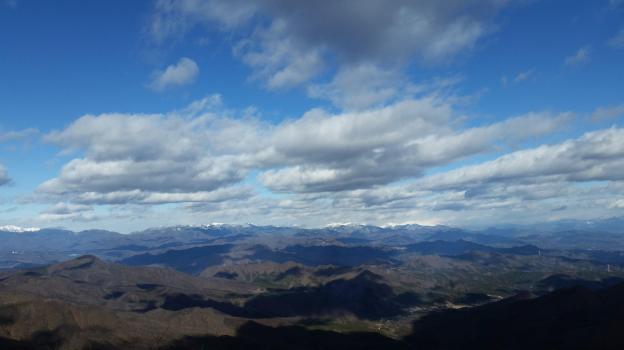
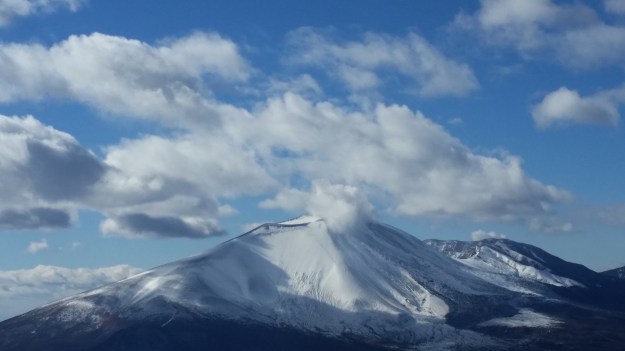
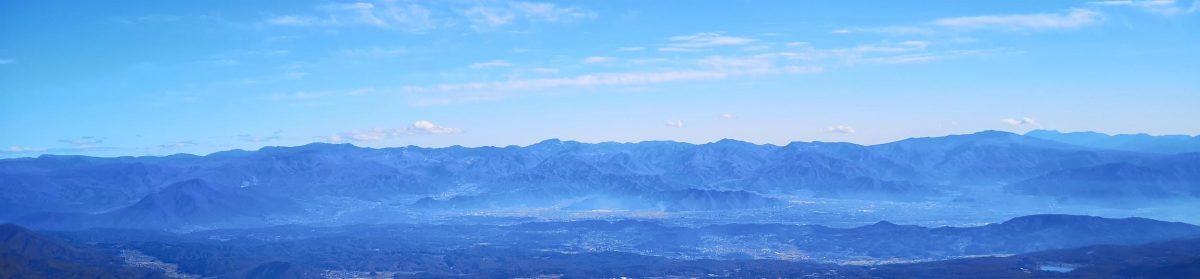
The view of snow covered Asamayama to the West was breathtaking. I could also see the entire Joshin-Estsu mountains forming the Northern edge of the Kanto plain; there are just too many mountains to list here. Southwards, I could make out the Yatsugatake range, Karuizawa and the Oku-Chichibu mountains. Finally the three holy mountains of Gunma – Myohgi, Haruna and Akagi – were all visible in the same panorama.

The Joshinetsu mountains

After an hour taking pictures and eating lunch in near freezing temperatures, I made my way down the same way I had come up. Once back to the car, I drove to the onsen at Hamayu Sanso at the base of the mountain. I got there just before 2pm and I was able to warm myself up, before driving back to Takasaki station.

20171209_121926

Mt Myoho (1332m), Chichibu City, Saitama Prefecture

The starting point for this hike was Mitsumine Shrine, a place I had visited a few times before, but had never really taken the time to explore. Since today’s hike was relatively short, I first took some time to check out the Mitsumine visitor center, one of the starting points for visiting the Chichibu-Tama-Kai National Park. It was a pleasant surprise – I found the displays of mounted animals and the model relief of the area particularly interesting.

View of Mt Wanakura (also known at Mt Shiroishi and climbed in 2018) from Mitsumine Shrine

After spending nearly an hour at the visitor center, I hurriedly set off along the hiking path up Mt Kumotori. The autumn colours were at their peak, and since it was a weekday, I had them mostly to myself. Very soon I reached the turnoff for today’s mountain, located on a small ridge branching left off the main ridgeline. In less than an hour, I reached the small shrine at the top of Mt Myoho (妙法山ヶ岳), from where I got some great views of Oku-Chichibu, with Mt Ryokami in the center.
View of the jagged peak of Mt Ryokami from the summit

After lunch, I headed back to the shrine, and since it was still early in the day, I took some time to check out the shrine grounds – it was beautiful with all the autumn colours. At the back, there was a spectacular view of the mountain I had just climbed as well as Chichibu city.

Good views from the trail heading down from Mt Mitsumine shrine

Afterwards, I located the hiking path leading down the mountain. Although there were a number of people at the shrine, no one seemed interested in hiking down, so once again, I had the path entirely to myself. Unfortunately, it wasn’t possible to hike all the way down to the train station, and the path ended up on the road, from where I caught an express bus back to Seibu-Chichibu station.

Mt Yokote (2307m) & Mt Shiga (2037m), Yamanouchi Town, Nagano Prefecture

I did this hike with my mother who was visiting Japan for a couple of weeks. Since it was quite far from Tokyo, we rented a car in Takasaki, and spent the night in a traditional Japanese inn, or “ryokan”, in Kusatsu Onsen. The next morning was sunny, but by the time we had made our way all the way up to Yugama Lake 湯釜 the clouds had rolled in. We admired the light blue colour of the crater lake, but gave up on climbing Mt Kusatsu-Shirane. I had climbed it before in the clouds, and had little interest in doing it again in similar conditions.

A beautiful crater lake

We drove on to Yokoteyama Ropeway which took us to the top of Mt Yokote 横手山. We got some nice views of Shiga Highland 志賀高原. Fortunately, the Nagano side was still free of clouds. We finally arrived at Kumanoyu (meaning the bear’s bath) where we left the car. We were now firmly inside Nagano prefecture. Another short ropeway took up to the start of the hike. Luckily, the weather was holding up. The first part was quite level. At one point the path went through some very high bamboo, higher than our heads, and I was worried about bears. So I reached into my bag to retrieve my bear bell only to realise that I had left it in the car!

View from the top of Mt Yokote

Soon the path started to climb. It was steep, with big rocks and protruding tree roots, making progress slow. The path slowly wound up the side of the mountain. We saw few people, and thankfully no bears. We reached the top of Mt Shiga 志賀山 just before 2 pm. A little way past the summit, there were some good views of Onuma-ike Lake below. The whole hike is inside the Joshin Etsu Kogen National Park and is very wild and beautiful.

The area of our hike – Mt Shiga is in the clouds on the right

We climbed down via a different path, spotting various small ponds on the way. Finally, after passing through a shinto gate or “torii”, we reached the base of the cone-shaped Mt Shiga. The next part involved walking along an elevated walkway through marshlands – much easier than the rocky path down the mountain! The final part back to the ropeway was along a wide and level path through the forest.

Onuma Lake in the middle of Shiga Highland

Since it was getting late, we decided not to take a bath at Kumanoyu, and leave right away. No sooner had we set off, that a dark shadow dashed across the road – it was a bear cub. It disappeared into the bushes opposite. We waited a bit for a mother bear, but she was nowhere to be seen. In any case the place certainly deserves its name!

Elevated walkway through the marshland 

On the way back, we stopped briefly for some photos at the marker for the highest national road in Japan at 2172m high. The drive down to Kusatsu onsen was through thick mist. We had a bath at the Sainokawara open-air bath, one of the biggest in Japan. After we were done, it started raining really hard, but we managed to get back to Takasaki safe and sound, a little after nightfall.

Hiking up and down Mt Shiga

Nikko-Shirane Ropeway & Goshiki-Numa Lake, Katashina Town, Gunma Prefecture

I did this hike with my mother who was visiting Japan for a couple of weeks. Since it was quite far from Tokyo, we spent the night at the Takasaki Dormy Inn Hotel, and the next morning, I drove to the Nikko-Shirane Ropeway. Even though it was a weekday, I was surprised by how few people there were, especially since it was the middle of the summer holidays. The place is mainly a ski resort in the winter so perhaps people aren’t aware that it also runs from June to October. I love ropeways and I keep on discovering new ones – it’s amazing how many there are in Japan!

Sun shining through the forest

At the top of the ropeway, inside Nikko National Park and nearly 2000m high, the visibility wasn’t the best, and the views were a little disappointing. At least it was cooler than down in the valley. The hike started out on a fairly level trail through beautiful forest. After an hour or so, we had to climb steeply for a short while to reach the edge of a pond. Here I was able to look up towards the top of Mt Nikko-Shirane. I had been hoping to get my revenge, since it was in clouds when I climbed it several years ago. However, the top was in the clouds again, and another ascent seemed pointless.

Midaga Pond near the top of Mt Nikko-Shirane

We continued a little further and reached the edge of a crater with at the bottom, the beautiful Goshiki-Numa lake 五色沼 (which means five-colour lake). Since we had enough time, I decided we could descend to the shore of the lake and climb back up again. Unfortunately the descent was steep and rocky, and we regretted it a bit.

The Goshiki-numa lake, inside Tochigi prefecture

After enjoying the peace and quiet of the lake, we made our way back up to the edge of the crater via a different path, and then walked back the way we had come. At the pond, we passed a group of noisy school children who had come up a different path. We headed back down the steep path to the forest below, and at the bottom we took another trail that looped back to the top of the ropeway.

View of Maru-numa lake from the ropeway

Check out the views of Nikko-Shirane

On the drive back to Takasaki we stopped at the very impressive Fukiware Waterfalls 吹割の滝 where we could walk along the river and the falls for a short way.

Where is all the water going?

Check out one of the famous waterfalls in Japan

Mt Sekirou (702m) or the Other Takao

Last Saturday, I finally made it back to Mt Sekirou 石老山 (702m) for the 3rd time. I wrote about this mountain in an earlier blog post and at the time I had to cut short the loop hike because of a sudden snowstorm. I had promised to update the post once I managed to complete it but so much time has passed since then – four years – that I think it warrants a new post. Another reason I’d like to write about it again is that as the title suggests, it has many things in common with nearby Mt Takao. However unlike Takao, there aren’t as many people.

First it all it has relatively easy access.  Although it requires a bus ride from Sagamiko 相模湖 which is the next station from Takao station, buses depart on average twice an hour all day long. I didn’t even check the bus timetable in advance this time and the bus left within ten minutes of arriving at the station. The best thing is not to fret about the bus and just focus on getting to Sagamiko station at a reasonable time for hiking. Additionally, the bus ride to the entrance of the trail – the bus stop is conveniently called 石老山入口  entrance to Mt Sekirou – takes only about ten minutes so standing is not an issue.

The trail is fairly well marked – there is also a big board with a map at the start – so you don’t really need to bring your own map although I always recommend getting one   At one point (just after the temple) the trail splits in two but this isn’t an issue since both trails join up again 30 minutes later. I recommend the right branch since the views are better (sakura michi さくら道 on the signs). If you decide to descend via the same route, rather than the loop trail as described below, you could take the other branch on the way down.

20161203_123725
View of Mt Takao from the Sakura path

There are several wooden seating platforms where you can eat lunch on the summit and a good view of Mt Fuji as well as Mt Omuro in the Tanzawa range. We had a late start on Saturday so we only got there at 1h30 and we had the summit to ourselves. The path for descending is to the right. This is the one I opted not to take last time because of the weather. After a hundred meters or so there is a split and in order to complete the loop hike, you need to go right again.

20161203_140438
The empty summit

The path is very pleasant, generally wide and not too steep. There are however a couple of steep rocky parts which should be descended cautiously. After an hour or so, and a few up and downs, there is an observation platform. It has a nice view of the long ridge that includes Mt Takao and Mt Jimba. After that it’s about 30 minutes of downhill to get back to the road. The path follows a valley with a small stream that can be pretty dark and gloomy towards the end of the day. At times the trail is fairly rocky and difficult to walk, not unlike the part leading to the temple when going up.

20161203_153223
View from the observation platform

After reaching the road it takes another 20 minutes or so to get back to the bus stop. Overall, including a one-hour lunch break and walking at an average pace, the entire hike shouldn’t take more than 5 hours. During that time we saw less than two dozen hikers. Before heading back, I would recommend taking advantage of the very nice Ururi hot spring that is just across the road inside the Pleasure Forest amusement park.

The only two areas where Mt Takao wins against Mt Sekirou is 1) the number of attractions – Takao has several temples, a beer garden, a funicular, a chairlift and a monkey park 2) the numbers of trails up and down the mountain.

As of October 2020, the trail around Kenkyoji Temple (顕鏡寺) is still closed due to trail damage due to last year’s Typhoon 19 / Hagibis – it’s not possible to reach the summit of Mt Sekiro via this route. No reopening date has been set yet. Please check the Sagamiko Tourist Association website for future updates.