For my last hike of 2019, I chose 3 small peaks along a narrow mountain range, squeezed between the Tanzawa mountains and the urban sprawl of Tokyo. This hike is right next to the city, and it’s possible to get to the start of the trail in under two hours. I had been to the area a few years ago, but this time I used different routes up and down. From afar, these mountains can seem deceptively high, however the trail inclination is mostly slight to average.
The highest part of the hike follows a gentle ridgeline
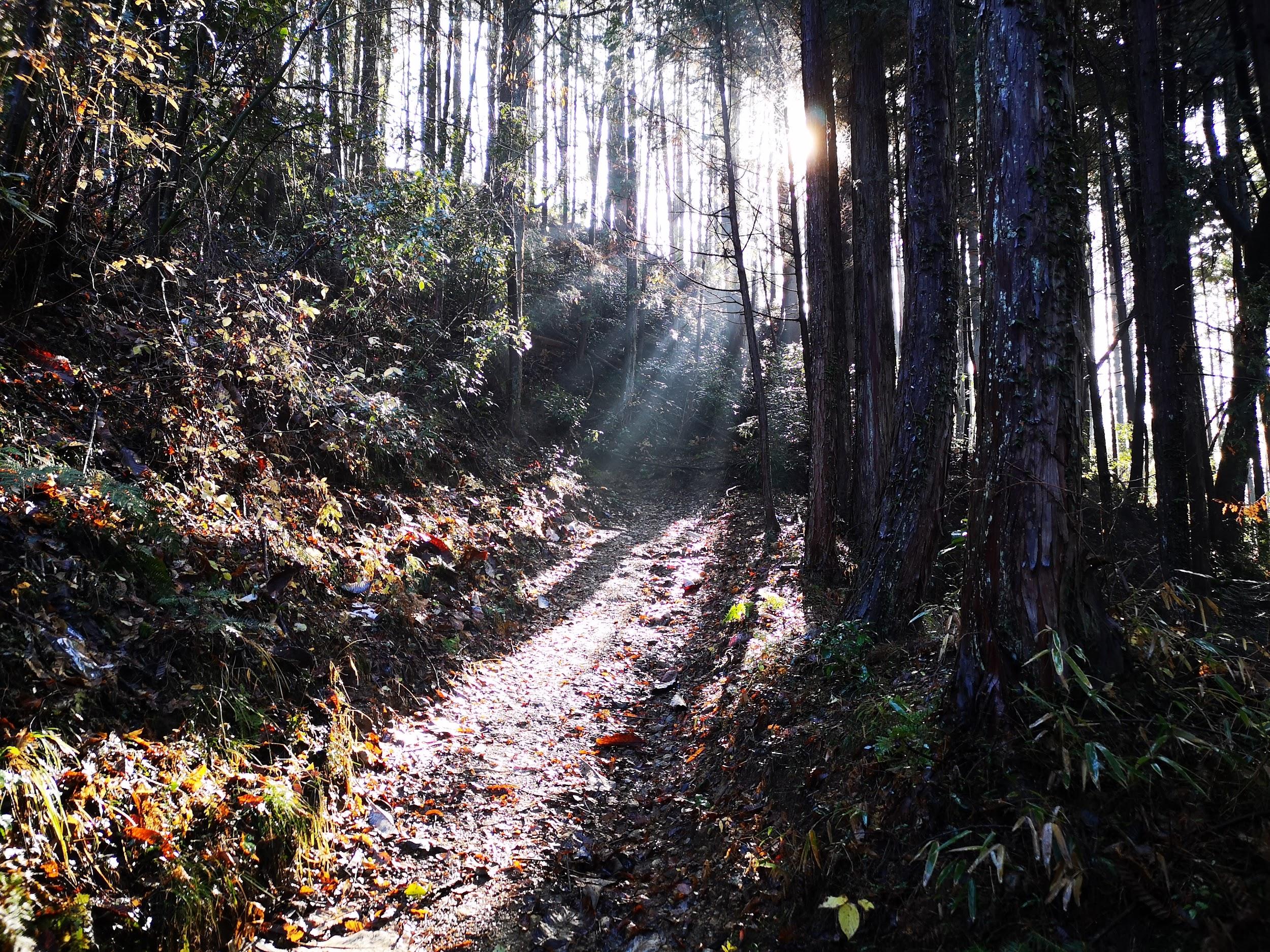
I took the Romance car to Atsugi station, technically still within the Tokyo area, where I transferred to one of the frequent buses heading out to Miyagase Lake 宮ヶ瀬湖. At 10am, I was ready to start hiking under blue skies and near freezing temperatures. The first part followed a section of the Kanto Fureai no Michi 関東ふれないの道. Like other portions of this long-distance trail, it was well-maintained and well-signposted; the surrounding forest was pretty and quiet, making this a good start to the last hike of the year.
Following the Kanto no Fureai Michi trail
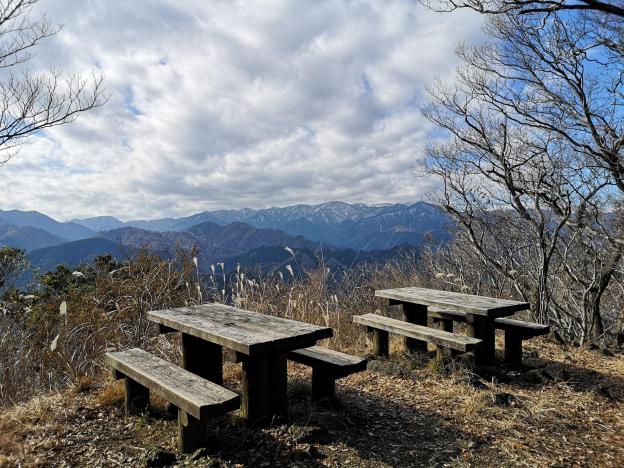
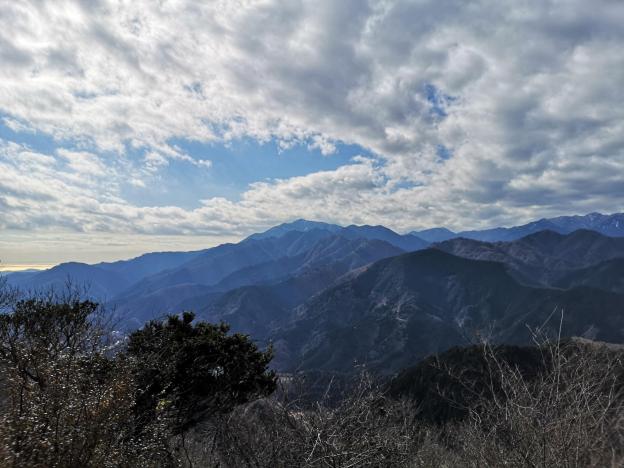
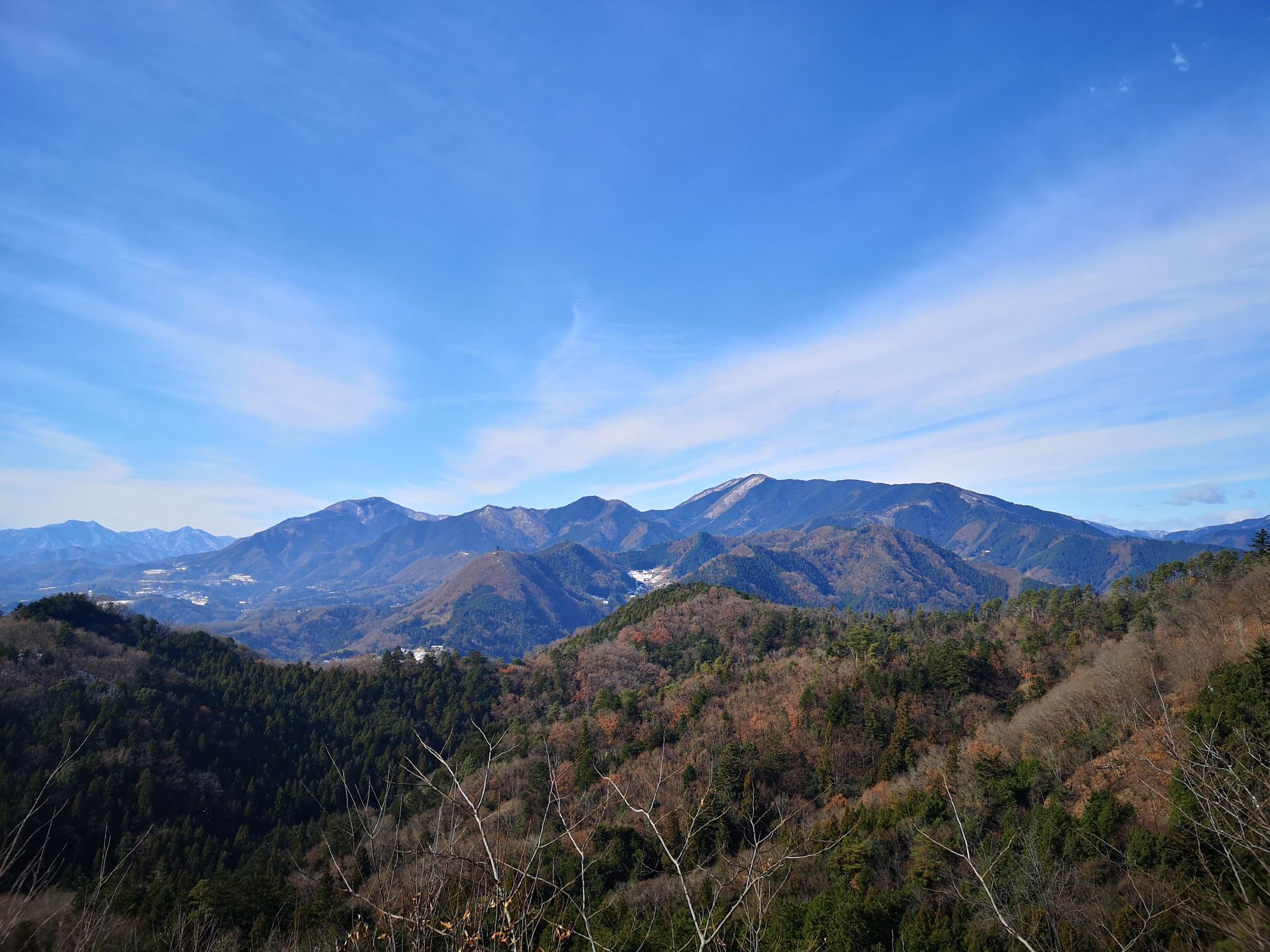
Soon, I was getting my first views of Tokyo. With the zoom of my smartphone camera, I could make out the row of skyscrapers in the city center, as well as the Skytree. Later on, I had glimpses of the ridges and peaks of the Tanzawa range in the opposite direction. I arrived at the top of Mt Kyogatake 経ヶ岳 at 11h30, where I had a magnificent view of Mt Oyama, Mt Tono and Mt Tanzawa, their peaks white with snow. A few minutes before the summit, there was a local trail heading left to the next mountain in the opposite direction – a hike for another day maybe.
Lunch with a view of the Tanzawa mountains
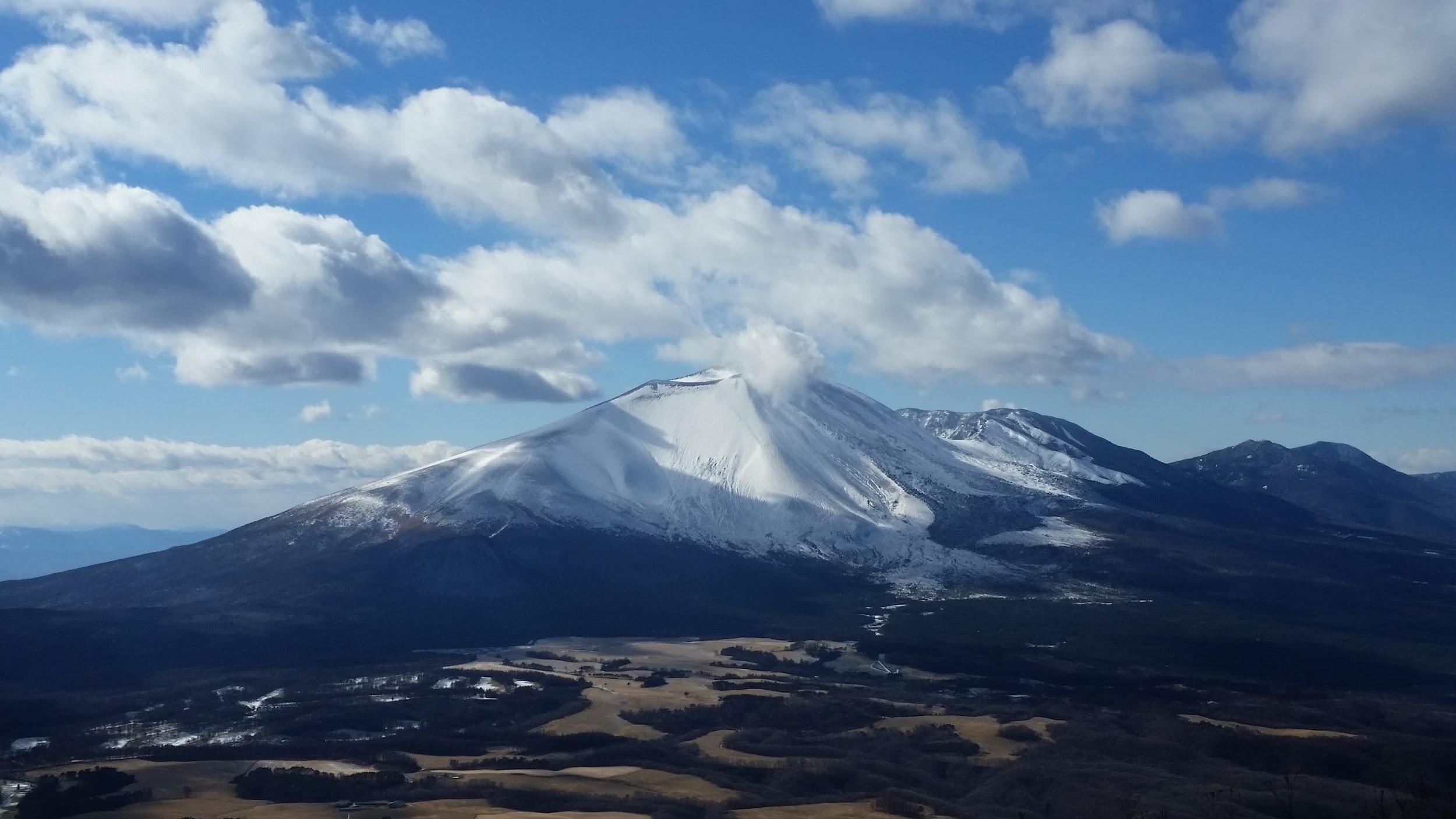
Mt Oyama, with its distinctive pyramidal summit
After a quick bite, I set off again. Some clouds had appeared over the Tanzawa mountains, but overall it remained a sunny day. The path descended steeply, crossed a road, and ascended steeply again. The climb was made easier thanks to steps built into the path, a common feature in the Tanzawa area. I reached a level section, soon merging with a path coming up from the left, the one I had used on my previous hike here.
The trail is well-maintained, as in the other parts of the Tanzawa mountains
The path immediately started rising again, via another series of steps, and turned into a narrow ridge with spectacular views of the Tokyo metropolis on the right, and Tanzawa mountains and Miyagase lake on the left. Up to this point, the hike had been relatively easy, but this section required some surefootedness. Although I had hiked this part before, it all seemed new to me, and I spent a lot of time taking photos. Enjoying the dual view of the mountains and the city from above is one of the aspects I like the most about hiking in the Kanto area.
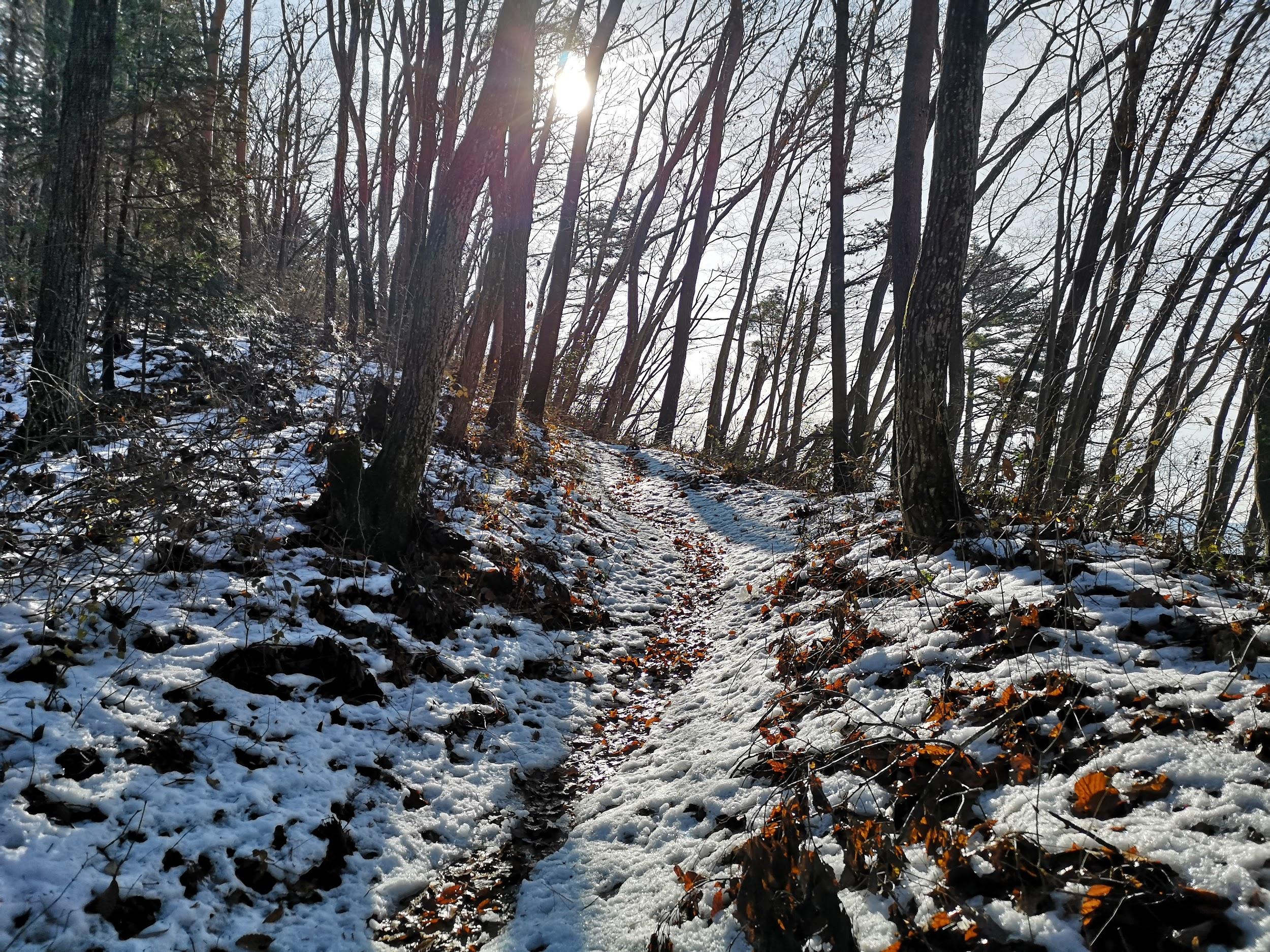
In winter, the trail is often in the sun
Approaching the highest point of the hike
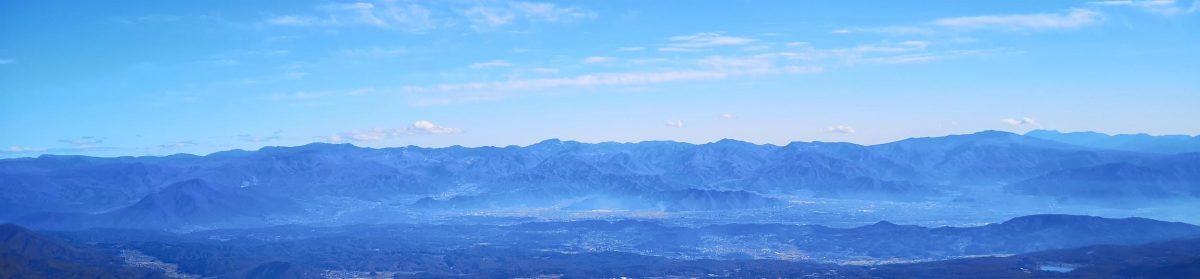
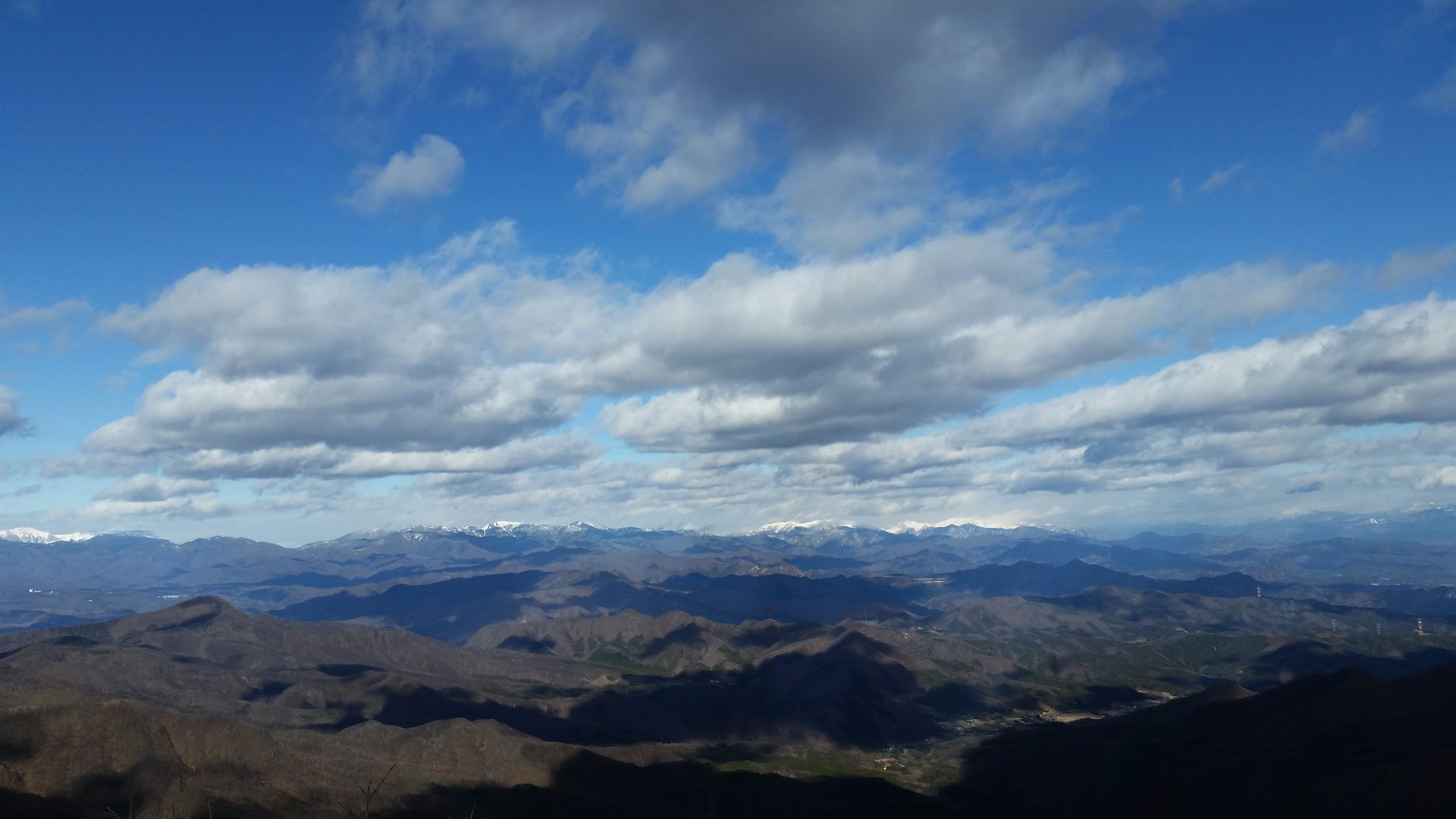
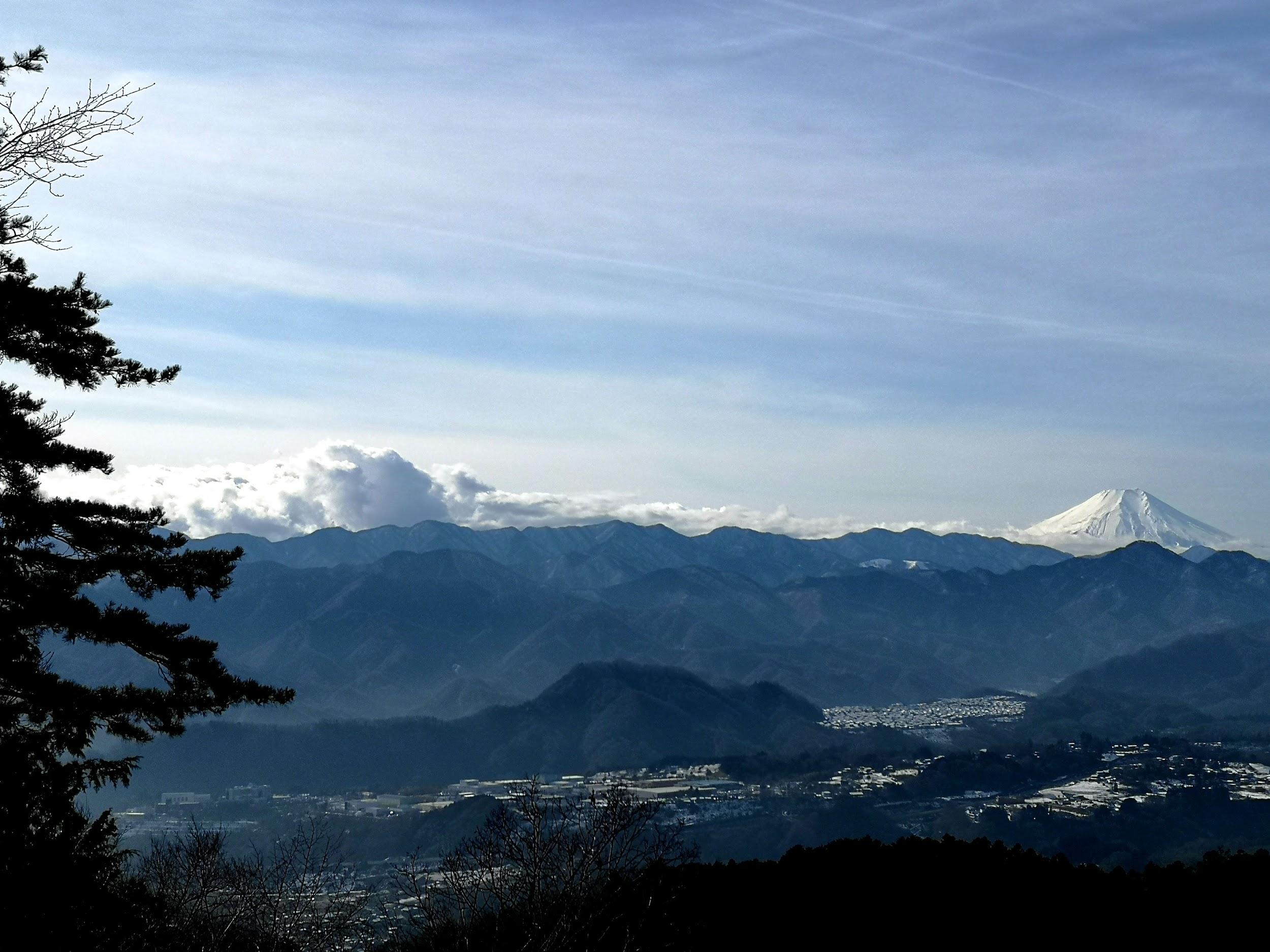
I reached the top of Mt Bukka 仏果山 just before 1h30 pm. The summit is completely in the trees, but someone thoughtfully built an observation tower so hikers can enjoy panoramic views of the entire area; the next peak has a similar tower. Despite being artificial structures, they make the hike worthwhile. They offer some of the best views in the Kanto area. I could see the entire Southern side of the Oku-chichibu mountains stretching from East to West, from Mt Takao to Mt Kinpu; in the foreground was Mt Sekiro. Unfortunately, Mt Fuji was hidden from sight, despite being quite close.
The observation tower rising above the trees…
…offers a great viewpoint of Tokyo
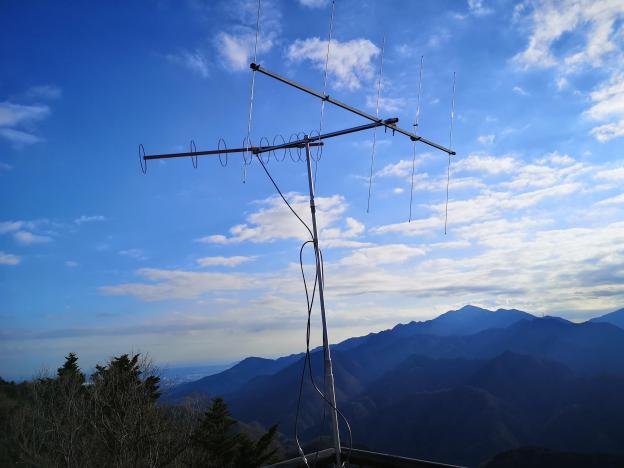
Without the protection of the trees from the icy wind, it was very cold at the top. I had left my backpack with my gloves at the base of the tower, so I soon went back down, and continued to the next peak. This section was short and easy, and I reached Mt Takatori 高取山 just fifteen minutes later. From the top of this second tower, the view was similar, except for a person dabbling in amateur radio; he had deployed quite a big antenna on one side.
Amateur radio antenna and Mt Oyama
This slideshow requires JavaScript.
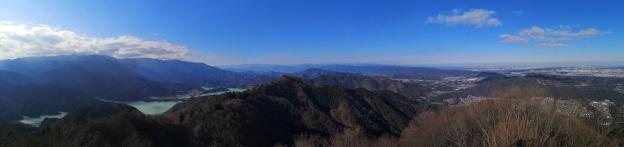
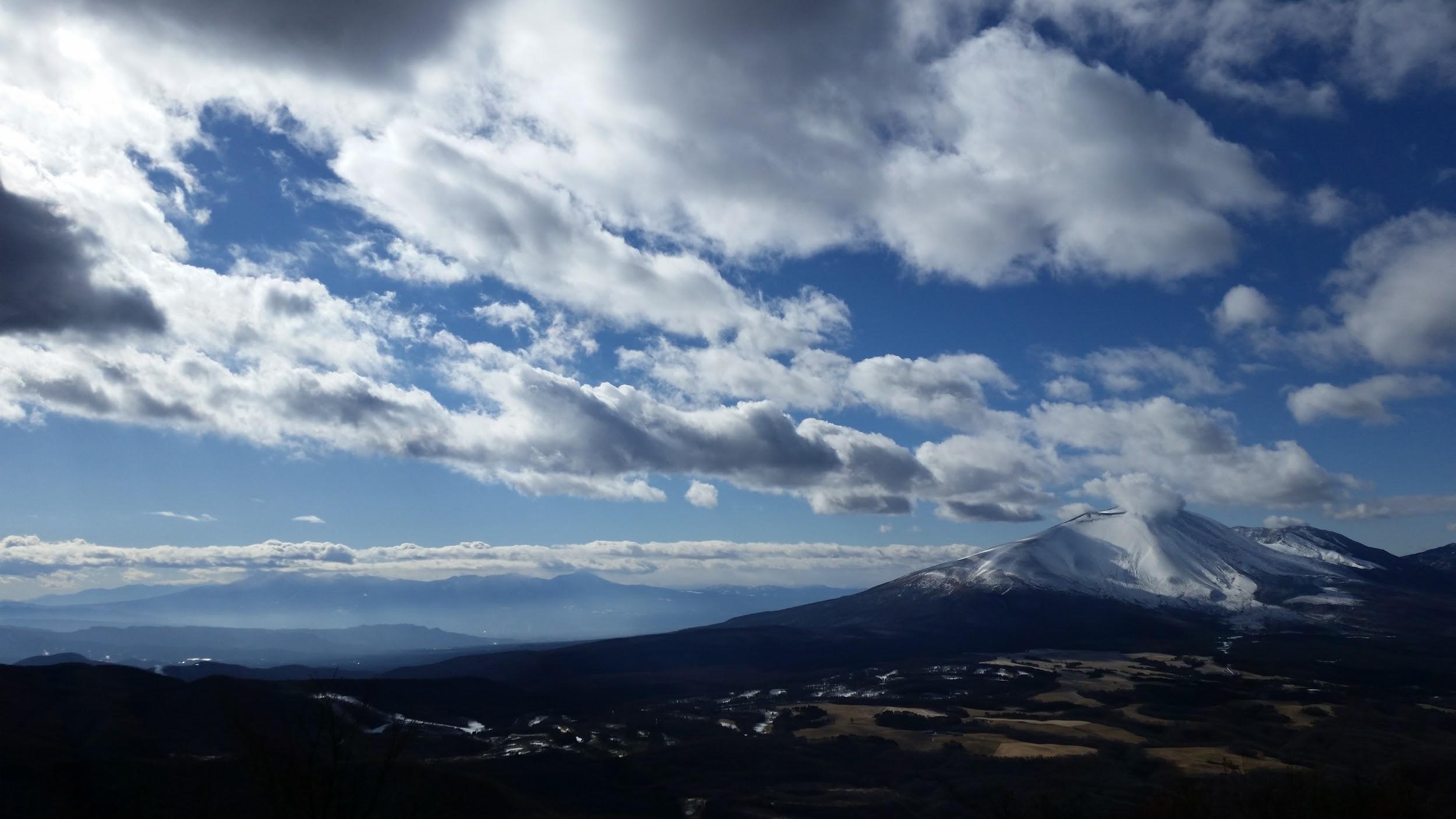
Panorama of Tanzawa and Miyagase lake
I had the second half of my lunch, and after I had my fill of food and views, I climbed down the tower, and started to descend towards Aikawa town. It was nearly 3pm and at this time of the year, it would be getting dark soon. The path down was easy to hike; there were a number of other trails, but I just followed the signs for Fureai no Mura ふれあいの村, and it took me less than an hour to reach the bus stop for Atsugi. It was a short ride back to the station. I hopped on the romance car back to Tokyo, and started to think of all the great hikes I would do in 2020.
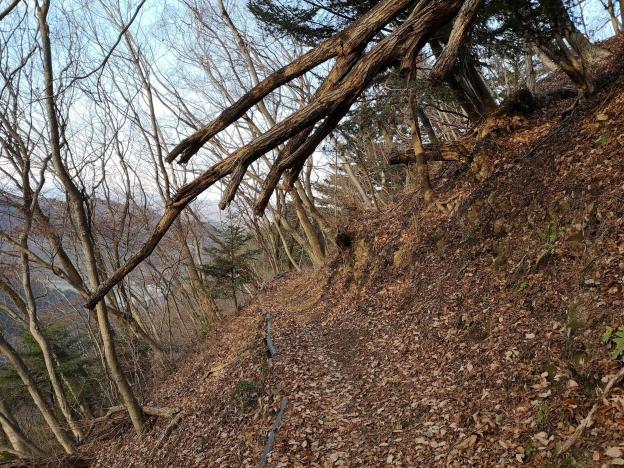
Trees pointing in the wrong direction
A view of Aikawa town through the trees
Panoramic view from the top of Mt Takatori (you can hear the amateur radio user in the background)
After my successful trip to Madarao Kogen Ski Resort, I decided to try something more ambitious. Shiga Kogen would be my largest ski resort so far (64 lifts, divided into 10 areas), as well as the highest. Access was via a winter-only express bus; as the last bus back was fairly early, I would only have five hours to explore this huge resort. I was wondering whether it would be worth it, but since the weather was supposed to be sunny all day, it made sense to go. For once, I could look forward to skiing many different slopes in one day in ideal conditions.
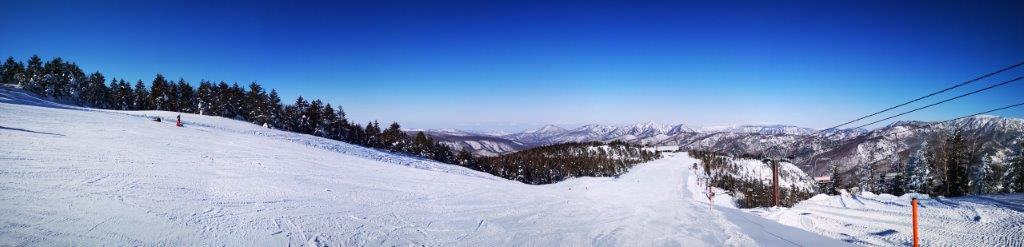
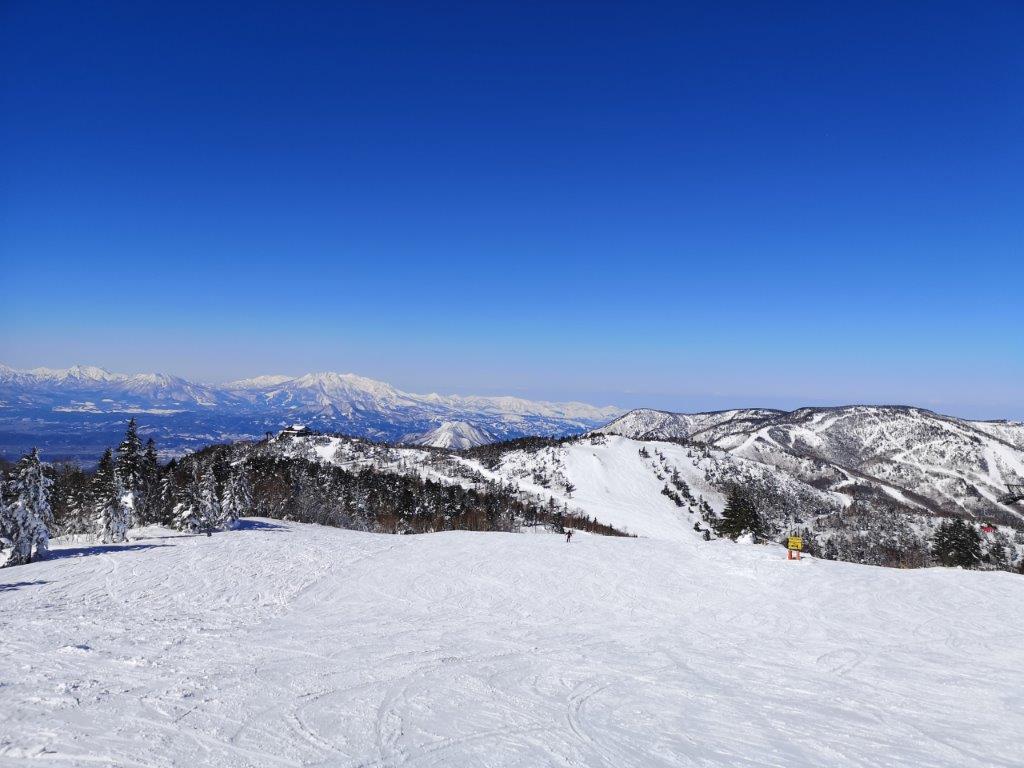
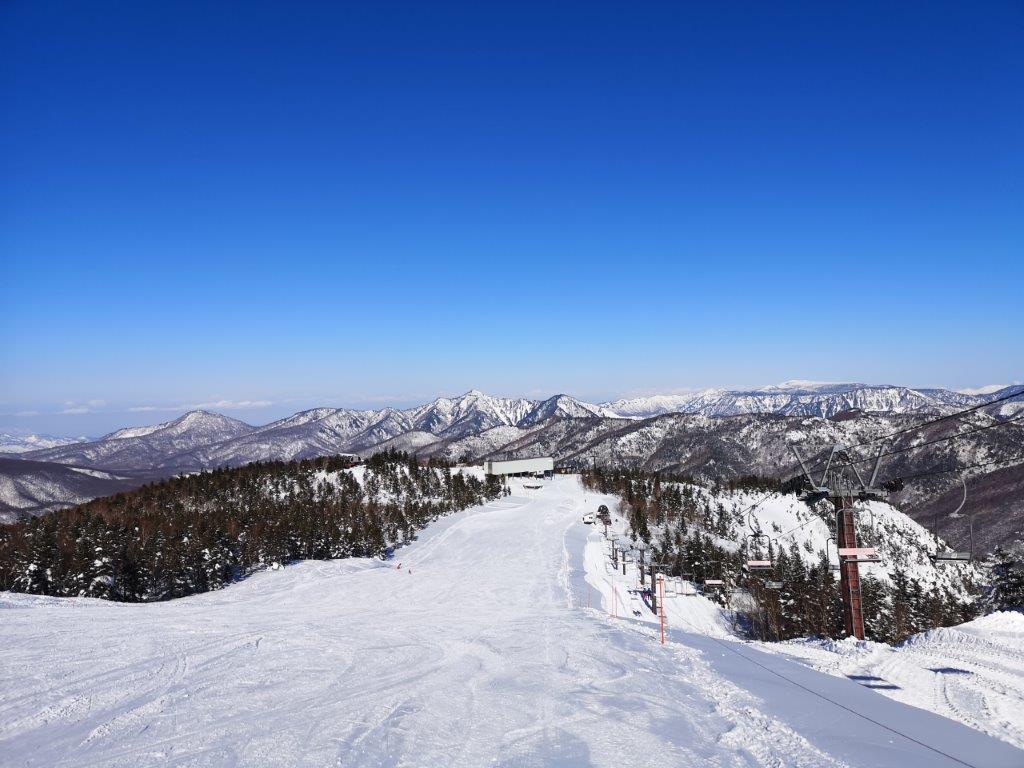
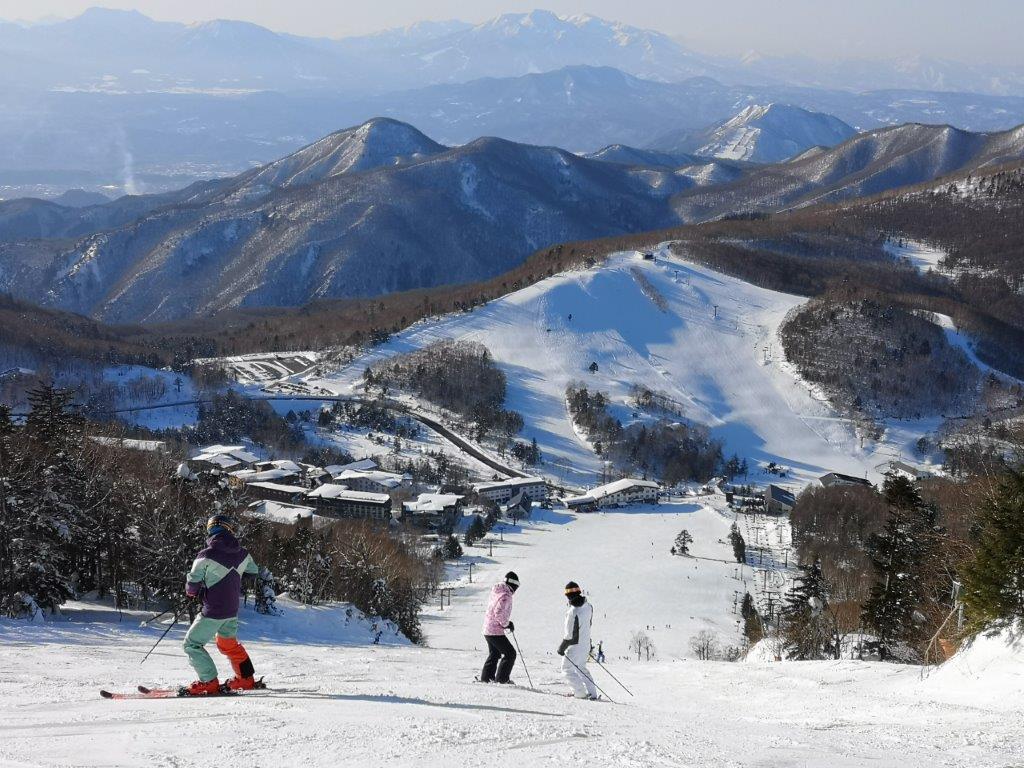
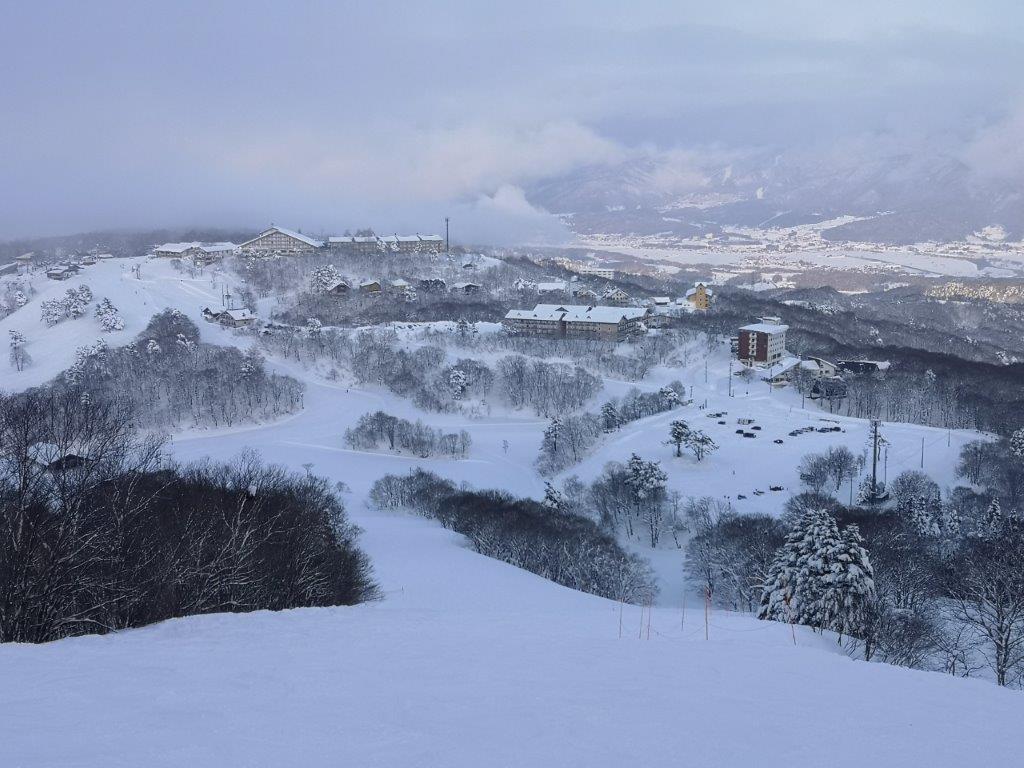
Looking down from the top of the Ichinose Family area
I arrived at Nagano station before 9am and headed directly to the bus stop outside the station. There was a small booth on the pavement where I could pay for my ticket (where do they sit in bad weather?) It was a beautiful blue-sky day, and as I waiting, the sun shining in my face, a long line formed behind me. During the 70-minute bus ride, I had fine views of the mountains of Togakushi Kogen on the left side, and Mt Kosha straight ahead (see video). We passed the entrance to the Jigokudani monkey snow park, and a little later, I saw a few monkeys enjoying the fine weather in the snow next to the road.
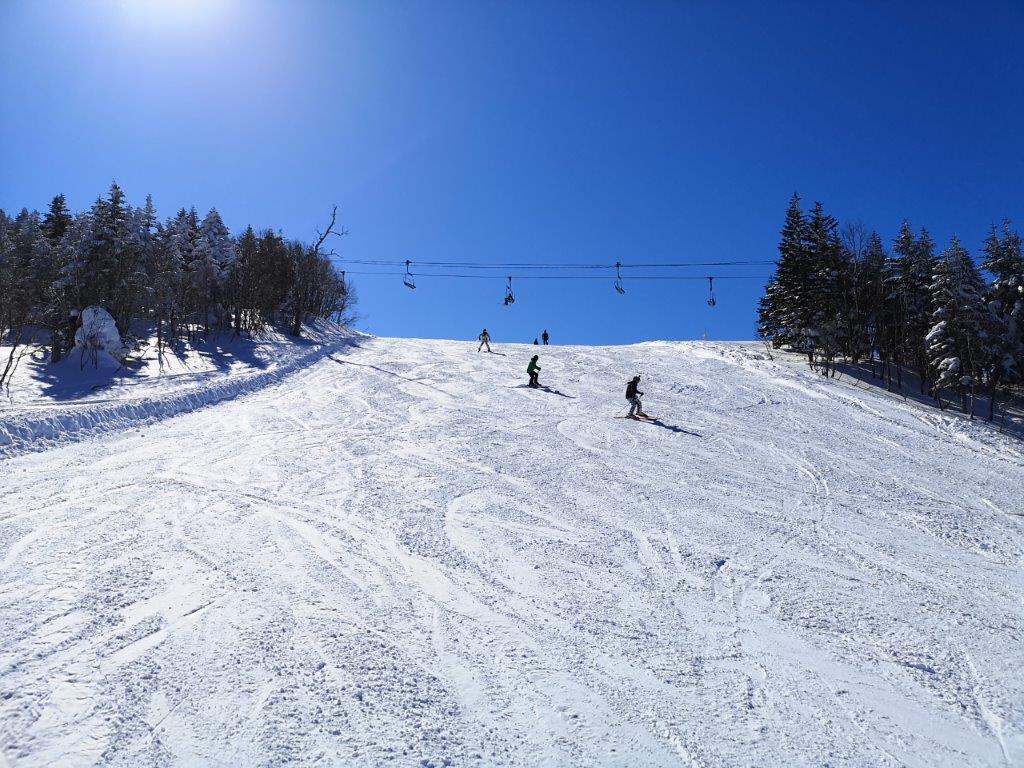
A beautiful day for skiing
Despite its high altitude, the resort is entirely below the tree line
I had reserved my skiing gear the day before with Alpina Sports inside Shiga Kogen Yama no Eki (志賀高原 山の駅); I got off there at 10:25, the bus continuing to Oku-Shiga at the top of the valley. The ski shop seemed brand new; the staff were super efficient: I had all my gear in less than 10 minutes. I could also buy my ski pass there, and I chose one for the entire area, 600 yen more than for the central area. It was impossible to visit the whole resort in 5 hours, but at least I could try. By 11am, I was ready to ski, and I headed towards the gondola next to the shop.
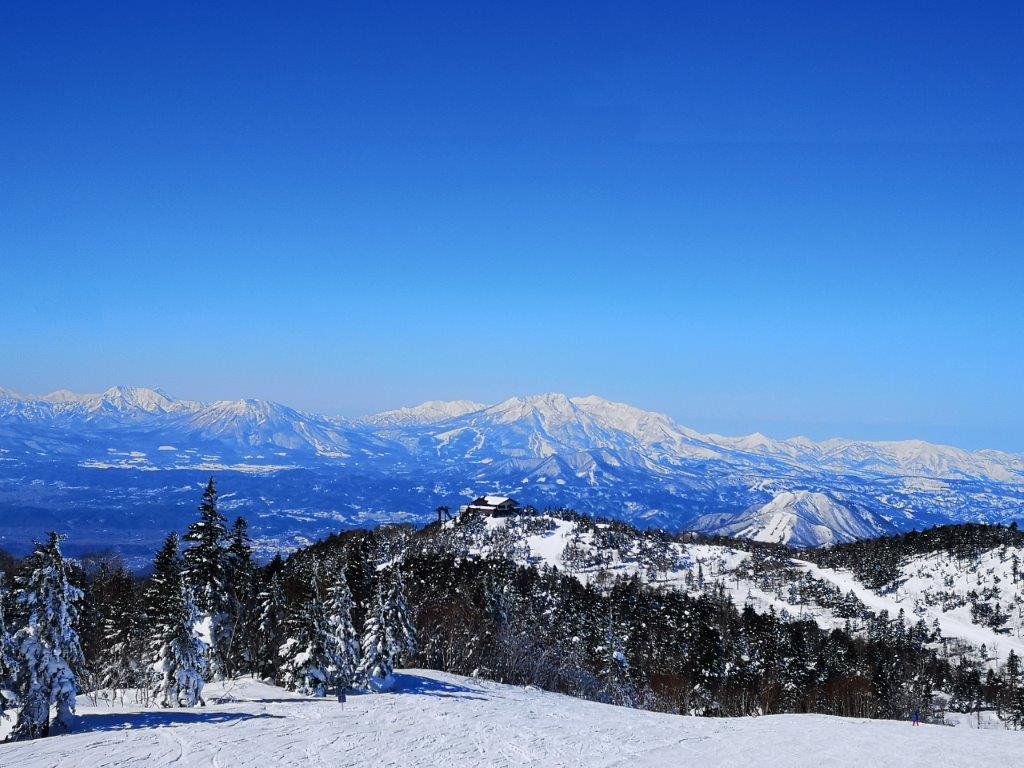
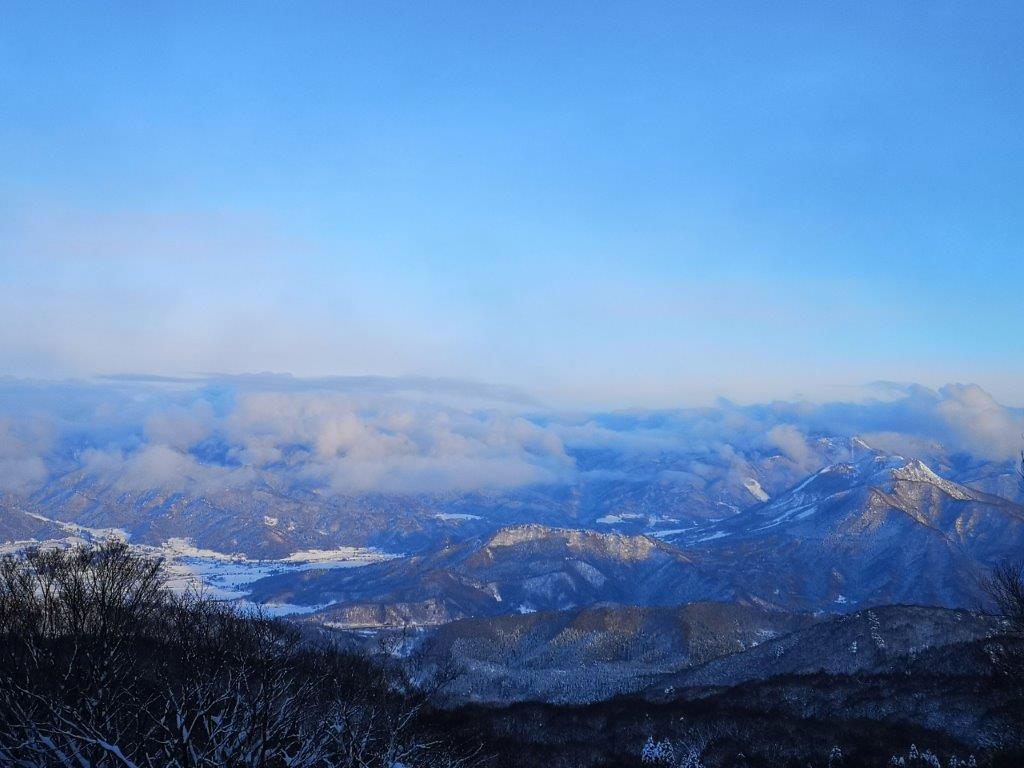
The northern half of the North Alps and Togakushi Kogen
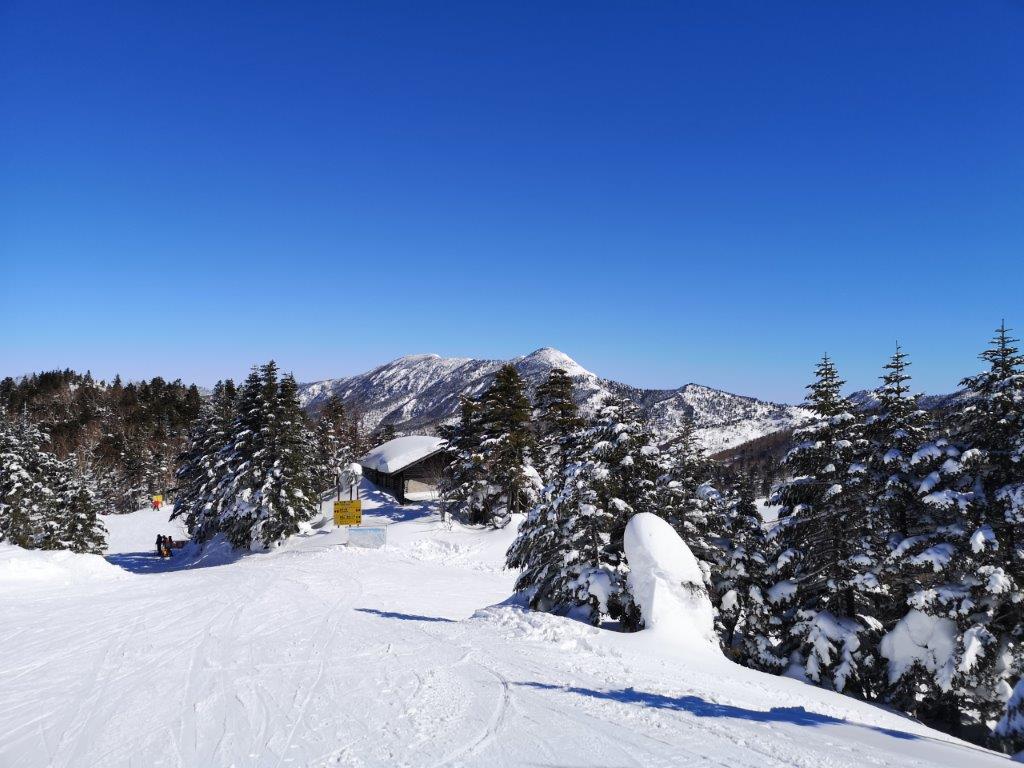
View from the top of the Terakoya area
I was surprised that my first ride of the day was down instead of up. Apparently there was no way to ski down to the start of the central area. Luckily it was a short ride. From there, I decided to up the mountain to the higher areas, leaving the smaller and lower Sun Valley area for later. I was keen to see the views from the top of the resort before the afternoon haze set in. It me took one gondola and two chairlifts to reach the Terakoya (around 2100m) at noon. Incredibly, I had spent the first hour of my short skiing day just sitting on lifts!
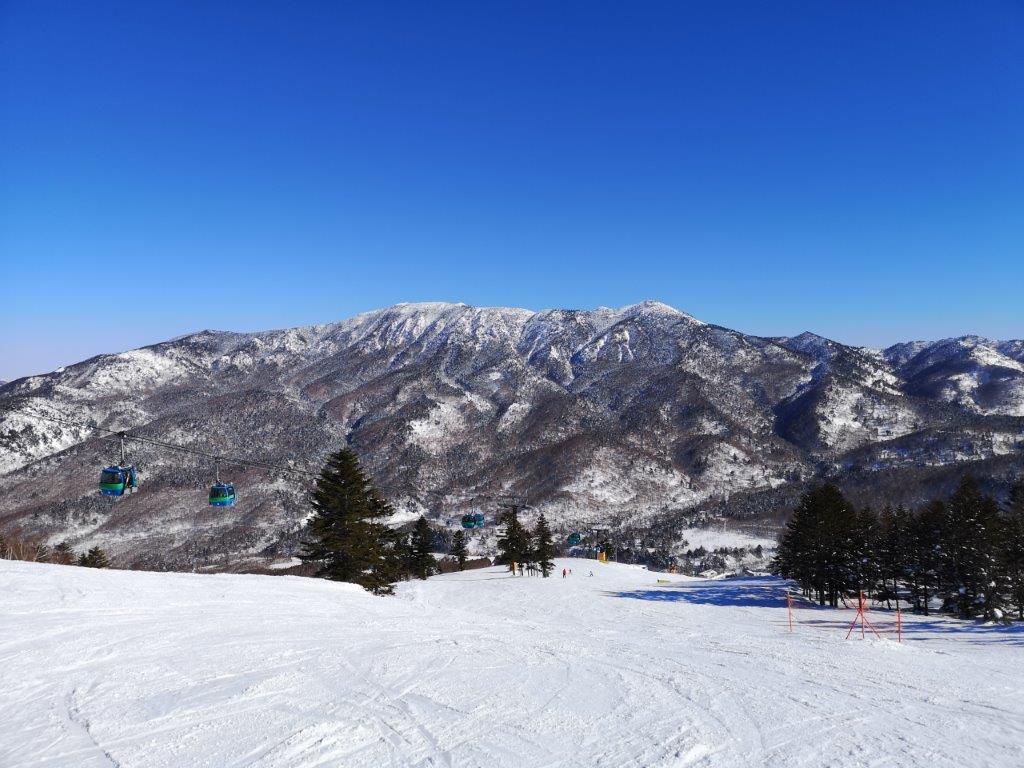
Ichinose Diamond area on the other side of the valley
Looking north towards Niigata prefecture
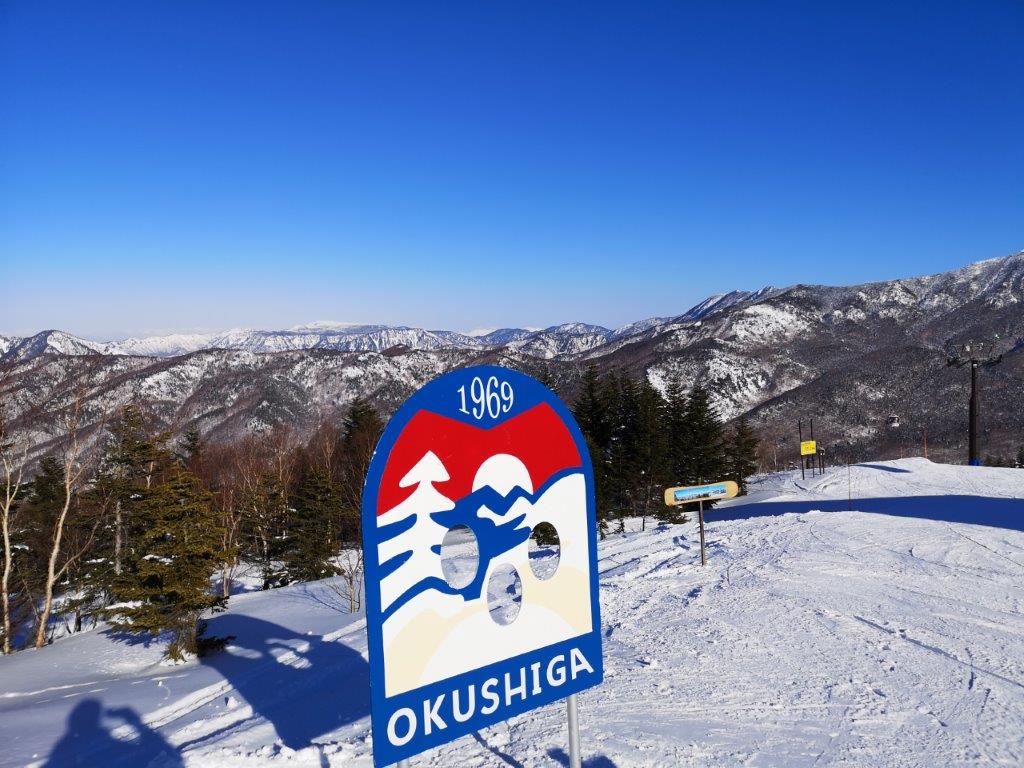
There wasn’t a cloud in sightfrom the highest point of the central area (around 2100m). I could see the northern part of the North Alps, as well as Mt Iizuna, Mt Kurohime and Mt Myoko (also a ski resort). This was where I had ended my summer hike in Shiga Kogen last July but I could barely recognise it. I did a couple of short runs and then decided to stop for a quick lunch at Terakoya, a restaurant serving Japanese and Western dishes. I then skied along a blue connecting slope through the forest to the top of the Ichinose Family area.
Ski lift and ski slope at right angles
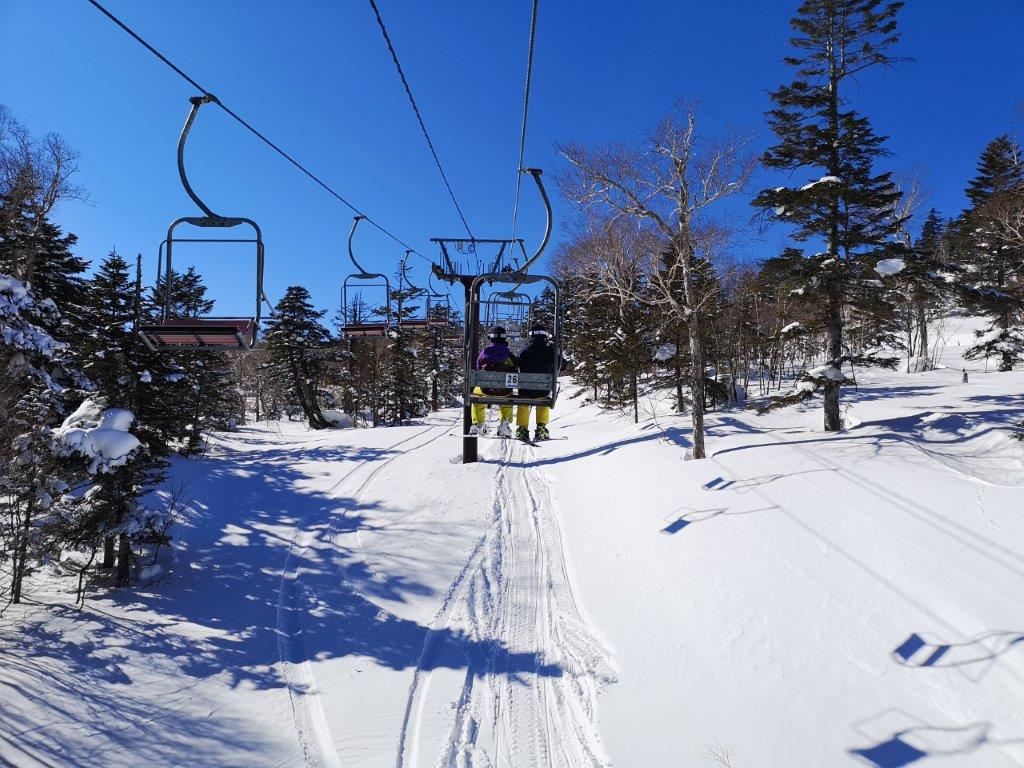
Matching ski wear on a chairlift to Higashi-Tateyama
From there,I had the most impressive view of the day: I could see most of the vast resort, spread over both sides of the valley. Since it was already past 1pm, I thought it would be better to continue to the opposite side (called Ichinose Diamond). Once there, I realised that I couldn’t just take a lift to the top, and then ski diagonally across the mountain; I had to follow the various lifts as they zigzagged across the mountain side. I found that Shiga Kogen was a hard resort to understand (and probably to explain); it made no difference whether I was looking at the map or looking around with my eyes.
In the center back, Mt Myoko
Mt Iwasuge, a mountain I hope to climb this summer
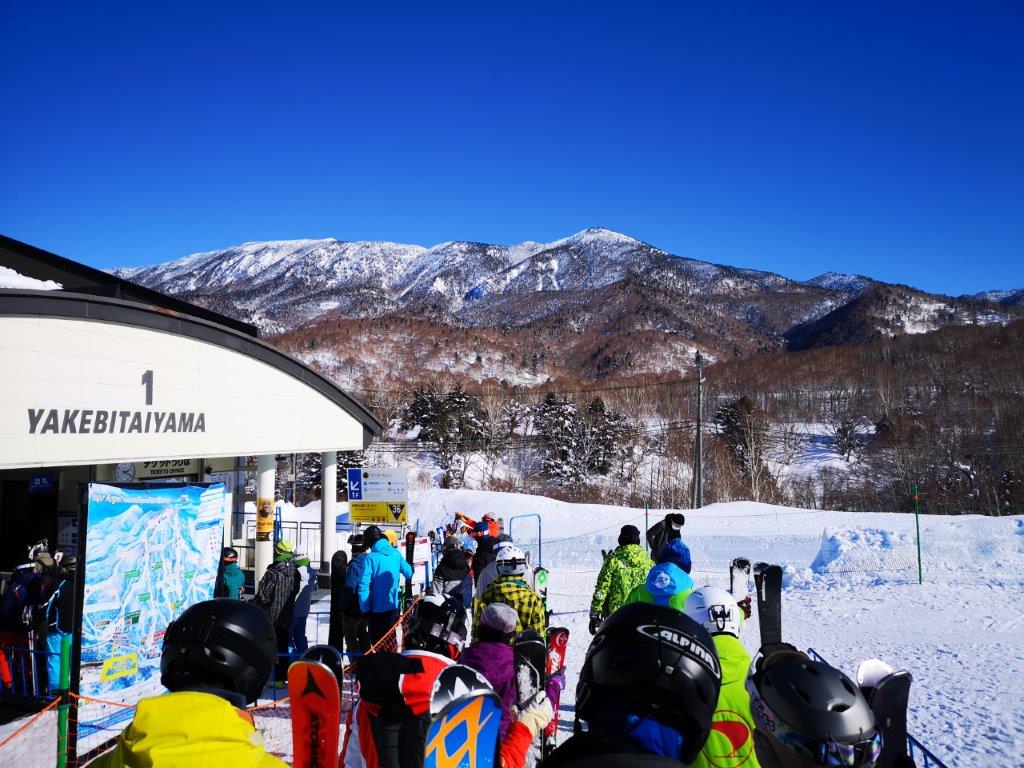
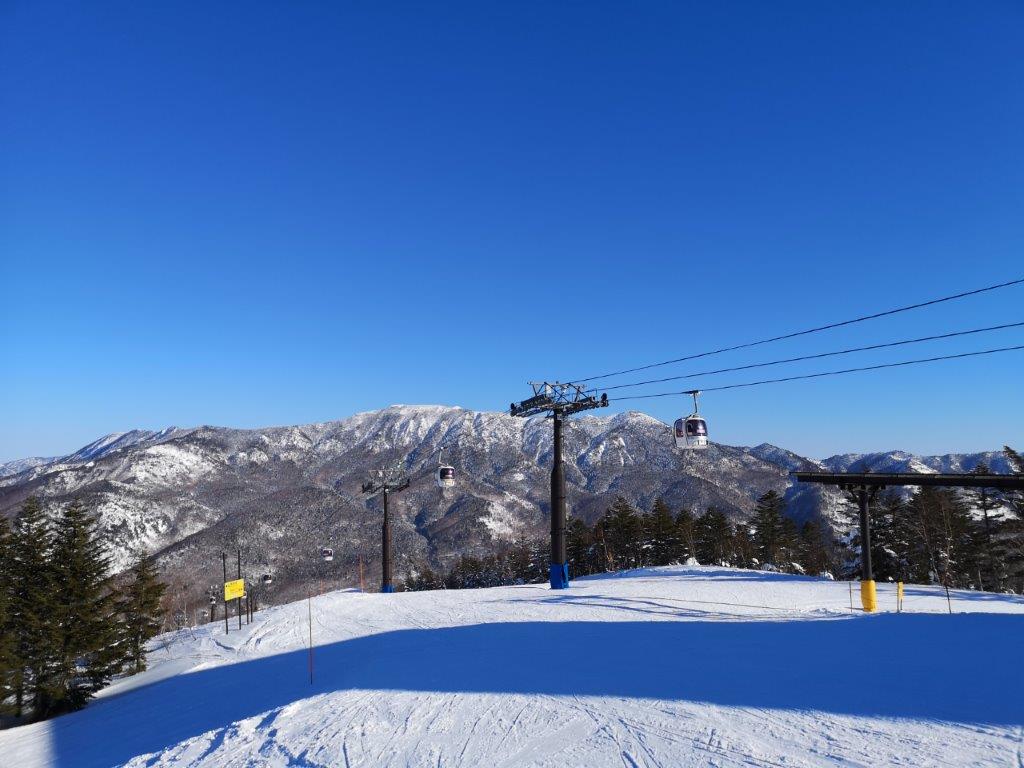
After making one such zig-zag, I reached the top of the Yakebitai area (around 2000m) at the end of a gondola lift. I was now outside the central area, and I was glad I had bought the all area pass. To my right, I could see the Oku-Shiga area, at the northern end of the resort. It was now 2pm – could I continue all the way there, and still make it back to the ski rental shop and bus stop by 4pm? after estimating that it would take at most one hour and a half to get back, I set off, skating at a brisk pace along the short connecting slope between the two areas.
Waiting to get on the gondola in the Yakebitai area
View from the top of the Oku-Shiga Kogen area
I was enjoying the amazing viewsof the mountains of the Joshin-Etsu Kogen National Park from the top of the Oku-Shiga Kogen Gondola, when I realised that it was already past 3pm. I quickly crossed back to the Yakebitai area and immediately skied down the Panorama course, stopping at several viewpoints on the way for some quick photos. Doing the zigzag in reverse, I eventually arrived at the road separating the Ichinose Diamond and Ichinose Family areas, halfway back to my starting point.
Top of the Oku-Shiga gondola
Few people on the slopes on this side of the mountain
This was where things suddenly went horribly wrong. I was unable to find the middle part of my next zigzag and had to ask a ski lift operator for directions. At the top of the lift, I discovered that I had dropped a glove while we were talking, and I had to ski back down to get it. I was starting to seriously fall behind schedule; there seemed to be no end to the zigzags. At 4pm, I was at the top of the Higashi-Tateyama area (2000m), mournfully looking down towards Yama no Eki five hundred meters below, where the last bus back to Nagano station was leaving in less than half an hour.
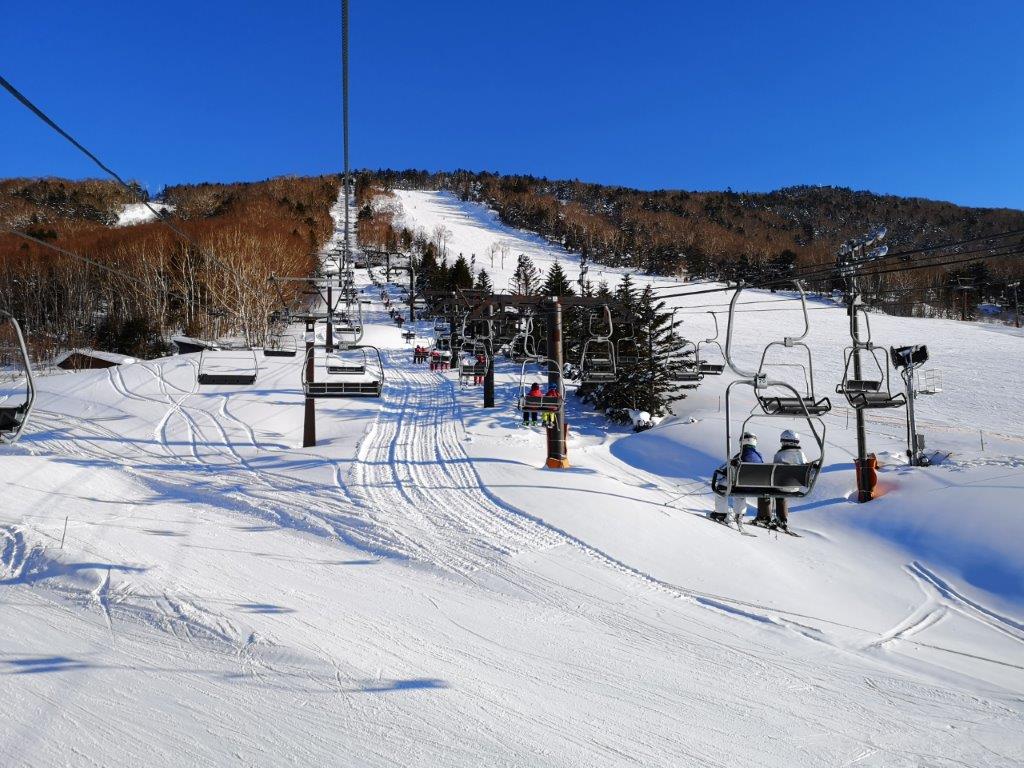
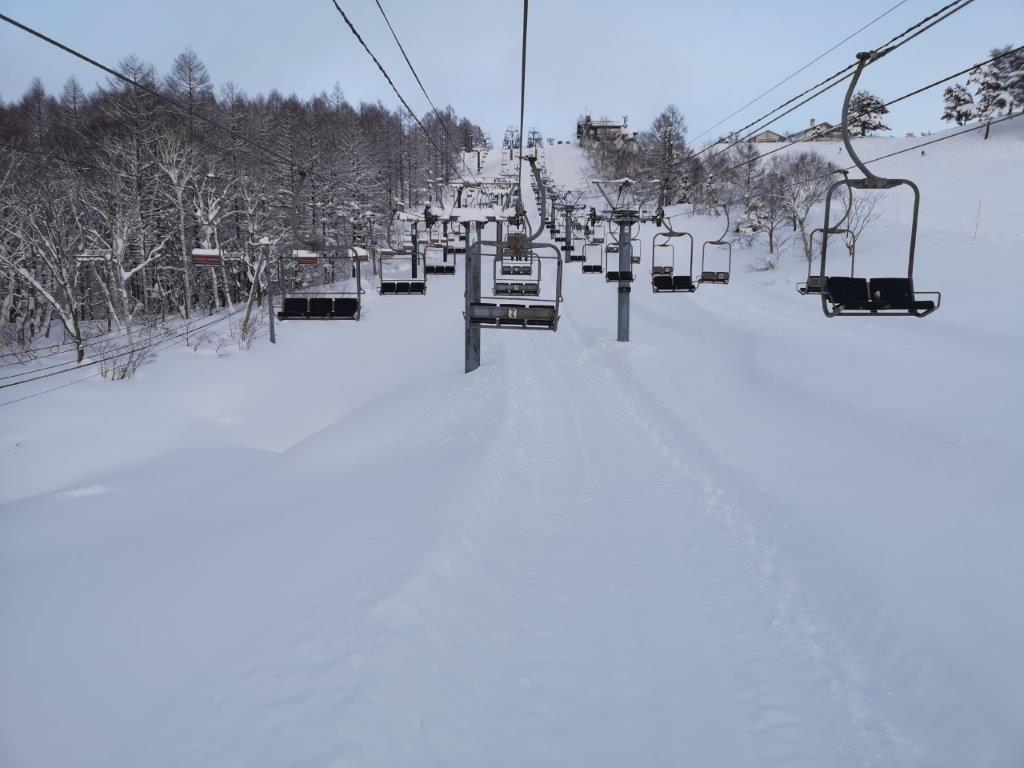
Riding the Ichinose quad lift
The classic Shiga Kogen view
Determined not to give up, I raced down the mountain, following a long winding blue slope. Ironically, this was the longest run of the entire day. I arrived at the final gondola with about 10 minutes to spare, only to see that it was stopped. It was an agonizing wait while it slowly started up again. I arrived at the rental shop with only 5 minutes to spare. I returned my gear in record time, thanks again to to the efficient staff, and collected my belongings from the coin locker at the back. The bus was waiting patiently outside – it was the starting point for the return – so I hopped aboard and settled in for the ride, relieved that I had made it back on time. Less than 2 hours later, I was seated comfortably on the shinkansen for the 90 minute ride back to Tokyo.
Check out the skiing conditions at Shiga Kogen Ski Resort
Over the years, I’ve done relatively little skiing in Japan. The resorts are quite small compared to Europe, and although the snow quality is great, the weather is usually horrible. So I decided to apply the same system I use for hiking: go by shinkansen on one day trips when the weather forecast is favourable. Thanks to the Tokyo Wide Pass, and the JR East Welcome Japan Pass, many resorts in Nagano, Niigata and the Tohoku region became easily accessible. One year ago, I had a great time skiing on Hunter Mountain in Tochigi. This year, I decided to return to a mountain I had climbed a few weeks ago. Getting to the Madarao Kogen Ski Resort seemed fairly straightforward: I would ride the shinkansen to Iiyama station in Nagano, and from there catch a shuttle bus to the resort. The weather forecast wasn’t great, but it wasn’t terrible either; I could even expect a little sunshine in the afternoon. Finally, the ski resort covered two sides of the mountain, so I was hoping that would be enough ski slopes to keep me busy the whole day.
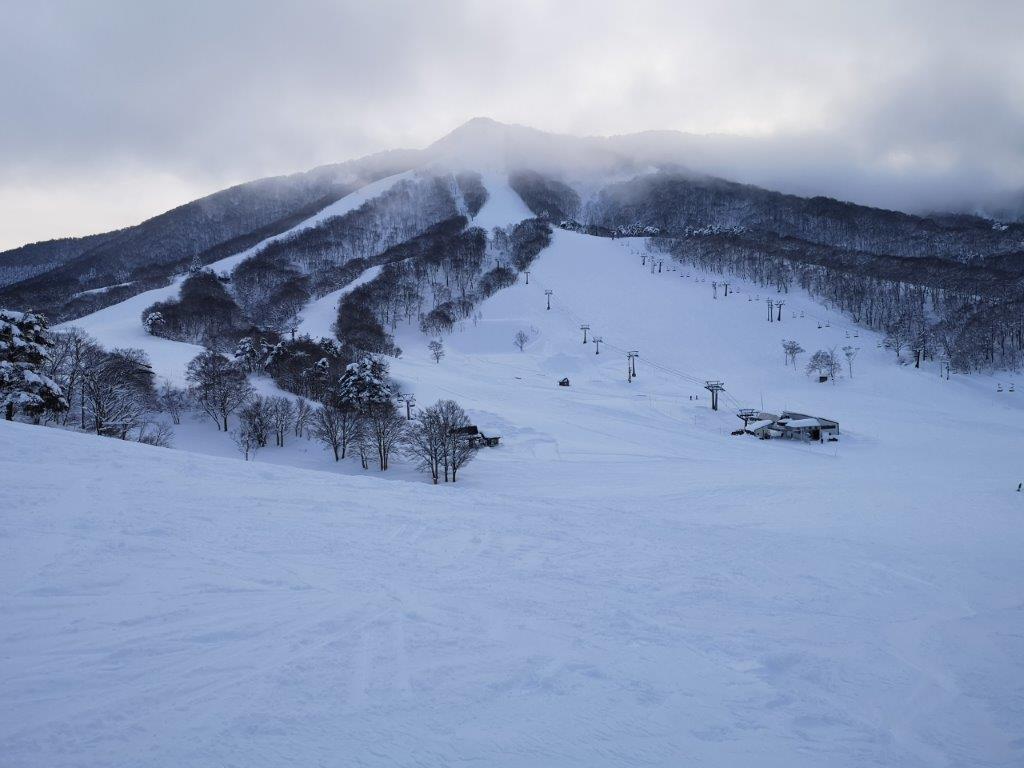
View of the slopes from Madarao Kogen
I left Tokyo under clear blue skies. I had fantastic views of the mountains of northern Kanto, tipped in white. In Nagano, however, I was greeted by snow, mist and clouds. The weather seemed to be improving, but not quite fast enough. At least there seemed to be enough snow for skiing. After getting off at the new and compact Iiyama station (built in 2015), I headed straight for the bus stop. A nice lady came over and redirected me to a ticket vending machine inside the station which I had missed. My ticket bought, I went back to wait for the bus. As the snow flakes floated down before me, I wondered what the conditions were like up on the mountain.
View of Madarao Kogen from the slopes
I was amazed to see how much the landscape had changed in just two months, during the thirty minute bus ride to Madarao Kogen hotel. It was still snowing when I got off the bus, but it wasn’t windy and it didn’t feel too cold. This was good news since there were no gondolas here, only chairlifts. Visibility was good, except for the top of the mountain, hidden in the clouds. I was glad it wasn’t whiteout conditions, and I was optimistic about the weather improving later in the day.
Good conditions for skiinglower down
I wandered into the hotel to get cover from the snow, and stumbled upon their ski rental shop. Originally, I had planned to go to the rental shop next to the ski slopes just a little further away. However, seeing that this shop was deserted, I decided to save some time and get my gear here instead. The staff was helpful and efficient, and I had all my gear in a matter of minutes. They also allowed me to use the hotel’s changing room downstairs. Once I was ready, I headed to the ticket center, next to the Shirakaba restaurant.
Less good conditions for skiing higher up
I decided to buy the Mountain Pass, valid for the Madarao Kogen Ski Resort and Tangram (on the other side of the mountain), since it was only 500 yen more. If I returned it at the end of the day, I could get 500 yen back. At 11am, I was finally ready to start skiing. I put on my skis and skated towards the ski lift, and I was surprised that the slope went down instead of up. I then realised that Shirakaba (and Madarao Kogen Hotel next to it) was on a rise separated from Mt Madarao by a small valley. I had to ski down a short slope to reach the main chairlifts.
In the afternoon, the weather improved
I started with the Superquad lift which took me two thirds up the mountain. It was fast, and had a cover that shielded me from the cold. I used it a couple of times, and found that I preferred the right side slope for going down. Then, I headed to the Tangram side, where I had been hiking last November. I could either ride to the highest point of the the mountain and take a black down. I wasn’t too keen, as the top was still in the mist. Instead, I took lift #15 halfway up, and used a gentler blue (marked green on the maps) through the forest . I remembered walking along it, and it felt funny to be zipping by on skis.
Sunny conditions on the Tangram side
At 1h30, the sun suddenly came out and blue skies appeared overhead. I enjoyed nearly an hour of sunny skiing before the clouds charged back. Even though there were only four chairlifts (Madarao Kogen had 9), only one of them had a bar for resting the skis on. This is a curious thing about Japanese ski chairlifts: they almost never have that bar, so your legs are dangling in the air for the whole ride, which I find uncomfortable and dangerous. At 2h30, I made my way back to Madarao Kogen to have lunch. To avoid skiing a black in whiteout conditions, I used a blue to ski to the base of the resort. Oddly enough, it ended at the parking, and I had to skate a hundred meters over flat terrain to reach the lifts.
Mushroom & bacon Pizza at Aki’s Pub and Cafe
I had an excellent pizza at Aki’s Pub & Cafe. I had to use Google Maps to locate it, since it stood apart from other buildings halfway down the small slope between Shirakaba restaurant and Mt Madarao. At 3h30, I was back on the slopes. The clouds were still in although it wasn’t snowing anymore. I had one hour of skiing left, but it didn’t seem that the sun would return. I chose to stick to the Superquad for my last runs. At 4pm, as I stood at the top of the lift before the final run of the day, the clouds suddenly parted and I had a glorious view of the valley below, including Shiga Kogen opposite.
Great views at the end of the day
I now had the slopes entirely to myself as most people had already finished for the day. I took my time even though the ski patrol was on my heels, stopping here and there to take photos. I returned my rental gear at 4h30 after five hours of satisfactory skiing. I’ve always had problems with ski shoes, but, these ones were quite comfortable. I had a quick hot spring bath inside Madarao Kogen Hotel before catching the 17:20 bus back to Iiyama station, where I hopped on the shinkansen for the under two-hour trip back to Tokyo.
A little unusual – finishing the day going up
Check out the conditions at Madarao Kogen Ski Resort
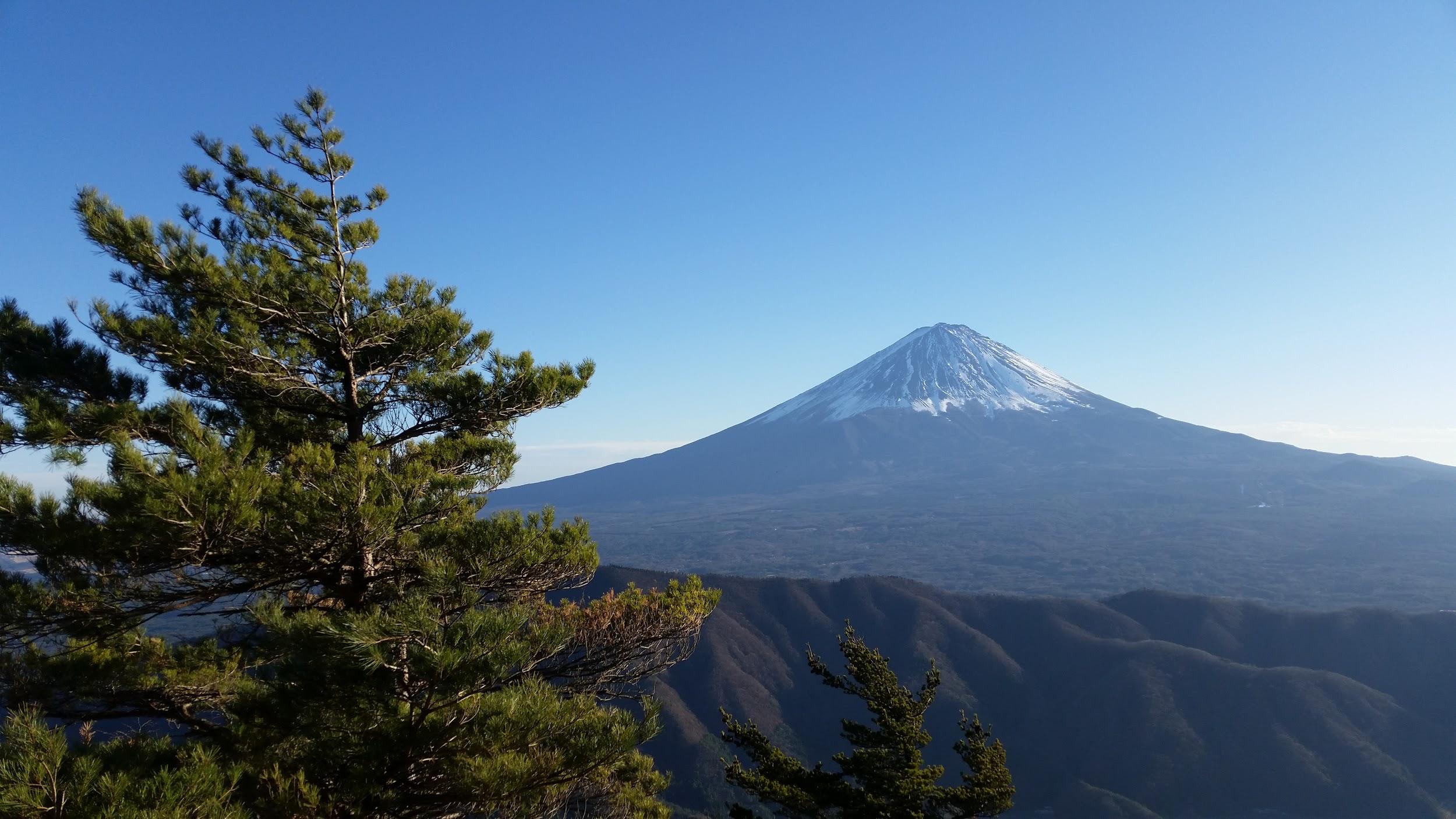
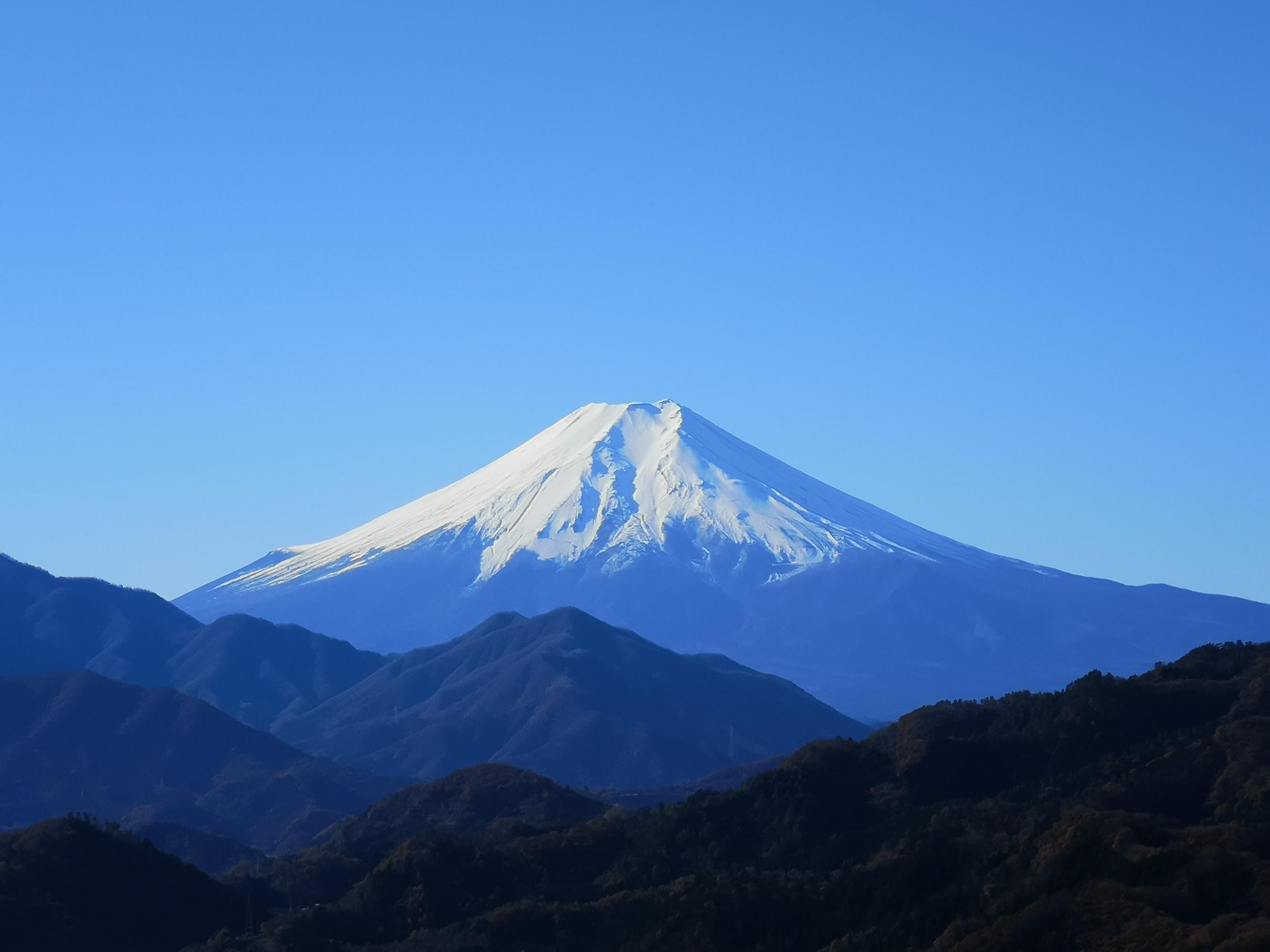
Here are two hikes from a couple of years ago in December that had one thing in common: great views of snow-covered volcanoes, on opposite sides of the Kanto plain, separated by 120 kilometers. One was the famous Mt Fuji, and the other one was the lesser-known, but currently active, Mt Asama.
I had already hiked parts of the Misaka mountains – the mountainous area between Mt Fuji and the Oku-Chichibu mountains (for example Mt Ou to Mt Oni). However, I had never hiked the central part, between Kawaguchi and Saiko lakes. I decided to approach from Ashigawa valley on the North side, and finish at lake Saiko, on the South side. I took the Chuo line to Isawa Onsen station, and then the bus to the farmer’s market in Ashigawa 芦川. I had a very good impression of the place since they offered me free tea while I got ready for my hike!
The Fujikyu bus from Isawa Onsen to Ogossoya (the Ashigawa farmer’s market) was discontinued in 2024. Access is now via car, or by bus from Kawaguchiko Station. However, since 2024, a free shuttle bus runs on weekends between Ogossoya and Suzuran.
Kawaguchiko City surrounded by nature
I started out after 10am, and walked along the road for about 20 minutes to the start of the trail, which then went straight up the side of the mountain, through trees completely bare of leaves. I reached Oishi pass (1515m) 大石峠 around noon. I had been there once before when hiking from Mt Kuro further to the East. This time I turned right and continued Westwards along the ridge.
Kofu valley and beyond the Oku-chichibu mountains
The hiking path went up and down a wide ridge through beautiful evergreen forest. I had occasional views of Mt Fuji to my left, lake Kawaguchi behind me, and the Ashigawa valley to my right. I soon reached the top of Mt Settou 節刀ヶ岳 the third highest mountain along the ridge, after Mt Mitsumine and Mt Oni. From there I could see all the way to the Southern Alps, and the Kofu valley.
Against the sun, looking back towards Minobu
After admiring the view, I started to head down towards Saiko lake. Soon, I had to negotiate a slightly tricky bit involving some rocks and chains. After that, I arrived at the top of Mt Junigadake 十二ヶ岳 which translates simply as “Peak 12”, from where I had some more great views of Mt Fuji ahead of me. I now had two options. The path to the left was an exciting ridge including suspended bridges. Alternatively, I could head straight down to Izumi no Yu, a hot spring on the side of Saiko Lake. Since it was already 3pm, I decided to head down, and leave the exciting ridge for another hike.
Mt Asamakakushi (1757m), Takasaki City, Gunma Prefecture, Saturday December 9, 2017
For this hike, I drove a rental car from Takasaki city to a small parking area near the entrance of the trail to the mountain. Starting from an elevation of 1450m at 11am, the hike to the top took only one hour. Although the top of Mt Asamakakushi 浅間隠し, meaning “Hidden Asama” was similar to that of my previous hike, it was a lot colder, since I was further North.
Yatsugatake in the background
The view of snow covered Asamayama to the West was breathtaking. I could also see the entire Joshin-Estsu mountains forming the Northern edge of the Kanto plain; there are just too many mountains to list here. Southwards, I could make out the Yatsugatake range, Karuizawa and the Oku-Chichibu mountains. Finally the three holy mountains of Gunma – Myohgi, Haruna and Akagi – were all visible in the same panorama.
The Joshin-Estsu mountains
After an hour taking pictures and eating lunch in near freezing temperatures, I made my way down the same way I had come up. Once back to the car, I drove to the onsen at Hamayu Sanso at the base of the mountain. I got there just before 2pm and I was able to warm myself up, before driving back to Takasaki station.
This was a short hike – about 3 hours – I did along the Chuo line. I decided to add it for a couple of reasons. First the views, including Mt Fuji, were amazing. Second, the signs – in Japanese and English – were excellent, and made this an easy-to-follow hike. It had snowed in the area 3 days earlier, but it seemed that crampons wouldn’t be needed.
I took the train to Uenohara station, about an hour from Shinjuku, from where it was another hour of walking to the start of the trail. In reality it takes a bit longer, but I was able to catch a bus midway. The buses in the area are infrequent and hard to figure out so I was lucky to catch one near a bus stop. It’s another ten minutes from the last stop to the start of the trail.
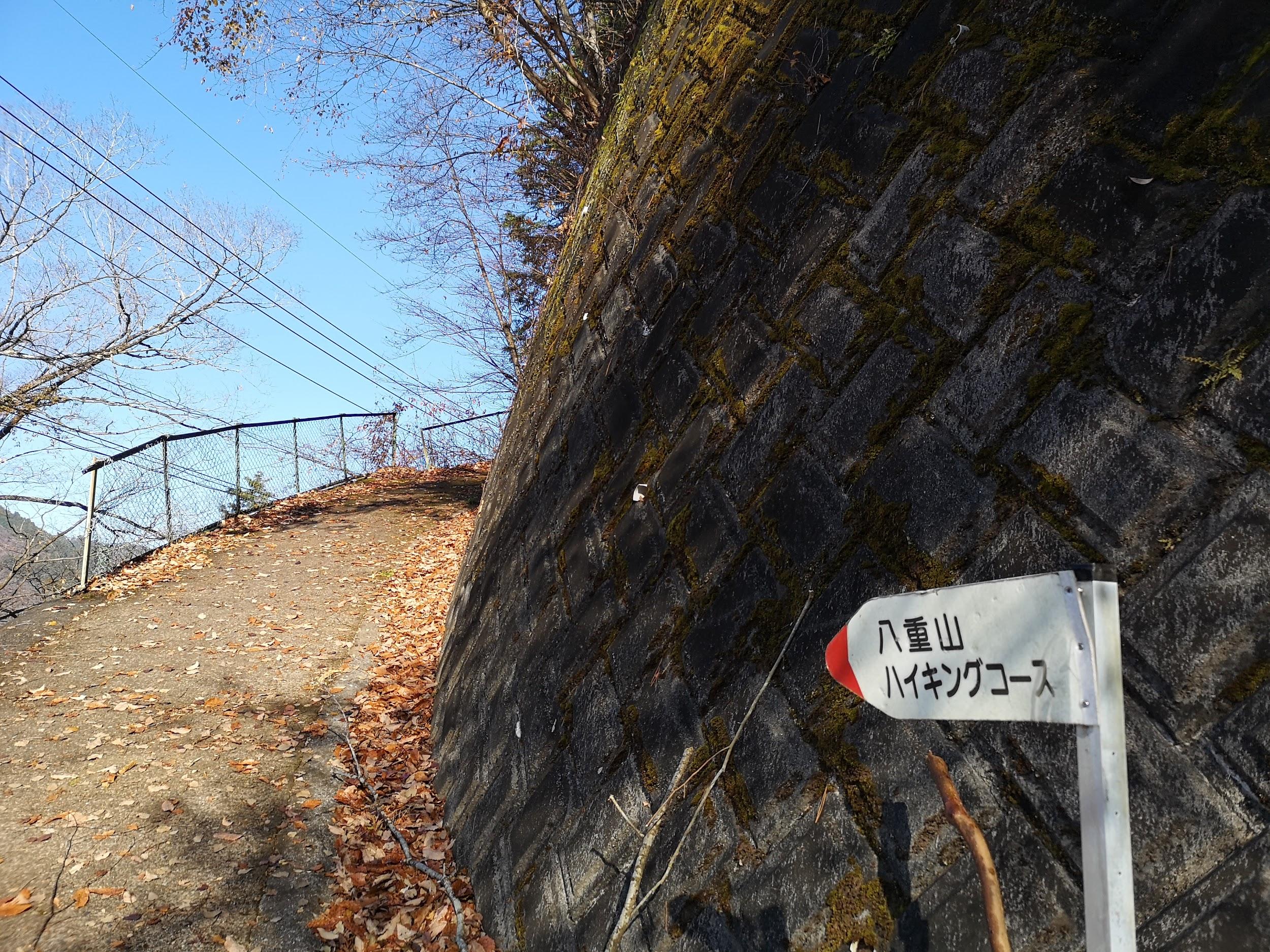
Start of the hiking trail
Beautiful forest just around the corner
I started up the hiking trail just past 10am, and in less than ten minutes, I reached a viewpoint where I could see Mt Fuji. After taking a few pictures, I turned around, and saw that the path was covered in snow! However, I happened to be there at the same time as another hiker on his way down, and he assured me that there wasn’t much snow higher up.
Snow on the trail, but mostly on the North side
The path turned along the side of the mountain, and once it faced southwards, the snow did indeed disappear. It reappeared here and there further on, but it was never an issue. I was soon walking on the summit ridge, and after a couple of ups and downs, I reached the top of Mt Nodake 能岳 before 11am. The view of the Katsura river valley below with Mt Fuji in the background was outstanding.
View from the top of Mt Nodake
Closeup of Mt Fuji
After a quick bite, I set off again. It took me only ten minutes to reach the top of Mt Yaeyama 八重山. There was a small arbour, but the view was somewhat obstructed by trees. I started walking down, and less than ten minutes later I came to another arbour and lookout point. Here, the view was top notch; arguably one of the best in the Tokyo area. From left to right, I could see the Tanzawa mountains, Mt Fuji, Mitsutoge, Mt Ogiyama and Mt Gongen.
View to the West of Mt Ogiyama and Mt Gongen
View from the Mt Yaeyama observatory
I left the viewpoint at 11h30. There are several paths down the mountain, but they all meet up lower down; some were closed due to typhoon damage. Once I reached the base of the mountain, the path followed a stream through the forest. At times, the sunlight filtering through the trees was magical. Very soon, I reached a road, and it took me another 45 minutes to get back to Uenohara station.
Kamakura area is a great place for hiking, especially during the colder months. The trails are easy to walk, the surrounding nature is lush even in winter, and it’s just one hour from Tokyo by train. My previous visit was in February last year, when I hiked the Miura Alps. Since then, typhoon Hagibis had wrecked several of the trails in the area, and I was concerned whether I could complete my hike as planned. Fortunately, the path I had chosen was open from start to finish. On the other hand, the very popular Ten-en hiking trail 天園ハイキングコース, which I had done a few years earlier, was closed due to fallen trees. It’s supposed to reopen in June.
The Ten-en hiking trail is closed…
Since most hiking trails around Kamakura are quite short, I had to cobble together 3 of them to get a full day of hiking (about 6 hours). I arrived at Kamakura station around 10am, and walked to Hokokuji Temple 報国寺. It’s also possible to get there by bus. There is a beautiful bamboo forest inside, but I skipped it since I had been there before and it was getting late. I found the entrance of the hiking trail a few meters further up the street. It was already 11am and I was finally ready to start hiking!
A well-hidden hiking trail…
Almost immediately, I went from a suburban neighbourhood to thick forest – the transition always amazes me. After a short climb, the path became level for a while, before reaching a park bordering a suburban community on the border between Zushi and Kamakura cities. Even though it was a Saturday, the park was nearly deserted, probably due to the overcast weather, despite the sunny forecast.
Surrounded by nature only ten minutes from the start of the trail
The hiking trail resumed at the end of the park. After some up-and-down over a couple of minor peaks, I reached the top of Mt Kinubari 衣張山 just before noon. It’s a low mountain, but since it’s right next to the ocean, the view was quite spectacular. I could see the Miura Peninsula stretching away to the South, and Kamakura City opposite Sagami Bay to the West.
Miura Peninsula near the top of Mt Kinubari
Shortly after, a group of a about a dozens hikers arrived. They were on some kind of guided tour – I had encountered the same thing when hiking the Miura Alps. It seems like guided hikes are quite popular in the Kamakura / Zushi area. I finished my early lunch and took off quickly. The trail heading down was short and enjoyable, but there were many fallen trees lower down. It’s not often that I see multiple fallen trees blocking the trail…in succession. Hopefully the trail will get cleared up in the future.
Evidence of the destructive power of typhoons on the way down
The trail soon ended a short way from my starting point of Hokokuji Temple. From there, I walked along roads to the start of a minor trail leading to the Ten-en hiking trail, which I would cross but not follow. Kamakura is pleasant and laid-back, and thus a nice city to stroll through – there are plenty of sights to check out. On the way, I decided I had enough time to pay a short visit to Sugimoto-dera Temple. According to the sign at the entrance, it was founded in the 8th century and is the oldest temple in Kamakura. It was a quick visit (costs 200 yen) but I was able to get some nice views and pictures. After that, I walked past Kamakura-gu shrine, turned left at Tsugen Bridge, then continued past Yofukuji ruins without visiting either since it was getting late. After 1pm, I was hiking on a trail and surrounded by nature again. It’s possible to skip Mt Kinubari and walk directly from Kamakura station (about 30 min)
View from the highest reaches of Sugimoto temple
First, the path followed a dramatic narrow gorge along a small stream, then climbed through some nice forest that still had some red and orange. Some steps brought me to the highest point: the intersection with the now-closed Ten-en hiking trail. It was 1h30, and I could hear many people talking and having lunch at the rest area just above, so I skipped it and continued in the direction of Kanazawa-Hakkei station 金沢八景 (not the final destination), through a short but beautiful bamboo forest. The trail was mostly level and thus easy to walk. It’s probably one of the flattest hikes I’ve ever done in the Kanto area. There was a fallen tree here and there, but it wasn’t too troublesome to get around. I was amazed that there were so few people hiking this great trail, but then it was a cold cloudy winter day.
Some minor obstacles on the way…
…but mostly easy hiking
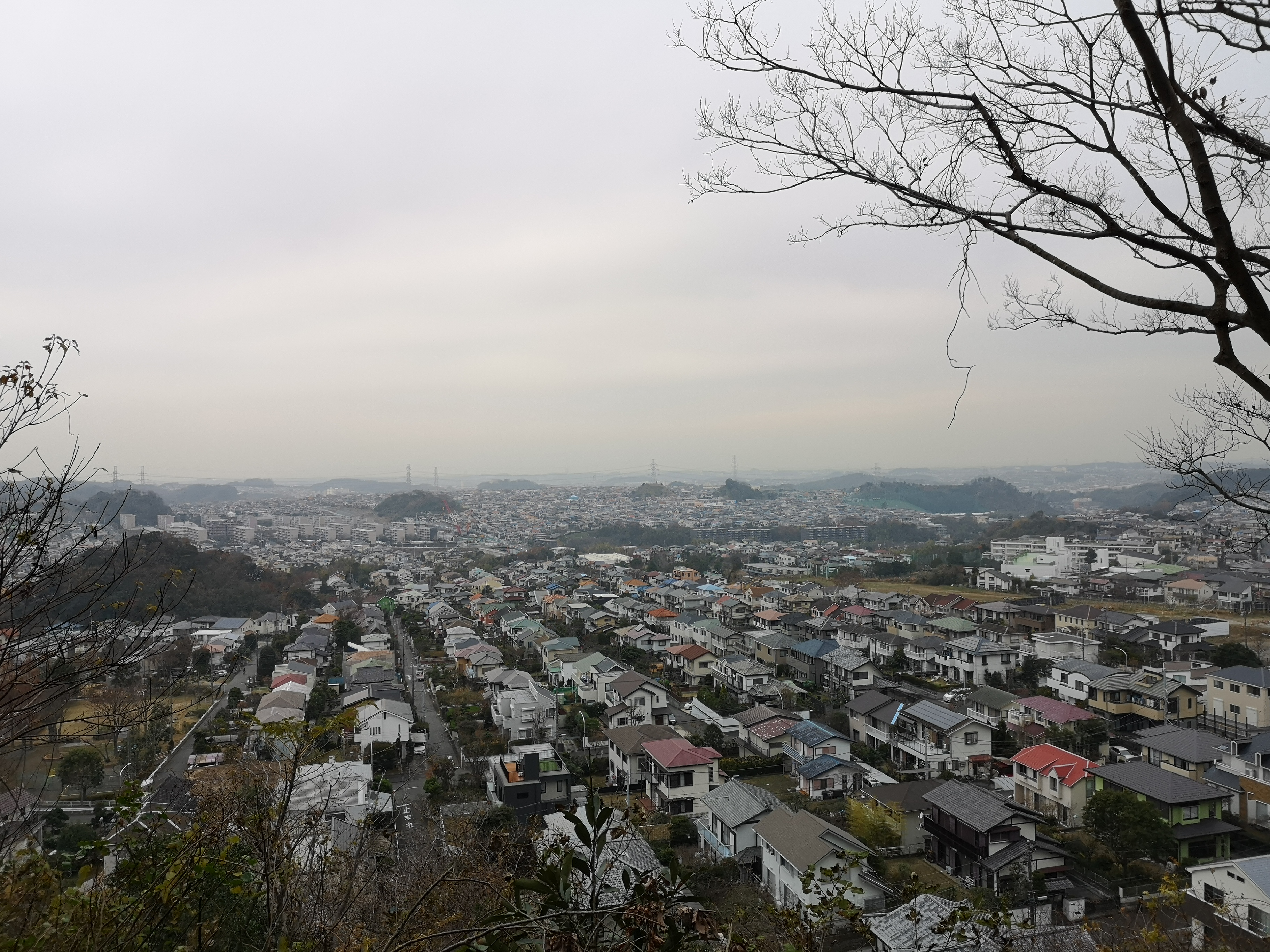
The path was now running alongside and above a huge cemetery. Later on, it passed above another suburban community. I could get occasional glimpses of both through the trees. On a clear sunny day I suppose you could see all the way to Yokohama city to the North. There were good information boards (with English) along the way, showing the extent of the local hiking trails: they connect several community woods, a nature sanctuary, and even a small zoo. There is also a pond in the middle of the forest, but trails leading to it were currently closed due to typhoon damage. I will certainly return in the future to hike more in the area since it’s so close to Tokyo. I couldn’t decide what was more amazing: that the city had penetrated nature so deeply, or whether nature had survived the invasion of the city.
Hiking a narrow green ridge…
…at the edge of the city
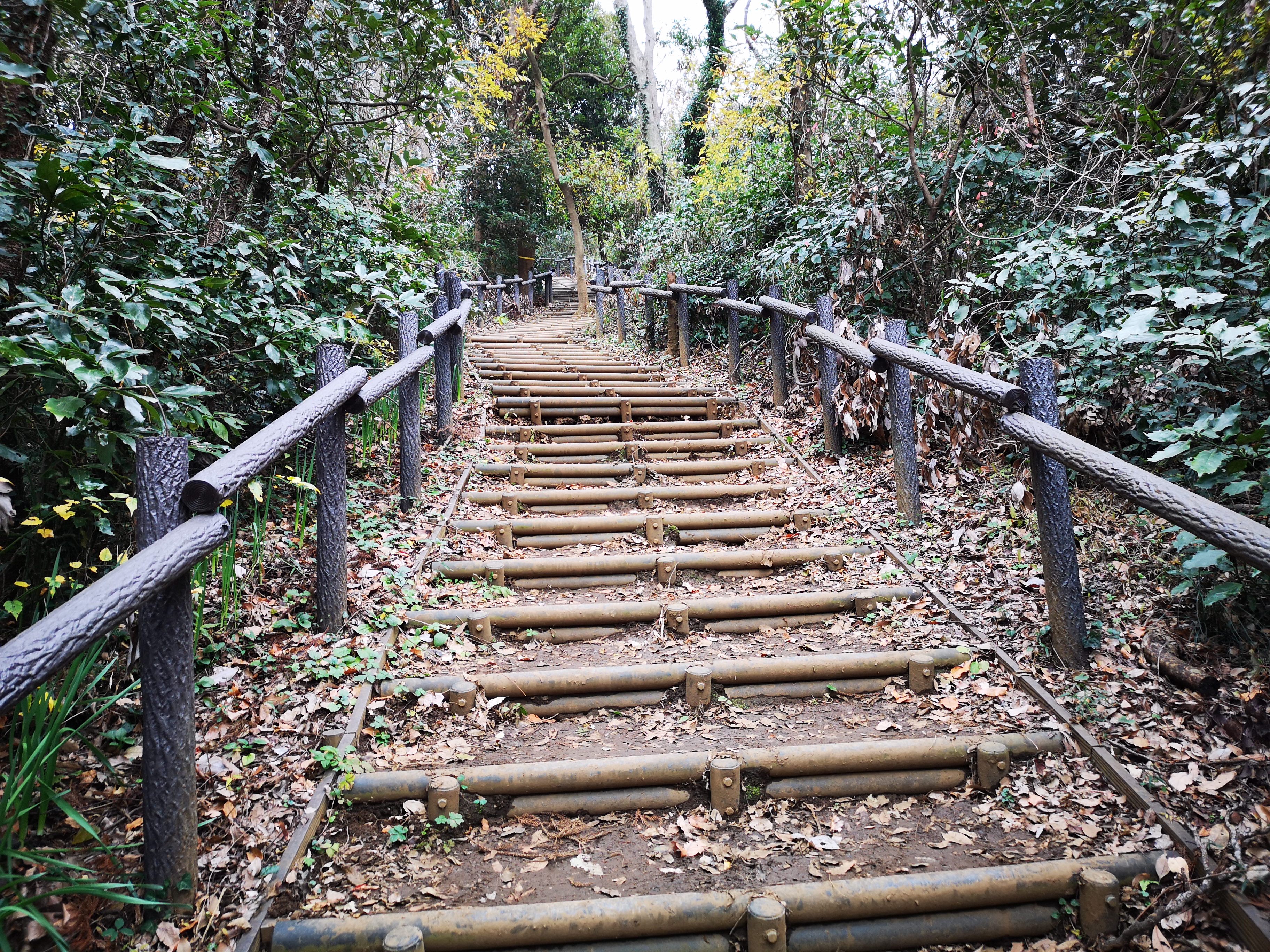
I was now following the signs for Kanazawa Bunko 金沢文庫 (not the final destination either). At 2h30, I reached the Sekiyaoku viewpoint 関谷奥見晴台. There were some benches but not much of a view on this grey day. I had the rest of my lunch and moved on. At last, I was following signs for Konandai station 港南台, the end point of my hike. A little before 3pm, I reached the turn-off for a long staircase leading to the top of Mt Omaru 大丸山, the highest point of Yokohama city. There was a view to the South of Tokyo Bay and the Eastern end of the Miura Alps.
Staircase to the top – one of the few climbs on the hike
I was starting to feel cold and since the sun was showing no sign of appearing, I didn’t linger. It took me another hour to reach Isshindo Plaza いっしんどう広場, a wide area where several trails intersect. Apparently you can see Mt Fuji from the West side in good weather. However the hiking trail wasn’t finished yet. It took me another fifteen minutes along a dirt trail through the countryside to get back to the busy city roads. There were some good views of the hills of Kamakura to the East. I finally reached Konandai station on the Negishi line station around 4h30, a short train ride from Yokohama and central Tokyo.
I had been to Shikoku twice, but I had never walked its famous pilgrimage trail, nor visited any of the 88 temples along the way. In January, I went on a short trip to Kamiyama. Since the Shikoku Pilgrimage went through this town, I decided to hike one section of it. Although mostly on the coast, a few sections went inland. Looking at the map, I could see that the Kamiyama section was the deepest inland the trail ever went; so deep that I wouldn’t be able to see the ocean. I knew that more than half ofthe pilgrimage was on paved roads. However, the section between temples 11 and 12, just before Kamiyama, followed a hiking trail through forestedmountains. The walking distance between them was about 13 kilometers, perfect for a one-day hike.
My enthusiasm wasn’t dampened after reading that this was one of the toughest parts of the pilgrimage due to its many ups and downs. Apparently, a lot of pilgrims give up on this section, known as “henro-korogashi”, an ominous phrase meaning “knocking down pilgrims”. However, since my purpose was to hike, I was looking forward to breaking a sweat on the trail, especially since I would be able to relax at the Kamiyama hot spring afterwards. I was concerned about the weather, since it was supposed to rain during my visit. However, on the day of my hike,the forecast was cloudy with some sun in the morning. I had brought all my waterproof gear, and although I didn’t mind a punishing trail, I preferred doing it in dry conditions. I kept my fingers crossed that the forecast would be accurate.
Hiking the Shikoku Pilgrimage Trail 四国遍路
Blue skies at the start of the hike
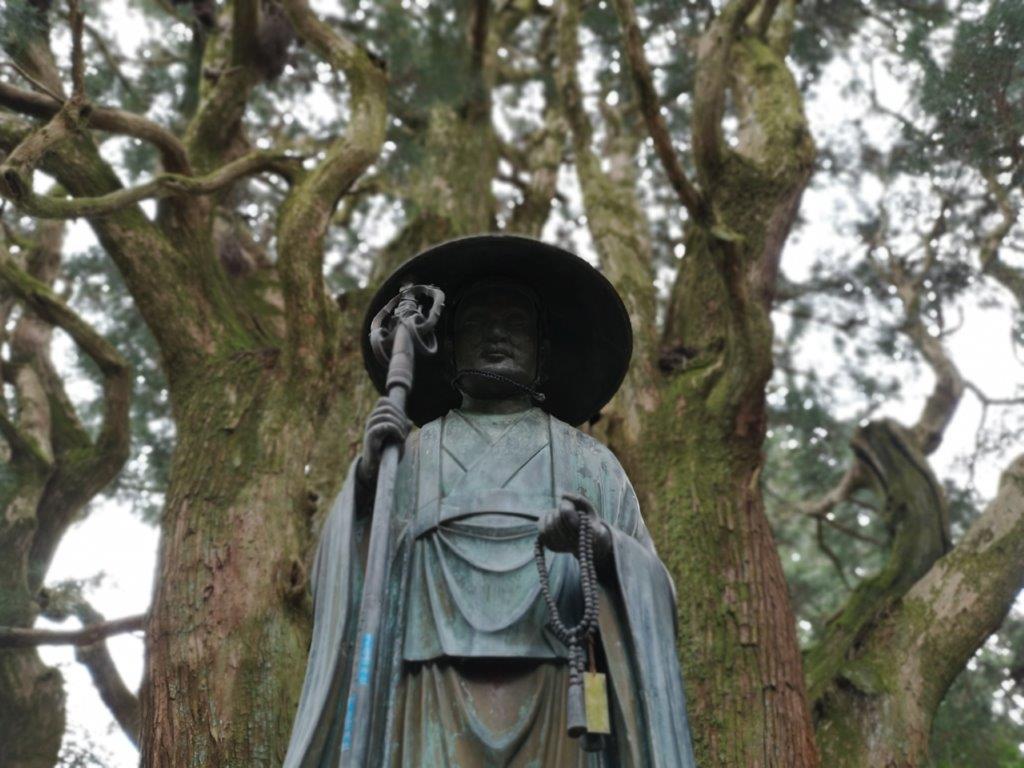
Since it was my first time to hike the Shikoku pilgrimage, I decided to do some reading beforehand. I learned that it connected places visited by Kobo Daishi (774–835), the founder of Shingon Buddhism. The pilgrimage itself only became popular during the Edo era, 1000 years later. Nowadays, the Shikoku Pilgrimage, or “Shikoku Henro” (“henro” is the Japanese word for pilgrim) is 1200 km long, passes by 88 temples, and takes one to two months to complete on foot. Although he’s one of the most famous historical figures from Shikoku, I had never heard of Kobo Daishi, also known as Kukai in his lifetime, but I had heard of the temple town of Koya-san, which he founded in 819.Some people believe he’s still alive on Mt Koya, in a state of meditative consciousness awaiting the appearance of the future Buddha. He also is said to have invented the Hiragana and Katakana writing systems, two things I am very familiar with.
Statue of Kobo Daishi between temples 11 and 12
It’s important to note that it’s not necessary to be a Buddhist to appreciate the trail. It’s also a way to find yourself, and immerse yourself in nature. Pilgrims usually wear a pilgrim’s outfit consisting of a conical hat, white vest, and a wooden staff. Anyone walking the trail is free to dress this way, the same way one wears a yukata or a jimbe to a fireworks festival. However, I felt more comfortable in my hiking clothes, including a cap, backpack and sturdy hiking boots.
Statue of a pilgrim dressed in his pilgrim outfit
I had an acquaintance living in Kamiyama Town, and after telling him that I planned to hike the Shikoku Pilgrimage between temples 11 and 12, he offered to pick me up at Tokushima station, and drop me off at temple 11, officially known as Fujii-dera Temple (藤井寺) . I gladly accepted his offer, since the temple was nearly one hour on foot from Kamojima station (about 30 minutes by train from Tokushima station). I wasn’t afraid of some extra walking, but I wanted to save my energy for the trials ahead. At 9h30, we reached the small parking area below the temple and above a wide valley. At the entrance gate was an illustrated signboard showing the different landmarks along the trail, before and after Fujii-dera.It included distances and walking times, of great interest to pilgrims (and hikers).Since I hadn’t been able to get my hands on a paper map, I studied it religiously.
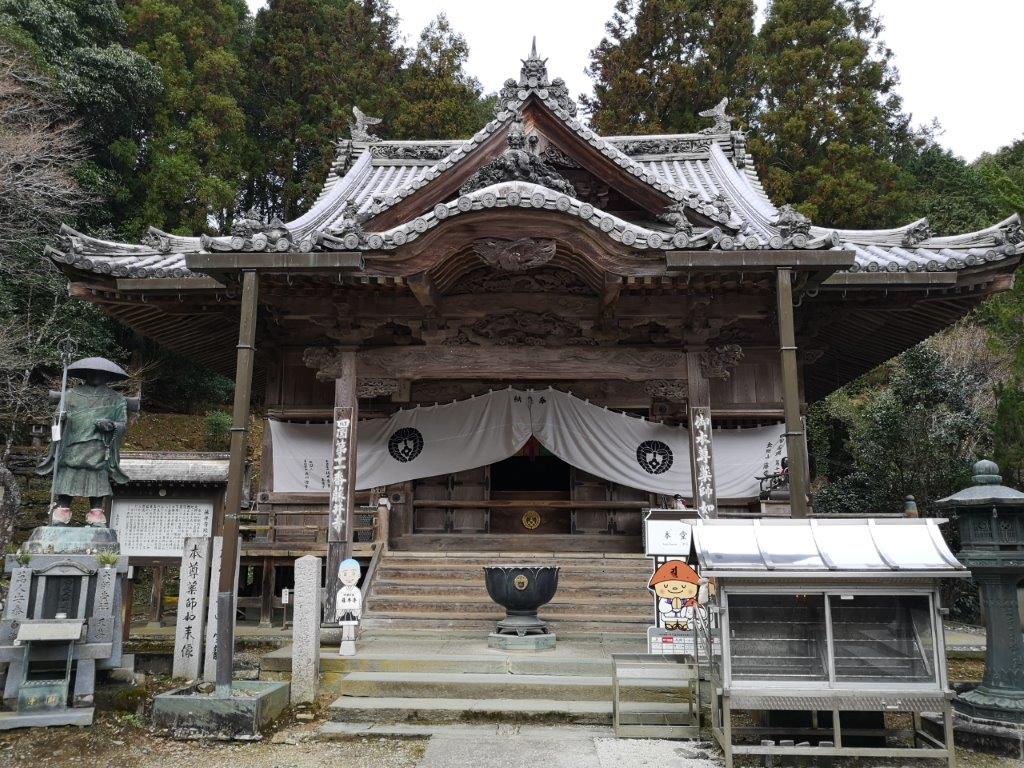
The main hall of Fujii-dera, built in 1860
The temple’s name includes the character for the Wisteria flower, and beautiful blue Wisteria can be seen inside the temple grounds every year in May. Unfortunately there weren’t any colours in the middle of January. It is said that it was founded by Kobo Daishi in the ninth century. It was converted into a Zen temple during the Edo period, and is one of the three Zen temples along the pilgrimage (the other 85 remained Shingon). As is often the case, the wooden buildings burned down several times throughout history, and the present ones date from the 19th century. However, a statue carved by Kobo Daishi survived each time, and is said to offer protection from disaster. Behind the temple were 88 small statues representing the 88 temples along the pilgrimage (I was in a hurry to immerse myself in nature, so I missed it).
Great views along the first part
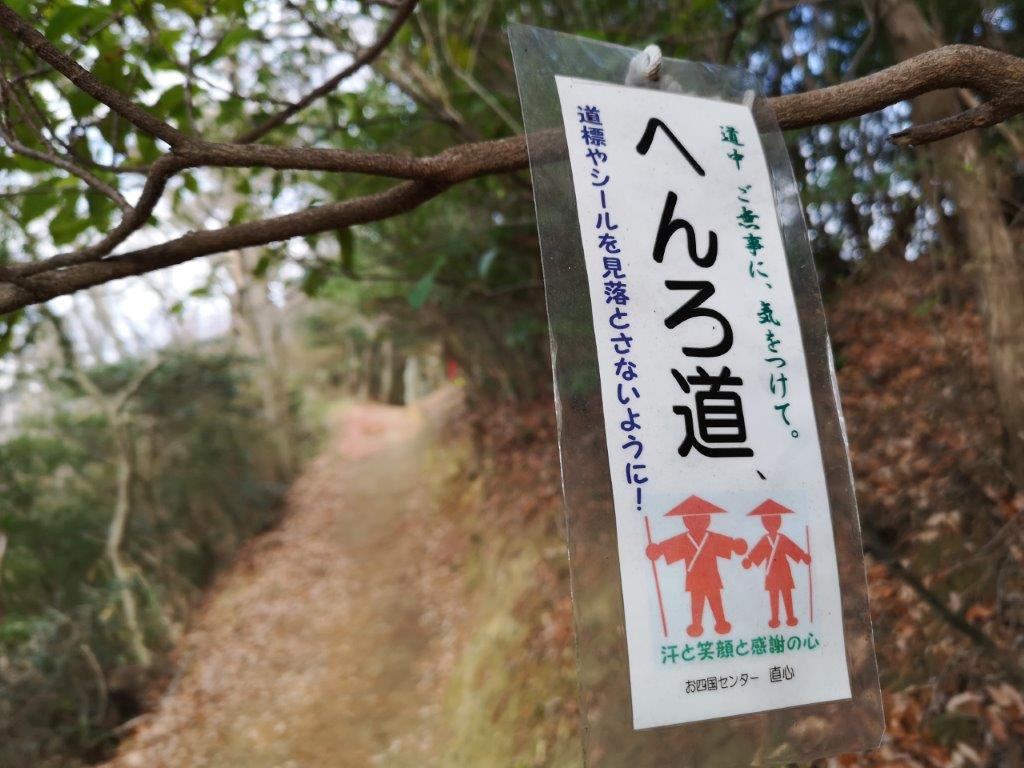
From the start, the path climbed steadily, slowly winding up the mountain side. Close to the temple,there were many reminders of the spiritual aspect of this journey: statuettes and mini-shrines could be seen on both sides of the path. The stone railing on the left was covered in green spongy moss. Small signs saying “henro-michi” (へんろ道) meaning “pilgrimage trail”, were periodically attached to tree branches, preventing all but the most absent-minded of pilgrims from straying from the path.
Helpful signs showing the way
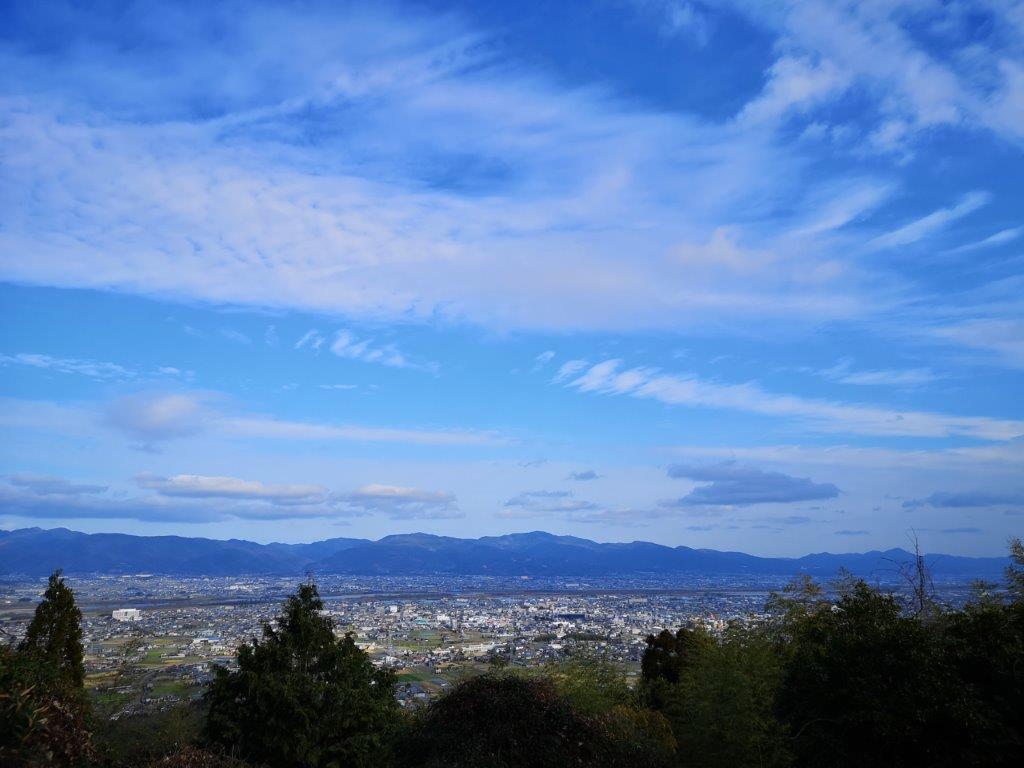
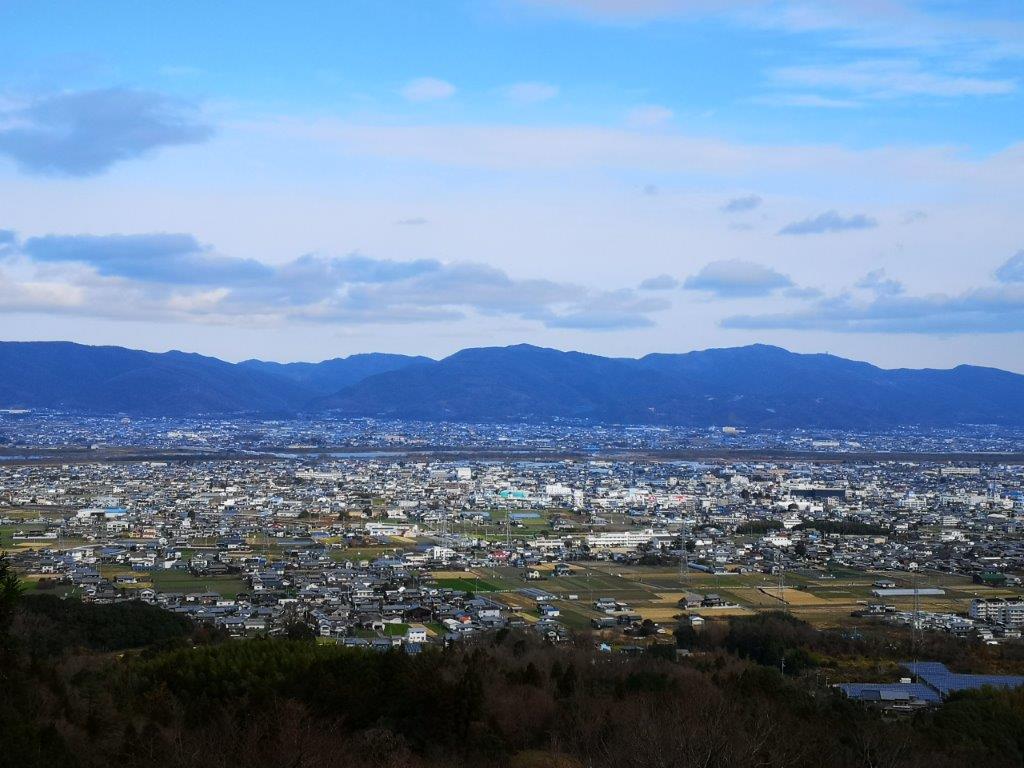
At exactly 10 o’clock, I reached the first viewpoint after crossing a small road. I could see the valley created by the Yoshino River, the second largest river in Shikoku (194 km), and one of the 3 great rivers of Japan. Beyond was a range of low mountains stretching East to West across Tokushima Prefecture. It seemed like an excellent spot for a late breakfast. A man in full pilgrim attire walked by. His pace was so slow that I thought I could easily overtake him later on, but I never saw him again, as if he had vanished into thin air.
Great view of the Yoshino river basin
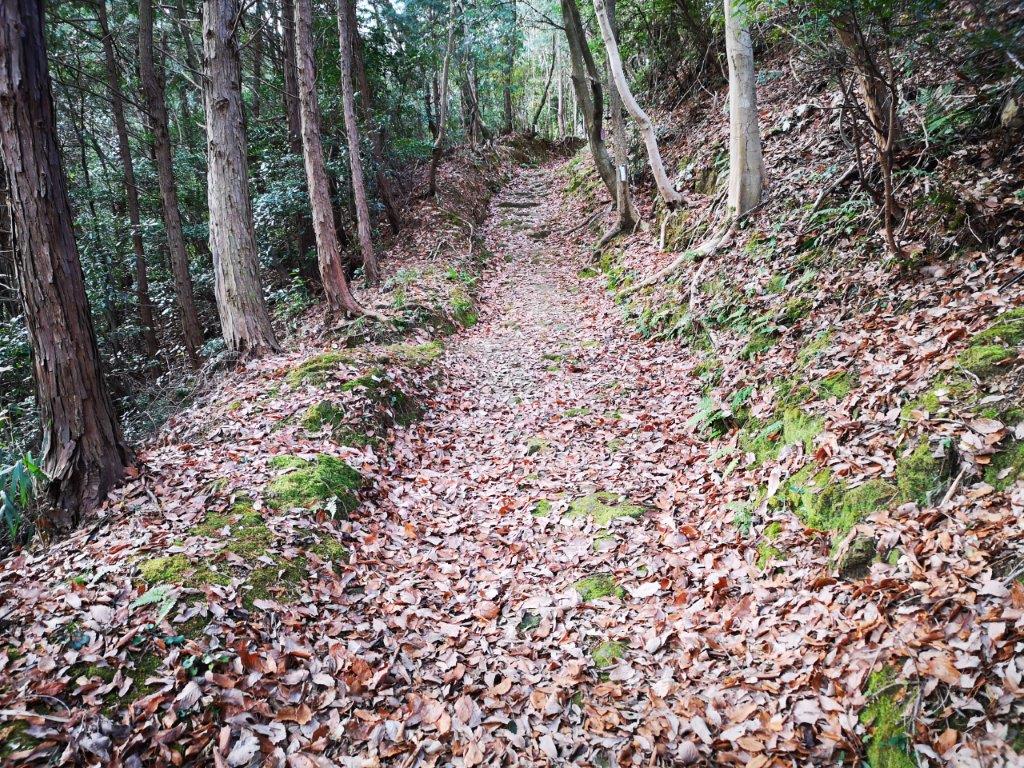
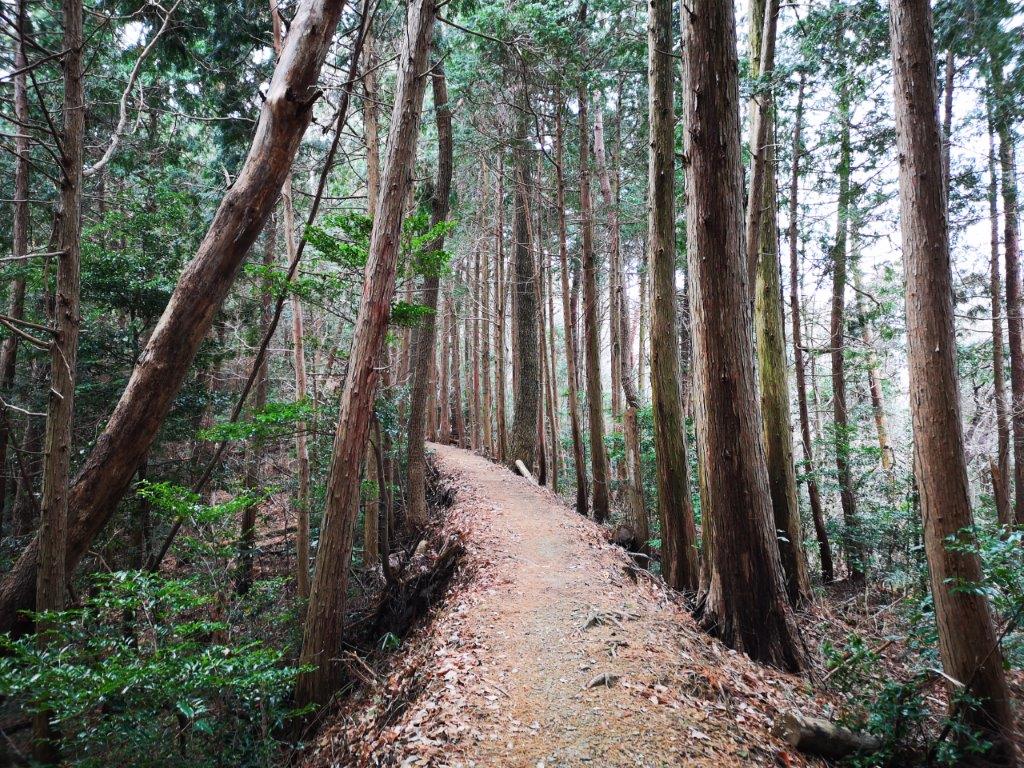
After setting off again, I soon reached a rest spot with another view and a small sheltered sitting area. Looking up, I could see large patches of blue sky, but the sun was still lurking behind the clouds. Here and there, attached to tree branches, were short Buddhist sayings. I didn’t stop to decipher them but I imagined that they were meant to encourage the weary traveler. The trail was covered in a layer of dead leaves, andalternated steep and gently sloped sections. This year’s winter was relatively mild throughout Japan, and so I felt lucky not to have any snow on the trail.
A typical section of the hike
I eventually reached a pleasant flat section. Initially I thought I had reached the pass, but I was only moving around the side of the mountain into the fold of a deep valley. Around this time, the sun finally came out. I had seen no one else apart from the phantom pilgrim from earlier. The noises from the valley below had become muffled. This was probably the most enjoyable section of the hike, and the tough ups and downs that lay ahead were, for now, completely forgotten.
A pleasant stroll in the sun
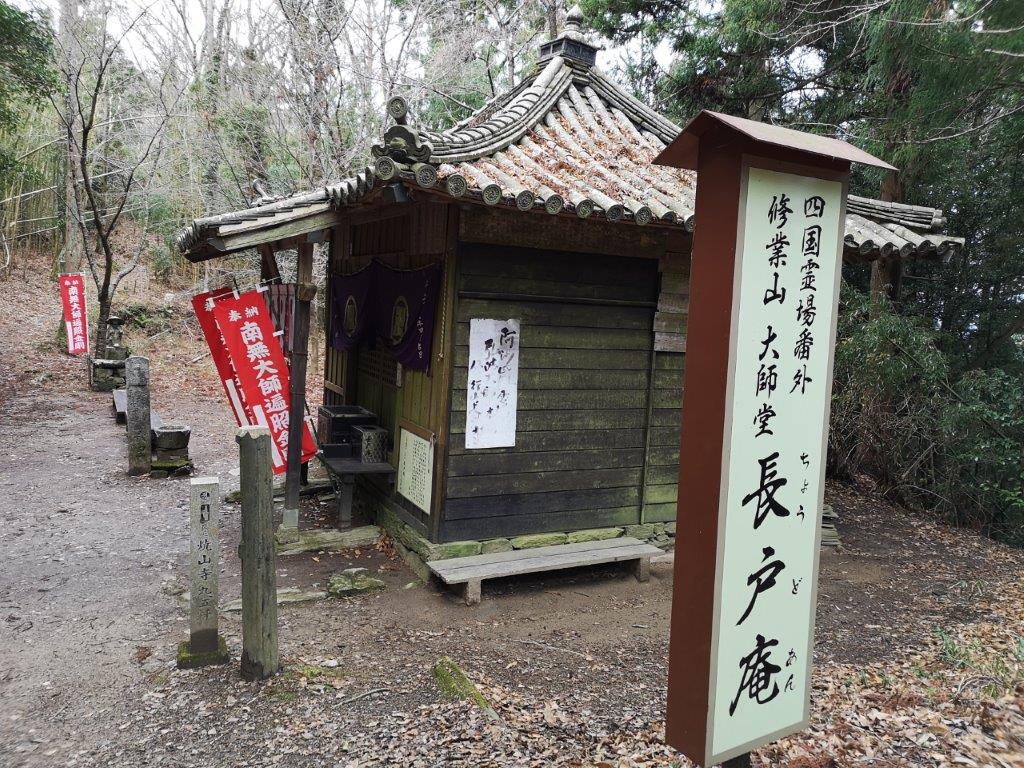
At the end of the valley the path started to climb steeply again.A few minutes later, I reached Chodo-an (長戸庵), a tiny Buddhist temple surrounded by trees at the top of the ridge. It was just past 11 o’clock and I was 3.2 km from Fujii-dera. According to the legend, Kobo Daishi was taking a break here, when an old man came by with pain in his leg. Kobo Daishi healed the pain by chanting a Buddhist mantra. Afterwards, the old man built the temple as a token of thanks. The characters in the temple’s name stand for “long” and “entrance”, and it’s said that the name refers to a place to take a break and recover. However, I wasn’t feeling tired yet, so I decided to push on.
Chodo-an, a tiny temple at the first stop on the trail
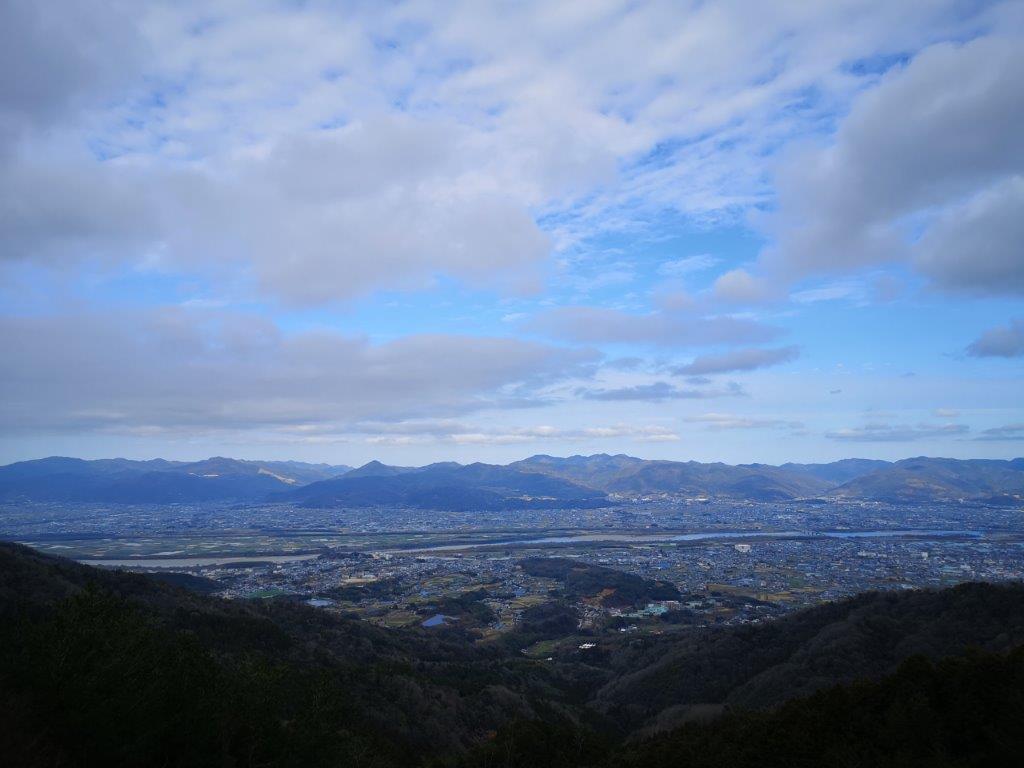
The path now followed a mostly flat forested ridge, with some short up and down sections. There were occasional glimpses of the mountains on the Kamiyama side. The sun had retreated behind the clouds; it felt cold, and a bit lonely. I suddenly emerged from the trees, and had an outstanding view of the Yoshino river valley. A sheltered bench beckoned me to sit down for an early lunch, but I wasn’t hungry yet. The path turned south, away from the Yoshino valley, and towards the Kamiyama area, and I soon re-entered the forest. There were frequent signs, including the distance and walking time to the next small temple on the way. I never had to wonder where I was, and the lack of a map didn’t seem to be adisadvantage after all.
View from just after Chodo-an, from an altitude of 500m
After reaching an elevation of 600 meters, the path descended quickly, and I soon arrived at another, larger, Buddhist temple called Ryusui-an (柳水庵), 6.6km from my starting point. The first two characters meant “willow” and “water”. When Kobo Daishi arrived here, he wanted to drink some water but there was none. So he used a mantra on a willow branch, which led him to an underground spring. Nowadays, the spring is called “yanagi no mizu”, meaning the willow’s water. I had my own supply of water, so I had a good long drink from my water bottle and moved on.
Trail just before the descent to Ryusui-an
I finally came across another person as I was walking past the temple buildings. I asked him if he was hiking the trail, or maybe a monk looking after the temple. He replied that he was doing some sightseeing, and pointed at his car, parked on a road behind. I had arrived at the first of the escape routes along the trail. I had been walking for two hours and a half, and was halfway to temple 12. There was a small rest house a few minutes away on a bend on the road, but I still wasn’t tired or hungry, so I crossed the road and continued along what was now a wide forest road.
Interesting statuette seen along the trail
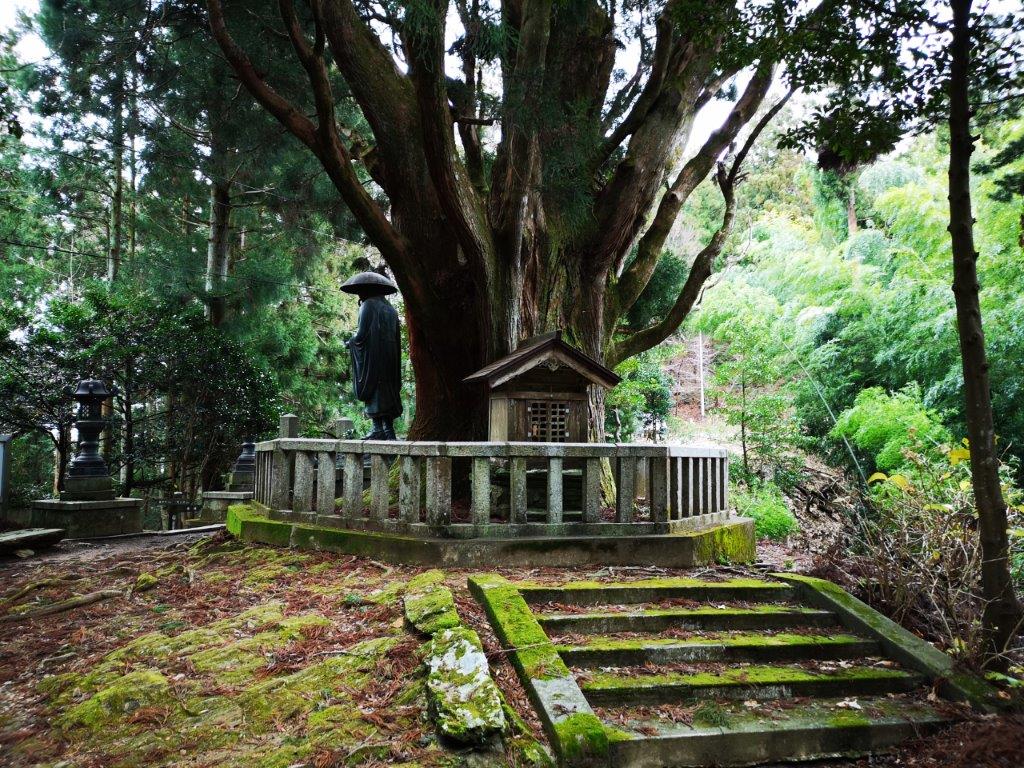
From this point, I saw fewer signposts and religious symbols along the way. The forest road went straight through the forest, and it soon joined up with another forest road. While I was trying to figure out whether I had to go left or right, I noticed that the hiking path had reappeared on the other side, marked by a small sign. I started to climb up the side of the mountain through a dark forest of tall cedar trees. Above, I could see some rocky cliffs, and I was hoping the path wouldn’t take me there. Just after 1pm, I reached a staircase at the top of which was a statue of Kobo Daishi.
The statue of Kobo Daishi at the top of the staircase
I was amazed to see a massive thirty-meter high cedar tree, called “Souchi-no-ipponsugi” (左右内の一本杉) or “ipponsugi” for short. Although at the base it was just one tree, it quickly formed several trunks that spread out in all directions, and could be better appreciated by walking past and seeing it from the other side. At 745 meters, this was the highest point of the section between temples 11 and 12. There was a bench, so I finally sat down for a quick lunch. According to the legend, Kobo Daishi took a nap using the roots of the tree as a pillow, and as he slept he saw the Buddha in his dreams. Although I felt tired from the steep climb, it was really cold, so I thought it would be better to skip the post-lunch nap, and hurry along my way.
The many branches of Ipponsugi
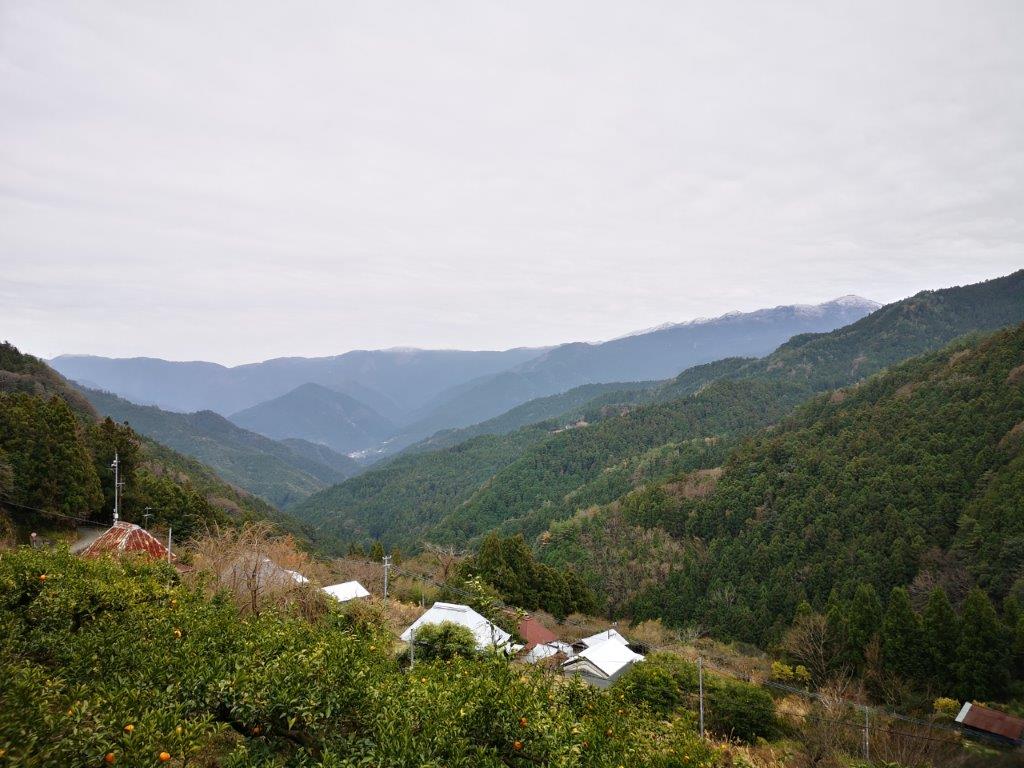
The path down was less steep than on the way up, so I started to run down. I wasn’t behind schedule, but it was an excellent way to warm myself up. I soon popped out of the forest into a cultivated area near a small village. There was a wide view of a valley to the north, at the end of which was Kamiyama Town. However, before I could get there, I needed to climb one more mountain.
In the distance, my final destination, Kamiyama
I noticed a house with a pointed metallic roof, like a pyramid, just outside the pyramid. Afterwards, I found out that it was a protective aluminium cover and underneath was a thatched roof, also known as “kayabuki”. In the past the roof was uncovered and exposed to the elements, but as the number of roof-thatchers dwindled, it became very difficult and expensive to repair these types of roofs, so these metal tops were introduced.
A short detour through a village
I was now walking along a road, but I picked up the hiking trail again shortly after crossing bridge over a rushing river. The final climb took me from the bottom of the valley up to a temple on the side of Mt Shosan. At 700m, it was the second highest temple on the Shikoku Pilgrimage. The path was steep and a bit rocky at times. At 3pm I reached the temple parking lot, where I was rewarded with a good view, looking back across the valley at the ridge with the spreading cedar tree.
Final approach to Shosan-ji Temple
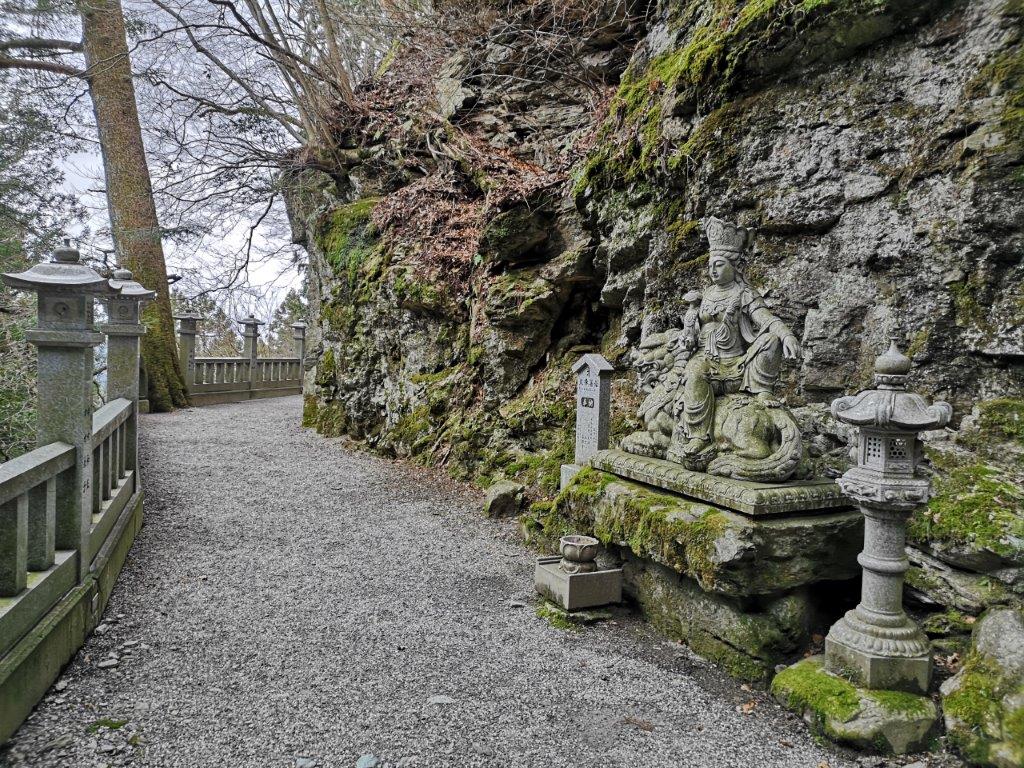
I walked another ten minutes along a wide flat gravel path round the side of the mountain to reach the main temple area, at the top of a staircase and past the entrance gate. I observed many interesting-looking statues along the way and within Shosan-ji, but my limited knowledge of Buddhism meant that I couldn’t really appreciate their significance. Within the temple grounds, there were many tall cedar trees; apparently, some of them were over 500 years old.
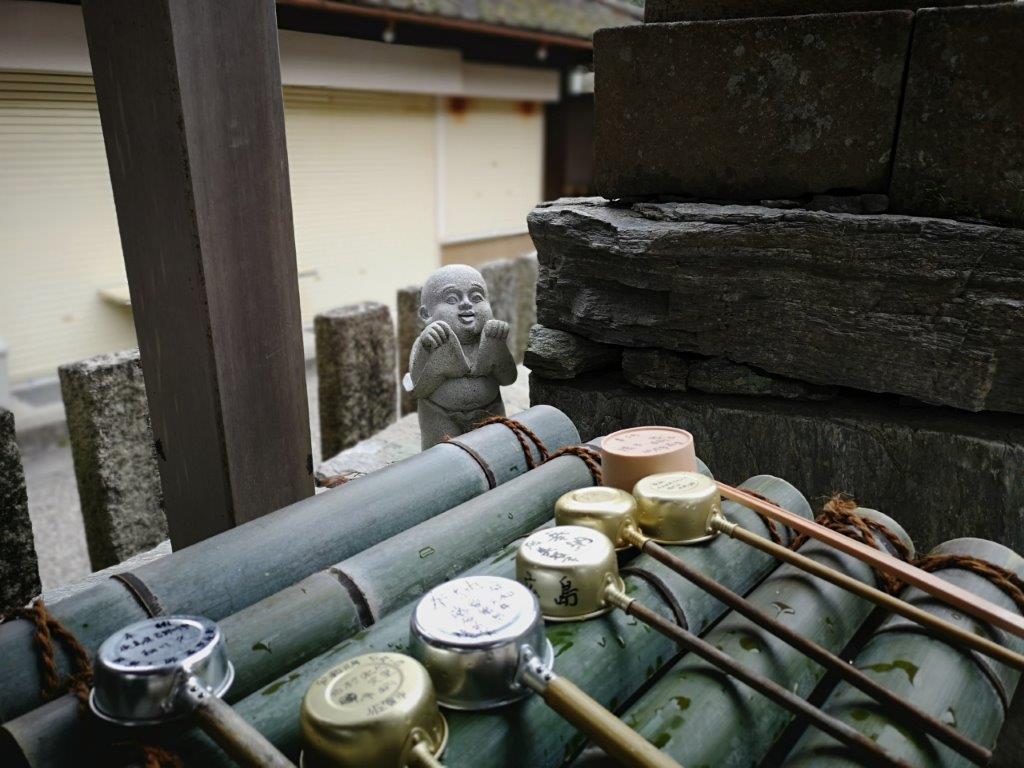
Mischievous child behind the purification basin
Shosan Temple was founded over a thousand years ago, and its name can be translated as “Burnt Mountain”. According to the legend, a dragon used to live there occasionally setting the mountain on fire, till Kobo Daishi came along and imprisoned it in a cave. I found out afterwards that there was a trail leading to this cave, which then continued to the top of the mountain (938m). Since I completely missed it, I have a burning desire to return and complete this part of the hike.
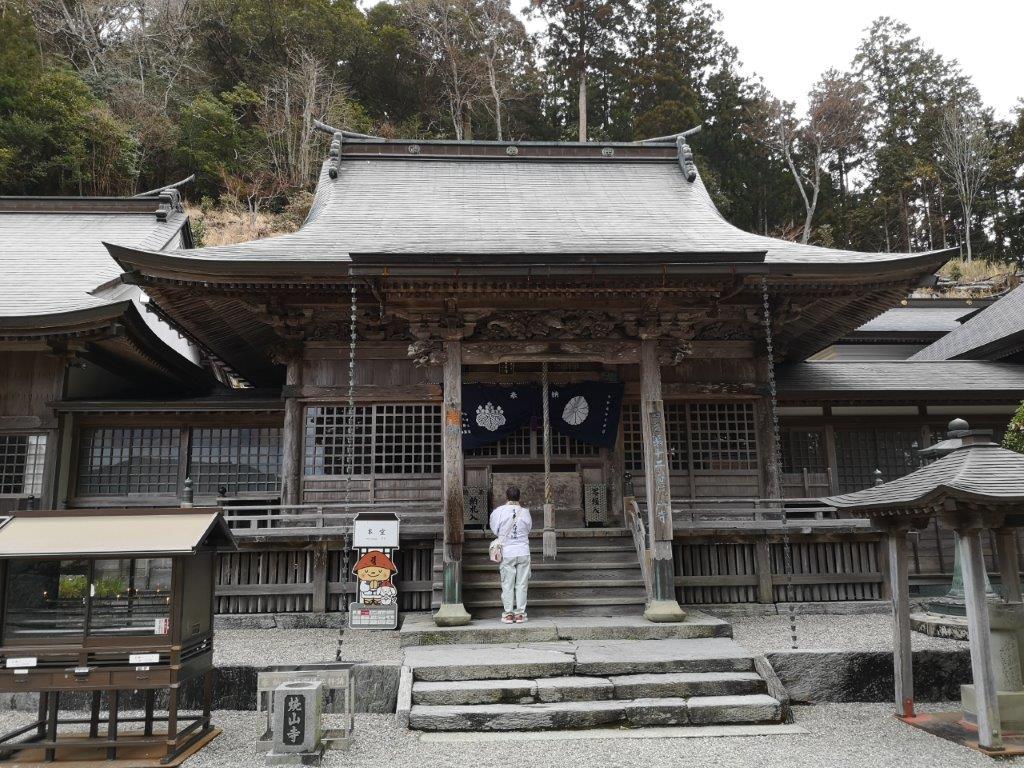
The main temple building at Shosan-ji
Since it was still early afternoon, I decided to walk down, adding a couple of kilometers to the hike. The main road descended through a series of switchbacks, but the trail went straight, and cut across it several times. Just before 4pm, I reached the small Buddhist temple of Joshin-an (杖杉庵). The legend associated with this place is more heart-wrenching than the previous ones. Emon Saburo was once the richest man in Shikoku. One day, he chased a pilgrim away from his house. Unbeknownst to him, the pilgrim was Kobo Daishi. After Emon’s eight sons all fell sick and died, he realised his terrible mistake. He walked the Shikoku pilgrimage 20 times looking for Kobo Daishi to ask for forgiveness. In the end he collapsed with exhaustion. However, he was visited by Kobo Daishi before he died and was forgiven. The statue next to the temple shows this last scene, and onecan’t help but feel a bit moved after knowing the story.
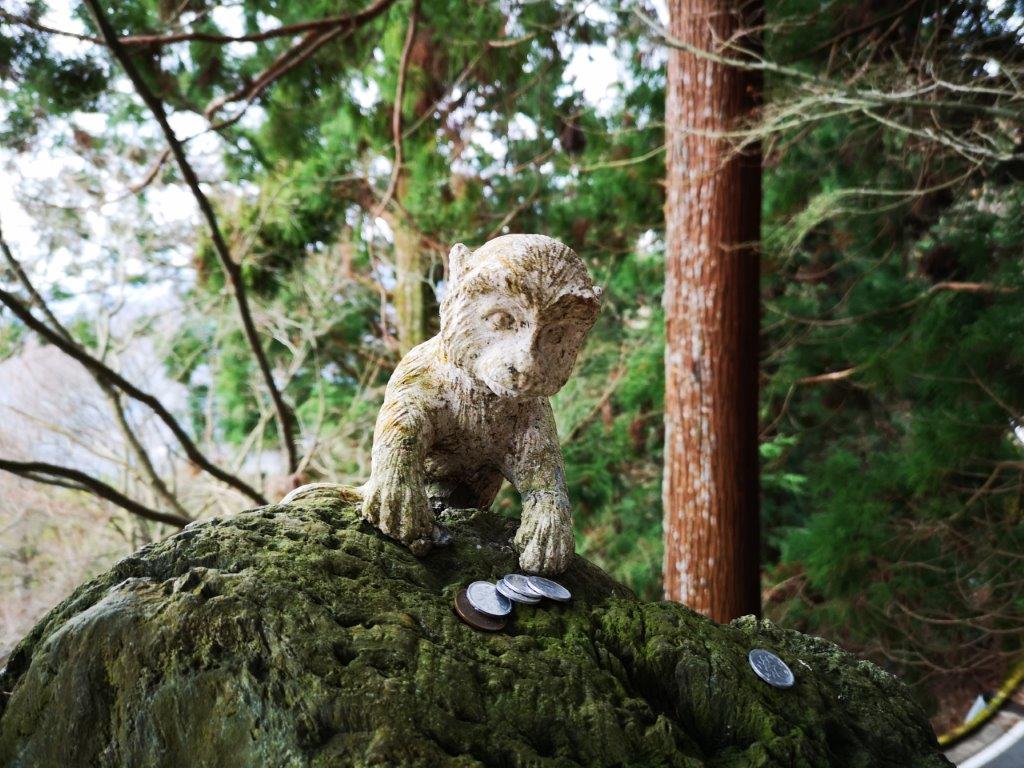
Cheeky monkey stealing offerings
This last temple on my pilgrimage hike was also my rendez-vous point with myKamiyama acquaintance, and he turned up with his car just a few minutes later. I was looking forward to getting to my hotel at Kamiyama Onsen and enjoying a relaxing hot spring bath, to wash away the weariness of the pilgrim’s trail. The path hadn’t knocked me down but my muscles felt knocked about!
My last visit to this part of Tochigi was in December 2018. I was concerned about snow on the hiking trails in mid-December, so I chose a low mountain close to Kanuma station. The whole area has many mountains with lots of hiking trails, and so far I’ve only scratched the surface.
A hidden valley encircled by mountains
A short bus ride (the same one for Furumine Shrine) took me to the entrance of Choanji Temple 長安寺 a little before 9am. The start of the trail, to the right of the temple, had been washed away by typhoon Hagibis. Fortunately, wands with pink ribbons had been placed through the wreckage of fallen trees, allowing me to make my way to an undamaged forest road above, leading to a good view of the valley below.
It’s a scramble but the path is still climbable
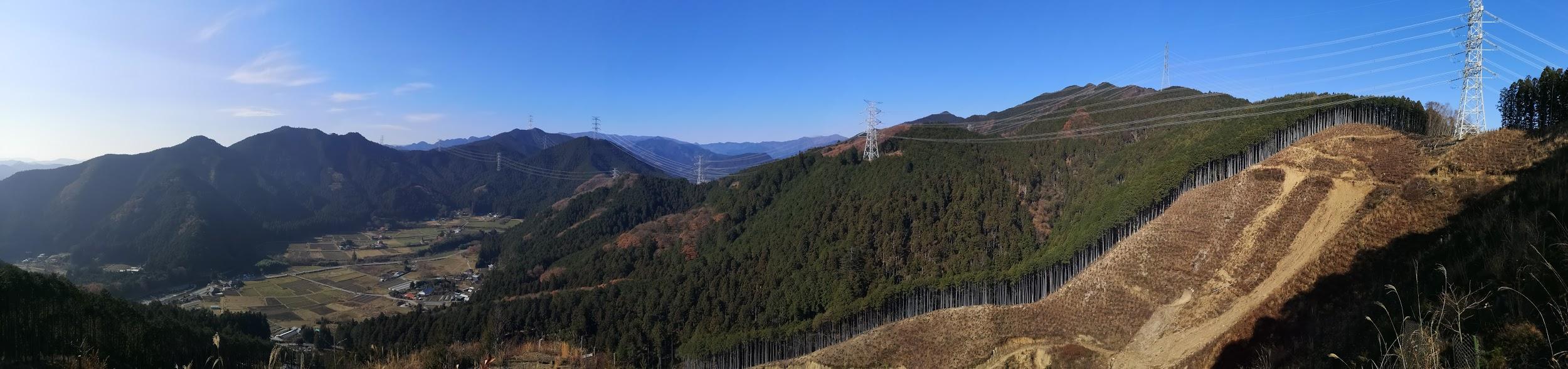
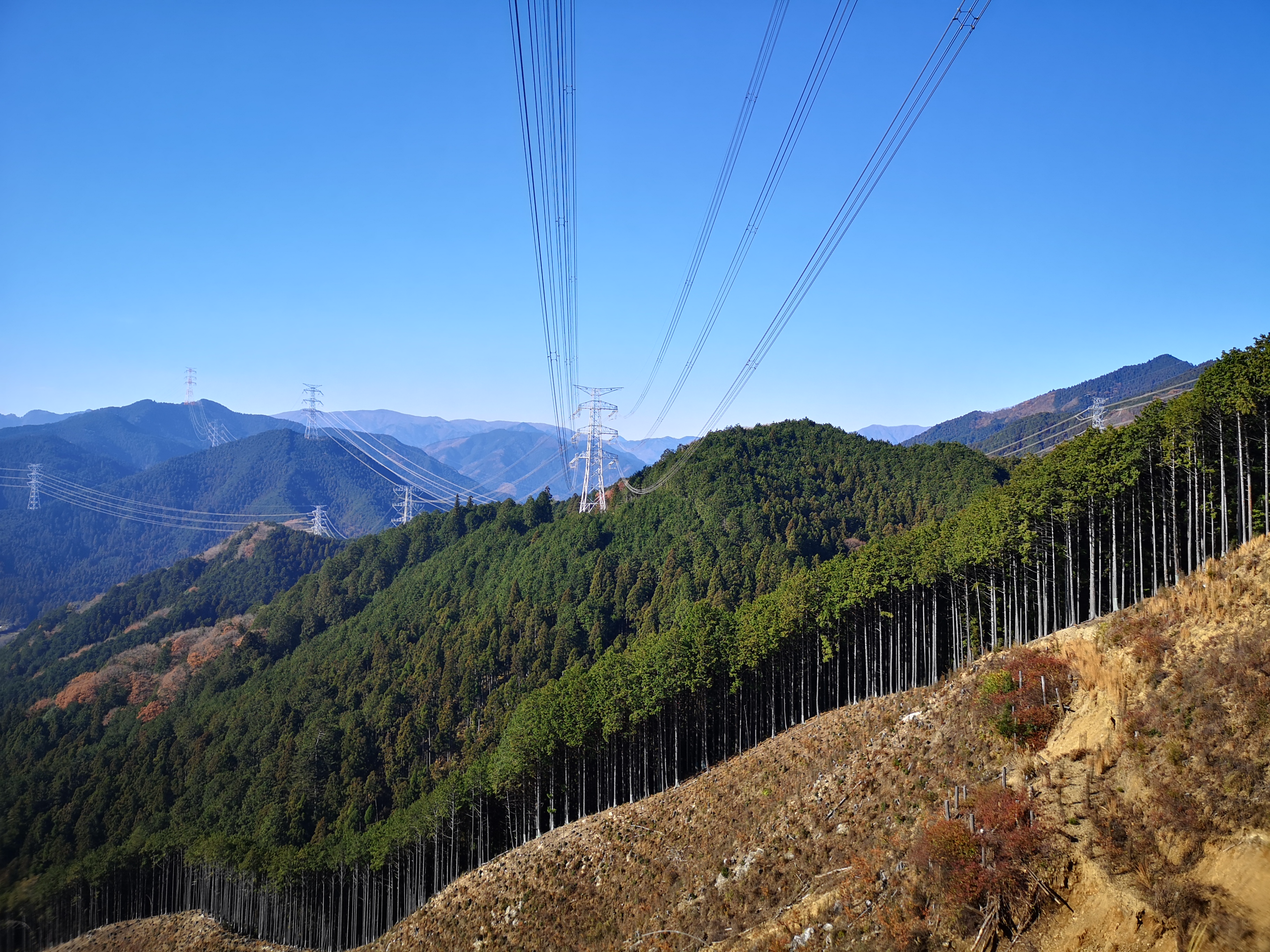
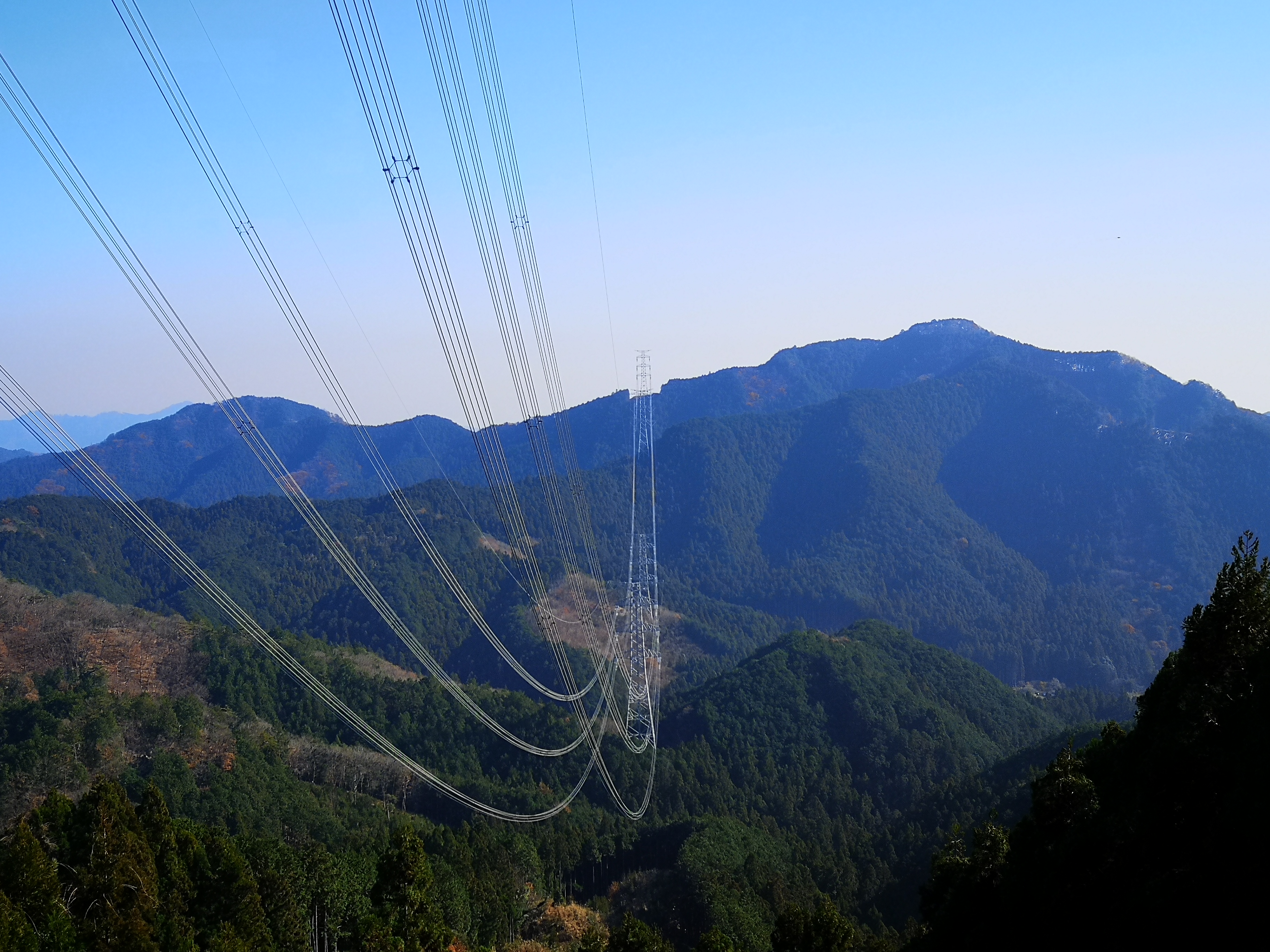
I then left the forest road for a nice hiking trail taking me to the top of the ridge with even better views of the entire area. Westwards, I could see Kobugahara and Mt Yokone, which I had climbed last year. There was a power line that cut across the entire landscape; the pylons were placed at the top of each ridge, and the electrical wires spanned the valley in a spectacular manner.
Bringing electricity to all villages in the mountains
After taking in the views, I continued along the ridge and soon entered a cedar forest with few views. This part was fairly easy, with some slight ups and downs. Suddenly the path started to climb steeply; rocky sections appeared, with rope on the side to help pull yourself up. The air also got colder – I could feel that the top was close. I reached the summit of Mt Hagaba 羽賀場山 completely in the trees just before 12h30. I found a small opening facing Southeast, and sat down to have lunch, with a view of the hills of Southern Tochigi stretching away into the distance.
Looking back towards Kanuma
Since I had barely completed half of the hike, I couldn’t spend too much time at the top. After setting off again, the path started to descend quite steeply – too much in fact. I realised that I may have lost the trail. I retraced my steps. Suddenly I heard some voices to my right. The ridge on that side didn’t descend quite so much, so I found what seemed like a path and crossed over. Once I was off the steep slope, I was more confident I was on the right path. I then encountered a group of three hikers – the only people I saw on the entire hike, and the sources of the voices I had heard earlier.
As the hike progressed, the ridge got narrower
From this point, the path went up and down more steeply. There were more and more rocky sections – it was starting to turn into an exciting hike. At one high point I had a glimpse of the Nikko mountain range through the trees. After one final steep climb, I reached the top of Mt Otenki お天気 (777m) at 2pm. It was an unusual summit in that there were at least five different summit markers! A few meters beyond the summit, there was a magnificent view of Mt Nikko-Shirane, Mt Nantai and Mt Nyoho. To the left and right were countless other mountains and ridges, mostly snow-free.
The Nikko mountain range
I would have spent an hour gazing at the view, but according to my guidebook, another 90 minutes were needed for the descent, and my return bus was at 4pm. I reluctantly started going down at 2h30. The path was very steep. It split into two and I took the left path following the ridge (both paths take the same time). I reached the bottom of the valley as the sun was starting to get low, creating some nice effects in the forest.
Late afternoon sun filtering through the forest
I arrived back the road and the bus stop after only one hour, one of the rare times I’ve ended a hike way ahead of schedule. Unfortunately there wasn’t much to do in the neighborhood, but I was able to use the time to get ready for the two hour trip back to Tokyo.
Since I made blog entries for nearly all my hikes in the Tokyo area in 2019 – there are some December ones left that I’ll write up soon – I won’t do a summary like last year. Instead, I’ll share some numbers for the past year.
Total Number of Hikes
In 2019, I had 46 outings that resulted in some form of hiking (ten more than in 2018). “Hiking only” trips within the Tokyo area, totaled 40 (also ten more than the previous year). I’m glad I achieved my personal goal of surpassing the number of hikes in 2018, and equaling that of 2017, (although 2019 had more short hikes), despite tendinitis in my left ankle that has been bothering me since the summer. The hikes were evenly divided between Saturday and Sunday, an improvement from last year when most hikes fell on a Sunday.
Hikes per Prefecture
The prefecture where I did the most hikes was Yamanashi (11) – a bit surprising since I had already done many hikes in that area, but then Yamanashi has many mountains. Gunma (8) ranked high up because half the hikes bordered on other prefectures. I was also surprised that Kanagawa (5) did well. I really thought I had exhausted that area in previous years. I was glad I was able to do several hikes in Ibaraki (4), an area I started to explore only last year. I also managed more hikes in Shizuoka (4) that weren’t on, or close to, Mt Fuji, and I hope to explore that prefecture more in 2020.
One of my goals for 2019 was to do more hikes in Tokyo (3), and although the result isn’t great, it’s honorable. I had really wanted to go to Tochigi (3) more often, but I often found myself canceling my plans there because of the weather. My biggest regret is not hiking more in Chiba (2). Many trails were severely damaged due to last year’s powerful typhoons, and it’s unlikely I will be able to go there this year. I was kind of shocked to see how little I had hiked in Saitama (2). However, this is one area I had extensively explored in previous years.
Hikes by Means of Transport
I wasn’t surprised that so hikes many hikes required access by bus (23). However, I still managed to find many station to station hikes (11), although road walking was required for a few of them. Occasionally, I opted to go by rental car (7) or by taxi (3), since there was either no bus or the times weren’t convenient.
I’d been through Otsuki so many times, on my way to either the Mt Fuji Five lakes area, or Kofu city, and each time I saw this rocky hill jutting up behind the city. Since it’s not a very big mountain, I did it as a morning hike, returning to Tokyo around noon. At the moment, two out of the three hiking trails are closed, these closures predate typhoon Hagibis, but it’s still possible to hike up via the back of the mountain. After reaching the highest point, it’s possible to continue along the ridge westwards for another hour, and finally walk back to Otsuki station forming a loop; since it’s a popular hike, there are warning signs and maps about this right outside the station, and along the approach to the trailhead.
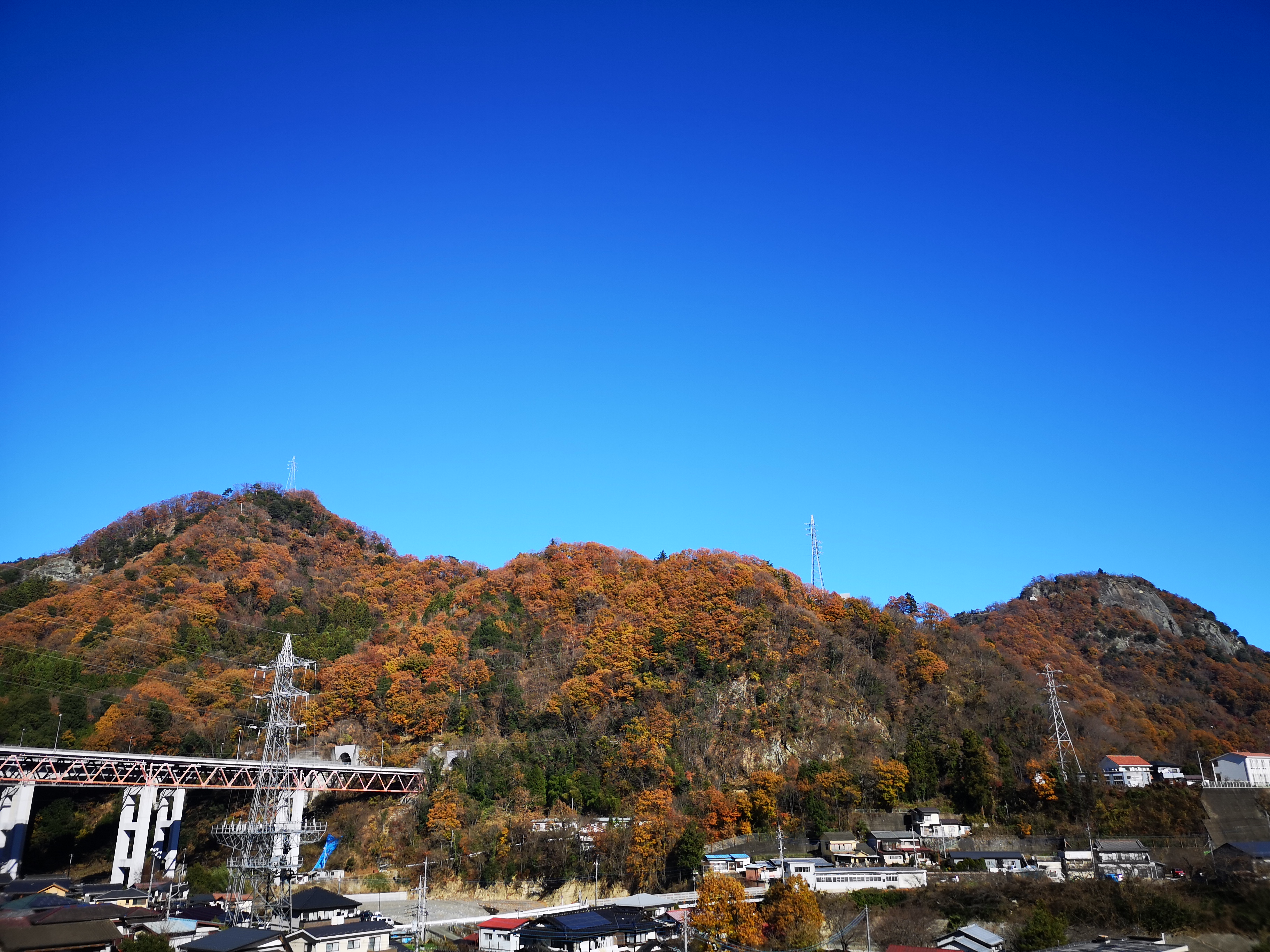
Autumn colours still on display in December
I used the convenient and comfortable Chuo line limited express to get to Otsuki station, only one hour from Shinjuku. It took me another hour to reach the start of the trail – Hatagura tozanguchi 畑倉登山口, just opposite a driving school. Although I had to walk on the road, there were good views of Katsura river (which later becomes Sagami river), Mt Momokura and Mt Gongen. The crisp autumn weather made all the surrounding mountains clearly visible. After crossing the river, I turned around, and I saw the snowy top of Mt Fuji rising behind Otsuki city.
The hike follows the ridge from right to left
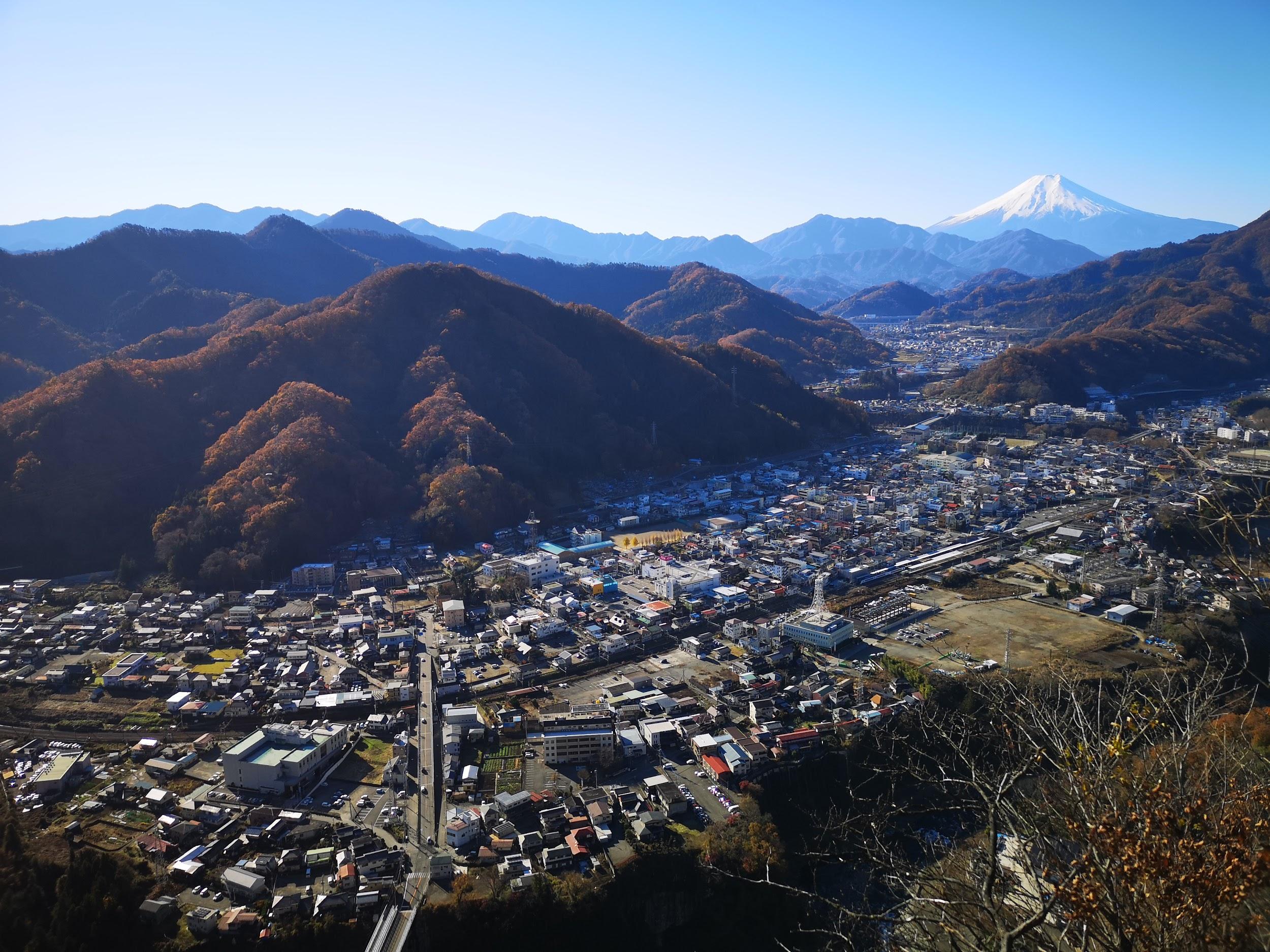
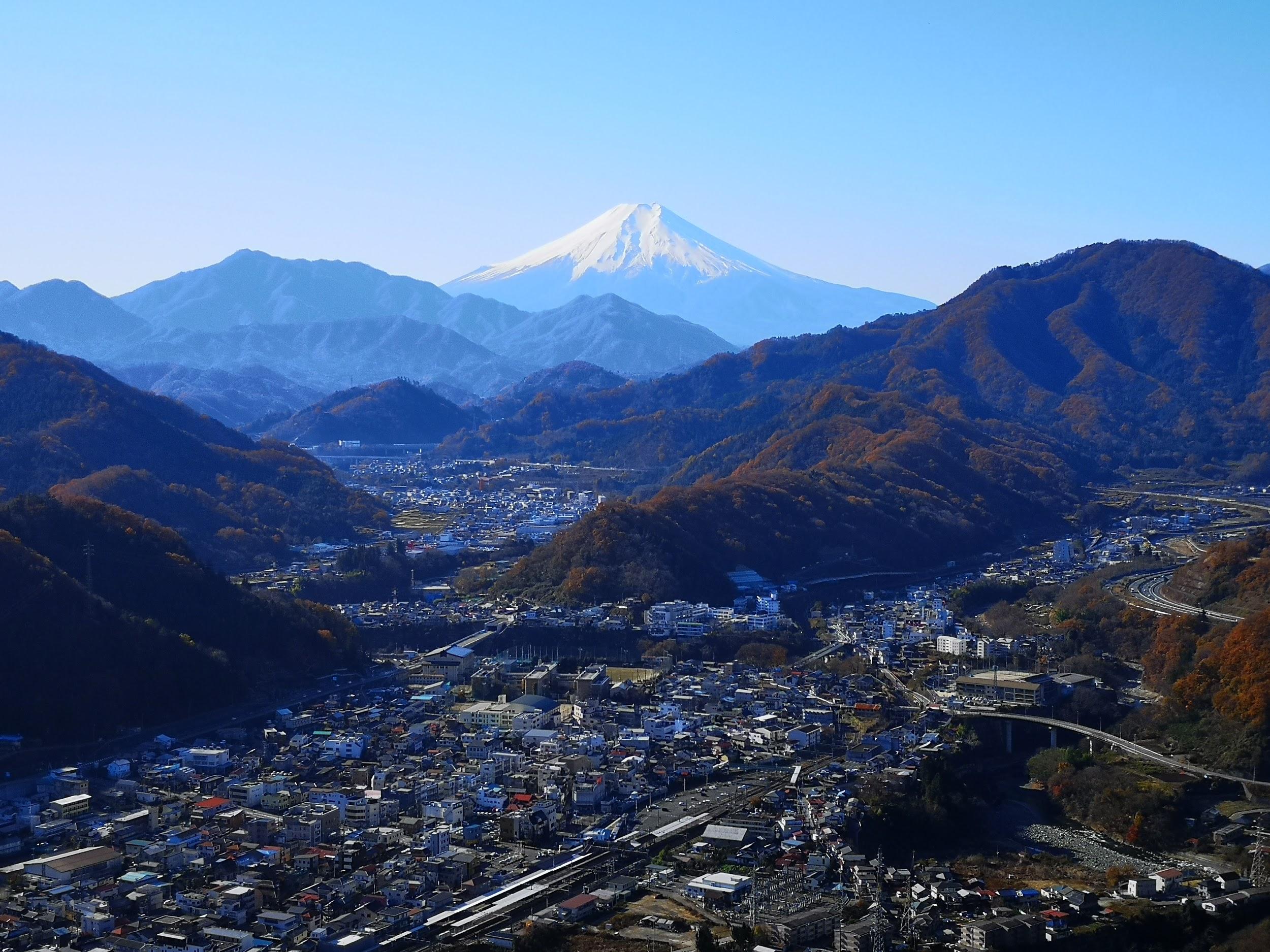
From the start of the hiking path, it took me just half an hour to reach the top of Mt Iwadono 岩殿山. It used to be the site of a castle, Iwadonojo 岩殿城 but there isn’t much left now. I was rewarded with an amazing aerial view of Otsuki town with Mt Fuji in the background. On the left, were the Doshi mountains, and on the right, were the Misaka Mountains. I was standing on top of the rocky face of the mountain, with nothing but a low fence and some bushes separating me from a hundred meter drop. My arrival at the top coincided with that of a rather large group, and I was asked to take their photo. One of the group members very kindly offered me some sweets in exchange. After they had moved on, I enjoyed an early lunch.
Spectacular view from the top of Mt Iwadono
Fortunately, my hike wasn’t over yet. From the summit, I continued along the ridge, first heading down for a short while before climbing again. I soon reached a fork where I had 2 choices – the forest path or the rock climbing path. Unfortunately, the group I had encountered at the summit, were now busy making their way up the rock climbing path – there was no way to get around them. Since I was on a schedule, I took the less exciting forest option. However, the paths merged soon after, and I found myself ahead of the large group, so in the end it was a blessing in disguise.
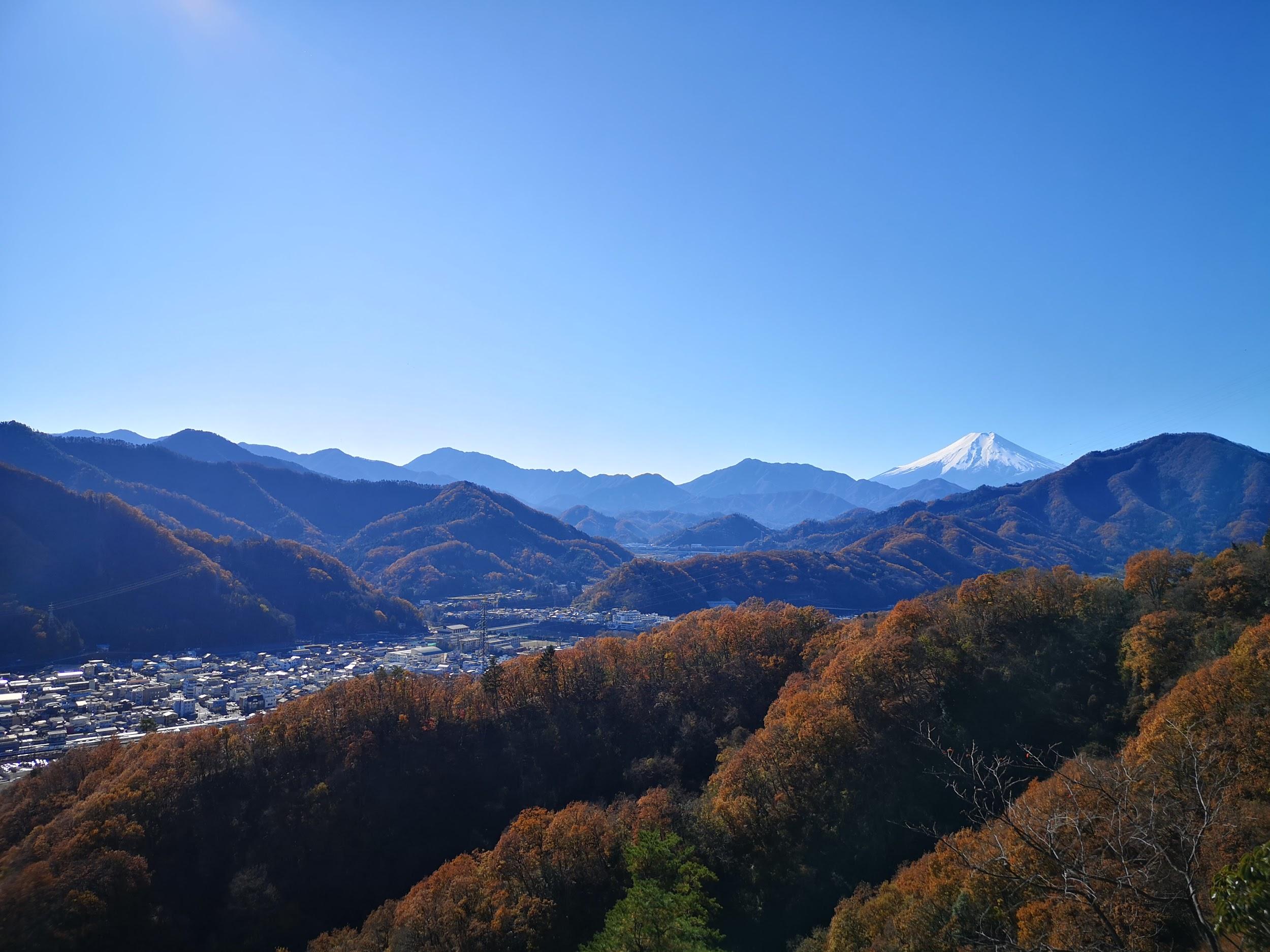
Last good view of Mt Fuji
I had some more excellent views of the valley below, and Mt Fuji, while hiking along a narrow, rocky ridge. I had imagined that this would be an easy hike, but it turned out to be quite exciting. It took me less than an hour to reach the top of the next summit, Mt Tenjin 天神山, surrounded by trees. A few minutes later, I reached an impressive rocky face called Chigo-otoshi 稚児落とし. The hiking path took me above it, where I had some more great views of the area. Standing on top of the highest boulder, I took in the last views of today’s hike. From there, the path descended steeply through forest to Asari 浅利 at the bottom of the valley, and it was another 30-minute walk along the road back to Otsuki station, which I reached just before noon, nearly four hours after setting out. I was glad to find a mountain that hadn’t been too affected by last year’s powerful typhoons. Apart from one fallen tree, the trail and the surrounding forest seemed in good shape. Hopefully the other trails will reopen sometime in the future.
Chigo-otoshi at the end of the hike – no safety fence here!










































 Hiking Around Tokyo
You must be logged in to post a comment.