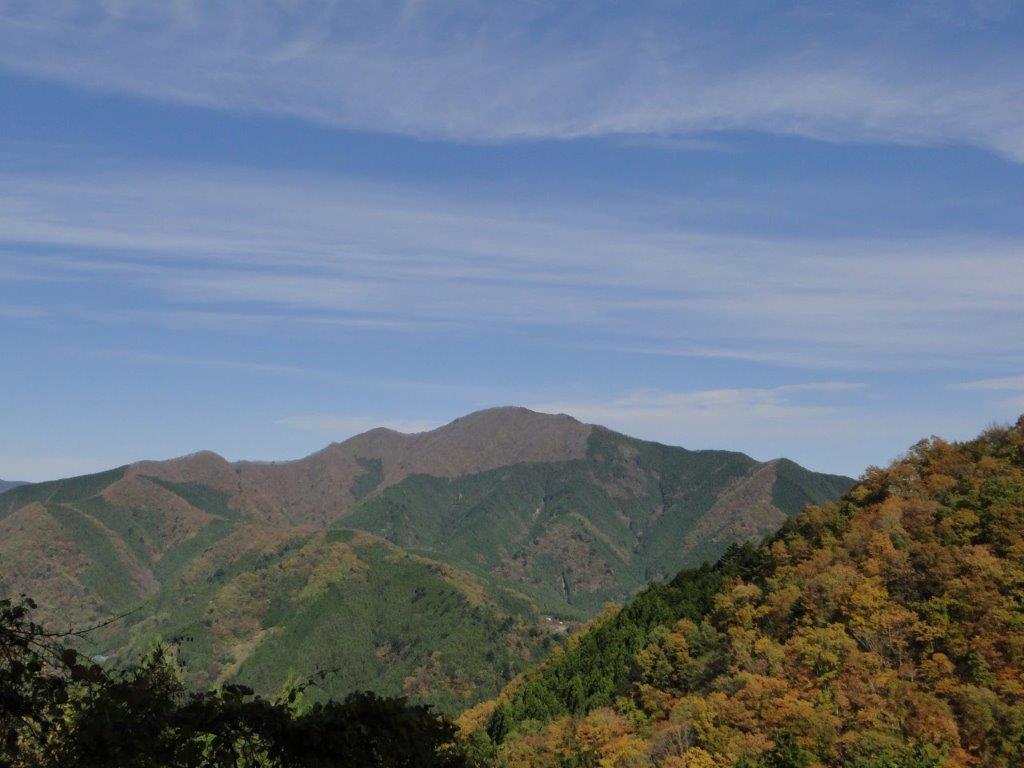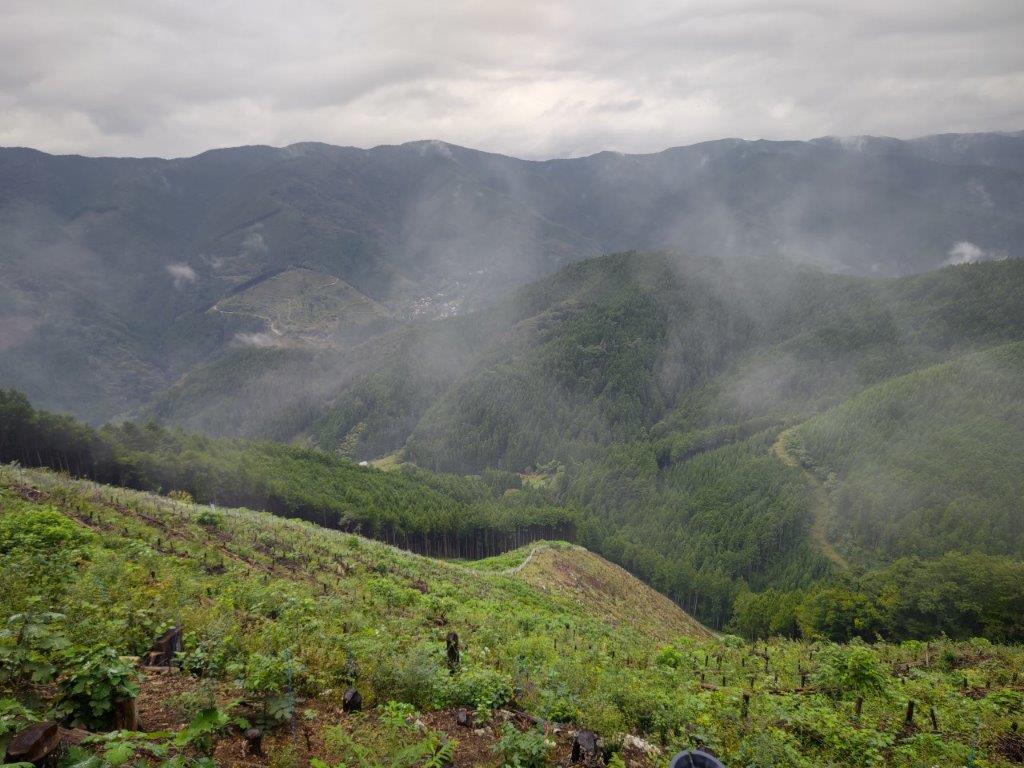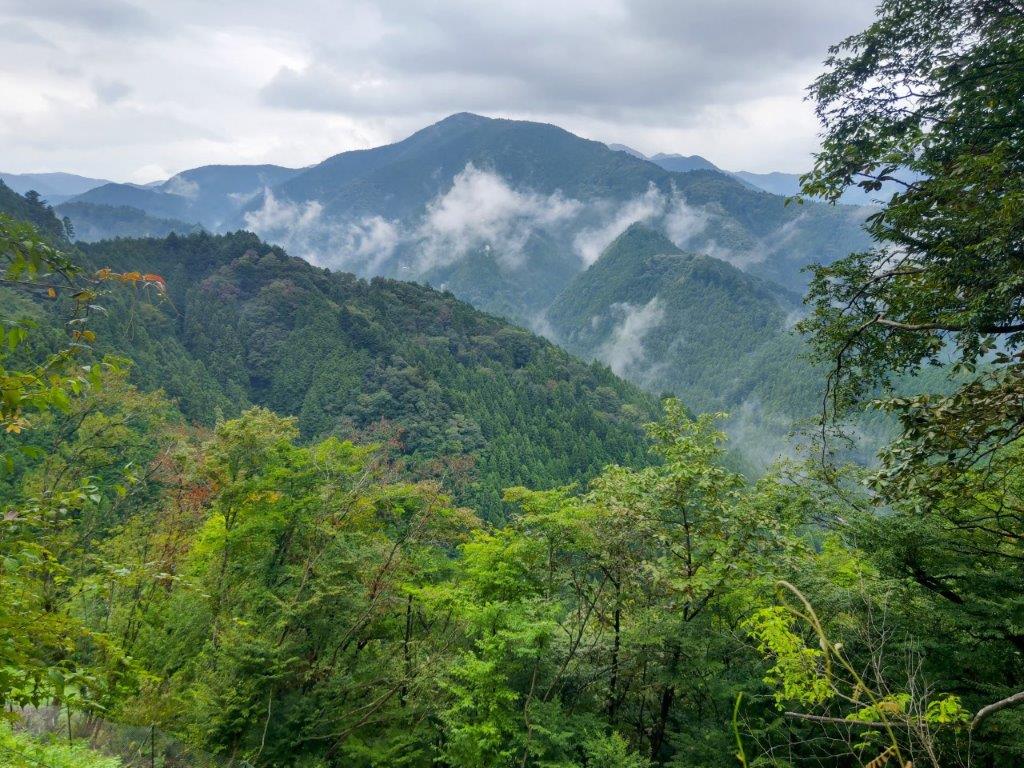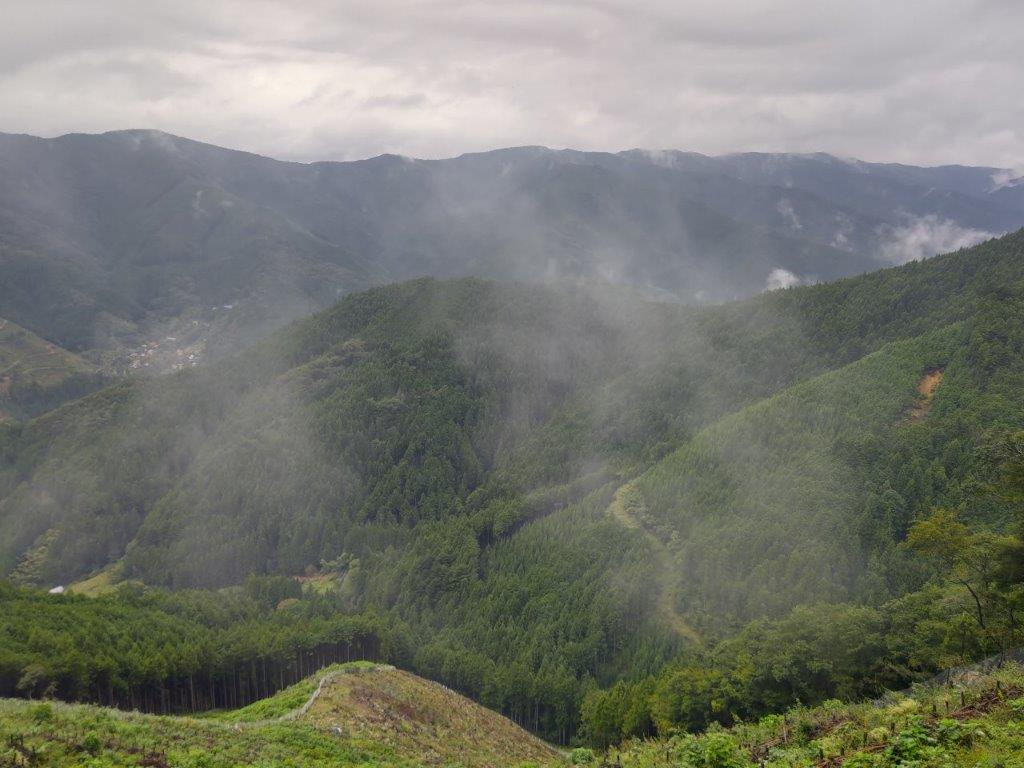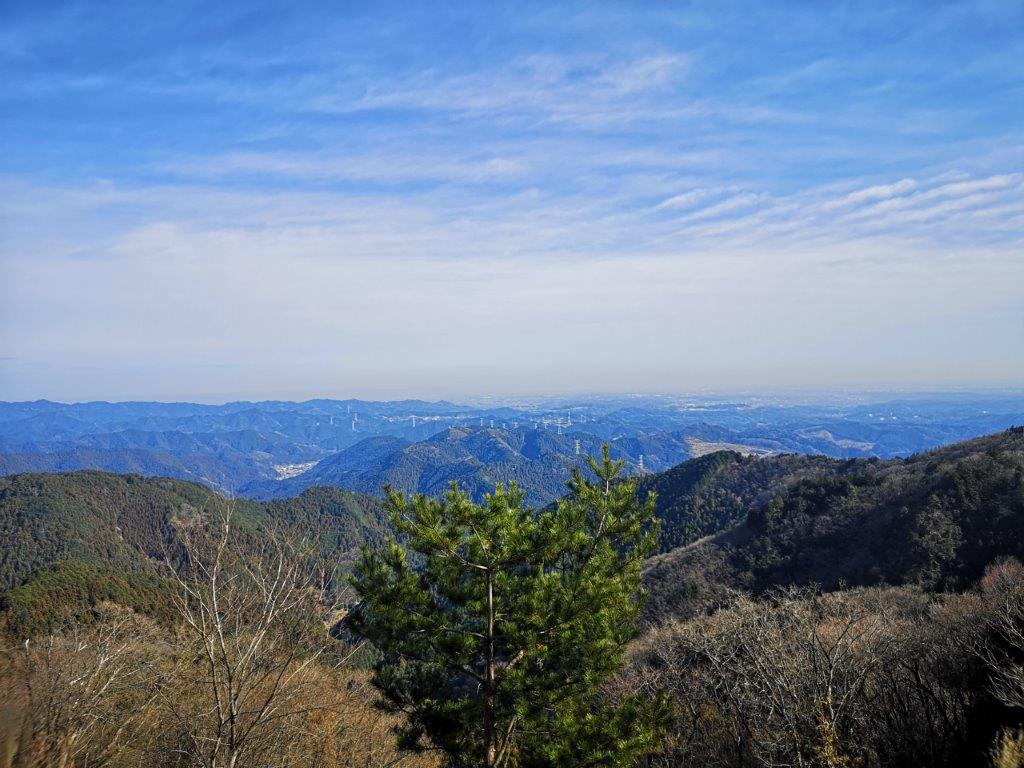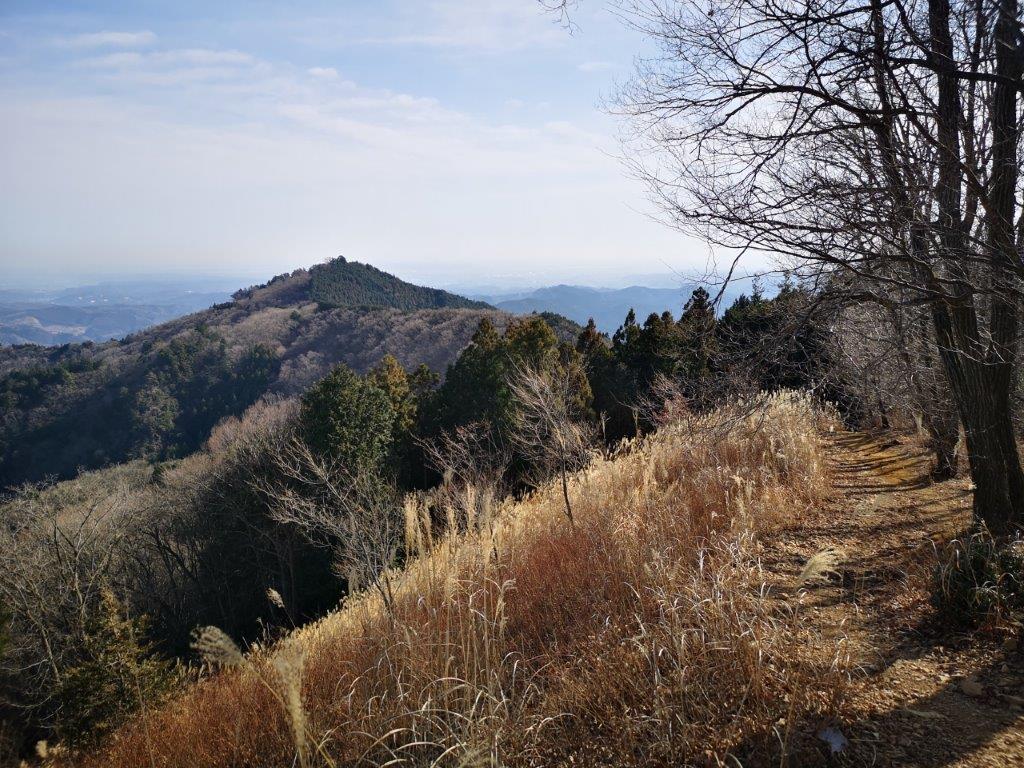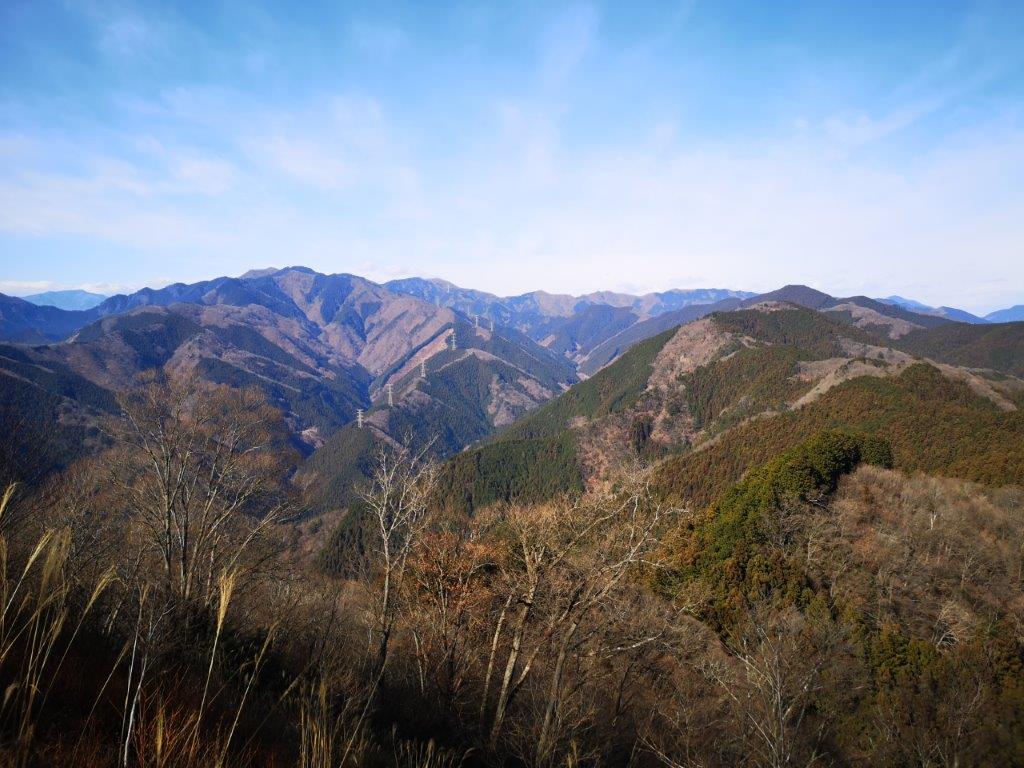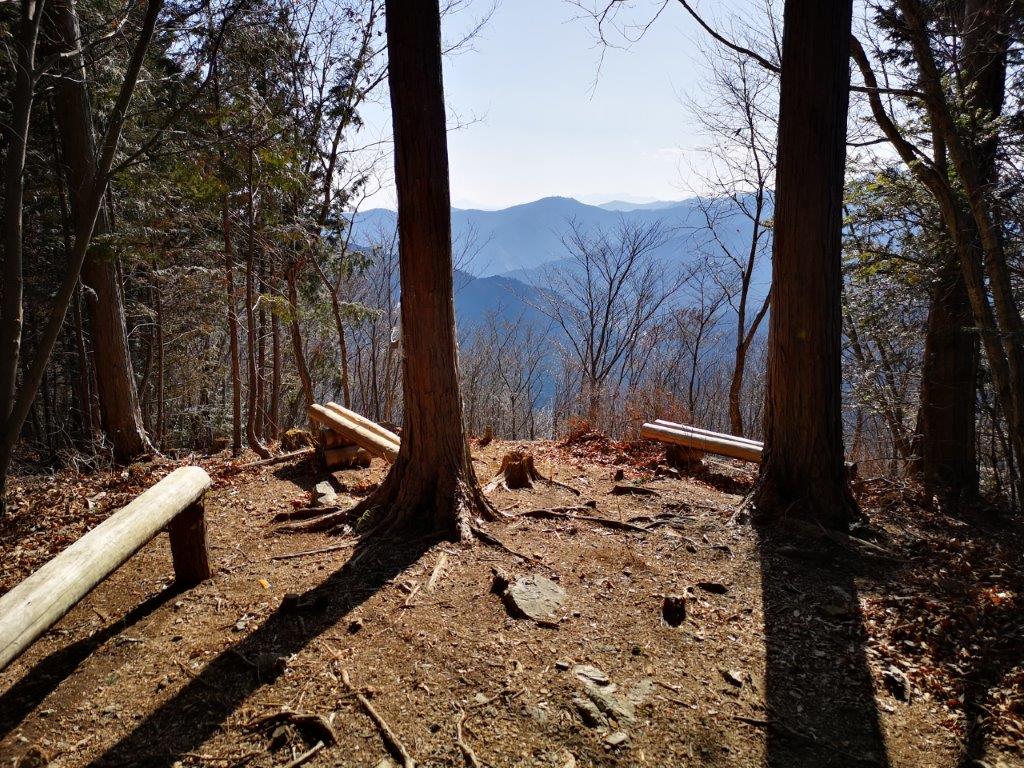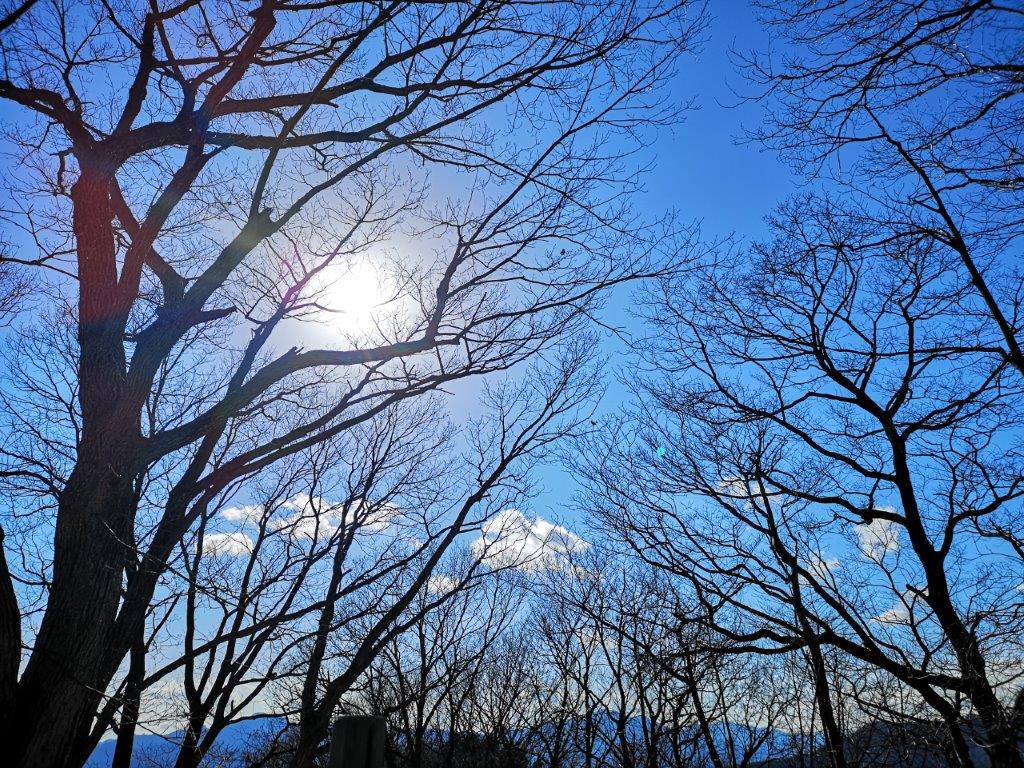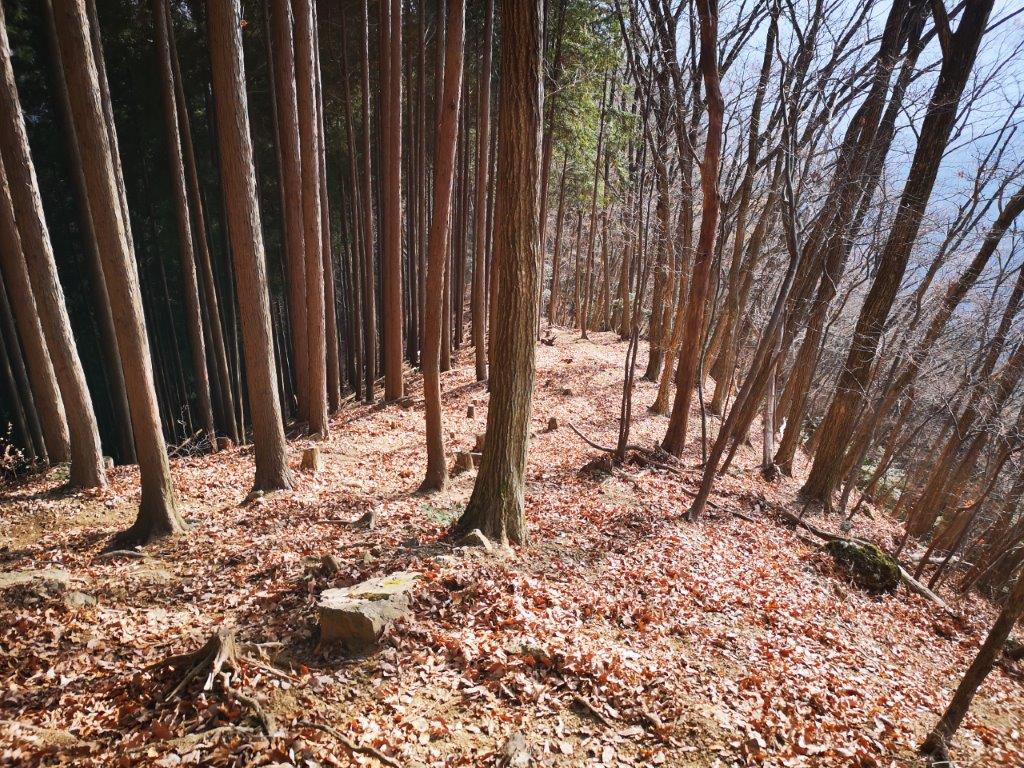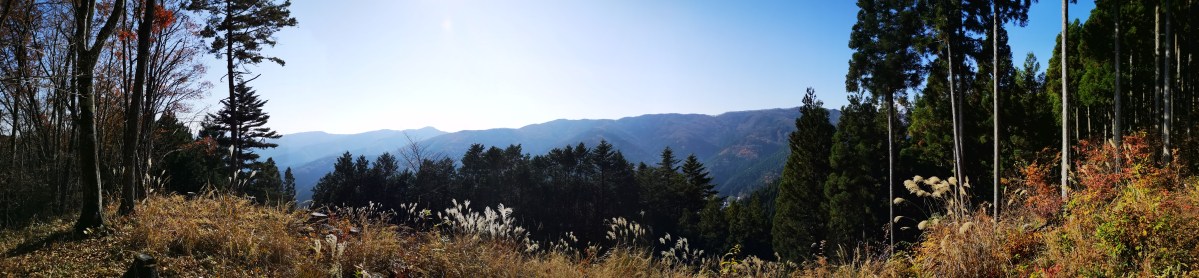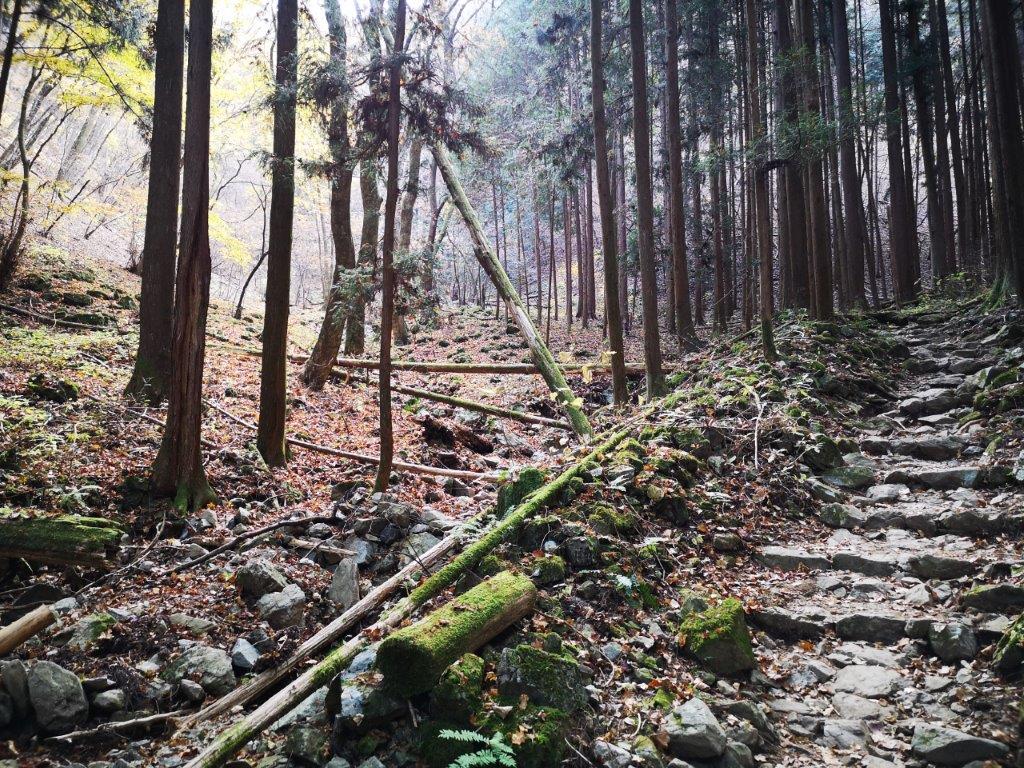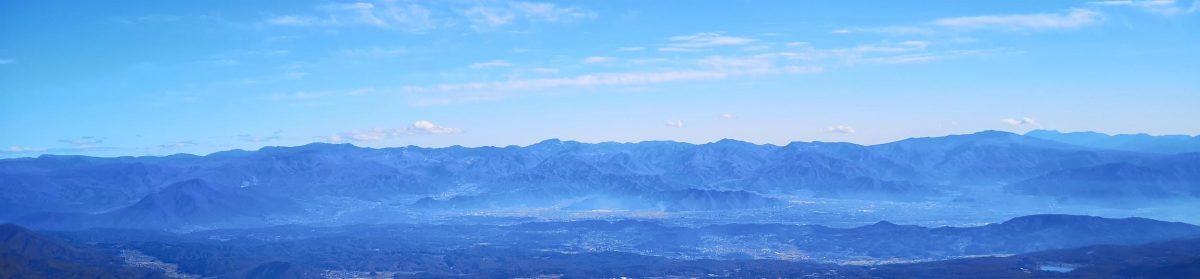
Mt Mito (1531m) & Mt Osawa (1524m), Hinohara Village, Tokyo Prefecture, Saturday, November 8, 2025

I had been up Mt Mito twice before, in 2010 and 2018, but felt it was time to revisit this 300 famous mountain of Japan inside the Chichibu-Tama-Kai National Park and the Hinohara Tokyo Citizens’ Forest. I wanted to walk though beautiful forest, see some more Autumn colours, as well as explore new trails close to the capital; with luck, I’d also get a view of Mt Fuji from the summit. Looking at my map, I decided to go up the Otaki and Buna Paths, as I did in 2018, but descend via a new route, the Miyama Path; I’d pass another summit on the way, and end up on the Otaki Path again for the last leg back.

Hiking in the Chichibu-Tama-Kai National Park

秩父多摩甲斐国立公園

To get to the start of the hike, I’d ride the Ome line to Hajima and change to the Istukaichi line for the short ride to Musashi-Itsukaichi station. From there, I’d board an express bus for the one-hour trip to Tokyo Citizen’s Forest, the end of the line. I decided to catch the mid-morning bus and take the last one of the day back, meaning I’d need to finish well on time today. The weather was supposed to be clear in the morning turning cloudy in the afternoon. I hoped I’d be able to get some views before the sun vanished and that it wouldn’t be too cold on top of one of Tokyo’s highest peaks.
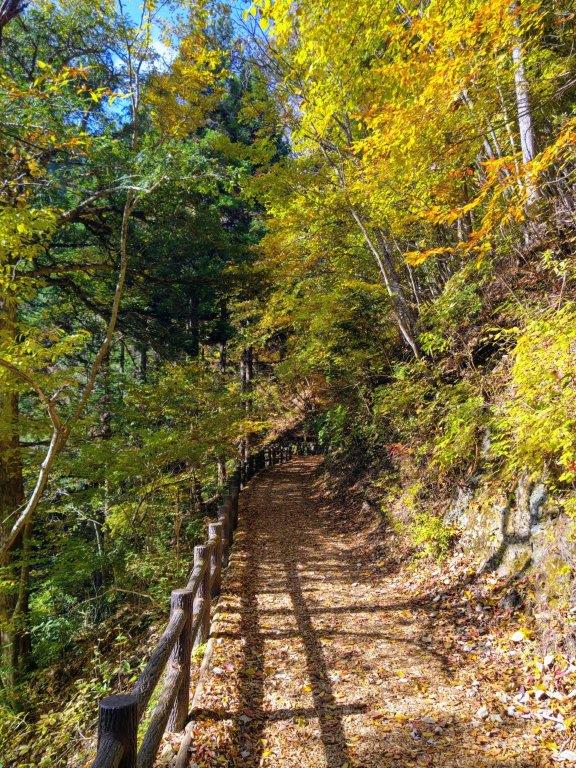
Start of the Hike (left) Above Otaki Waterfall (right)
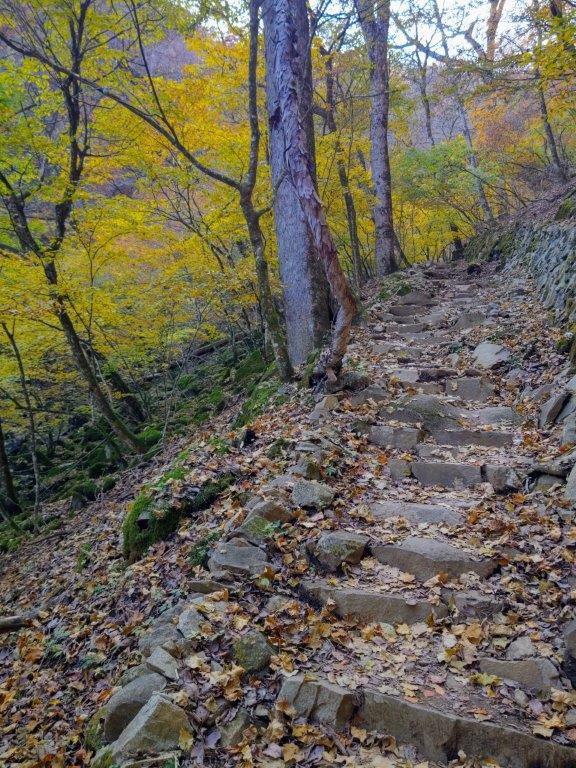
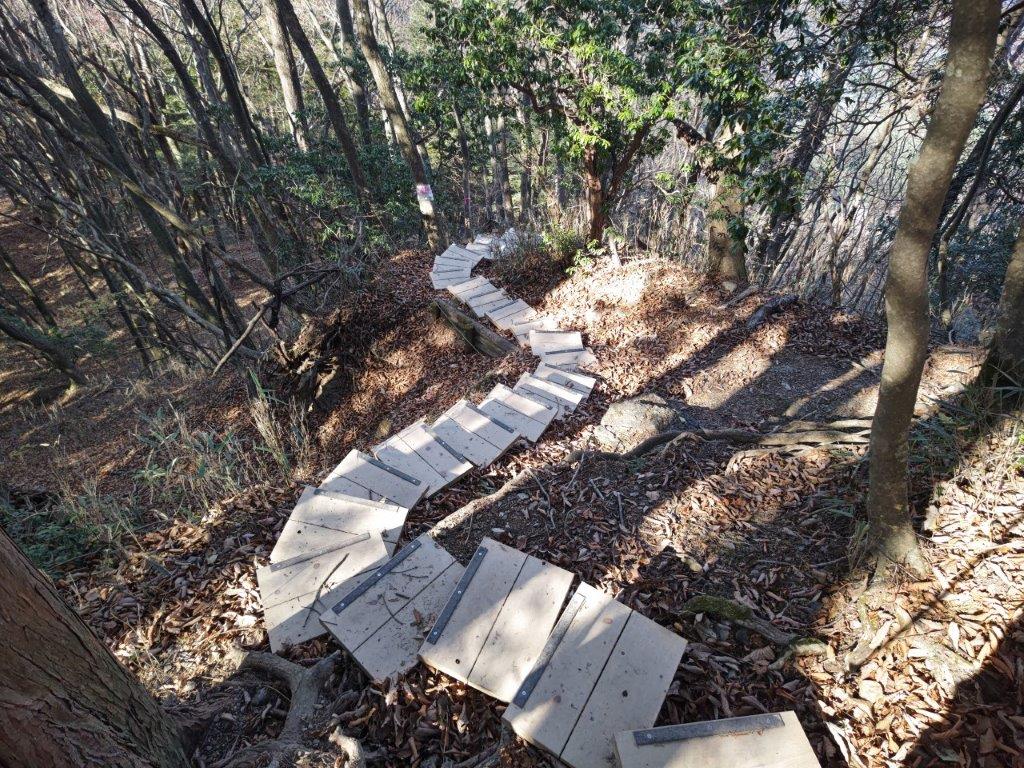
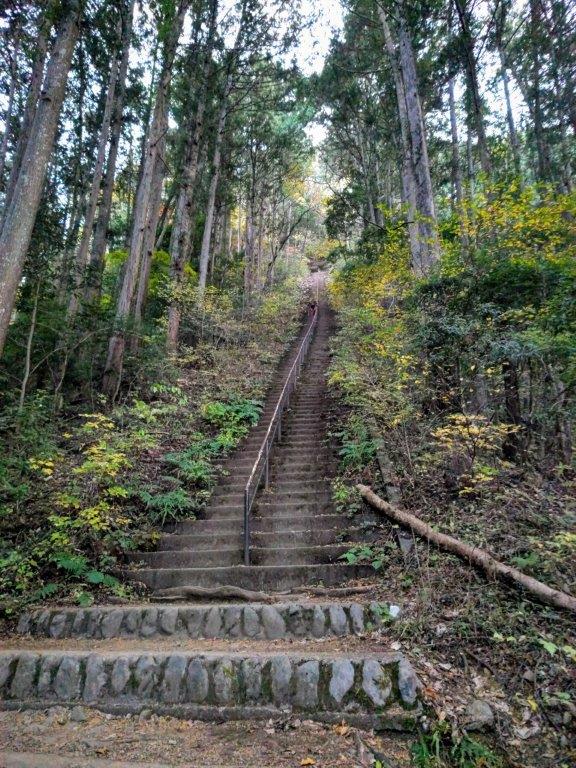
Stone Steps (left) and Log Steps (right) on the Beech Path

It was a sunny day as I rode the Green Car through the suburbs of Tokyo. After arriving at Musashi-Itsukaichi station just before 11am, I made my way to the head of the line for the Tomin no mori (東民の森) express bus. Thanks to the bus being only half-full, most hikers having taken the early morning one, I had views on the left and right of the Autumn colours along the Akigawa river, as the bus crossed several bridges on the way up the narrow valley.
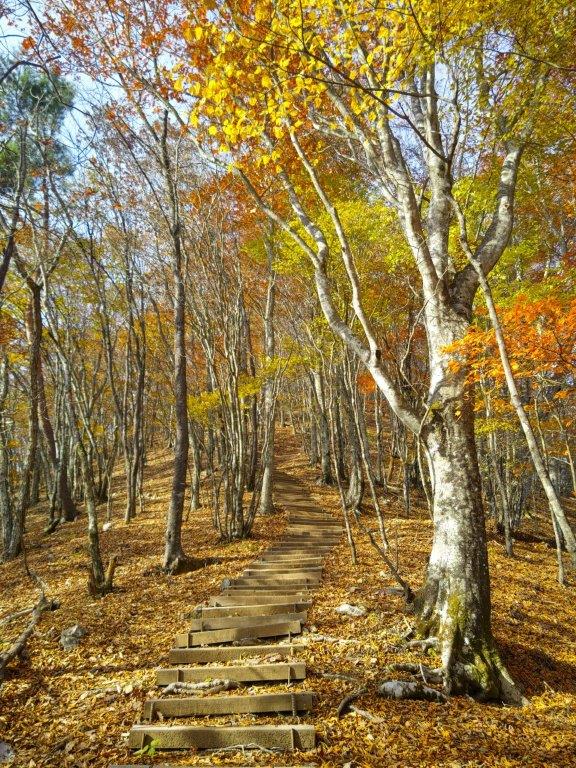
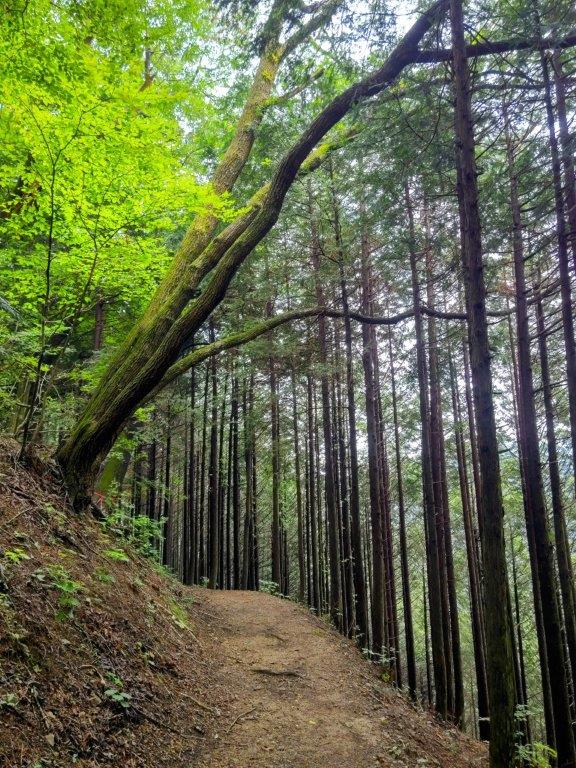
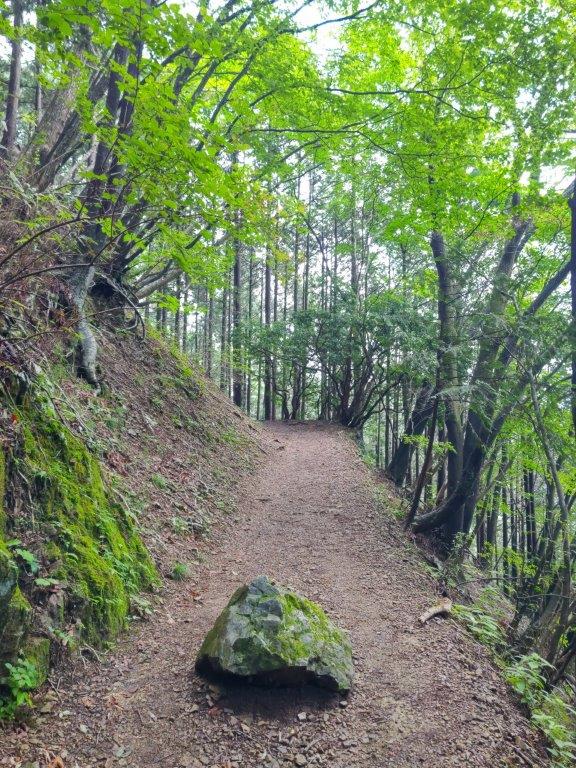
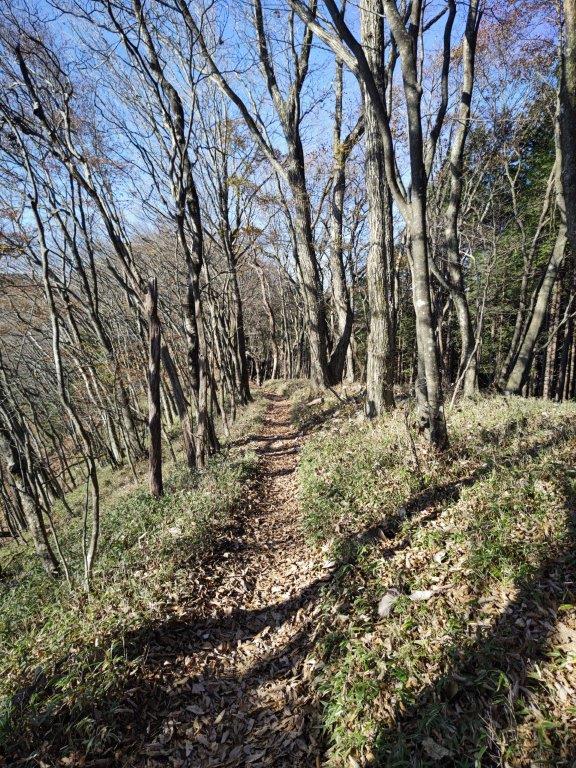
Ascending (left) and Level Sections (right) along the Beech Path

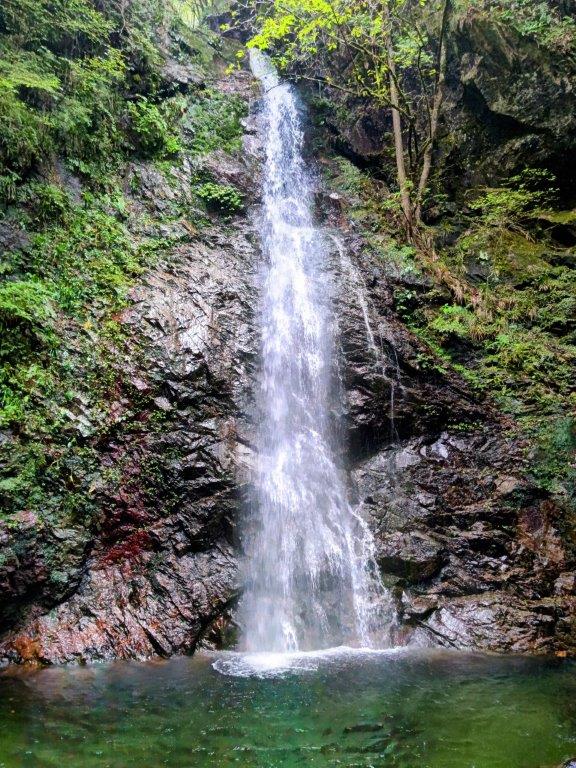
Takimi Bridge (left) Mito Otaki Waterfall (right)

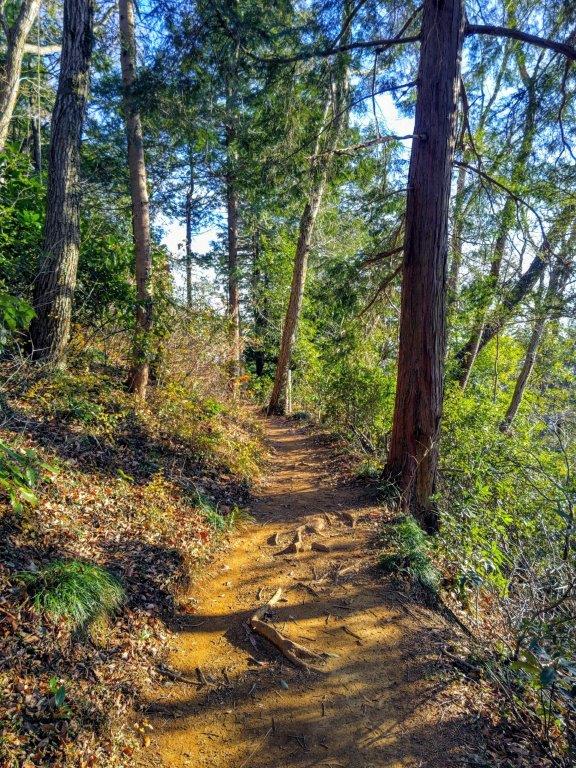
I was lucky to spot some monkeys along the road, on the opposite side of the ridge from Hossawa falls where I had spotted them on my 2020 hike. There was little traffic in the middle of the day, allowing the bus to arrive ten minutes before schedule, at 1235. I set off almost immediately to get the most out of the sunny weather, passing many people wrapping up their hike. Within a few minutes I was walking along the “Big Waterfall” Path (大滝の路 ootaki-no-michi), also called the Forest Therapy Road (森林セラピーロード shinrin-serapi-rodo), a wide, level trail through mixed forest. Very soon, I reached a viewpoint on the left side.

Start of the Forest Therapy Road

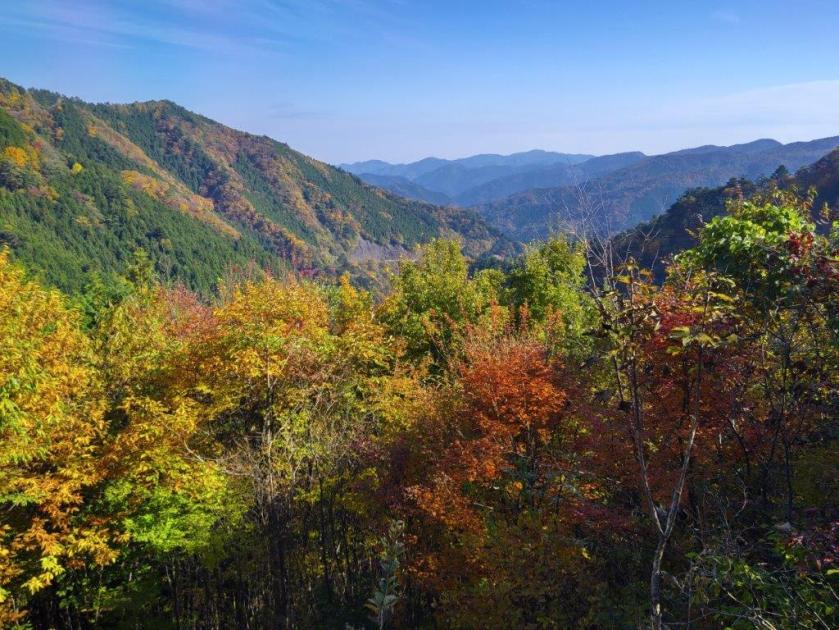
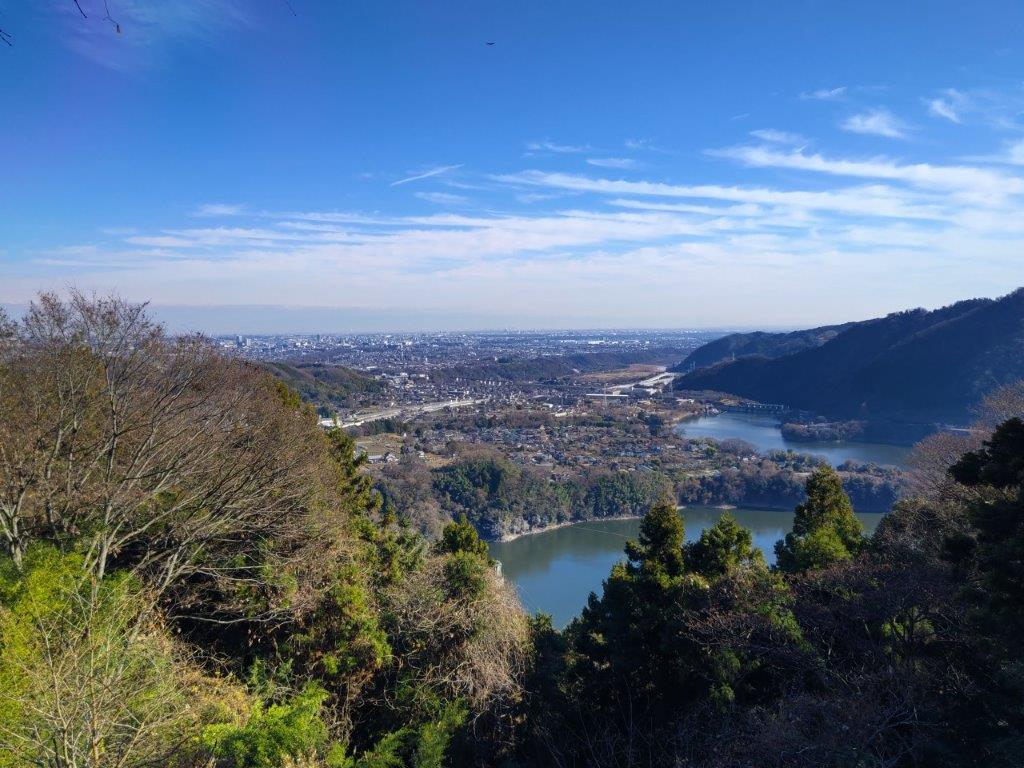
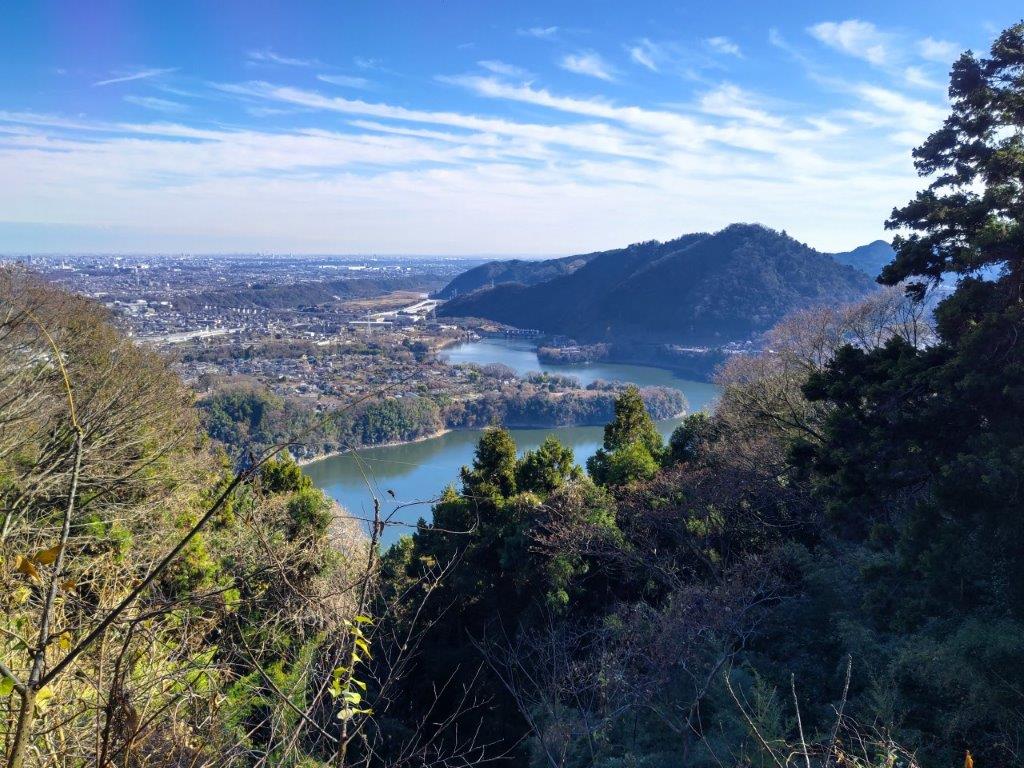
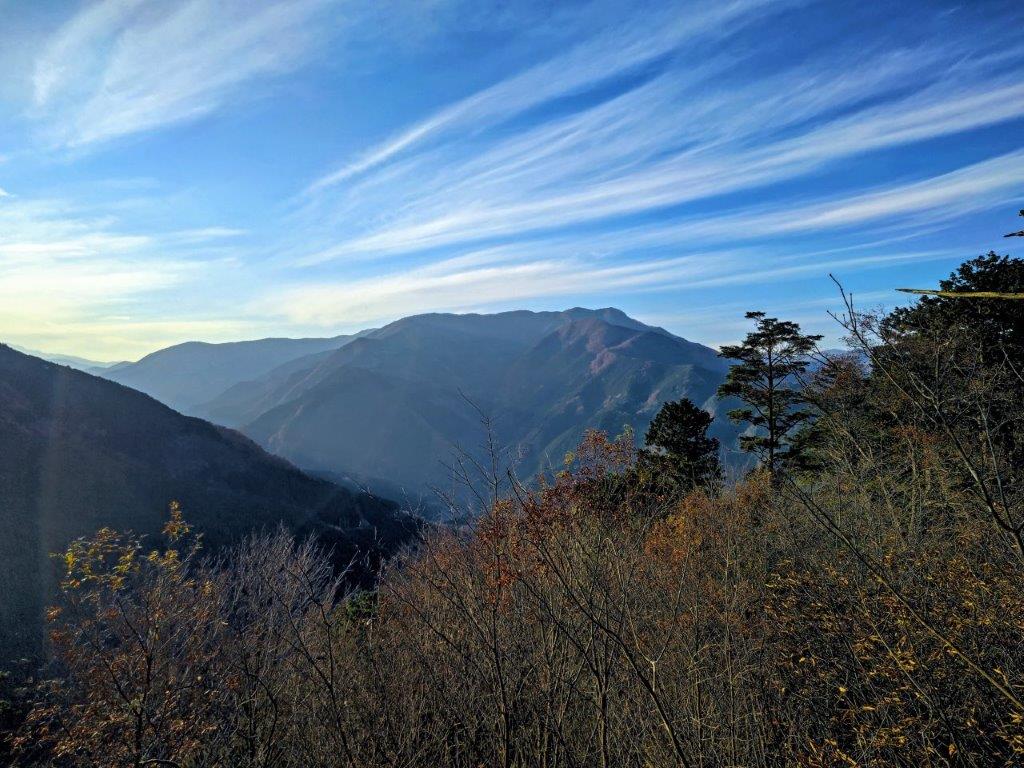
Viewpoint of the Akigawa Valley from the Otaki Path

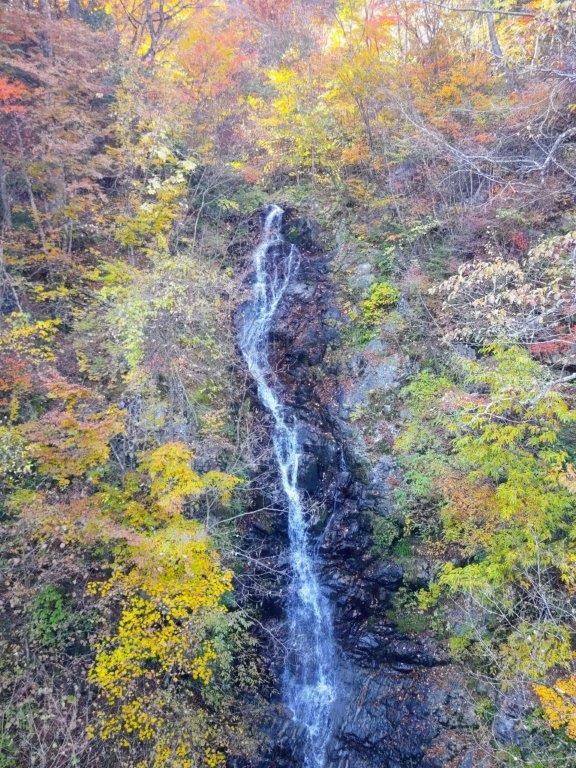
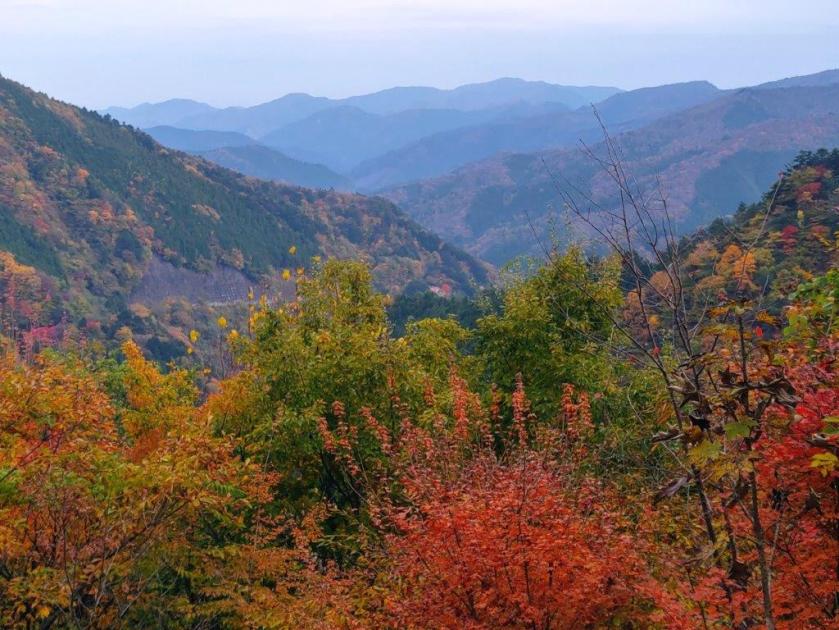
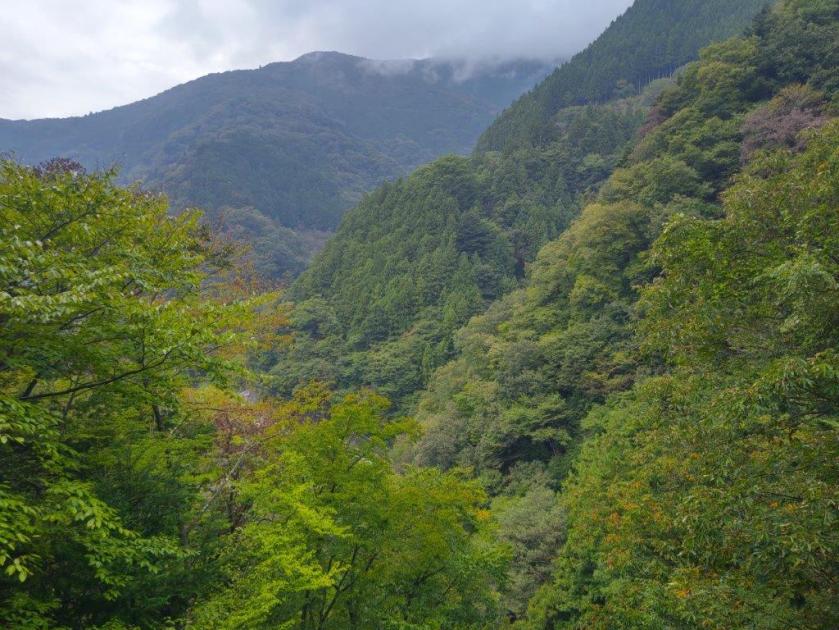
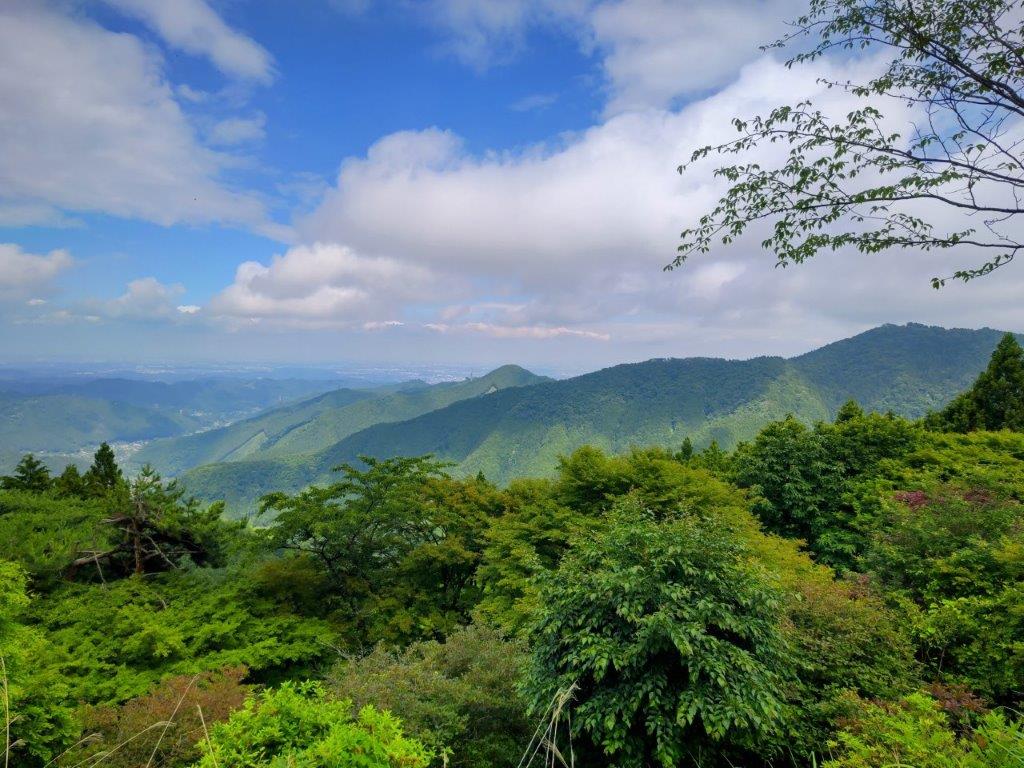
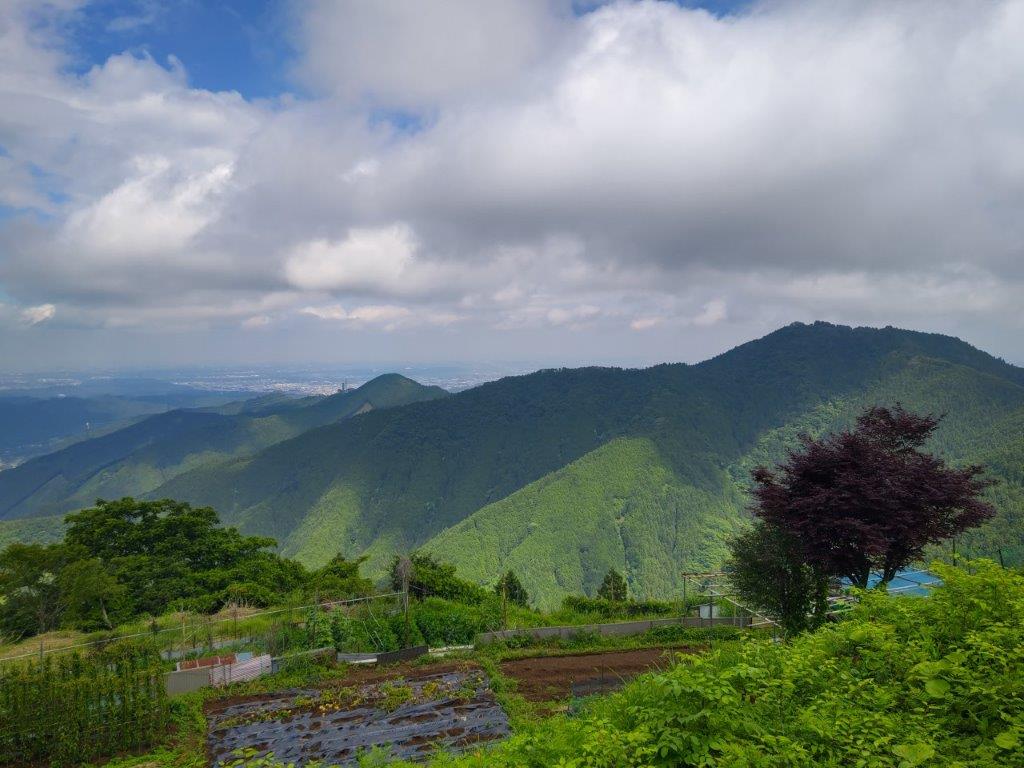
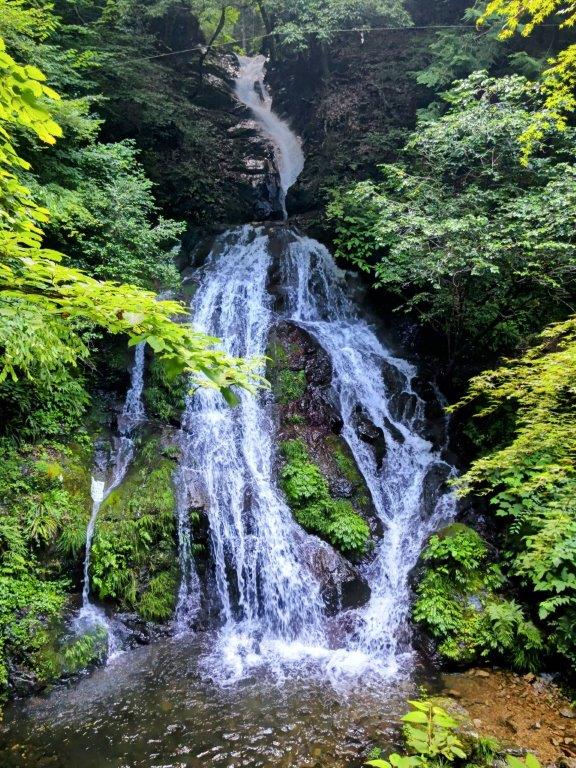
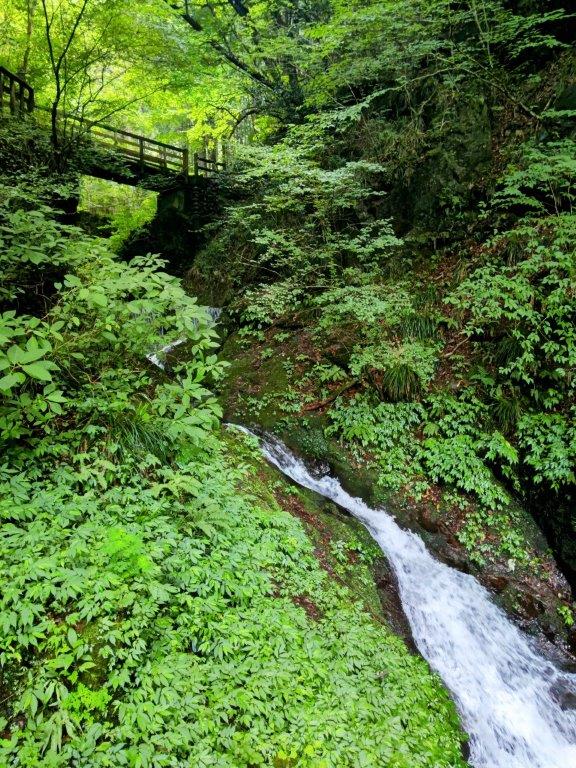
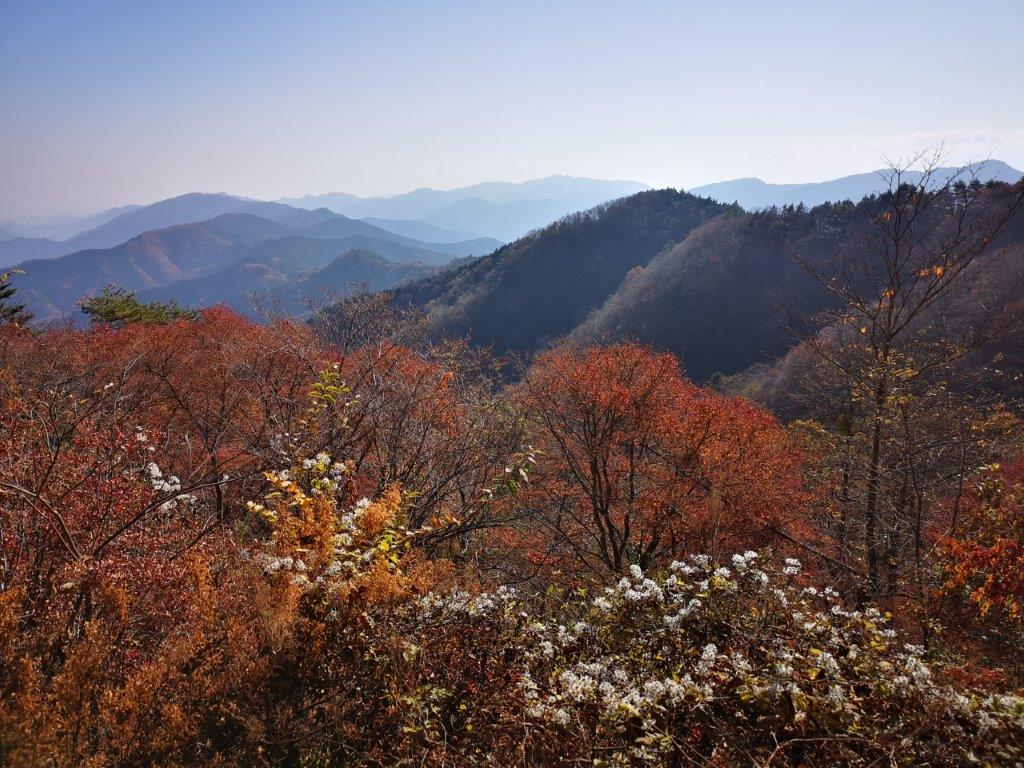
I was glad to get a view of the Autumn colours under the blue sky, high thin cirrus clouds announcing an imminent weather change. Directly ahead was the long ridge leading to Sengenrei opposite was the ridge for Mt Maruyama; in the far distance, I could make out the 3 mountains of Tokura (戸倉三山). A sign indicated that the elevation was 1078m, meaning I had about 500 meters to climb. I set off again and at 1pm, arrived at Takimi bridge (滝見橋), a wooden suspended bridge, opposite Mito-otaki (三頭大滝), a 30-meter high waterfall.

Beech Path below the Summit

View of Mt Odake (left) from the Observation Deck

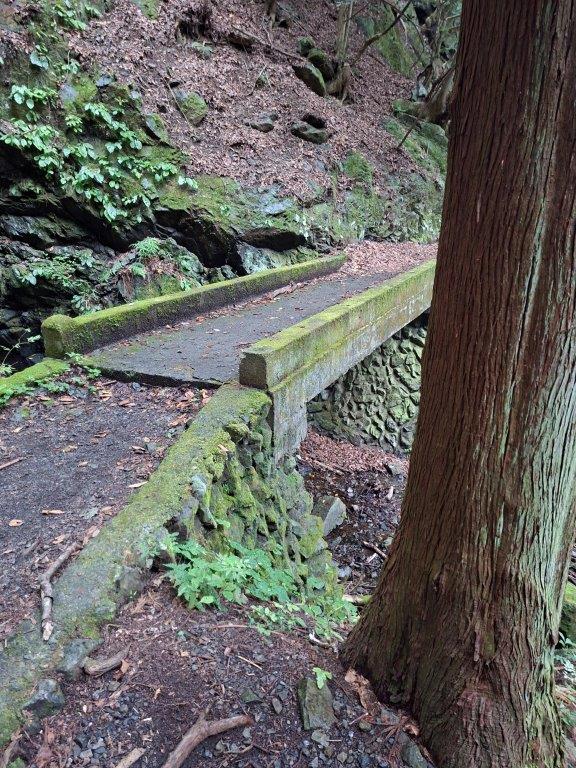
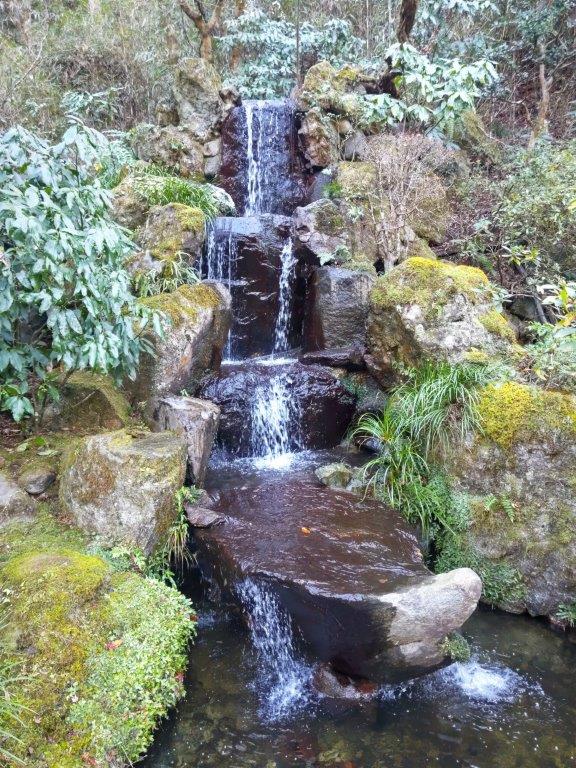
The stream of falling water surrounded by vivid Autumn foliage was more impressive than I had remembered. I spent a few minutes enjoying the view before retracing my steps back to the trail, the other end of the bridge leading nowhere. I soon reached a junction where I took the right branch, the start of the Beech Path (プナの路 buna-no-michi); the left branch was the end of the Miyama Path where I hoped to arrive later on. The rocky path, possibly an ancient road, climbed steadily, crossing a stream several times over man-made stone bridges.

Going Down via the Miyama Path

Autumn Colours on the Miyama Path

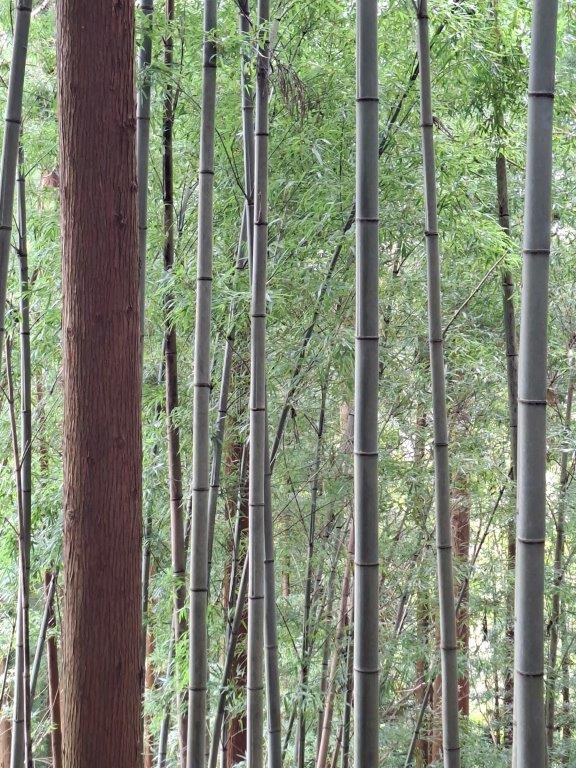
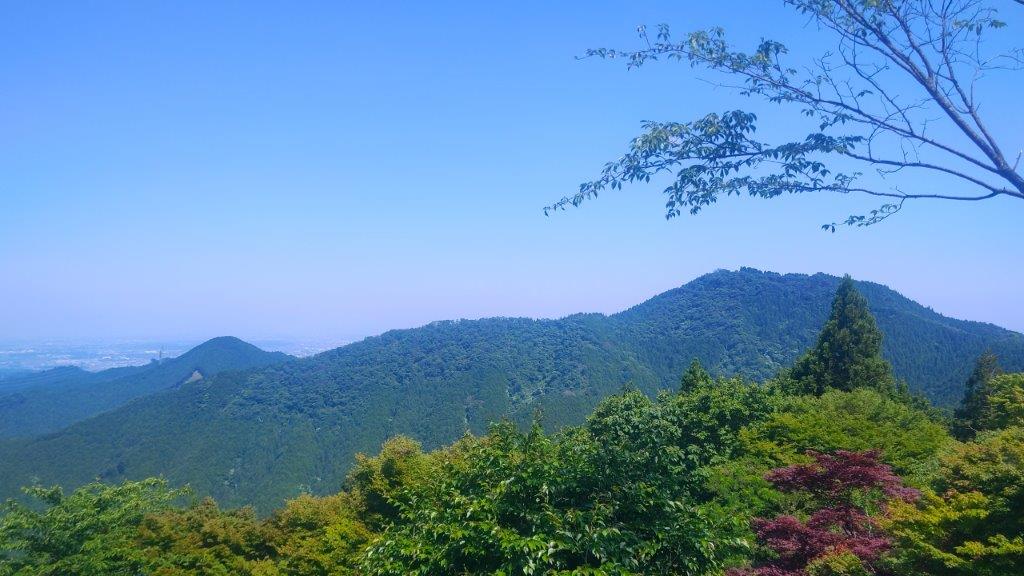
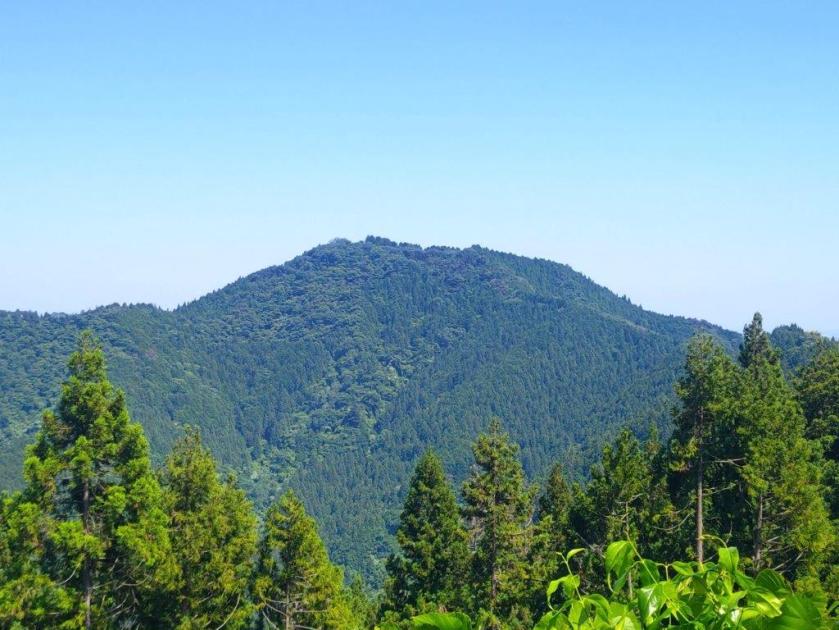
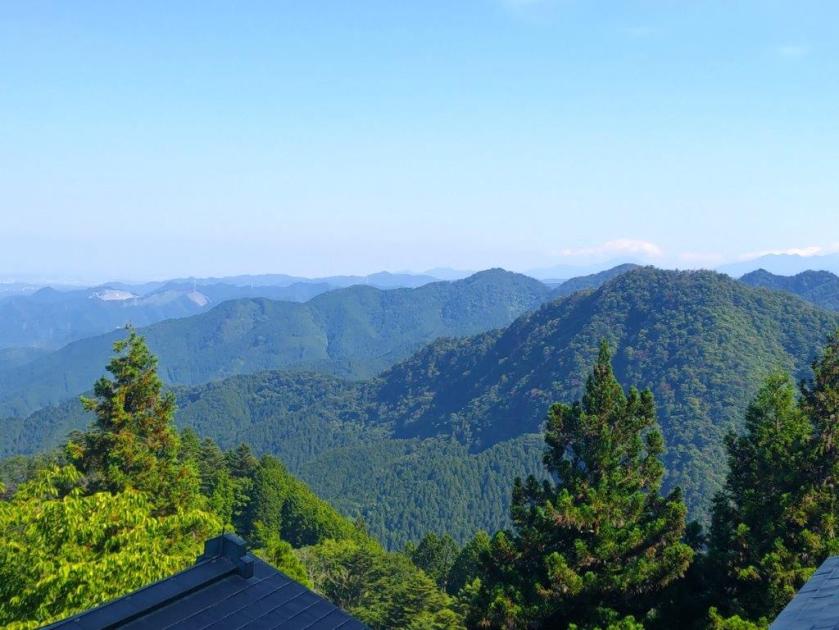
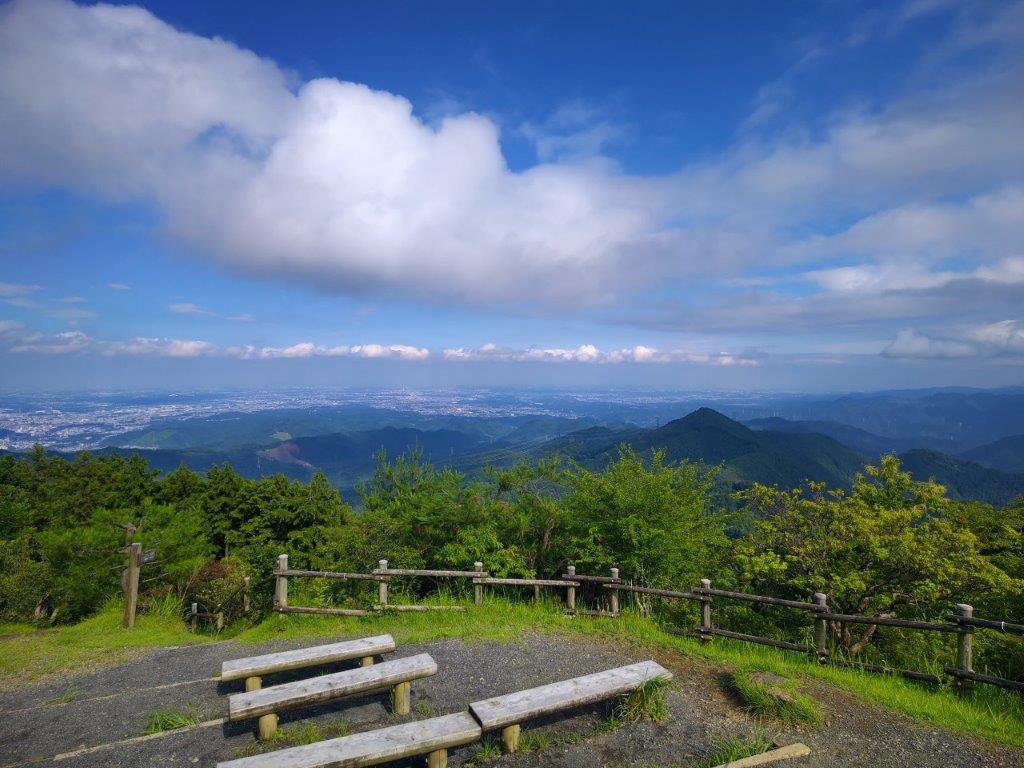
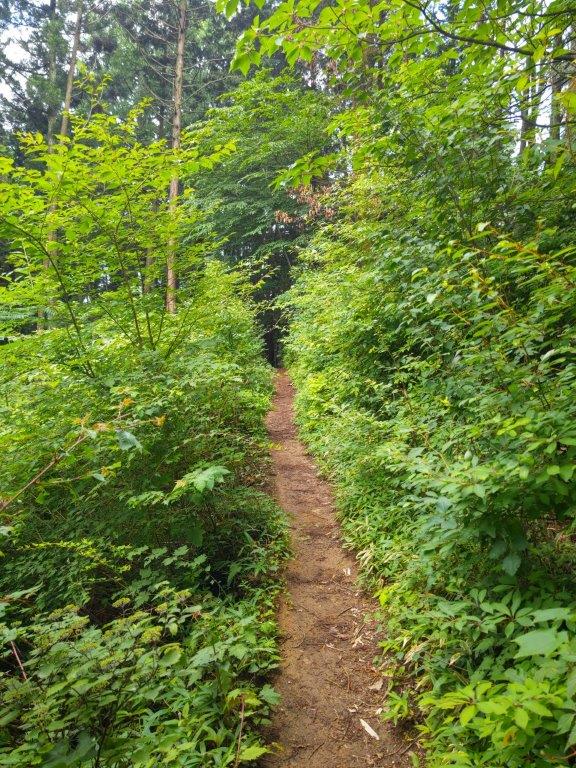
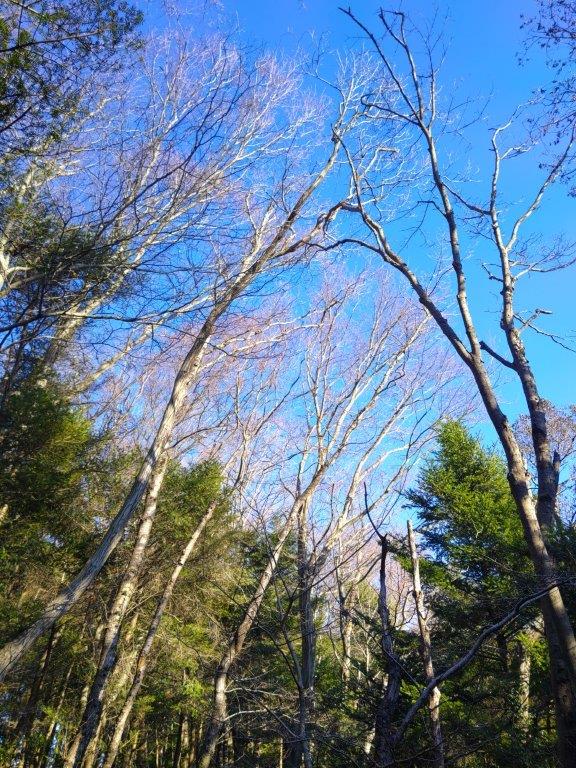
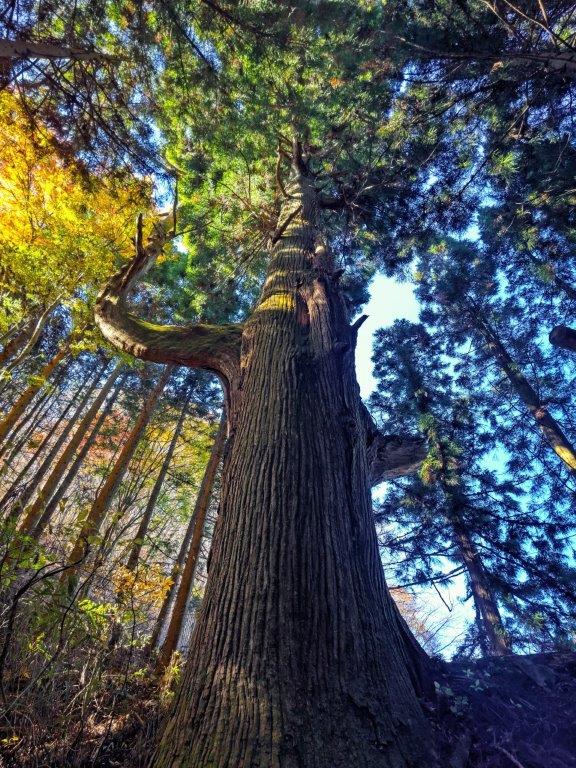
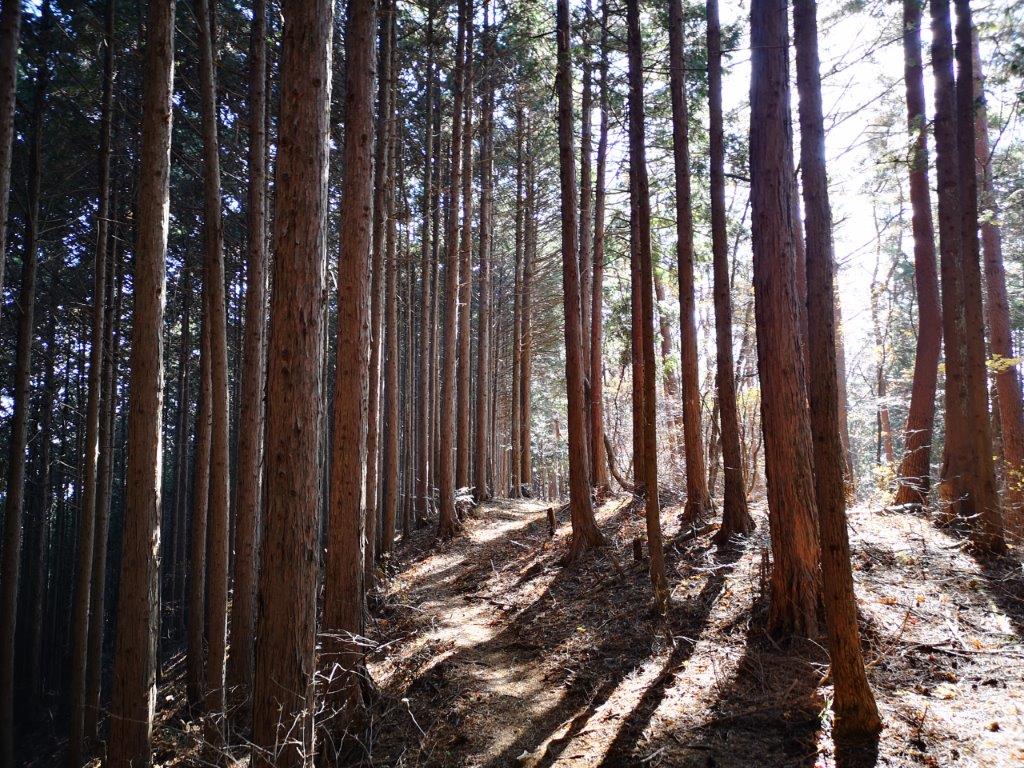
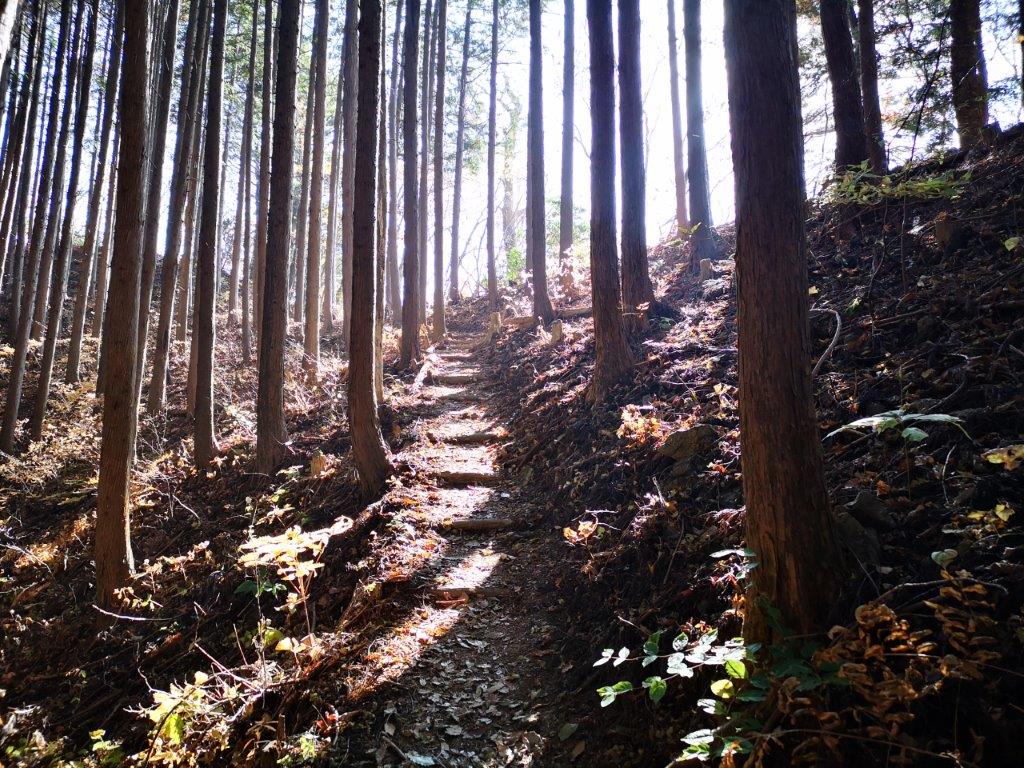
I was glad to be walking alongside rushing water since it had been nearly 6 months since my last river hike. I kept up the fast pace, and after reaching a couple of benches at Mushikari Pass (ムシカリ峠), turned right up a series of log steps for the final part of the climb. The beeches here were stunning, with their white trunks and orange leaves. I soon passed a sign for 1500 meters, my fast climbing speed protecting me against the near freezing temperatures. Just after 2pm, I arrived at the Mt Mito West Peak (三頭山西峰 1524m). Mt Mito translates as “three tops” since it is formed of 3 separate peaks. Looking south through a gap in the trees, I could see the top crater of Mt Fuji poking above the clouds; looking north, I could see the prominent peak of Mt Takanosu directly ahead; further away and slightly to the left was Mt Kumotori.

Few People on this Adventurous Trail

Trail before Mito Otaki Waterfall

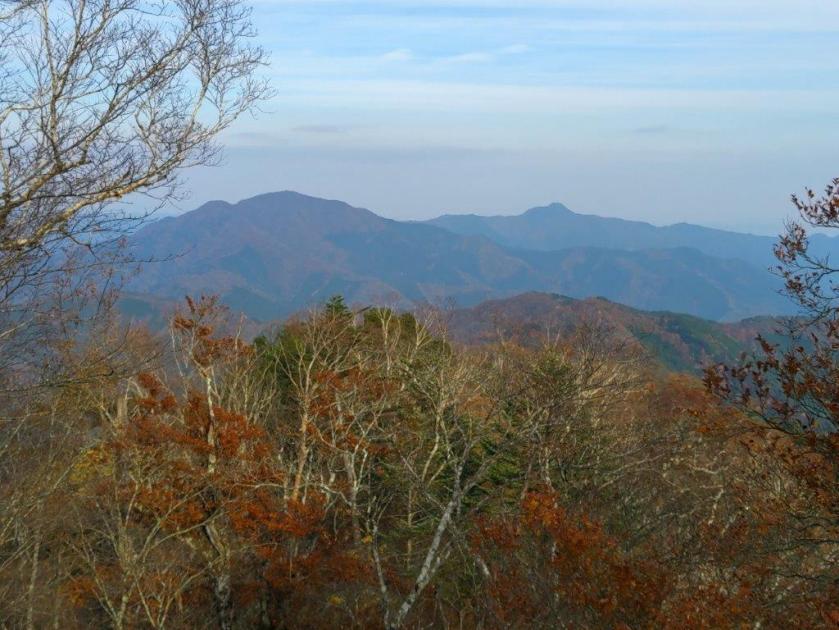
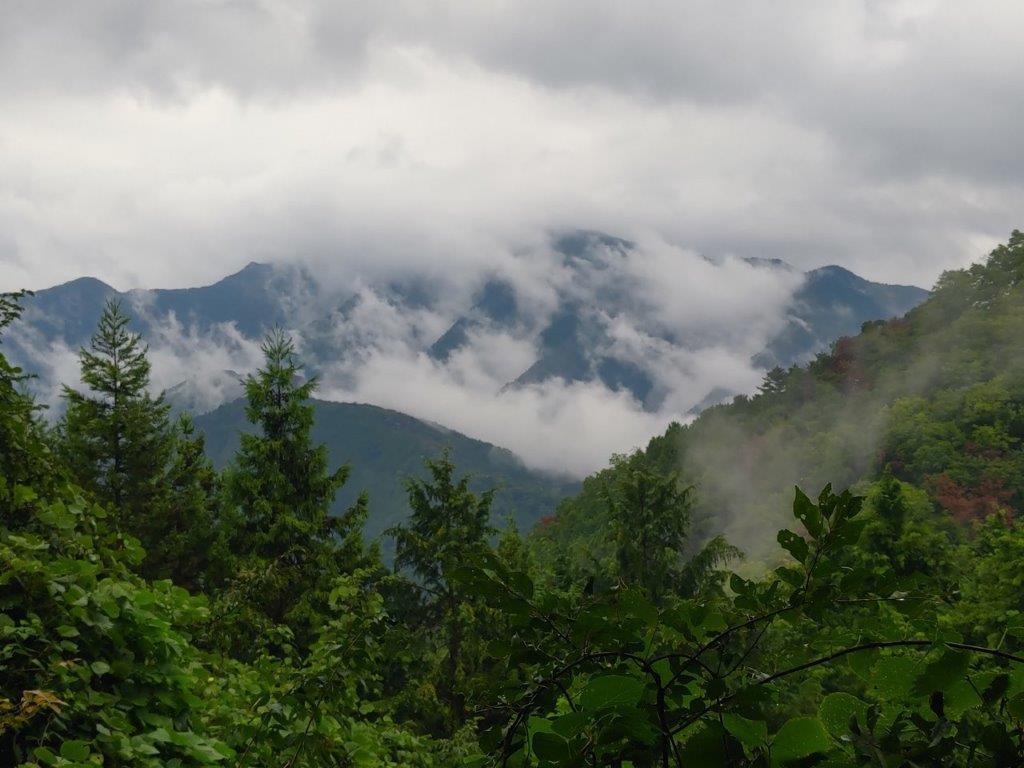
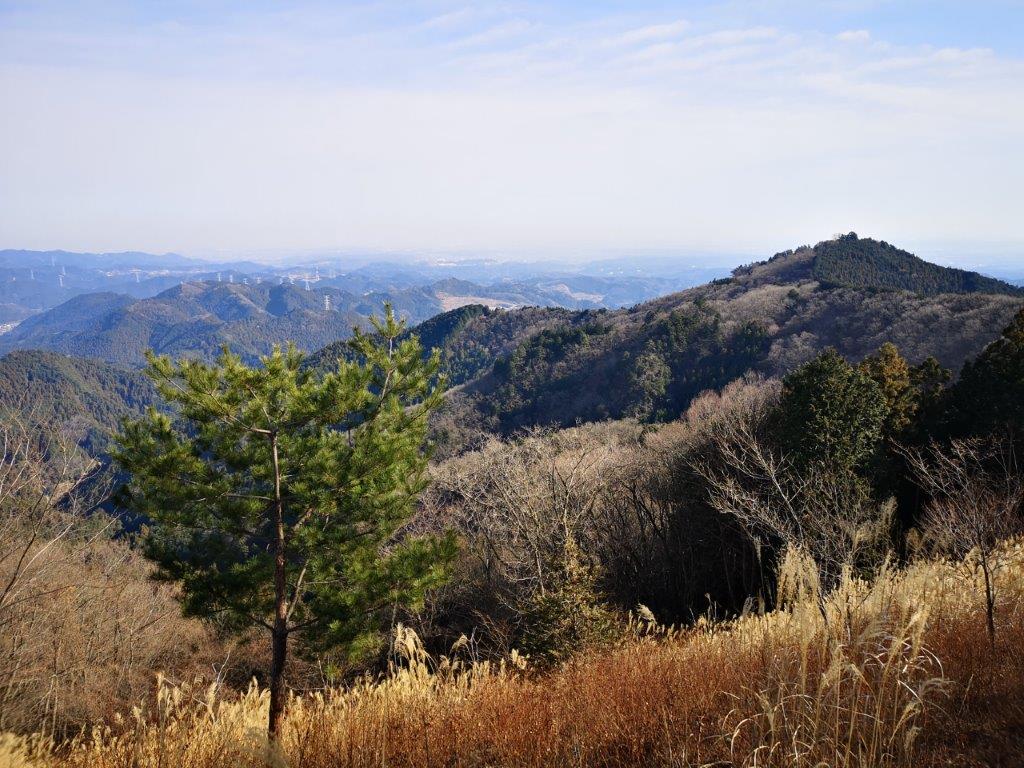
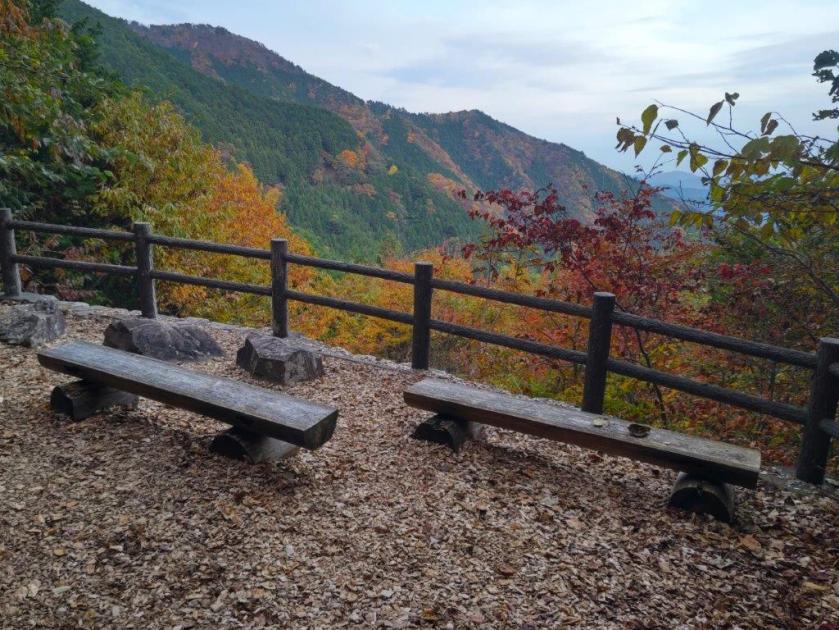
I suddenly felt very cold, the forecasted clouds having filled most of the sky; after bundling up, I headed down a trail on the west side but soon found myself climbing again. In quick succession, I passed the central and highest peak of Mt Mito (三頭山 みとうさん mitou-san) and the Mt Mito east peak (三頭山東峰 1527m), both completely in the trees; beyond was an Observation Point, a wooden deck on the north side of the mountain. Here I dropped my backpack for a late lunch with a view. I could see Mt Gozen and Mt Odake, the Autumn leaves in the foreground slightly muted by the overcast sky. At 2h30, feeling chilled, I shouldered my pack, retraced my steps to Mushikari Pass, and continued straight, following the ridgeline southwards, past the Mt Mito Emergency Hut (三頭山避難小屋). At 3pm, I reached the top of Mt Osawa (大沢山 おおさわやま oosawa-yama), Mt Fuji now hidden in the clouds but Mt Mishotai and Mt Kuki both clearly visible.

Takimi Bridge and Otaki Falls
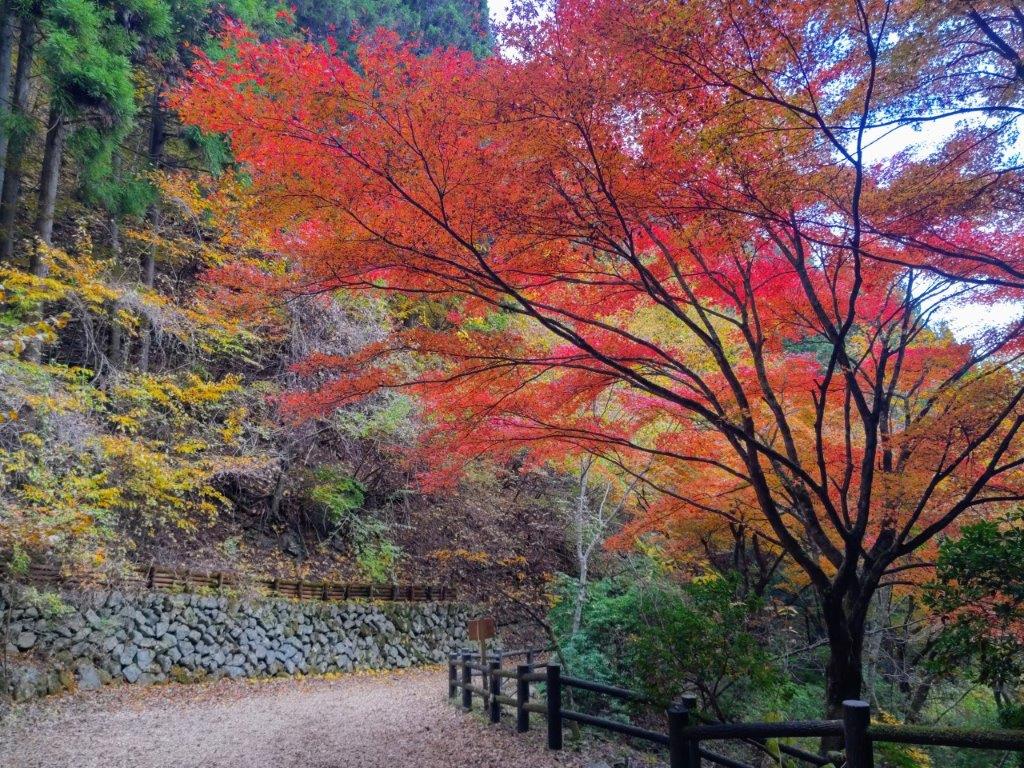
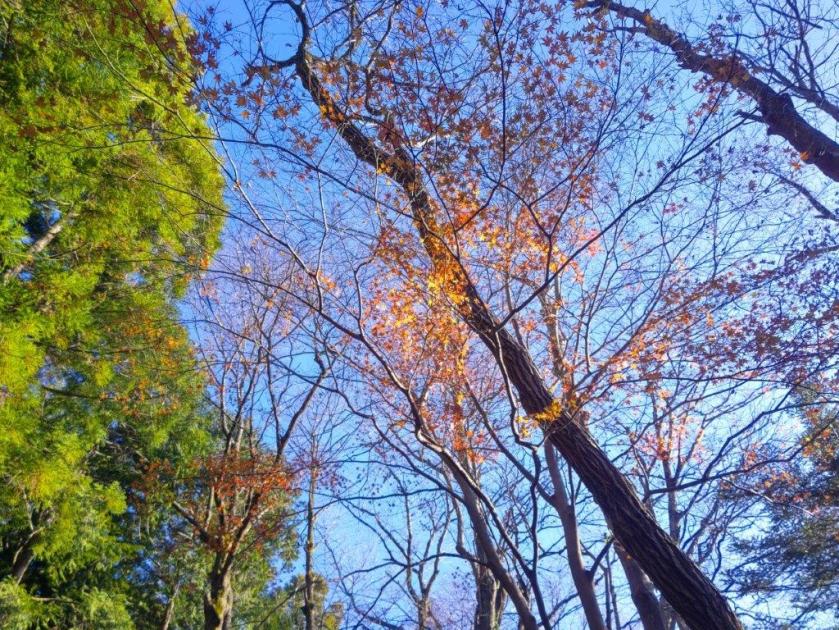
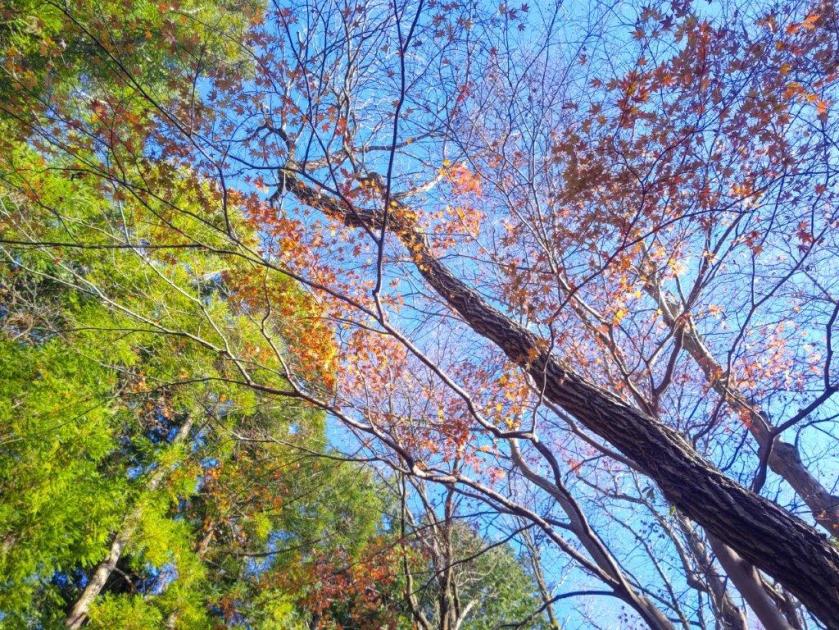
Red Japanese Maple on the Forest Therapy Road

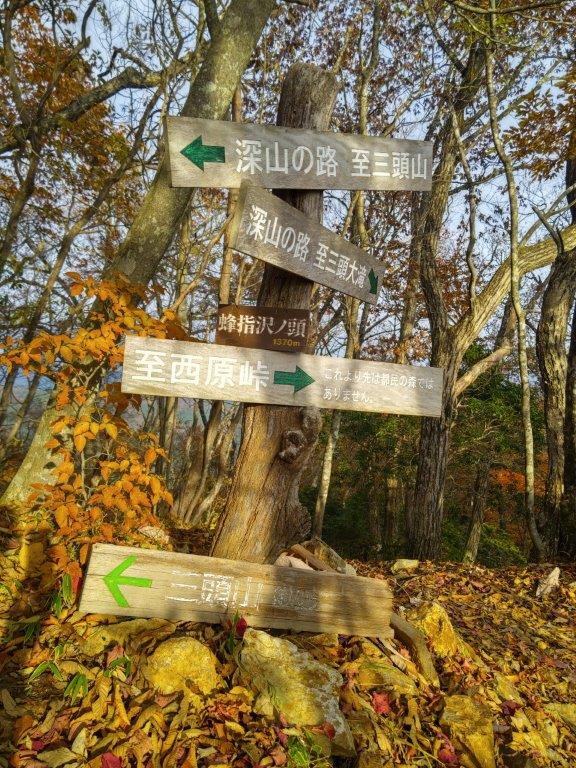
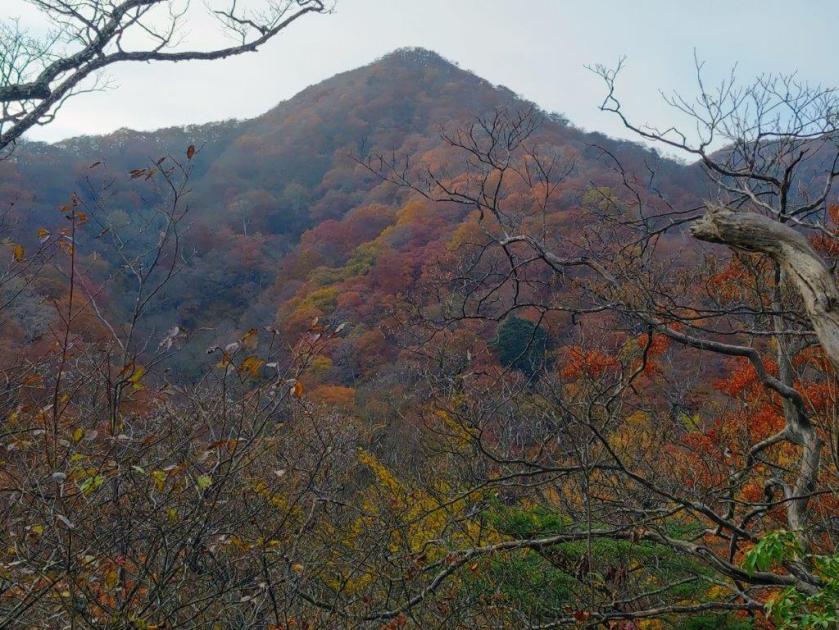
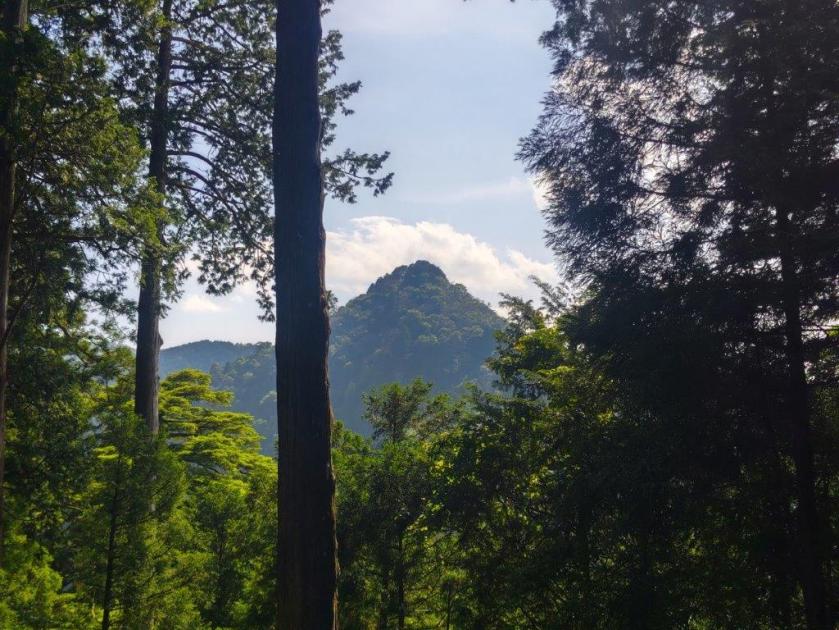
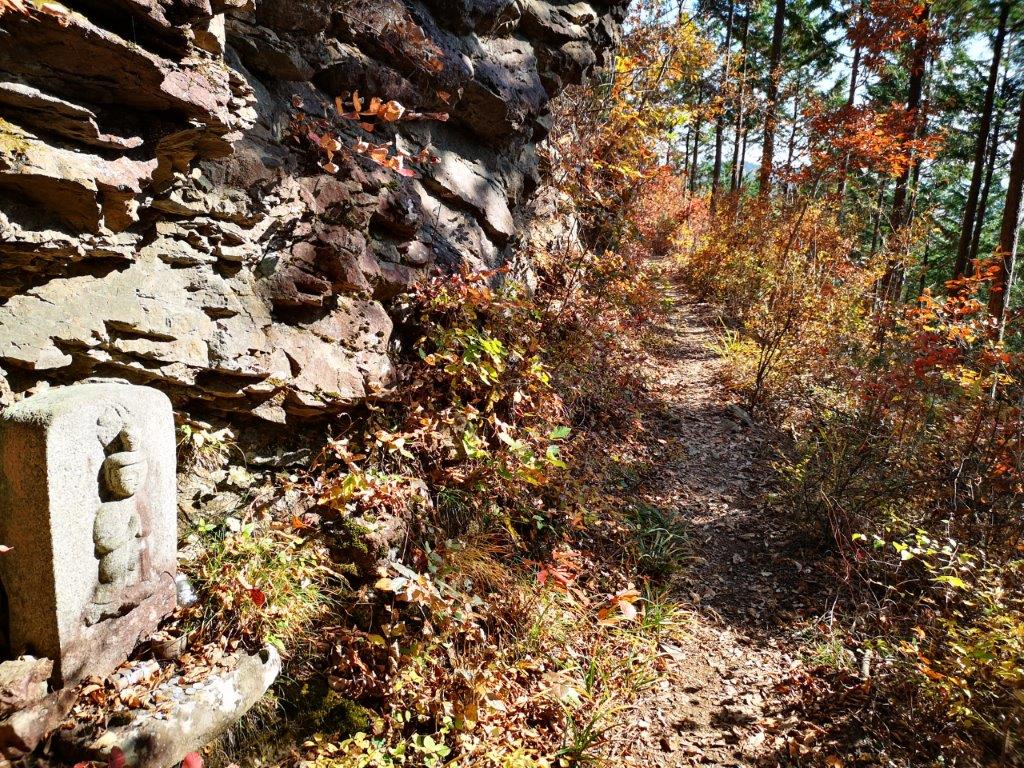
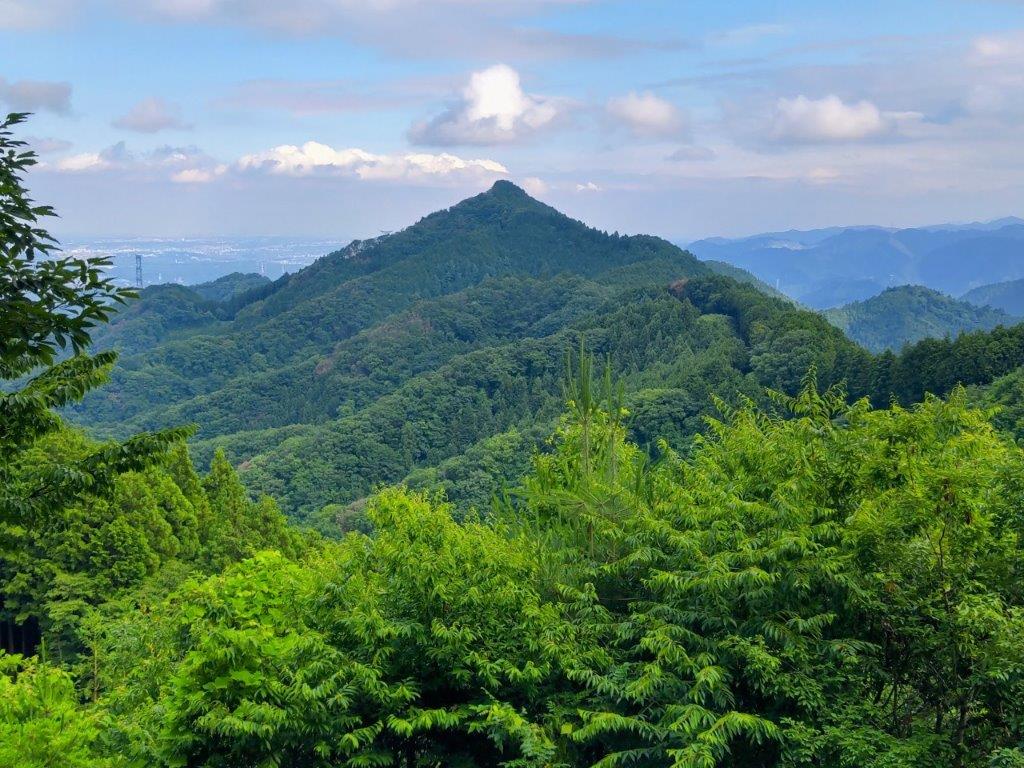
I headed downhill through a deep, quiet forest, now following the Mountain path (深山の路 miyama-no-ro), the only person to venture along it at this late hour. After some level ridge walking, I turned left at a junction, leaving the route of my 2010 hike. From this point it was mostly downhill, through mixed forest in resplendent Autumn colours, interspersed with solitary pines. Around 3h30, I passed a rocky clearing with a view of the triangular summit of Mt Mito on the north side. About 30 minutes later, the path crossed a stream, and after following it for a short while, merged with the Otaki Path. Since I was ahead of schedule, I had time to check out the waterfall again and also drop by the Shinrinkan (森林官 Forest Building) before hopping on the bus for Musashi-Istukaichi station. Light traffic allowed the bus to arrive early again, giving me ample time to buy some local sake before boarding the train for the train ride back to Tokyo.

Watch a Video of the Hike
See More Pictures of the Hike
Okutama Old Road (Highest Point 619m), Okutama Town, Tokyo Prefecture, Sunday, October 5, 2025

I had already walked the Okutama Old Road, also known as the Okutama Historical Road, twice before; however, it had been 8 years since my last visit, so I decided to hike it again to refresh my memory of this interesting trail. I would start from Okutama Lake and walk mostly downhill to Okutama station; by doing it in this direction, I could tackle the steeper sections near the lake first, and also get better views of the Tama river valley.

Hiking in the Chichibu-Tama-Kai National Park

秩父多摩甲斐国立公園

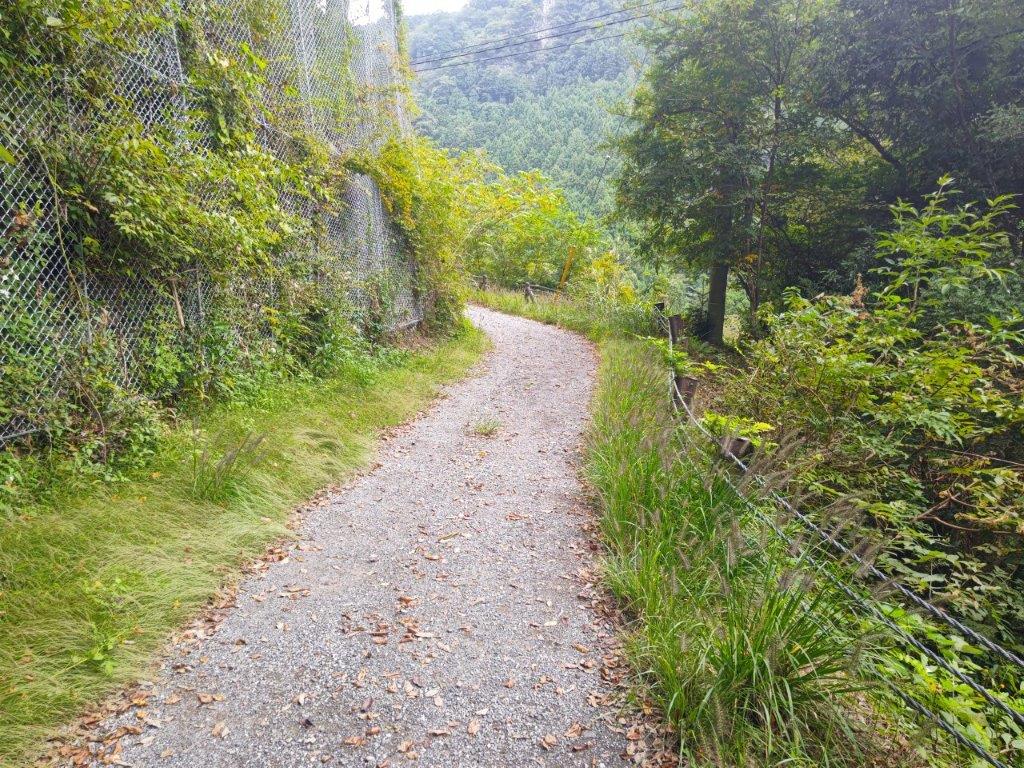
Start of the Hiking Trail (left) Short Uphill Section (right)

Level Section (left) Near the Highest Section (right)

To get to the start of the hike, I would ride the green car on the Ome line from Shinjuku, and then change to a regular car on the Okutama line at Ome station; from Okutama station, it was a short bus ride to the lake. The weather was supposed to be mostly cloudy without rain and temperatures in the low twenties, ideal for some light hiking. I was looking forward to a relaxing, and hopefully spider-free, hike in the mountains west of Tokyo.

Trail before the Rest Spot (left) Road after the Rest Spot (right)

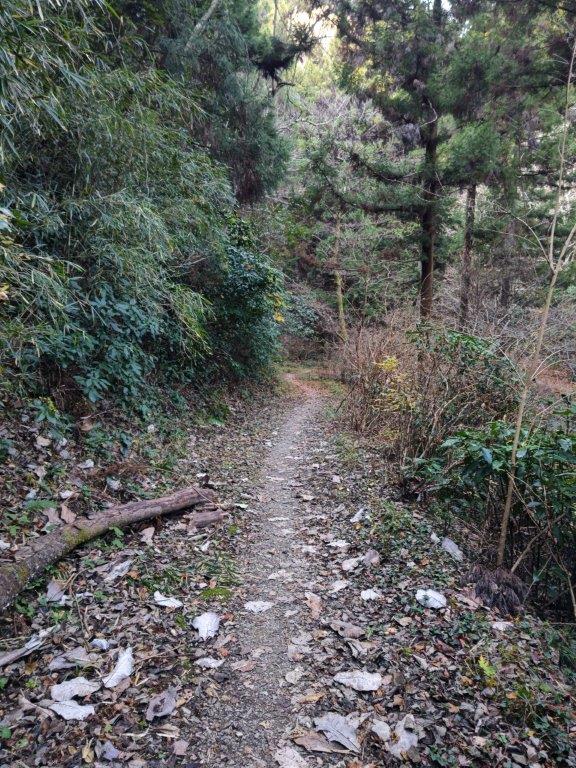
Steps (left) and Forest Section (right) near the End of the Hike

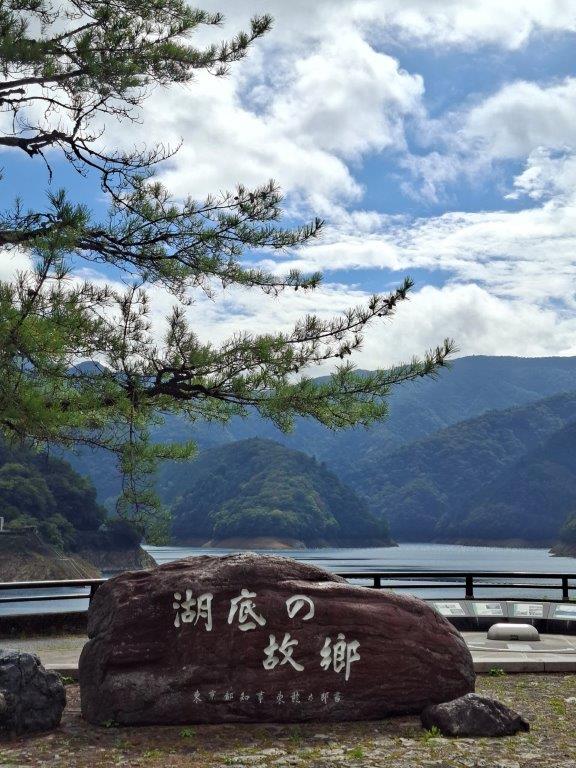
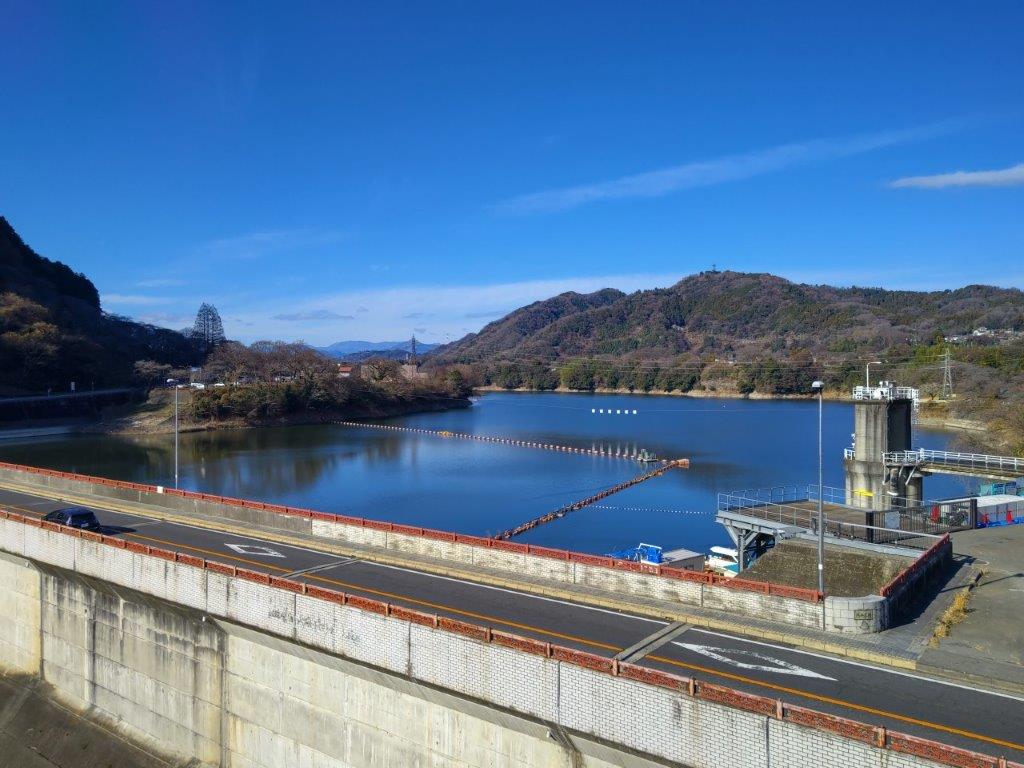
I was delighted to ride a mostly empty bus to Okutama lake, possibly because in this season most hikers prefer to head to higher destinations. After a quick lunch at a picnic table with a view of Okutama Lake and Oguchi Dam, I set off at 12h30. Soon after, I reached the entrance of the “Old Road” (むかし道 mukashi michi), hidden behind the Mizune Parking lot. After carefully crossing the busy Ome-Kaido Avenue, I headed up a steep paved road.

View of Okutama Lake and Ogouchi Dam

The Okutama mountains from the “Old Road” (2012 Photo)

I was startled to feel some raindrops as I reached a fork; I opted for the shorter, right branch, in case it turned into a downpour, which happened in 2017. Fortunately it soon let up, and after passing a bamboo grove and a view of Okutama lake on the right side, I arrived at the start of a hiking trail; this is also where it meets up with the longer, left branch. After a short uphill section, the trail descended steeply through thick forest, but became level after crossing a stream on a moss-covered concrete bridge.

View of the Tama River from the “Old Road” (2012 Photo)

Paved Part of the Okutama Old Road

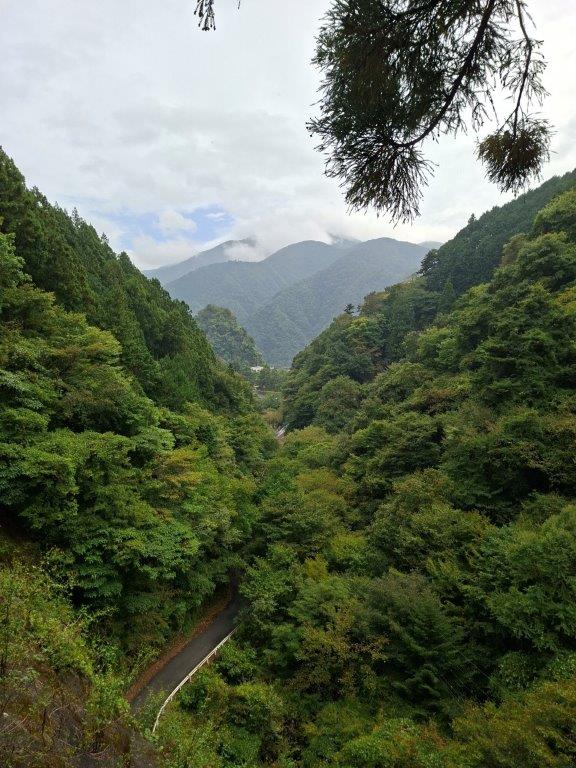
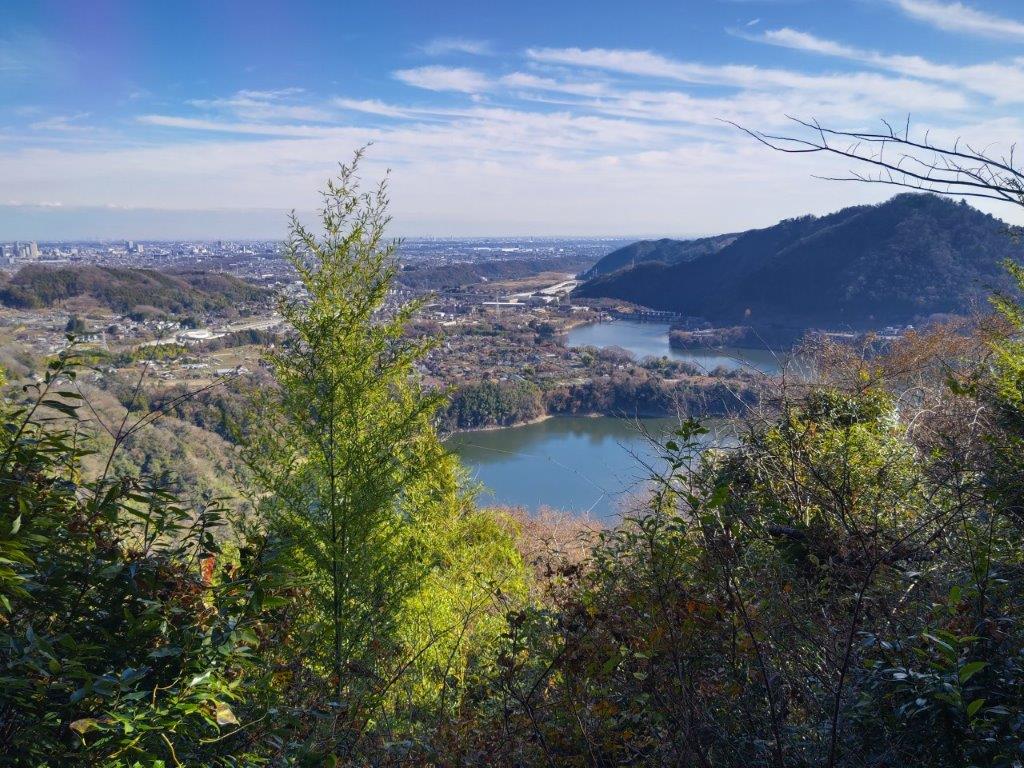
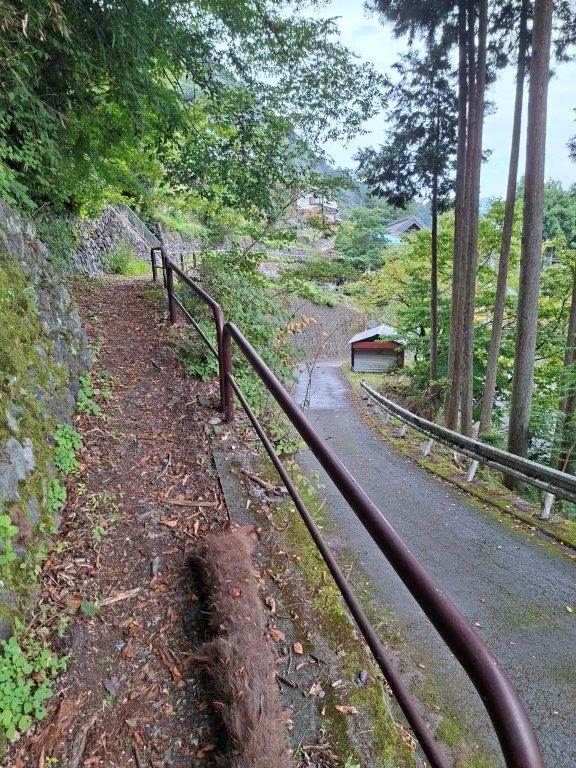
I had forgotten the first part of the trail was so narrow, hugging a steep mountainside; however, a metal railing on the valley side ensured it could be walked safely. After some ascending, I reached a metal cross at the highest point of today’s hike, also the turnoff for Mt Mutsuishi; beyond this point, the trail descended into the valley; on the way down, I had another glimpse of the Ogouchi dam through a gap in the vegetation.

Some Sun on a Cloudy Day

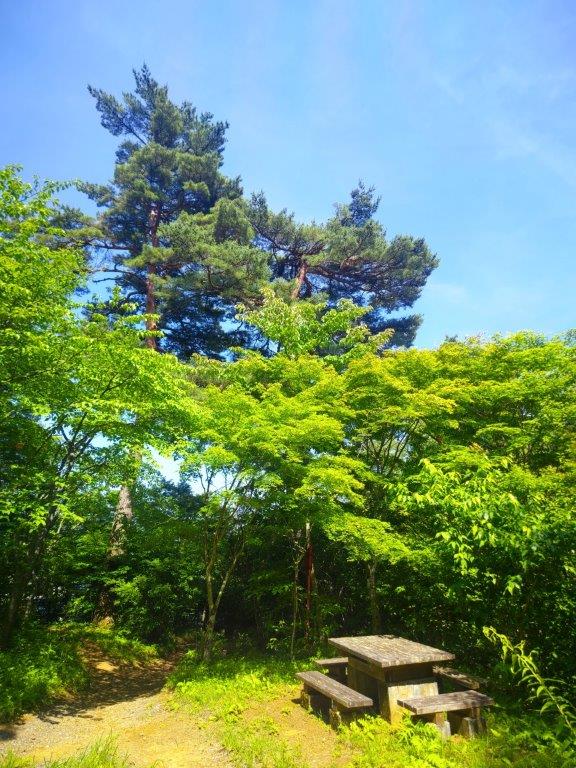
Shidakura Bridge across Tama River

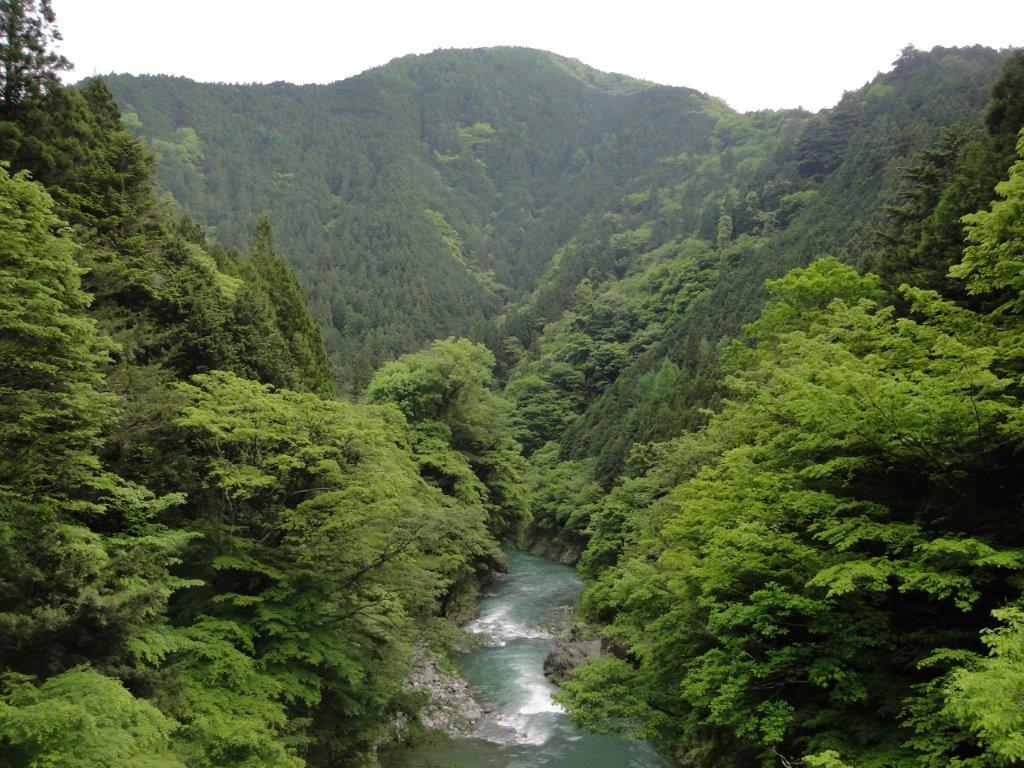
I was shocked how close the dam still was after one hour of hiking; however from now I’d be following the Tama river, moving in a mostly straight line towards my destination. I eventually reached the end of the trail near a rest spot with picnic benches and momiji trees; I now found myself walking along a paved road, the river at times visible through the tree branches. At 2h30, I passed Shidakura bridge (しだくら橋), the second of two suspended footbridges; I walked to the halfway point although it’s not part of the Old Road.

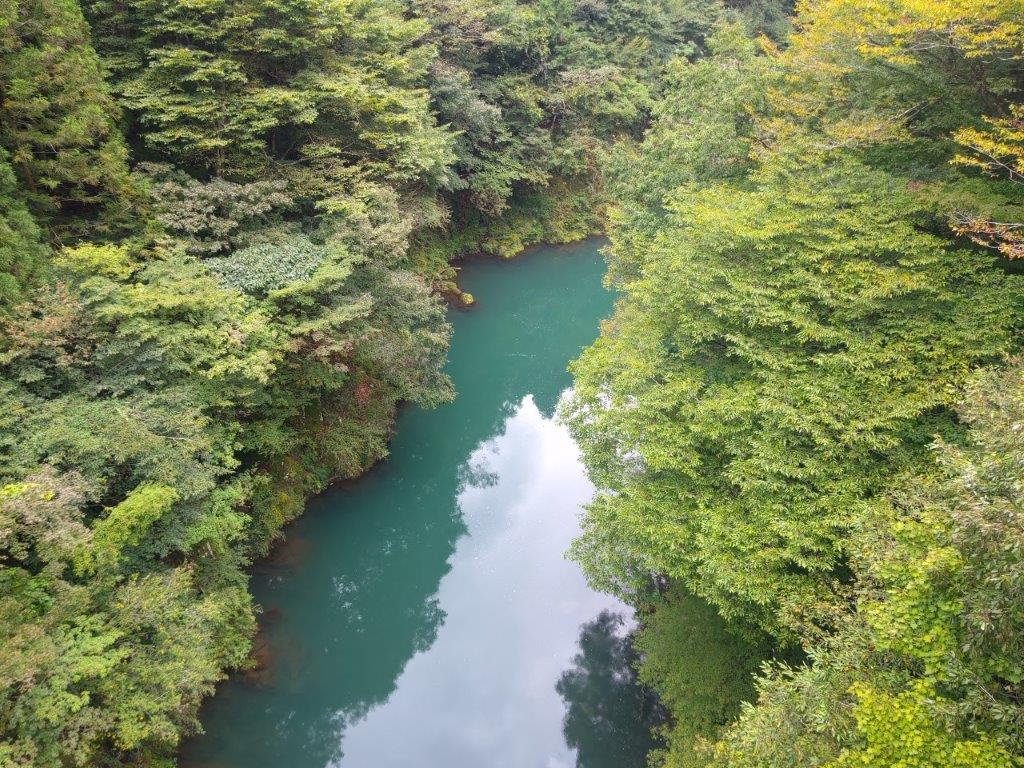
View of the Tama River from Shidakura Bridge

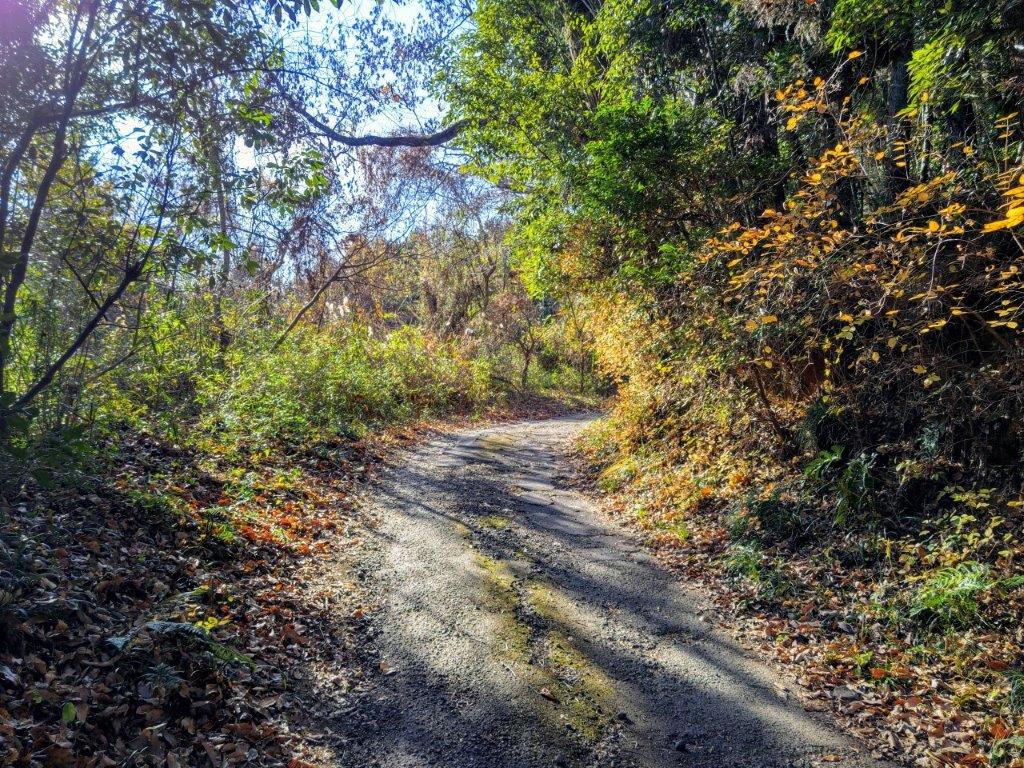
Walking on a Gravel Road

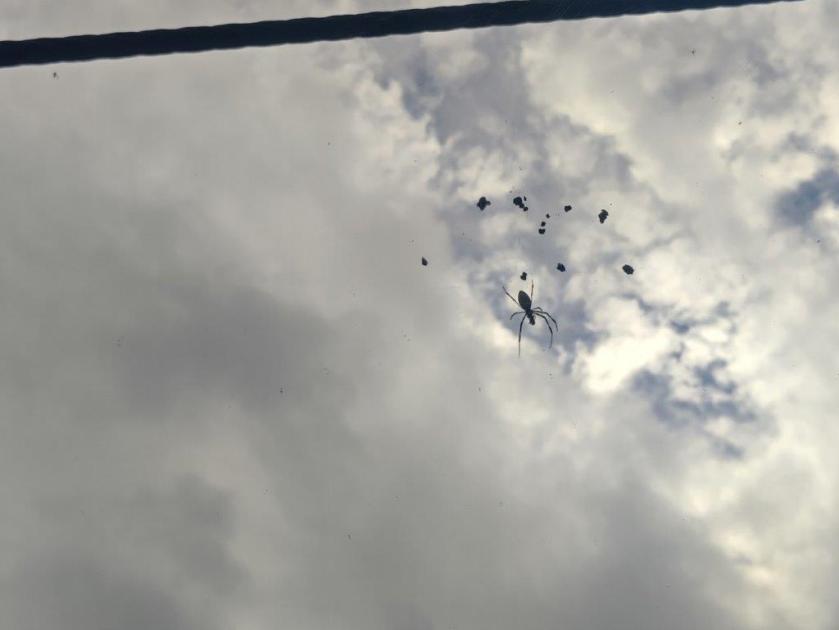
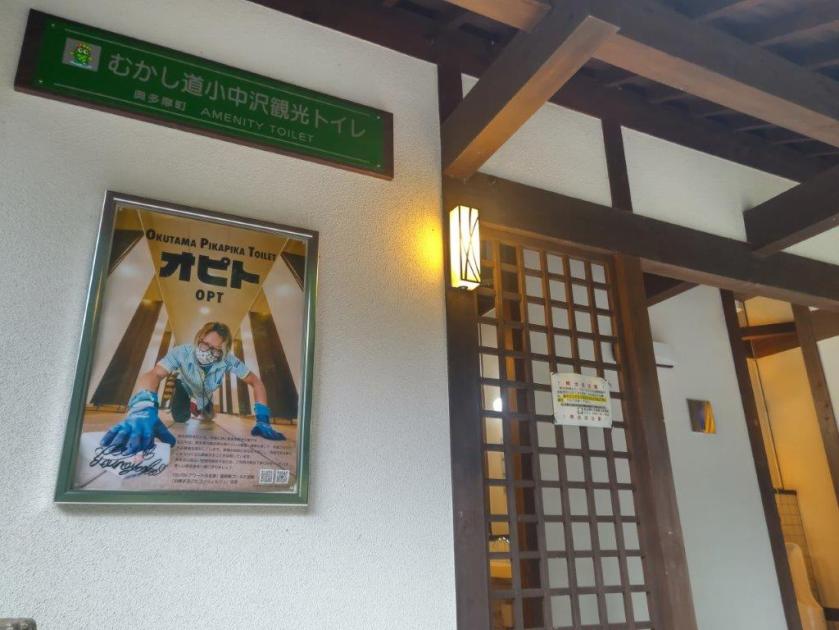
I enjoyed views of the Tama River looking down from the bridge; I also had views of spiders when looking up through the steel wires supporting the bridge. At 3pm, I passed by a modern, clean bathroom inside a traditional building, courtesy of OPT or Okutama Pikapika Toilet (“pikapika” means “with a sparkle”). In total, I saw three such toilet buildings, each as sparkling clean as the other; apparently they are also in charge of the one next to Okutama station.

Modern Bathroom inside a Traditional Building

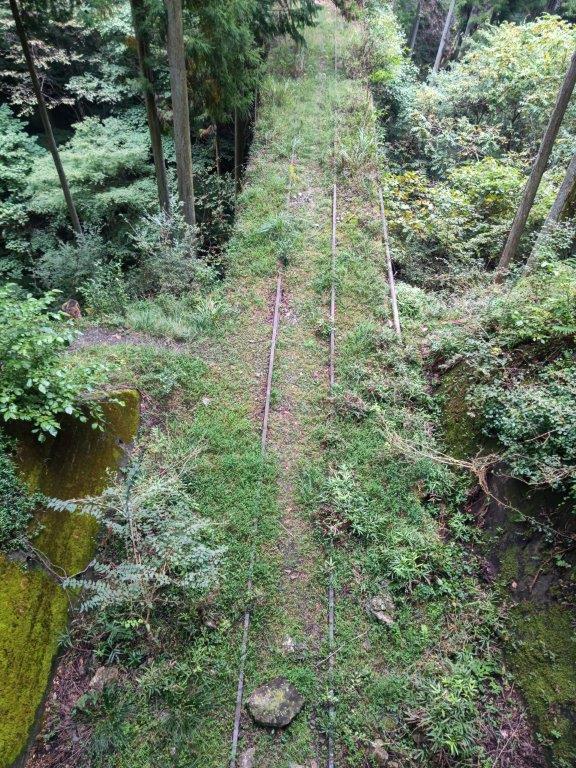
Traces of the Old Railway Line

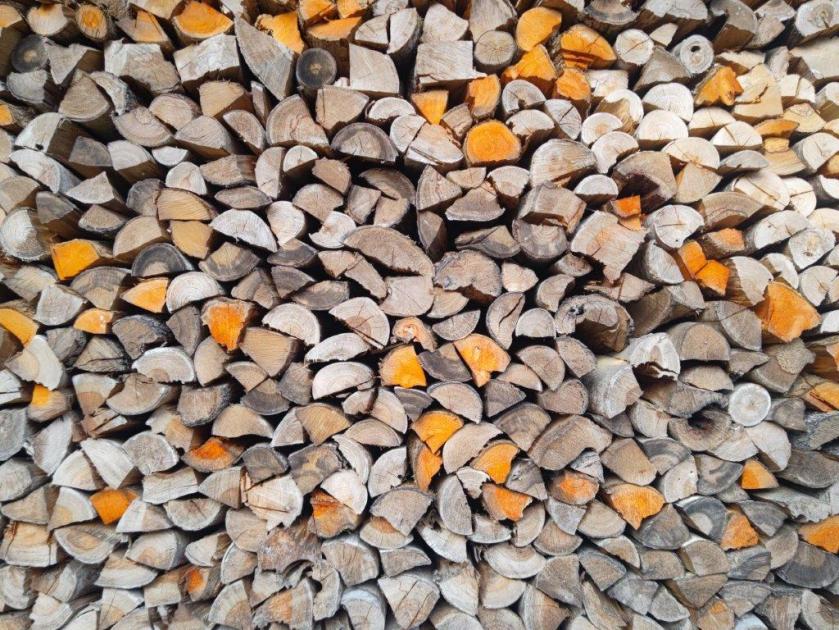
Past a house with a huge firewood stack, I saw remains of the railway that used to run through the valley; it was abandoned 80 years ago after the completion of the present-day road. At a bend in the road, a signpost guided me onto a footpath on the right side; I followed it through tall cedars, down a small valley, across a narrow bridge, and around a rocky outcrop, after which I found myself walking on a stone-paved path.

Footpath near the End of the Hike

Stone-paved Section Near the End of the “Old Road” (2012 photo)

I stepped up the pace as the light was starting to fade quickly on this cloudy day. Shortly after crossing another disused railway section half-hidden by grass, I arrived back at the Ome-Kaido Avenue at 4h30, also the trailhead of the Okutama Old Road. It took another 5 minutes to get to Okutama Station, from where it was a ninety-minute ride back to Shinjuku.

Watch a Video of the Old Okutama Road Hike

See More Pictures of the Hike
Mt Mitake (929m) & Mt Hinode, (902m), Ome City & Hinode Town, Tokyo Prefecture, Sunday, June 22, 2025


I had hiked Mt Hinode one year ago but wanted to return for several reasons. First, the recently introduced “green cars” on the Chuo and Ome lines, would make the ride there and back more comfortable; next, the Mitake ropeway would allow me to start hiking from a higher elevation, essential in this season; finally, I could wash off the sweat at Tsuru Tsuru onsen conveniently located near the end of the trail. This time I’d include the summit of Mt Mitake and descend via the shorter Mt Hinode Hiking Trail.

Hiking in the Chichibu-Tama-Kai National Park

秩父多摩甲斐国立公園

Near the Start (left) Near the End (right) of the Ropeway

To get there, I’d ride the JR Ome line from Shinjuku station to Ome station, and change to the JR Okutama line for the 15-minute ride to Mitake station. There, I’d catch a bus for the short trip to the base of the Mitake Ropeway. For the return, I’d ride the bus from Tsuru Tsuru Onsen to Musashi-Itsukaichi station and take the JR Itsukaichi line to Tachikawa. There, I’d transfer to a “green car” on the JR Chuo line for the thirty-minute ride back to Shinjuku.

Hiking in Okutama 奥多摩

Hiking the Kanto Fureai no Michi 関東ふれあいの道

Bench at Fuji-mine Park (left) Steps up Mt Mitake (left)

The weather was supposed to be sunny but quite hot. I decided to leave late in the morning and start hiking in the early afternoon to avoid the time when the sun is highest in the sky; I’d also reach the onsen in the late afternoon, a good time for a relaxing bath and perhaps an early dinner afterwards. I hoped the high temperatures, as well as the Tokyo prefectural elections held the same day, would reduce the number of people who usually visit this popular Tokyo hiking spot.

Find Japan Hiking Maps on Japanwilds and subscribe to our newsletter

Kanto Plain from Mitake Shrine

Mt Hinode from Mitakesan Station

It was a shock to the system to step out of the air-conditioned train into thirty-something degrees outside Mitake station. Surrounded by the mountains of the Chichibu-Tama-Kai National Park it was hard to believe how hot it was but I hoped the temperature would be more bearable six hundred meters higher up, at the top of the ropeway. The five-minute walk between the bus stop and Takimoto station (滝本駅), the ropeway base station, was particularly tough, a steep paved road directly under the sun.

Riding the Mitake Ropeway

View East from the Top of the Mitake Ropeway

Thankfully few people boarded the ropeway. I got a good spot at the back of the car allowing me to enjoy the view as the ropeway gradually gained altitude. It felt less hot at the top station but I knew that the temperature would still continue to rise. At 2pm, I set off through Fuji-mine Park (富士根園地), a green oasis above the ropeway, mostly deserted on this hot day. Half an hour later, I reached the Mitake Visitor Center (都御岳ビジターセンター) where I examined the exhibits and chatted with the friendly staff, glad to be in a cool space for a short while. After setting off again, now on the Kanto Fureai no Michi, I soon reached the turnoff for the first mountain of the day.

Mt Hinode from the Entrance of Fuji-mine Park

View East from the Entrance of Fuji-mine Park

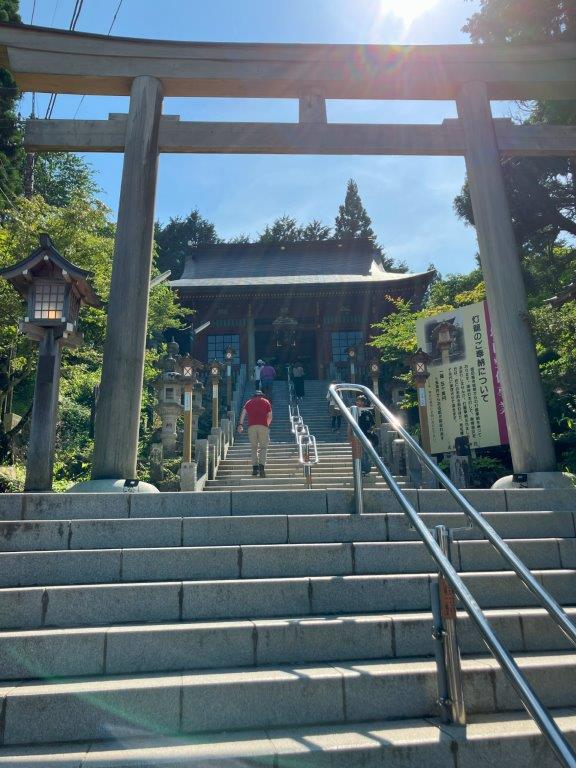
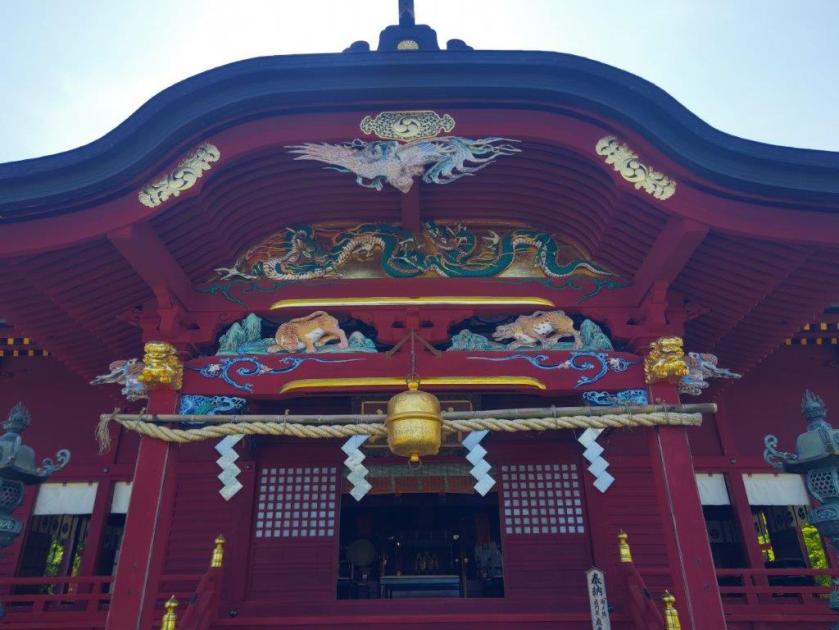
After making my way up a steep slope and then through a street lined with souvenir shops, I reached a stone “torii” and the first of the several flights of steps leading to the top of this sacred mountain. I questioned the wisdom of going up on the hottest day of the year so far, but it had been 11 years since my last visit and I wanted to refresh my memory of this popular sightseeing spot. At 3pm, I arrived at the red and gold Mitake Shrine (御岳神社), where I had a view of the Okutama mountains on the south side. Slightly behind the main shrine building was the summit marker of Mt Mitake (御岳山 みたけさん mitake-san), a Kanto 100 famous mountain. I was so focused on climbing in the heat that I missed the demons carved into the stone steps.

View South from Mitake Shrine

Open Shelter at the Top of Mt Hinode

I was surprised to have the summit to myself as most people seemed to turn back at the shrine. The small auxiliary shrine on this side of the flat summit area seemed to be undergoing some renovation work, blue tarp somewhat spoiling the mystical shrine scenery. It was my third visit, and I had always thought it was completely in the trees, so I was glad to discover that a gap between the cedars allowed for a view of a conical-shaped peak on the west side (possibly Mt Nabewari). I descended back to the junction with the Kanto Fureai no Michi and headed in the direction of Mt Hinode.

View of the Tanzawa Mountains from Mt Hinode

View South from Kuromo Rock

I saw very few people during the next section of the hike, although I did count one cat and one domestic goat. At the top of some log steps I emerged from the shade of the forest onto the sunny summit of Mt Hinode (日の出山 ひのでやま hinode-yama), my fourth time on this Tokyo 100 famous mountain. The view was better than last year, mostly blue sky in all directions. Since it was past 4pm, I retreated to the benches on the east side, out of the sun at this time of the day, for a late lunch break. By now I was starting to feel the effect of the heat so I soon continued my hike. I made my way down some steep log steps, and then turned left onto the Mt Hinode Hiking Trail (日の出山ハイキングコース), a gently descending path on the south side of the mountain.

Mitake Shrine (photo from 2014)

Mitake Shrine (photo from 2014)

I had the final view of the day from Kuromo Rock (クロモ岩) from where I could see a section of the Shirataki Hiking Trail I had taken last June. After passing the junction with the New Mt Hinode Hiking Trail, which mostly follows a paved road, the trail reentered the forest. After a thirty minute descent in semi-darkness through a dense cedar forest, I was relieved to reach a paved road and be back in the daylight; by now the sun was low enough so that the valley was entirely in the shade. At 5h30, I arrived at Tsuru Tsuru onsen, where I made sure to take a nice cold bath, a necessity after hiking on such a hot day. After a light meal and a cold beer, I boarded the bus waiting outside the hot spring facility for the short trip to the train station.

Watch a Video of the Hike

See a Slideshow of More Pictures of the Hike (including 2014 ones)

Sengenrei (903m), Hinohara Town, Tokyo Prefecture, Sunday, September 30, 2024

I was looking for an easy hike close to Tokyo for a misty early autumn day. I had done this long ridgeline twice before, each time on sunny days in the late autumn, so I was familiar with this views; this time, it seemed I’d get to experience a different aspect of the mountain. To reach the start of the hike, I’d take JR local lines to Musashi-Itsukaichi station and from there catch the 9am Nishi-Tokyo bus, for the one-hour ride to the trail entrance.

Hiking in the Chichibu-Tama-Kai National Park

秩父多摩甲斐国立公園

Hiking the Kanto Fureai no Michi 関東ふれあいの道

For the most part I’d follow a level trail along the Kanto Fureai no Michi, ending at Hossowa Falls, about a thirty minute bus ride back to the station. Some rain was supposed to fall throughout the day but I hoped it would just be light drizzle instead of a heavy downpour. On the bright side, this meant I could expect less people on this trail and so I was looking forward to a relaxing ramble through a familiar area.

For subscribers, read this Blog Post on Hiking Around Tokyo for a better viewing experience and the latest updates

Lots of clouds at the start of the hike

Same view but in good weather (2014 photo)

Light rain started to fall as soon as I got off the bus at the Sengen Ridge Trailhead (浅間尾根登山口); fortunately the bus shelter kept me dry while I got ready. At 10am, I started up a switchback trail leading to the top of the Sengen Ridge. Soon after setting off, the rain stopped, although I could still get wet from the tall grass lining the path. Darks clouds hang overhead but as expected I had the trail mostly to myself.

View South of the Mito-Jimba Ridgeline

Looking down at Hinohara Town

At 1130, I reached a viewpoint on top of an area cleared of trees; through the slowly lifting mist, I could see the ridgeline connecting Mt Mito and Mt Jinba. This deforestation was relatively new as I had no recollection of seeing it 4 years before; I passed several more such areas on the way. Soon after, I spotted the first mushrooms of the year, shaped as parasols; the ground was strewn with chestnut burrs (“igaguri“), both signs of the approaching autumn season.

View North of Mt Gozen

Misty Panorama from Sengenrei

At noon, light rain started to fall again, so I bypassed the true summit, taking a detour on the north side, soon arriving at the Sengen Ridge Rest Area, its most important feature being an open shelter. It was the perfect time to take a lunch break. After 30 minutes the rain stopped and I made my way to the observation deck on the lesser summit of Sengenrei (浅間嶺 せんげんれい), a Kanto 100 famous mountain, where I enjoyed a misty panorama. At 1pm, I continued on my way, now on the Kanto Fureai no Michi. After a slippery descent, I turned right at a crossing, and followed a path hugging the north side of the ridge.

Sunny View from the top of Sengenrei (2014 photo)

View North of Mt Odake (2014 photo)

I had several wide views of the misty foothills on the other side of the valley from the top of some more clearings, although the highest points were hidden in the clouds. A little before 2pm, I headed down a rocky river valley, spotting a toad along the way, trying its best to blend in next to a mossy rock. It was only past Tokisaka pass (時坂峠), that I started seeing the first “Jorogumo” spiders of the day, forcing me to wave my stick in front of me to clear the way of hard to spot webs.

View North of Mt Gozen (2014 photo)

Hossowa Falls at the end of the hike

I had almost reached the end of the hike when it started to rain again, this time harder than before. I picked up the pace, arriving at the parking lot at 3pm. I sped up and down the well-maintained path for the falls, my 3rd visit overall, Hossowa waterfall (払沢の滝) looking quite impressive this time, thanks to the more than average rainfall this year. I made sure to buy a box of tofu donuts from nearby Chitoseya before heading to the shelter to wait for the bus back to Musashi-Itsukaichi station, which I reached at 5pm and from where it was a one hour ride back to Shinjuku.

Watch a Video of the Sengenrei Hike

Watch the Video of the Hike on YouTube

See a slideshow of more photos of the hike

Mt Hinode (902m) & Mt Aso (794m), Tokyo Prefecture, Ome City & Hinode Town, Saturday, June 29, 2024

I was looking for another afternoon hike to make the most of the longer days of June. I also wanted to include a river section as it had rained a lot recently. I decided to head to Mt Mitake and follow the Kanto Fureai no Michi to Mt Hinode last visited ten years ago. From there I would follow a ridgeline to a minor peak I had to yet to climb; according to online reports, it had a wide view on the east side. I’d then follow the Shiraiwa-Taki hiking trail westwards to Shiraiwa waterfall, a short distance from the end of the trail. If time allowed, I could drop by nearby Tsuru Tsuru Onsen for a wash and a soak before heading back.

Hiking in the Chichibu-Tama-Kai National Park

秩父多摩甲斐国立公園

Hiking in Okutama 奥多摩

Hiking the Kanto Fureai no Michi 関東ふれあいの道

To get to Mt Mitake, I’d ride the Chuo line from Shinjuku, change to the Ome lime in Tachikawa, change again to the Okutama line in Ome, and get off at Mitake station, a short bus ride from the Mitake cable car. For the return, I’d ride the bus from the hot spring to Musashi-Itsukaichi station, then take the Itsukaichi line to Tachikawa and finally transfer to the Chuo line for Shinjuku. The weather was supposed to be cloudy with temperatures in the mid-twenties. I hoped the higher humidity would still allow for comfortable hiking. I was looking forward to exploring new trails, getting some good views and seeing lots of rushing water.

For subscribers, read this Blog Post on Hiking Around Tokyo for a better viewing experience and the latest updates

Fureai no Michi past Mitake Village (left) on the way to Mt Hinode (right)

Mt Hinode Trail Before the Summit (left) and Past the Summit (right)

It was a cloudy day as I rode the train from the tall, shiny skyscrapers of Shinjuku to the low, green hills of Ome. As I had left around noon, I was rewarded with sitting space on the trains, as well as on the cable car shuttle bus and the cable car itself, my first time to be comfortably seated after half a dozen trips to the area. It was also my first time to visit in June, the green of spring in full swing, white and purple Hydrangea (ajisai) lining the road.

Trail between Mt Hinode and Mt Aso (left) Shiraiwa-Taki Hiking Trail (right)

Falls (left) and Wooden Walkway (right) along the Shiraiwa-Taki Hiking Trail

It felt pleasantly cool felt as I exited the cable car top station just before 2pm. I was relieved that few people had chosen to visit in the rainy season. After getting ready and checking the view of today’s two peaks from Mitakedaira, I made my way up some steps to an observation deck from where I had a slightly better view of the area. I decided to make a quick detour via Ubuyasu Shrine (産安社), a peaceful spot with some impressive cedars, reminding me that I was inside the Chichibu-Tama-Kai National Park. I then headed down a different path taking care not to slip, the ground still wet from yesterday’s rain, arriving at the Mitake Visitor Center at 2h30, also the junction with the Kanto Fureai no Michi.

View of Mt Aso (left) and Mt Hinode (right) from Mitakedaira

View of Mt Aso (left) and Mt Hinode (right) from the Observation Deck

I suddenly felt quite warm as the sun had came out from behind the clouds. After crossing Mitake Village, I found myself on a level path through cedars, arriving at a junction past a Shinto gate at 3pm. I took the left path heading up the mountain side, and less than half an hour later, arrived at the top of Mt Hinode (日の出山 ひのでやま hinodeyama), a Tokyo 100 famous mountain, the name translating as “sunrise mountain”. Looking north, I could see the Okutama Mountains, and to the south, the Tanzawa mountains; straight ahead was the Kanto Plain and Tokyo.

Steps leading to the Observation Deck and Ubuyasu Shrine

View of Tokyo and Kanto Plain from the top of Mt Hinode

I was slightly worried about rain as thick clouds had appeared on the west side, hiding the summit of Mt Mitake. After a break, I set off down a steep trail on the south side, the descent made easier by log steps. Just before 4pm, I reached a T-junction: to the left was the shortest path for Tsurutsuru onsen, favoured by the few remaining hikers; however, I turned right, now following a narrow path, with views of the triangular summit of today’s next mountain on the left side through gaps in the vegetation; I soon left the Fureai no Michi as it descended into the valley on the right. At 4h30 I was standing on the top of Mt Aso (麻生山 あそうさん aso-san), feeling quite sweaty despite the short climb.

View of the Triangular Summit of Mt Aso

Second Viewpoint of Mt Aso

I was stunned by breathtaking view of the Kanto plain, the east side completely free of trees and mountains. I was a little behind schedule so instead of taking a breather on one of the several benches, I headed west, now following the Shiraiwa-Taki Hiking Trail (白岩滝ハイキングコース). As I walked down a dark valley, I could hear the bark of deer but never saw any. Very soon, I was walking beside a small charming stream, my hopes for the day fulfilled. A little after 5pm, I arrived at a trail junction, where I went right, sticking close to the rushing water. I passed several small falls before arriving at a point where the trail had collapsed.

View of Mt Mimuro from Asodaira

Trail leading to Shiraiwa-no-Taki Waterfall

I thought I’d have to turn back but then noticed some rope leading down into and then up and out of the jumble of rocks and sand. Proceeding carefully and using the rope, I safely crossed to the other side and was soon walking again on a normal, but slippery trail. Shortly after, I arrived at the highlight of the hike, Shiraiwa waterfall (白岩ノ滝 shiraiwa-no-taki). The path took me right next to the falls, the sound water roaring in my ears; at the base, I crossed a bridge and made my way to a an observation platform on the opposite side.

Preliminary Waterfall near the Collapsed Part of the Trail

View of Shiraiwa Waterfall from the Observation Platform

I gazed in wonder at the thundering falls, wondering how much of the water was due to the recent rainfall. I was also amazed I had the place entirely to myself, although this may have been due to the late hour. I eventually pulled myself away from the view, and at 6pm, arrived at a bus stop at the end of the trail. After a short wait I boarded a bus for the short ride to Tsurutsuru Onsen, at the end of the line. After a refreshing bath, I boarded the bus again for the 30 minute ride to Musashi-Itsukaichi station where I boarded the 8pm train, finally arriving back in Shinjuku about an hour later.

See a video of the Mt Hinode Hike

Watch the Video of the Hike on YouTube

See a Slideshow of More Pictures of the Hike

Mt Enokubo (420m), Sagamihara and Hachioji Cities, Kanagawa and Tokyo Prefectures, Saturday, December 24, 2023

For subscribers read this Blog Post on Hiking Around Tokyo for a better viewing experience

I wanted to do a short and easy hike close to Tokyo for Christmas Eve. I had been doing bits and pieces of the Kanto Fureai no Michi for a while now, and this was a good chance to explore the final section of the Kanagawa trail, starting at Tsukui Lake and ending at Takaosan-guchi Station. I had previously hiked Mt Shiro on the other side of the lake, as well as the first part of the Tokyo Fureai no Michi, from Takaosanguchi station to Mt Shiro (no relation to the Kanagawa one). Since the hike was relatively short, I could leave later than usual, and since it probably had few views, I could expect fewer people. At the end, I could take a hot bath at the Keio Takaosan Onsen, my first time to visit this hot spring right next to the station. The weather was supposed to be cloudy over Tokyo, but sunny over Kanagawa. I would take an express train to Hashimoto Station, and there, transfer to one of the frequent buses for Shiroyama. Afterwards, I could take an express train directly back to Shinjuku. I was looking forward to a relaxing Christmas hike and hoped I could still catch the very last of the autumn colours.

Hiking on the Kanto Fureai no Michi 関東ふれあいの道

Hiking up to Misawa Pass (left) Exploring the Tokyo Fureai no Michi (right)

Hiking down from Misawa Pass (left) Heading to the Takao Green Center (right)

The sky was grey and gloomy as I made my way to the bus stop at Hashimoto station. However, blue sky miraculously appeared as I approached my stop, just before Shiroyama dam. I walked a short distance to a viewpoint of the dam where I had breakfast, warming up under the midday sunshine. It was nearly noon when I finally set off, first on a road next to the lake, then along a forest road up the mountain side. I met no other hikers till I arrived at a Buddhist temple called Mine no Yakushi (峰の薬師), at the halfway point.

Shiroyama Dam and Bridge from the Observation Deck

Forest road for Mine no Yakushi

I was delighted to get some views through gaps in the trees on the southeast side. Directly below, I could see Mt Shiroyama, lake Tsukui; filling up the rest of the horizon was the city of Tokyo. Soon after, the forest road turned into a hiking trail, leveling out as it reached the ridgetop. At 1h30, I arrived at Misawa Pass (三沢峠) where the Kanagawa Fureai no Michi intersects with the Tokyo one. I was tempted me to have lunch at one of the tables there, but was dissuaded by the lack of sun. Instead, I headed up a path on the right and soon reached the top of Mt Enokubo (榎窪山 えのくぼやま enokubo-yama), completely surrounded by trees.

View of Mt Shiro and Lake Tsukui from Mine no Yakushi

View of western Tokyo from Mine no Yasushi

I was happy to see that one of the three benches was bathed in sunlight and I immediately claimed it for my lunch spot. After my break, I returned to the pass and made a short loop along the Tokyo Fureai no Michi, along which I was lucky to spot some fiery orange “momiji” (Japanese maple). At 2h30, I followed a forest road into the valley on the north side, already in the shade; I had the trail entirely to myself. At one point, I thought I heard a wild animal to my left, but it was just my imagination; later on, I thought I heard water coming from the right side.

Clouds were still hanging over Tokyo

Where the city meets the mountains

I was surprised to see that a stream had appeared at the bottom of the valley, turning my forest walk into a river walk. Soon after passing the Takao Green Center, I was back on a paved road surrounded by fields. I sneaked a peak at the outer gardens of Ukai Chikutei, a Japanese restaurant on the way, and was enchanted by the small waterfall and its carp pond. At 3h30, I joined a busy road at Ume-no-ki-Daira (梅ノ木平) that took me under the impressive Takao interchange. Suddenly, shops appeared on both sides of the road, and a few minutes later, I reached the beautiful Takaosanguchi station. After a satisfying hot spring bath, I hopped on the train for the one-hour ride back to Shinjuku.

Waterfall Outside Ukai Chikutei Restaurant

A Rare Shot of Takaosanguchi Station without People

I was glad I was able to stretch out this hike to just over 4 hours, making it a nice Christmas day stroll. The Fureai no Michi frequently follows paved roads but in this case, most of this section was along forest roads and hiking trails. The views from Mine no Yakushi, the hot bath at the end and the easy access at both ends, made it worthwhile. It would be good to return one day to redo the first section of the Tokyo Fureai no Michi, or even a Mt Takao hike.

Watch a Video of the Mt Enokubo Hike

Watch the Video of the Hike on Youtube

See a Slidehsow of more Pictures of the Hike
Mt Odake (1267m), Okutama Town, Tokyo Prefecture, Saturday, November 19, 2022 [Mitakesan Station to Okutama Station]

Hiking in the Chichibu-Tama-Kai National Park

秩父多摩甲斐国立公園

I had hiked this mountain during my first year in Japan, following a route from my hiking in Japan Lonely Planet guidebook. Over the years, I had redone portions of it but not the peak itself. I had originally planned to do the entire route again last summer, but the weather never cooperated; this time, the forecast called for blue skies, little wind and pleasant autumn temperatures.

View towards the Kanto plain from Mitakedaira

I only had faint recollections of the hike, and no blog post, but since it’s a popular, well-trodden trail, I found plenty of information online to refresh my memory. One aspect I could recall was that it was long walk with some steep, rocky sections; fortunately, I was feeling relatively fit and nimble after 3 consecutive hikes.

Mt Nabewari, not part of today’s hiking route

I also knew it would be crowded, especially the first part around Mitake shrine. However, I wanted to go on the weekend to take advantage of the direct train from Shinjuku, a minor comfort to make up for the lack of limited express trains on the JR Ome line. I was looking forward to redoing a classic Tokyo hike inside the Chichibu-Tama-Kai National Park.
A 60-metre high cedar (left) Hiking in the sun past Okunoin (right)

It was a beautiful, slightly chilly autumn day as I rode the “Okutama Holiday Rapid” through western Tokyo. I had arrived early in Shinjuku to make sure I could sit during the 80-minute trip to Mitake, arriving there at 9am. I boarded a Nishitokyo bus for the short ride to the base of the Mitake Tozan Railway. I tried to be quick but could only get on the second bus, added to help with the weekend crowds. I had better luck on the cable car, ending up with a front view for the ascent.
View of Mt Gozen (foreground) and Mt Mito (background)

I had a wonderful view of the Kanto plain, past some fiery larches, from Mitakedaira (御岳山平) next to the Mitakesan top station. It was nearly 10h30, so I quickly moved on, skipping the many steps to the Mt Mitake summit, climbed twice before. I soon arrived at the Nagaodaira viewpoint (長尾平展望台), a couple of minutes off the main trail, from where I could observe the Akigawa river valley. By 11am, I was back on the main trail.

Mt Fuji, clearly visible from the summit

I continued along the wide, easy-to walk path, following the mountain side. I stopped briefly to gaze up at the 60-meter high “Tengu-no-koshikake” Cedar (天狗の腰掛け杉), and also glimpsed a “Kamoshika”, navigating the steep forested slope below. After Okunoin (奥の院), the path started to climb, merging with the ridgeline around 11h30. After some small ups and downs, I reached the start of the rocky section just before noon.

A steep descent aided by steps

I carefully navigated this section, using the fixed chains for support, occasionally waiting for people ahead of me. Past the rocks, I ducked under a Shinto gate, part of the Odake Shrine (大岳神社) and started up the steep summit climb. A little after noon, I was standing on top of Mt Odake (大岳山 おおだけさん oodakesan meaning big peak). From the top of this famous 200-mountain, I had a sweeping view of the Okutama and Tanzawa mountains, with Mt Fuji in the middle. After about an hour, I headed down the other side.

View of Mt Takanosu on the way down to Okutama town

I could enjoy the peace and quiet of the surrounding forest as I saw few people on the descent. The path alternated between level and steep sections, the latter made easier thanks to steps, chains and the occasional short ladder. A little after 2pm, I reached the top of Mt Nokogiriyama (鋸山), surrounded by the trees. An hour later, through a gap in the pines, I had a spectacular view of Mt Takanosu. After a short break, I resumed my descent, quickening my pace as I wanted to be down before dark.

The path alternated between level and steep sections

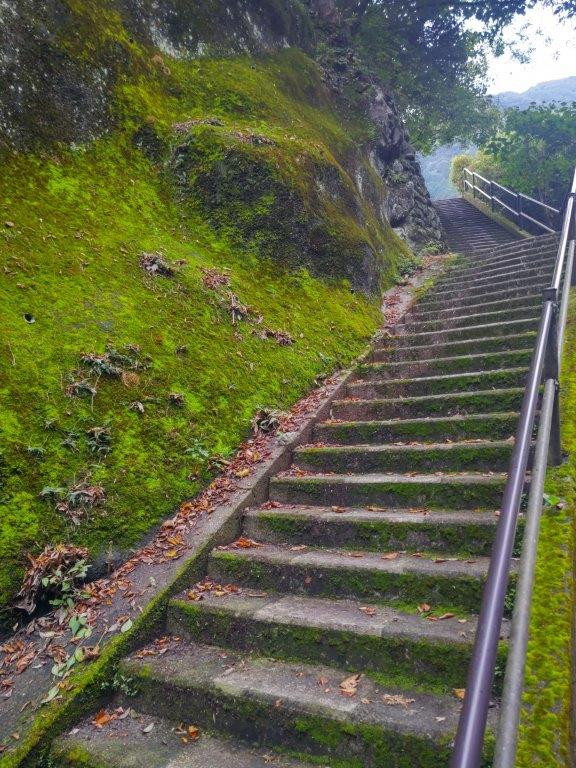
I was relieved when the path became easier to walk, descending rapidly through the dark forest. At 4pm, just as the sun was dipping below the mountains, I arrived at a small shrine on top of Mt Atago (愛宕山). I took a minute to admire the nearby five-story pagoda, before tackling the final stretch, consisting of a long, steep staircase. I carefully walked down the mossy, narrow steps in the gathering gloom. At 4h30 I emerged onto a road near a bridge across the Tama river. After walking to Okutama station a few minutes away, I hopped on the direct train for the 90-minute ride back to Shinjuku.

Autumn leaves and afternoon sun (left) A long, steep staircase (right)

See the autumn views along the Mt Odake hike

See a slideshow of some more pictures of the Mt Odake hike
Mt Iwatakeishi (793m), Mt Kuro (842m) & Mt Onita (505m), Ome and Hanno Cities, Tokyo and Saitama Prefectures, January 2021

I was looking for some more “Kanto no Fureai trails” close to Tokyo. I found a promising section in the Okutama area and decided to combine it with a couple of nearby mountains, forming a zigzag hike, straddling Tokyo and Saitama prefectures. My main concern was whether I would have enough time to complete what seemed like an ambitious hike. The last section followed local trails that weren’t shown on my hiking map, and I was hoping they would be easy to follow. I had been to the area many times before, so I was familiar with the way there and back. The weather forecast was good, and I was looking forward to my first multi-prefecture hike in a while.

Hiking in the Chichibu-Tama-Kai National Park

Looking east towards Tokyo

I arrived at Kawai station at 9h30 on a sunny winter day. I quickly made my way down to the Ome-Kaido road to catch the bus scheduled to arrive in a few minutes. I got off before the other passengers headed for Bonomine, and followed the signs, first through the village, and then along a paved forest road, which later became a dirt road. At 10h30, just when I was starting to think that I would be walking on this road all the way to the top, I spotted the hiking trail leading off to the right and up the mountain side.

The low, hilly area of Oku-Mukashi

The path to Mt Takamizu

The trail went up a small valley through a gloomy, dark forest. Suddenly, it veered left, leaving the valley and hugging the sunny mountain side. It took me another twenty minutes to reach Nasaka pass (名坂峠). Today’s hike was along the ridge to the left, but, I decided to first do a short round trip to the peak on the right. At 11am, I was standing on the top of Mt Iwatakeishi (岩茸石山 いわたけいしやま iwatakeishi-yama), a Kanto hundred famous mountain I had climbed once before in the spring a few years ago. There were so many people at the top it was hard to find a place to sit down!

On the left, Mt Kawanori

The ridge leading down from Mt Kuro towards Kosawa pass

The view was a lot better than I remembered. To the east was the summit of Mt Takamizu; looking north, I could see the mountains of Oku-Musashi; eastwards was Mt Kawanori and Mt Honita. I walked south along the summit ridge to another viewpoint, where I could see right through the middle of the Okutama mountains all the way to Daibosatsurei and the long ridge leading away from it to the south. After having a late breakfast, I made my way back to the pass and started the long climb along the ridge, part of the Fureai no Michi, leaving the crowds behind me.

In the back, Daibosatsurei

This is still inside Tokyo Prefecture

There were almost no other hikers along this section and it was very peaceful. It was also quite warm, and felt like March rather than January. After about an hour, I reached a viewpoint above a cliff from where I could see Mt Mitake and its shrine to the south; behind and on the right was Mt Odake; Mt Fuji, further behind, was hidden by the clouds. I reached the lonely but sunny top of Mt Kuro (黒山くろやま kuroyama meaning black mountain). There was no view but there was a bench in the sun so I sat down and had some lunch. I decided to skip Bonomine, which I had climbed several times before, and head down another ridge; it formed a sharp angle with the one I had just come up, like a bent elbow.

Looking towards Mt Mitake

A good place for a break

Here the trail became more difficult to follow; I was no longer following the Fureai no Michi, and the signposts were less frequent. At one point, I passed a group of lumberjacks just as the tree they had been cutting crashed to the ground (I was at a safe distance). Just afterwards, I crossed a forest road where a group of hunters was getting ready. They had a loud barking dog, but fortunately it was locked inside a cage. I started to walk faster to put some distance between myself and the hunt. Suddenly, I was no longer on the path. Using Google Maps, I saw that the ridge curved northwards around this point. I retraced my steps and quickly found the trail again.

The sunny top of Mt Kuro

Still sunny through the leafless trees

I could hear the noise of barking getting ever closer. The hunting dog eventually caught up and overtook me. Having seemed quite agressive earlier on, it showed no interest in me. Later on, it passed me again on its way back, having failed to find anything hunt-worthy (see video). On the left side, I had some glimpses of the Iruma valley. Around 2h30, the path started to descend steeply and I saw some towering cedar trees. This section was very beautiful and I was glad it was protected since it was part of the Chichibu-Tama-Kai national park. At 3pm I reached Kosawa Pass (小沢峠). It was later than I had planned and I needed to quicken the pace if I wanted to be able to climb today’s last mountain before dark.

Mostly hiking through forest at lower altitude

Approaching the last mountain of the day

The sun was already low on the horizon and I had to be careful not to miss the frequent twists and turns of the trail through the dark forest. It took me one hour and a lot of ups and downs to reach the top of Mt Onita (大仁田山 おおにたやま oonita-yama). There was a small gap through the trees on the east side through which I could see the flat Kanto plain. For some reason, one side of the summit sign was in English. I took a short break before heading down as fast as I could. It took me 20 minutes to reach the road and the bus stop. At 5h30 I was at Hanno station where I got the Limited Express train for Tokyo, relieved that I had managed to complete this long hike before sunset.

Check out the views from the top of Mt Iwatakeishi

Mt Honita (1224m), Okutama Town, Tokyo Prefecture, December 2020 [Monkeys]

For my final hike of the year, I decided to look for something not too far nor too difficult. I wanted everything to go smoothly since many services close around the New Year. I settled on a mountain that could be done station to station on the Okutama line. It was next to Mt Kawanori which I had climbed several years ago in the spring. Back then, the skies were clear but hazy, so I was hoping for better views in the crisp winter weather; perhaps I might even spot Mt Fuji. A less popular climb than its neighbour, I was hoping for a peaceful and solitary hike inside the national park closest to Tokyo.

Hiking in the Chichibu-Tama-Kai National Park

Hiking up Mt Honita

I reached Hatonosu station at 10am on a blue sky winter day. I soon found the start of the hiking trail, and after climbing through the village, entered the forest covering the mountain side. One hour later, I arrived at the first trail junction, marked by a small shrine. I took a short break and then headed up the left branch. The path climbed gradually through dark forest. At noon, I emerged from the trees onto a steep ridge partly free of trees. By now, however, thin clouds had rolled in; looking back, the views east towards Tokyo weren’t as good as I had hoped. A little later I was standing on the top of Mt Kobutaka (1116m コブタカ山).

Still sunny in the morning

Getting cloudy around noon

I continued without a break, and after some more climbing, reached the top of Mt Honita (本仁田山 ほにたやま honitayama). Despite the high clouds, I was able to see Mt Fuji, just to the left of Mt Mito, and perfectly framed by the surrounding trees. Its snowy top was still incomplete, unusual so late in the year. I sat down on a tree stump opposite Japan’s highest mountain and had lunch. It felt cold without the sun, and I soon moved on. The descent was steep and some sections were lined with rocks; I had to be careful not to stumble here, especially since it felt like I was alone on the mountain. Before I knew it, I was already halfway down the mountain. By now, the sun had returned, and it felt a lot warmer; today’s hike was turning out pretty well.

Mt Fuji from the top of Mt Honita

The sun has returned

Around 2pm, I heard some noise from the forest; looking carefully, I spotted monkeys! this was my fourth time to see them this year. Like the previous times, they were rather cautious and kept their distance. The terrain here was steep and rocky, and I couldn’t move far from the path to take pictures. I had to use the zoom of my smartphone camera, balancing image stability with monkey visibility. I finally gave up and continued on my way. Suddenly, around a bend, I spotted a solitary monkey about 10 meters from the path. He didn’t seem to mind me and let himself be filmed while cracking open nuts with his teeth (see video). I had hoped for a solitary hike, but I was glad to enjoy the company of the locals!

An Okutama monkey

The Okutama factory

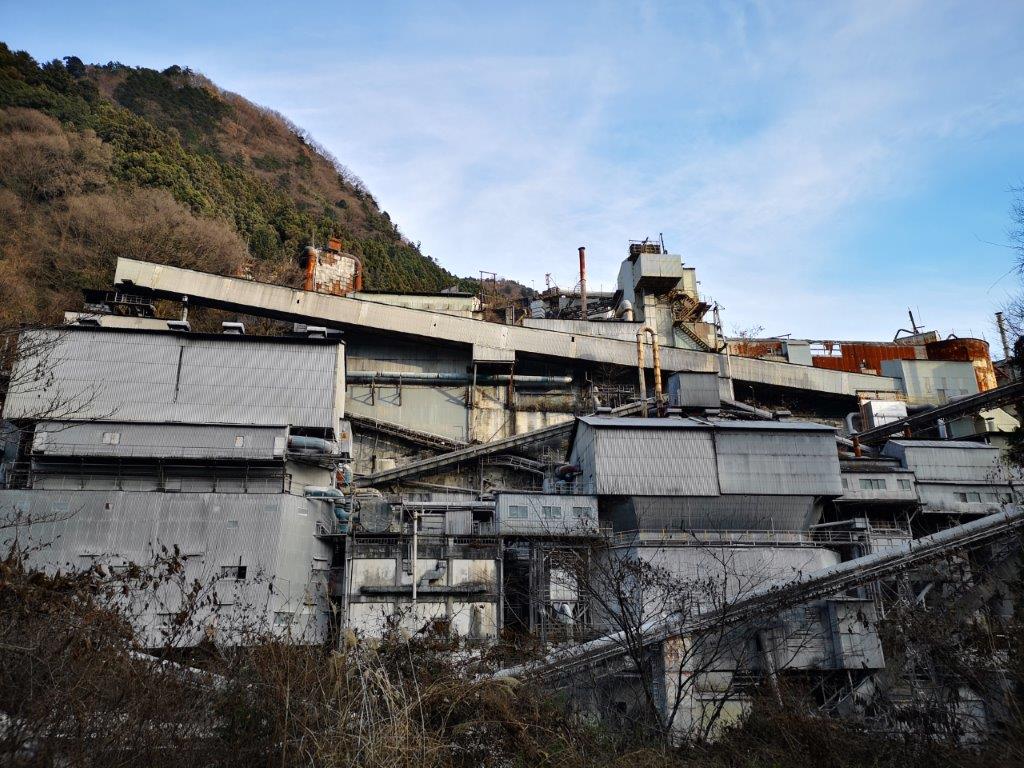
At 2h30, I let the monkeys finish their meal in peace, and resumed my peaceful hike. Ten minutes later, I reached a road at the end of the trail. As I walked back to the station, I passed by the Okutama Industrial Plant. It was an eyesore and a fascinating sight at the same time; an ugly metallic structure inside the Chichibu-Tama-Kai National Park just minutes away from a wild monkey habitat, it was a scene that seemed to belong to a Hayao Miyazaki movie. It reminded of the factory at the base of Mt Buko. At 3pm, I was back at Okutama station, a 90-minute train ride from Shinjuku.

See the monkeys of Okutama in action

Sengenrei (903m), Hinohara Town, Tokyo Prefecture, November 2020

I had good memories hiking this ridgeline in 2014, so I was keen to redo it. This time, instead of starting from the bottom of the valley, I decided to start from near the base of Mt Mito. I would mostly be walking on level or downhill terrain, a rare thing in Japan, so I was looking forward to a relaxing ramble. Last time, I had still been able to see some autumn colours, so I was hoping I would be lucky again, even though the season was nearly over. I also decided to skip the Hossawa falls at the end, since I knew there was less water at this time of the year. The weather forecast was perfect: blue skies and higher than average temperatures. I wasn’t sure if anything could make this hike better.

Hiking in the Chichibu-Tama-Kai National Park

Ask for a hiking plan for Sengenrei

View of Mt Gozen from the top of Sengenrei

It was still early when I got off the bus at the Citizen’s forest (都民の森). While the other passengers headed up Mt Mito, I continued on the sidewalk next to the road for Okutama lake. After it ended abrubtly, I was forced to walk on the winding but busy mountain road. It didn’t feel very safe, but fortunately, I soon arrived at the Sengenone parking lot, where there was an excellent view of the ridgeline I would be following today. After getting ready, I walked past a sign informing me that I was inside the Chichibu-Tama-Kai National Park, and entered the hiking trail a little after 10am.

The Sengen Ridge in the autumn

Hiking a level trail through the forest

Barely 15 minutes later, I reached the first peak of the day, Mt Obayashi 1078m (御林山 おばやしやま obayashiyama). Some trees had been cut down so it was possible to see the view southwards – I recognised the ridge I had hike over a year ago. There was no wind, and no noise, except for the song of a nearby bird. Even though I had just set out, I sat down for a few minutes to enjoy the peace and quiet. After setting off, I quickly reached another clearing with an even better view to the south. The trail was mostly level, with some small ups and down and frequent signposts. Half an hour later, I reached the trail junction I had hiked up 6 years ago; from now, the trail would be more familiar.

The ridge I hiked in June 2019

There were many statues and other religious icons along the trail

I passed a good viewpoint of Mt Gozen on the left, one of the 3 mountains of Okutama. A little further, I arrived at a huge boulder called Saru-Ishi (サル石) because the pattern on the face of the rock resembles the handprint of a monkey. Just before 1pm, I reached a wide deforested area on the left. I had an excellent view of Mt Gozen, Mt Odake (another of the 3 Okutama mountains), and Mt Mitake. In the distance, I could also see Mt Kumotori, the highest point of Tokyo prefecture, and a hundred famous mountain of Japan. I was tempted the stop for lunch, but I knew that the summit with an equally good view, wasn’t far away.

A narrow path following the mountainside

Climbing towards the sun

I reached a junction where both branches were signposted for the summit. On my previous hike I had taken the level path on the left. This time, I took the right branch for the summit of Koiwa-Sengen 908m (小岩浅間). The trail was rather faint and there was no view, so I concluded that the left path was probably the better of the two. Walking down the other side, I soon reached the Sengen Ridge Rest Area (浅間尾根休憩所) where a group of people were having lunch. This is also where the trail merged with the Kanto Fureai no Michi climbing up from the valley on the right. I continued without stopping to the Sengenrei viewpoint just a few minutes away.

Mt Gozen, with Mt Kumotori behind on the left

Mt Odake with a white leafless birch tree in the front

I had the viewpoint entirely to myself. Since it was already 1h30, I sat down on one of the benches surrounded by the pale yellow “suzuki” and enjoyed lunch with a view. Although Sengenrei (浅間嶺 せんげんれい) felt more like a ridgeline, it had a proper summit marker at the highest point. Thin wisps of white cloud had now appeared in the sky, but it was still warm under the late autumn sun. I set off again just before 2pm. After passing a flat area with some beautiful autumn colours, the path started to descend. Suddenly, a helicopter flew by overhead, disturbing the quiet of the forest. I supposed it was bringing supplies to the mountain huts in the area.

Double view of Mt Gozen and Mt Odake with autumn leaves in the foreground

Rocky path down the mountain

The trail left the ridgeline and followed a rocky path next to a small stream. Eventually, I arrived at a soba restaurant (closed today), on the bend of a paved road, which I now had to walk on for a short while. Fortunately, there was no traffic. I walked past a small shrine and a good view of Mt Odake, and arrived at Tokisaka pass (時坂峠) just before 3pm. Here, I ducked down a small hiking path on the right, under a huge fiery red maple tree. The path descended quickly and soon I was walking among small fields and small houses. After walking down a staircase covered in fallen leaves, I joined a paved road leading to the Hossawa Falls marking the end of the hike.

One of the short road sections along the hike

Huge maple tree at Tokisaka Pass

I noticed some movement on the left side just as I walked through Hossawa Falls parking lot. Taking a closer look, I saw a couple of monkeys scampering besides the small river below. I was pretty excited, since it was only my third time seeing wild monkeys this year. Scanning the side of the mountain, I realised that that there was a whole troop of them in the forest above the river. They were shier than the ones I had seen next to Okutama lake the previous year, but I was still able to film them at a distance (see video). I wanted to linger there longer, but it was nearly 3h30, and I had a bus to catch. Since I hadn’t expected to see any monkeys today, I felt quite satisfied with my hike inside the National Park closest to Tokyo.

Ask for a hiking plan for Sengenrei

Check out the monkeys of the Chichibu-Tama-Kai National Park