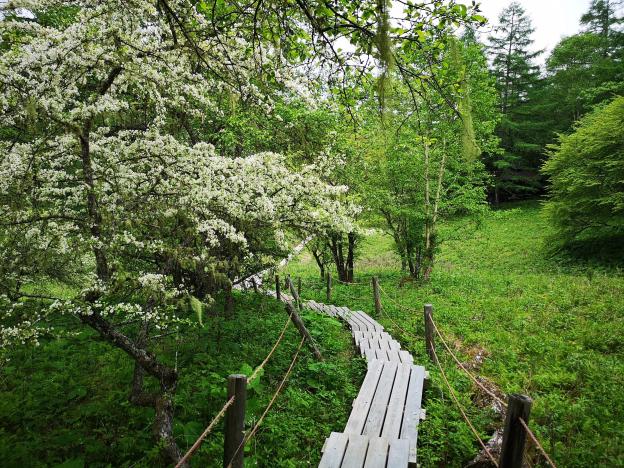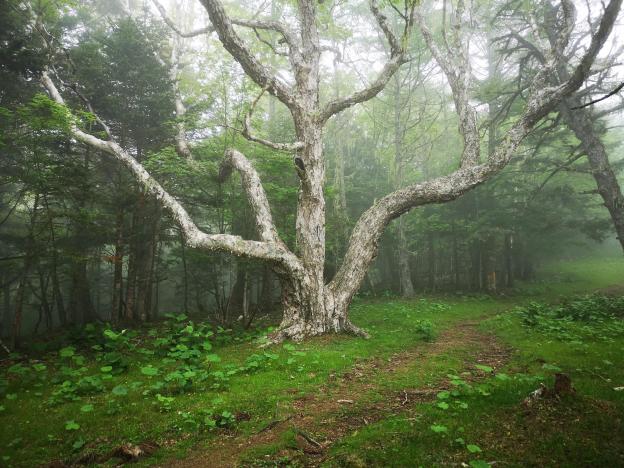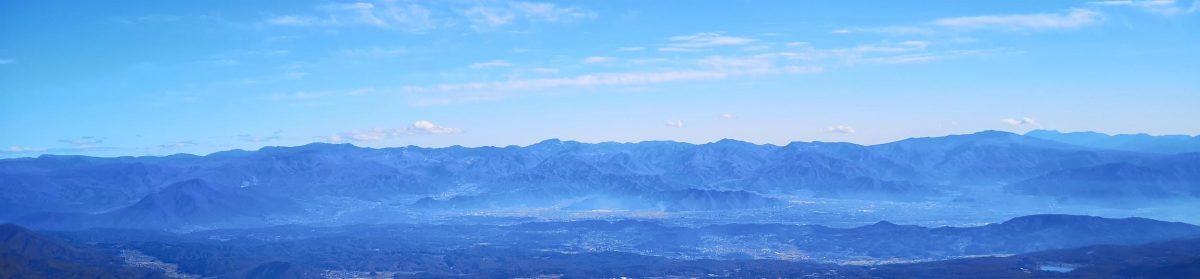
Hiking in the Tokyo Izu Islands

These aren’t day trips, but they are Tokyo hikes, so I decided to include them in this blog. The Izu islands 伊豆諸島 are a group of islands Southeast of Tokyo prefecture – the furthest are the Ogasawara islands, a 24-hour ferry ride away! Last year, my mother visited Japan again, and together we made a visit to the closest island, Izu-Oshima 伊豆大島, and Kozushima Island 神津島, about 60km South of Oshima.

Mt Mihara (758m), Oshima Town, Tokyo Prefecture, Monday October 22

The impressive crater of Mt Mihara

I’ve had my eye on Mt Mihara 三原山 for a while, every since I first spotted it during one of my hikes along the Izu peninsula. It’s also an active volcano which last erupted in 1990, and thus has a spectacular crater. Although there are night ferries from Takeshiba pier to Oshima, I felt that it was wiser to take a daytime ferry and spend the night in Motomachi, the main town, so that we could leave refreshed the next day.

The final climb from the end of the road is not so high

We were very lucky with the blue-sky weather. The views of the Izu peninsula and Mt Fuji from the Mihara Sancho Guchi bus stop were fantastic. At 9h30 we set off for the summit, and from the start we had great views of the flat mountain top. First, we hiked on a level road through shoulder-high (for me) vegetation. We saw a couple of tiny deer dart into the bushes. It wasn’t until I wrote this article that I found out that they are in fact called “Reeves’s muntjac” and they are not native to the island.

Very soon the road started the climb up the side of the volcano, and in no time we reached the top of the wide caldera. From there it was a fairly easy loop walk around the crater. There was an option to walk down towards the crater, but we decided to skip it since we were on a tight schedule.

An easy hiking path on an active volcano

There were beautiful views inwards of the smoking crater, as well as outwards of the Pacific ocean, and the other Izu islands to the South. Although it wasn’t particularly cold, it got windy at the higher points of the caldera. We reached the highest point on the Southern side just before 11am, and after a quick summit photo, we completed our loop of the caldera, and retraced our steps back to the start of the trail. All in all, in was a quick and easy hike with fantastic views.

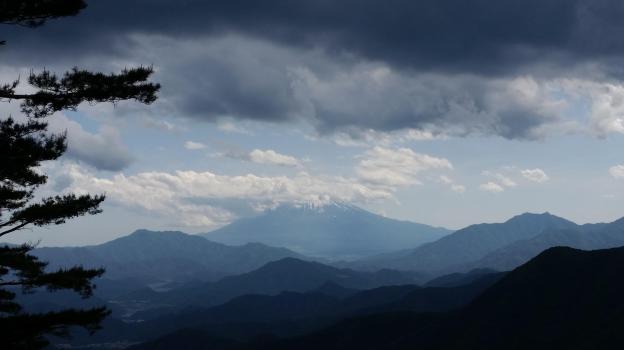
Heading down with views of Mt Amagi (left) and snow-capped Fuji (right)

Mt Tenjo (572m), Kozushima Town, Tokyo Prefecture, Tuesday October 23
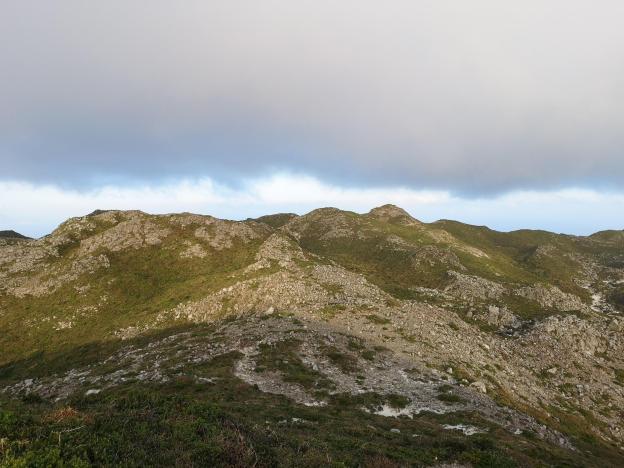
The following day we took the slow ferry two hours South to Kozu island. The highest point is Mt Tenjo 天上山, another volcano and a Kanto hundred famous mountain. The very friendly owner of La Familia hotel gave us a lift to the start of the trail. The first part consisted of a switchback along a steep slope divided into ten stations. As we climbed, the views of Kozushima and the ocean got better and better. Once we reached the end of the steep bit, we were hit with cold gusts of wind, a little surprising considering how many kilometers South of Tokyo we were.

Climbing and climbing…

Once we had bundled up, we took in the surrounding landscape. We seemed to arrive at a sort of plateau covered with a mix of low bushes and grass, punctuated with a number of low rounded summits. Without a map, it would have been hard to know which way to go. The hotel owner of La Familia, had kindly drawn a loop trail on a map, and we followed it religiously. There were a lot more clouds today and thus less sunshine, but fortunately no rain.
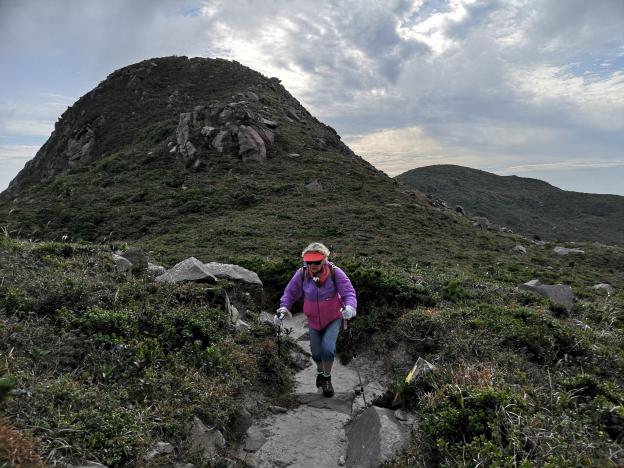
Fantastic landscape near the top of Mt Tenjo

First we headed to the center of the plateau to one of Mt Tenjo’s two sand deserts. Apparently, Kozu island residents think that the sands of Mt Tenjo form the only true desert of Japan, not the Tottori sand dunes. I’ve been to both, and both have merits. After some snapping some photos, we set off for the second sand desert, at the Southern end of the top plateau, where, from certain angles, you could think that you are really walking in the desert.

Walking through Tokyo’s desert

A few minutes away, there was a good viewpoint to the South. It was fun to watch a boat zip around a rocky island below in the distance. We were only 500 meters high, but it felt much higher since we were directly above the sea. We then set off Northwards, following the Eastern edge of the plateau. The path started to rise slightly, and we reached what is known as one of Tokyo’s top hundred views 新東京百景展望地. The view of the Tokyo islands we had passed the day before by ferry, sitting like white and green gems in the middle of the blue ocean, was indeed stunning.

Looking Southwards

After pulling ourselves away from the view, we set off for the true summit of Mt Tenjo, which we reached just before 4pm, a relatively late time in the shorter days of Autumn. There we could take in the entire plateau we had spent the whole afternoon traversing. More than half a kilometer below, was the village of Kozu island – it looked so far away, and we had to walk all the way back down!
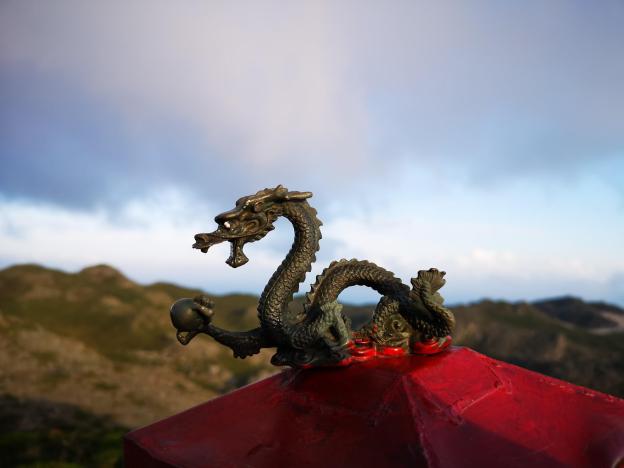
Dragon on top of Mt Tenjo’s summit marker

A well marked path

Going down and down

We were the only hikers on the mountain

We set off hurriedly as the sun slowly approached the horizon to the West. A different switchback path took us down, and soon we were walking under forest cover at the base of the volcano. Darkness was falling quickly and trail was getting harder to follow. Finally, just when I was considering taking out my headlight, we reached a road at around 5h30. Thirty minutes later we reached our hotel, where we were rewarded with a couple of cold beers.

Nearing sunset

Two beers (and a turtle) for two tired hikers

Check out the howling wind and desolate landscapes of the Izu islands
Hossawa Falls to Musashi-Itsukaichi Station, Hinohara Village, Tokyo Prefecture, Friday, July 5, 2019

Despite the long rainy season this year, I managed to squeeze in a short hike on a cloudy, rain-free day. Although the elevation of the walk was relatively low – between 400m and 200m – the temperature and humidity were also low for July, so conditions were quite pleasant throughout the day. In general, this hike is best attempted in the spring and autumn.

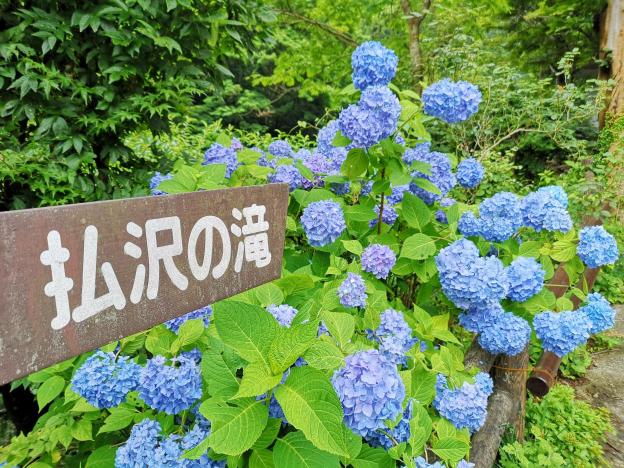
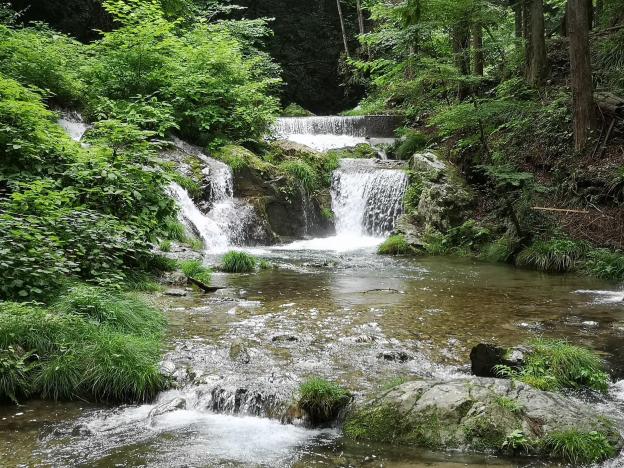
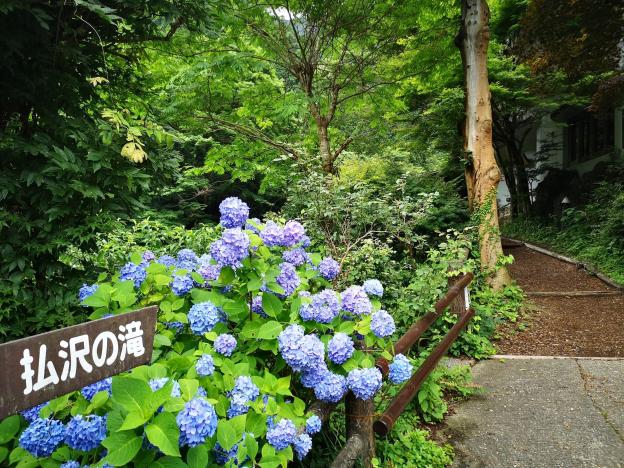
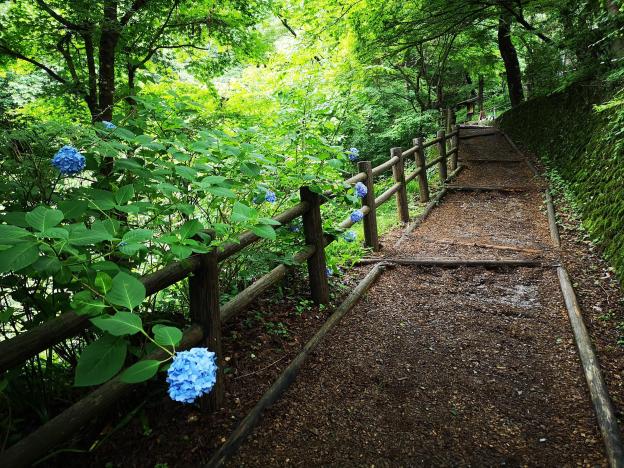
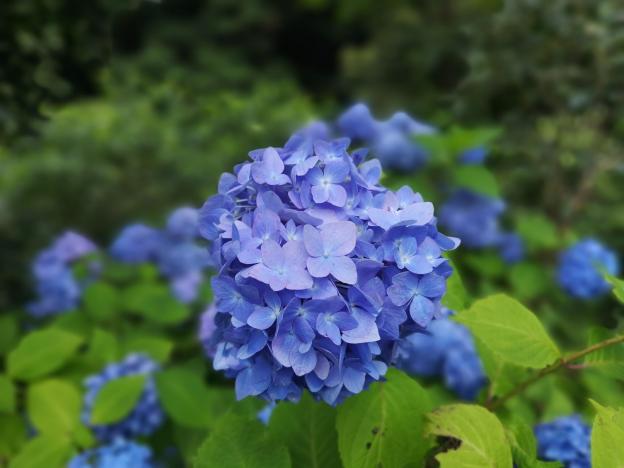
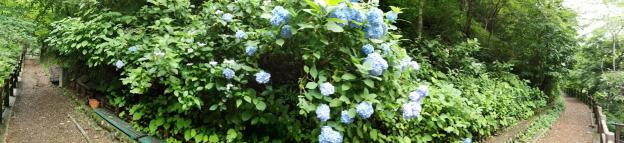
I had last been to Hossowa falls 払沢の滝, one of the hundred famous waterfalls in Japan, located inside the Chichibu-Tama-Kai National Park, after hiking Mt Sengen 浅間山 a few years ago. Then, Autumn was in full swing and I got to see some beautiful autumn leaves along the short trail to the waterfall. This time, the surrounding trees were lush with green leaves, and hydrangea flowers (ajisai アジサイ) were still in full bloom. The river and small falls leading up to the waterfall were wider and bigger that I had remembered, perhaps due to the high amount of rain that had fallen in recent weeks.

Smaller falls on the way to the main attraction

I had set off late and so I arrived at the Hossawa Falls entrance bus stop 払沢の滝入口, just after noon, and promptly started up the narrow climbing road to the left of Hinohara Tofu – their tofu donut makes an excellent snack! I soon reached an information board that showed the details of the whole area, and another one showing the location of 13 (!) waterfalls in the area of Hinohara Village, Hossawa falls being the most impressive one.

Entrance to the path to the waterfalls

Hossowa waterfall is located at the Eastern base of a narrow ridgeline wedged between the Kita Aki river to the North, and the Minami Aki river to the South. The latter is the longer of the two, and takes its source at the base of Mt Mito. The Kita Aki river joins the Minami Aki river just before the falls. Further downstream, it joins up with the Yozowa river (coming down from Mt Mitake to the North), and finally becomes the Akigawa river (which later merges with the Tamagawa further East).

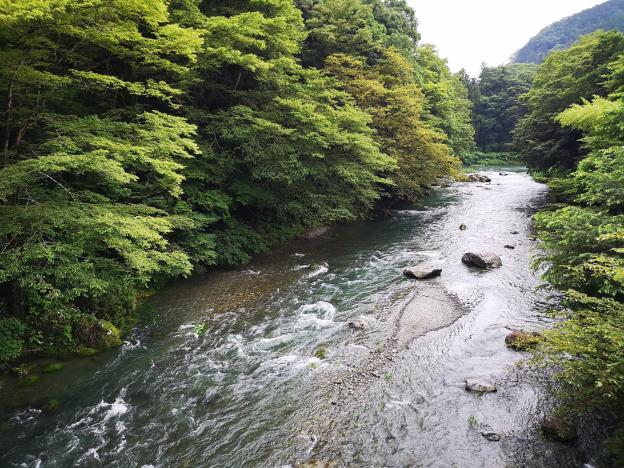
The Minami Aki river after merging with the Kita Aki river

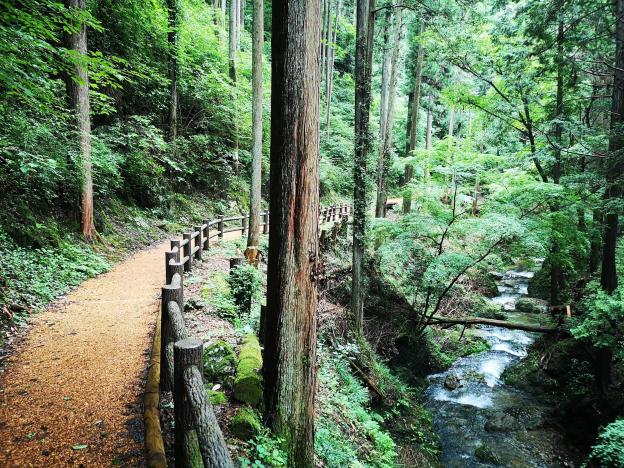
Since I was taking many photos of the river and flowers, it took me nearly half an hour to reach the waterfall, along an easy-to-walk path with no steep inclines. Along the way there were good views of the rushing stream below.

Not a real hiking trail but more of a walking path

On the left, a ravine, on the right, a cliff

There is a wooden sloping section that can get slippery when wet – someone took a tumble just as I was approaching! According to Wikipedia, the total length of the falls is 60m, divided into four sections – it was indeed an impressive sight to behold. You can get relatively close to the base pool, but the best shots can be obtained next to the stream, a little further away. After comparing with photos from my previous visit, I can confirm the falls are much bigger in the rainy season than in the autumn.

You can even feel the wind blowing from the force of the falling water

The return was much faster, and it only took me 15 minutes to get back to the main road. There were few people on a weekday, but I expect there would be a lot more people visiting on the weekend. There is also a cafe at the start of the path but it was closed on Friday.

Racing the stream on the return

Watch out for this interesting chap on the way back

Once back at the Tofu shop, I made my way back to Musashi-Itsukaichi station, sometimes following the main road, and sometimes following smaller and quieter roads on the other side of the river. The various bridges offered nice views of the Minami Aki river. The parts on the left side of the river made for a pleasant ramble through nice countryside with occasional glimpses of the river through the trees.

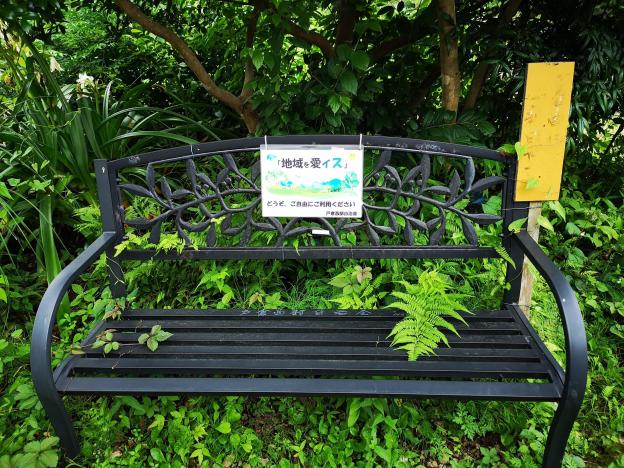
The sign says “Have a seat!”

Just before Sawato Bridge 沢戸橋, about two kilometers from the station, I stumbled upon a small path heading down on the right. According to the information board, it was the Akigawa Kyuryo Trail 秋川丘陵コース, a very nice discovery! I crossed the Bonbori river on a small wooden bridge, and then followed a very nice hiking path along the right side of the Akigawa river.

Careful not to take a tumble into the river!

Too soon the path joined up with the road again. There a small detour away from the river was needed, but soon I was walking next to the Akigawa again with good views of the surrounding hills. I reached the train station just after 5pm. Hopefully, I’ll be able to return sometime and continue hiking East along the Akigawa!

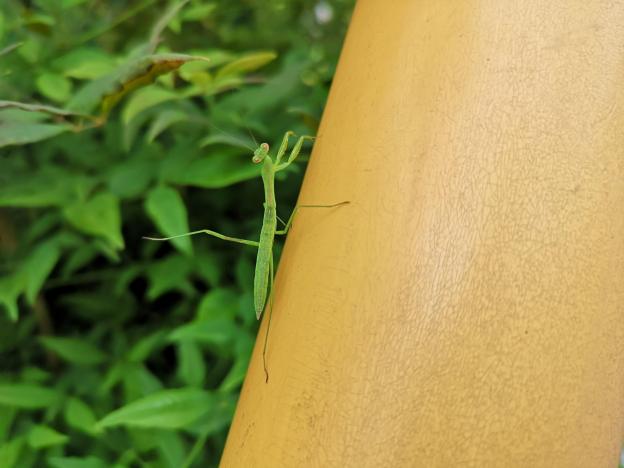
I found this little fella along the path

The “ajisai”, the symbol of Japan’s rainy season

Check out the power of water

From the Archives: Tokyo Day Hikes, June & July 2017

As the 2019 rainy season drags on, the past two weekends have been washouts. Fortunately, this gave me time to revisit some of my hikes during the same period two years ago. All four hikes are quite long since I was taking advantage of the longer summer days, and none are featured in my guidebooks. Considering the continuing gloom of this year, I realise how lucky I was with the weather!
 

Mt Omatei (1409m), Mt Narakura (1349m) & Mt Tsubo (1102m), Otsuki & Uenohara Cities, Yamanashi Prefecture, Saturday, June 3, 2017

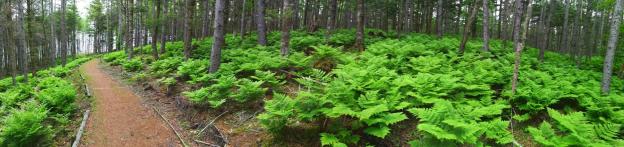
This hike starts from Matsuhime Pass (1250m). I first headed Northwest towards Mt Omatei 大マテイ山 (written like this) less than one hour away. It was featured in my best hikes of the Kanto area guidebook, so I wanted to check it out. It was an easy and peaceful walk through beautiful forest, with a good view of Mt Fuji on the way.

Still lots of snow on Fuji in June

I then retraced my steps to the pass, and continued Southeast towards Mt Narakura 奈良倉山 only thirty minutes away. There was another view of Mt Fuji, but by now it was hidden in the clouds. The trail, which had veered southwards, had become a pleasant forest road. On the other hand, dark black clouds had suddenly appeared overhead – fortunately they didn’t lead to any rain.

I saw some pheasants on this hike, a sign of a seldom hiked trail

After another hour of solitary hiking I reached a junction where I turned left (East) at Nishihara Pass – I had been here once before when coming from the opposite direction from Mt Gongen. One hour later I was at the top of Mt Tsubo 坪山. The last part of the hike was down to Saihara village 西原村 where I had hiked recently.

End of the hike – Saihara Village

There are 3 trails heading down from the summit. Unfortunately I could only find two of them, and I ended up going down the wrong one. Originally I wanted to go straight but I went down a much steeper path, heading North. The silver lining was that I could walk along the river at the bottom of the beautiful river valley to the bus stop for a while longer!


Mt Nyoho (2483m), Nikko City, Tochigi Prefecture, Saturday, June 17, 2017

This is a really long day hike from Tokyo, and I only recommend it if you are fit and the days are long – it took me four hours to reach the top and four hours to walk down. I saw only three people during the entire hike. The starting point, Sanbonmatsu (1500), just North of Chuzenji Lake, could be included as a good place for hiking when it’s hot and humid in Tokyo, if it didn’t take such a long time to reach from Tokyo (approximately 4 hours).

The first part of the hike was rather boring, following a road through the forest. At one point I saw a solitary monkey. It took me around two hours to reach the junction with Mt Nantai. By this time, the blue skies had turned into mist. Another hour of mostly flat walking took me to a rocky river valley, where the real climbing started.

Climbing hard from here

Although the climb was tough, steep and shrouded in thick mist, the surrounding forest was wild and beautiful – is it possible that I had left Tokyo only this morning? I put on my bear bell, which I rarely do, since I saw no other people and the vegetation was still thick above 2000m.

It was shakunage season!

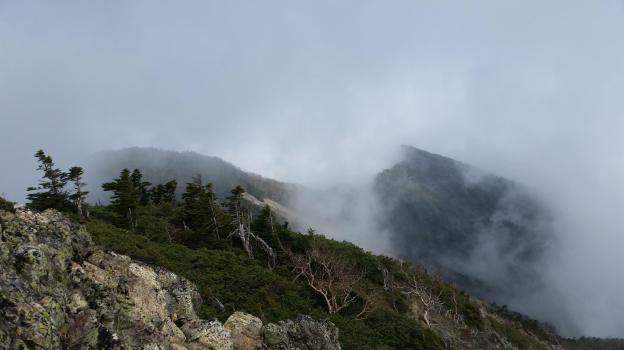
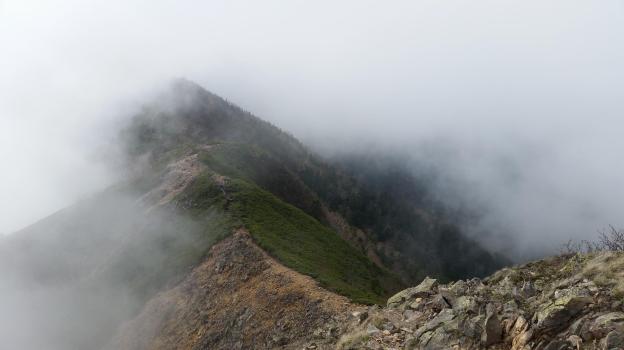
I reached a lonely emergency hut after an hour, and I was at the summit of Mt Nyoho 女峰山, a two-hundred famous mountain, just after 2pm. The very last part was above the tree line, and through some very impressive steep and rugged volcanic landscape. Unfortunately the mist was still in. I waited as long as I could, but despite giving some signs of lifting, it never did in the end.

Nyoho summit landscape I

Nyoho summit landscape II

I finally headed down, back to the hut, where I continued along a different path through thickening mist. My plan was to walk all the way down to Nikko city, 1800m below, but I hadn’t realised what I little frequented path I was taking. It was an eerie descent: mostly silent, with fantastically shaped trees popping into view at various points.

Fantastic tree I

Fantastic tree II

Fantastic tree III

Finally, I was below the cloud cover, and a wide view of Nikko city and the surrounding mountains emerged. The path flattened somewhat. I was no longer alone – deer scattered before me. Another hour and a half of walking brought me to the Nikko Toshogu shrine complex, from where it was another twenty minutes to the train station.

A mix of misty and panoramic views


Mt Imakura (1470m), Mt Nabatake (1283m), Mt Asahi (1299m) & Mt Akakura (1257m), Tsuru City, Yamanashi Prefecture, Saturday, June 24, 2017

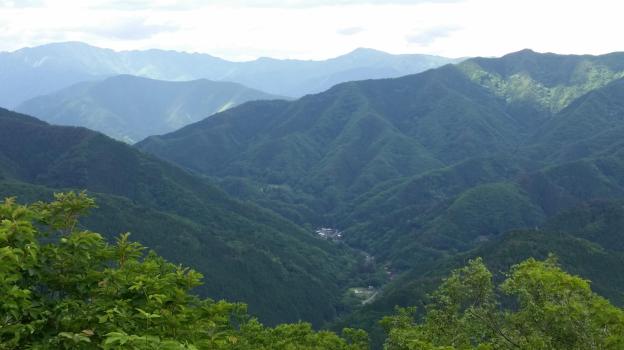
This is another long hike of my own creation. Basically I wanted to link Michizaka Zuido Iriguchi with Akiyama hot spring. I had been to both places before, but I wanted to hike the ridge connecting them, since it overlooks the valley of Doshi village. I had hiked the opposite ridge when I crossed the entire Nishi Tanzawa mountains in one day. The village of Doshi, which I have never been to, is a place of great fascination to me.

It’s about the same distance from Tokyo as Chichibu, yet it’s impossible to visit as a day trip using public transport due to poor bus connections. So every chance I get to peek at it from the surrounding mountains, makes me feel like I am getting a glimpse of a hidden valley. I must always remind myself not to end my hike along the valley containing doshi valley because it would require hitchhiking to get back to nearby Tokyo.

The “hidden valley” with Fuji hidden in the clouds on the right

The day I chose for the hike was a very hot and humid day, and although the climb to the top of Mt Imakura 今倉山, which I had climbed before, was short, it was also tough. Luckily, from there it was mostly going down, albeit with one steep climb on the way. The ridge was narrow but shady on this beautiful sunny day. Half an hour after leaving the summit I got my first views of “doshi valley” and Mt Fuji peaking through the clouds as an additional bonus.

The path near the top of Mt Nabatake

Thirty more minutes of easy hiking brought me to the top of Mt Nabatake 菜畑山. A steep descending slope, followed by an equally steep one going up, brought me to the drawn-out summit of Mt Akakura 赤鞍ヶ岳. From there it was a gentle downward sloping ridge. The vegetation had changed from wild to tame – you could sense the proximity of human habitation.

As I dropped below one thousand meters, I started feeling the heat and humidity more. At Gando Pass 厳道峠 I turned right. I could have continued straight, but I wanted to explore the connecting to path to Mt Afuri – I had seen the other end I few years ago after climbing that mountain. The first part was disappointing – a fairly steep and difficult to navigate descent, followed by a shorter but equally steep ascent.

Turn left here

However, after that I was hiking through beautiful forest – squirrels and pheasants  darted left and right into the bushes. The second half of the trail certainly lived up to its promise. Too soon I reached the road at the end of Mt Afuri, from where it was another hour of hiking till the (very welcome) hot spring bath. I was fortunate to spot a Japanese badger crossing the road at one point.

Mother and chick pheasant running for cover


Mt Kita-Okusenjo (2601m) & Mt Kokushi (2592m), Yamanashi City & Kawakami Villages, Yamanashi & Nagano Prefectures, Saturday, July 8, 2017

This is another ridgewalk connecting two prefectures of my own creation. Since the return is via Shinkansen, it’s a bit pricey, unless you have a Tokyo Wide Pass. The starting point is from Odarumi Pass (2365m), the 2nd highest place you can reach by bus from Tokyo as a daytrip. I had been there once before when climbing Mt Kinpu (the day Mt Ontake erupted). This time, I headed due West under a grey overcast sky. Very soon, I reached the trail for Mt Kita-Okusenjo 北奥仙丈山, branching southwards, the highest peak of the entire Okuchichibu mountain range. Unfortunately because of the clouds, the view wasn’t so great.

I didn’t linger since insects were swarming, so I retraced my steps and continued to Mt Kokushi 国師ヶ岳, a 300-hundred famous mountain, which I reached just before 11am. Afterwards, the path descended somewhat, then flattened while turning Northeast. It was a long forested ridge, with few views, and I reached the base of Mt Kobushi, two and a half hours later. I saw very few people, and it was a very enjoyable ramble.

One of the few Southward views I got on this solitary hike

Since I had been up Mt Kobushi before, and thunderstorms were threatening, I decided to skip going to the summit, and descend immediately via the upper reaches of the Chikuma river. This river is the longest and widest river in Japan (known as the Shinano river in its lower reaches). Soon after I started descending, I reached the source of the Chikuma: just a signpost and a trickle of water through the forest, around 2000 meters high. Very soon, the trickle of water became a mountain stream.

The Chikuma river at mountain stream stage

It was a very enjoyable two-hour walk along a beautiful river valley in what was now Nagano prefecture. Eventually I reached the car park from where it was another hour of walking to the bus stop. However, a group of young people kindly picked me up on the way and dropped me off at Shinano-Kawakami station on the Komi line.

Check out the humble beginnings of the longest river in Japan

Mt Kushigata (2052m), Minami Alps, Yamanashi Prefecture, Saturday, June 22, 2019

After my foray into the very southern part of the Southern Alps the previous weekend, I decided to go back and do one of the few higher mountains in the Minami Alps that can be done as a day trip from Tokyo. I had been wanting to climb this one for a while but since it requires a car, I kept putting it off (it can be done via public transport but you’d have to stay the night before in the area). The weather wasn’t perfect but I decided to risk it anyway, and I was glad I had!

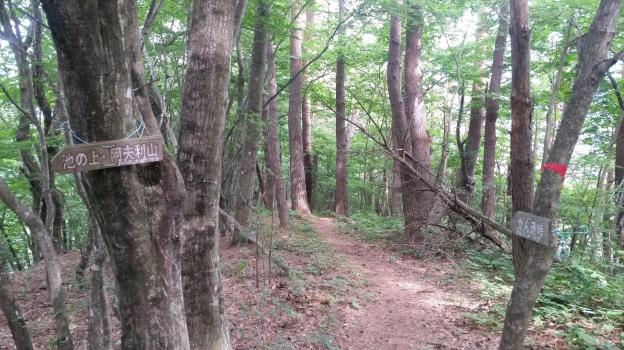
It was my first time experiencing the new “all seats reserved” Chuo line, and overall, I felt that it was an improvement over the previous system. At least I was guaranteed a seat, which is essential when traveling all the way out to Kofu, where I had reserved a shared car. The trip up to the parking lot at Ikenochaya 池の茶屋 (1860m) was mostly uneventful – the road was pretty bad in some parts, but I had seen worse. I snagged the second to last parking spot. Under a thick cover of clouds, and the odd drop of rain, I was ready to set out at 11h15.

Super easy hiking for the first thirty minutes

The first part of the hike was incredibly easy to hike – a gently sloped series of switchbacks leading to a viewpoint of Mt Kitadake which was unfortunately entirely in the clouds. Rain was falling intermittently, but I didn’t mind since the surrounding vegetation, mostly ferns, was a very beautiful shade of light green. Soon the path started to descend via a series of log staircases. The amount of descent started to alarm me – I should be going up a mountain not down – but my guidebook and the numerous signposts reassured me that I was on the right trail.

Looking back up this long log staircase

The path soon bottomed out and I was rising again, gently, through beautiful typical Southern Alps forest scenery. At this point I got a bit confused. I pride myself on my sense of direction, but here I will admit I lost track a bit. The path did what I thought was a loop, yet I never crossed my previous path. Eventually I arrived at a flattish area with a wooden walkway, and white flowers that ressembed sakura, but which were in fact oxalis.

An unexpected flower observation section on the hike

Apparently the area is famous for its irises, but they weren’t in bloom yet. In no time, I reached the top of Mt Hadaka (meaning Mt Naked). I was supposed to see the main peaks of the Southern Alps and Mt Fuji but in reality I saw nothing. However the temperature was pleasant, even a little cool, and there was no wind, so I settled down for some lunch.

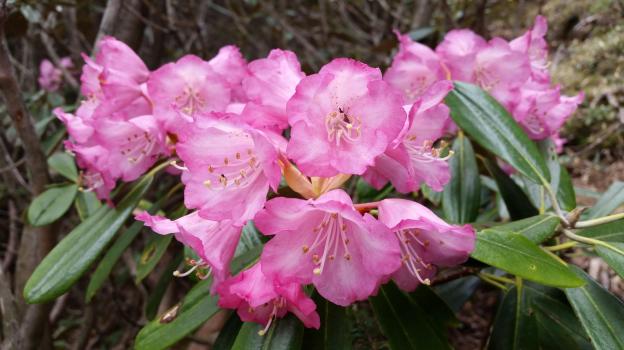
At first sight I thought these were some really late blooming mountain sakura

The next section was through amazingly beautiful forest, full of massive camphor trees and moss-covered undergrowth. At one point I spotted a solitary juvenile Kamoshika (Japanese serow), passively munching some grass (see video). I arrived at the top of Mt Kushigata 櫛形, a two-hundred famous mountain, a little after 2h30, where there was a relatively new summit marker, a few meters from the old weather-worn one. The clouds were still in, so no view, but it was very peaceful and quiet. I had not seen anybody in the past hour and a half.

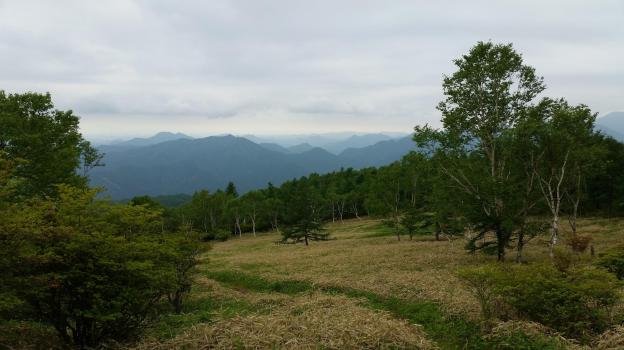
Most of the hike scenery and trail was like this

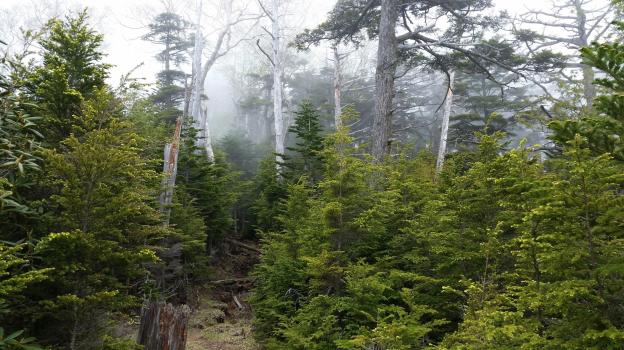
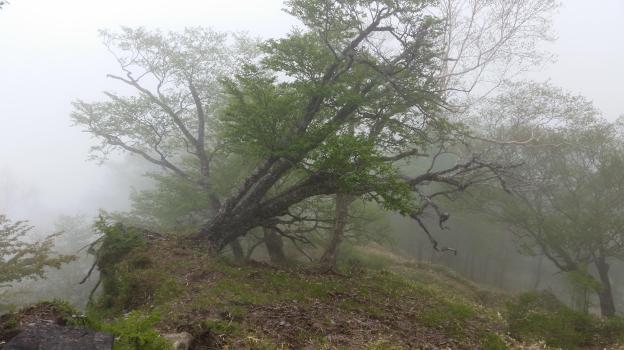
I set off for the final part of the hike back to the parking area. The mist had rolled in, providing some very nice photo opportunities. At the car park, my car was the only one left – time to head back! Heading down the mountain, the sun broke few in a few places, I was able to get some nice views of the valley below. Instead of taking the train directly back to Tokyo, I got off at Isawa Onsen, less than ten minutes away. It’s a great place to have a hot spring bath, and I got to taste some Yamanashi wines at the wine server in the tourist office below the train station – a great way to finish a Yamanashi hike!

Tree in the mist number 1

Tree in the mist number 2

Have you ever seen a Kamoshika while hiking?