Mt Nokogiri (鋸山 のこぎりやま nokogiriyama), literally “Saw Mountain”, due to its jagged summit, is a popular sightseeing spot situated on the Tokyo side of the Boso peninsula. In the Edo period, it used to be a quarry, which explains its smooth cliffs below the top ridge. It can be reached from Hama-Kanaya station on the Sazanami limited express (about 2 hours from Shinjuku), or by using the Tokyo Bay ferry from Kurihama on the Miura peninsula, Kanagawa prefecture (40 minutes each way).
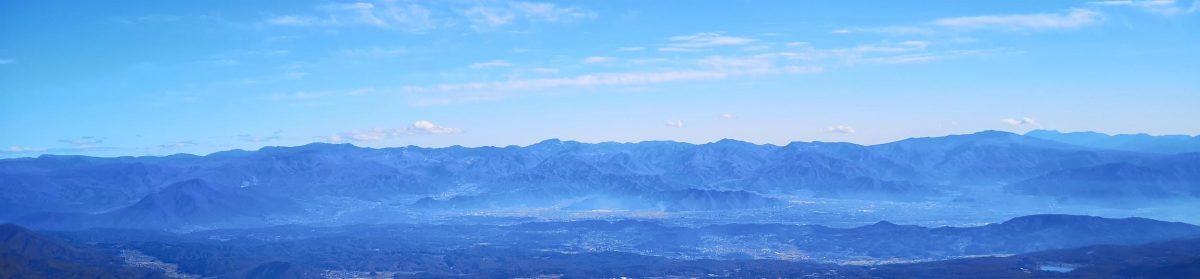
View south of Minami-Boso from the top of the ropeway
View of the Kanaya ferry port
Most visitors prefer to take the Nokogiriyama ropeway up, and then make the roundtrip along the ridgeline to the observatory at Jigoku Nozomi (地獄のぞみ), meaning ” A peak into hell”, a ledge of rock overhanging a cliff. Looking west, one can gaze upon Tokyo bay and Mt Fuji in the distance. Although an entrance fee is required, it also gives access to Nihon-ji temple (日本寺) and the Nihon-ji Daibustu (日本寺大仏), both worthwhile sights on the south side of the mountain.
A peak into hell, the highlight of a visit to Mt Nokogiri
Kannon carved into the cliffside
For those wanting more exercice, it’s possible to walk down to the base of the ropeway on the north side via the Kangetsudai trail (観月台コース), also part of the Kanto Fureai no Michi. On the way, you’ll pass by the impressive Haykushaku-Kannon (百尺観音), carved into the cliffside. For a longer hike, it’s possible to start from Hota station and approach via the Ura-Nokogiri trail (裏鋸コース, the Nokogiri back trail), leading around the back of the mountain and over its highest point. Whichever option you choose, Mt Nokogiri makes a fun and interesting daytrip from Tokyo.
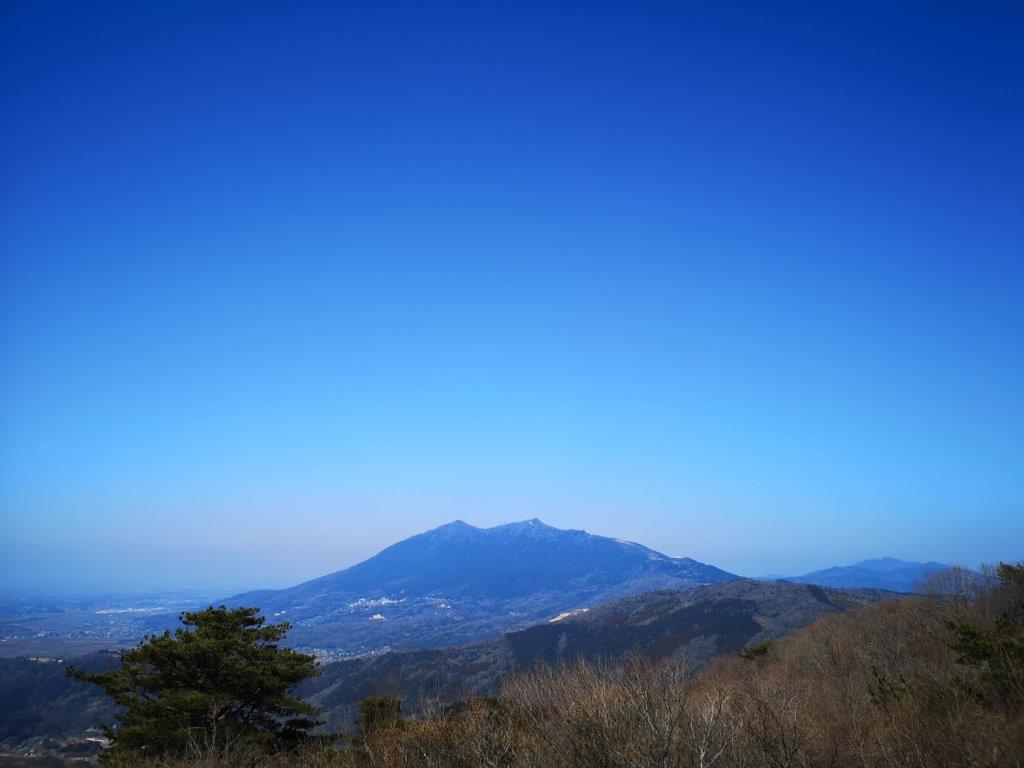
Mt Tsukuba was one of the first mountains I climbed in Japan; its also one of the mountains I’ve been up the most. The shrine at its base is about a 40 minute bus ride from Tsukuba station, itself a 45-minute train ride from Akihabara station with the Tsukuba Express. The mountain is best known for the interestingly shaped rocks below the summit area. The view of the Kanto plain from the top is stunning, and on clear days, even Mt Fuji can be seen. A cable car and a ropeway can shorten the hike for those who’s rather just walk up or down. After the hike it’s possible to take a hot both at one of the several Onsen hotels clustered around Tsukuba Shrine.
Hiking in the Suigo-Tsukuba Quasi-National Park
水郷筑波国定公園
Tsukuba-san (筑波山 つくばさん)
Nyoto-san 女体山 (877m) & Nantai-san 男体山 (871)
Japan 100 Famous Mountain 日本百名山
Climbed in December 2006, November 2009, November 2010, February 2013
I am an avid hiker. Maybe its because when I was a child my parents used to drag me and my brother on long tiring walks in the mountains most weekends. Or maybe I am seduced by the beautiful and complex shapes of mountains and the awe-inspiring vistas from their summits. Or maybe I am just a sucker for physical punishment and get off on pushing my body and my mind to its limits. Whatever the reason, I really enjoy walking up mountains and not just the famous ones. There are literally dozens of greats climbs within reach of Tokyo and, by steering clear of the aforementioned famous ones, you will not have to share them with half the population of Tokyo. The purpose of this blog is to document some of these hikes.
While studying Japanese, one of the things I learned early on was that a kanji used by itself would use its “kun” reading, and two kanji used together would use their respective “on” readings. This is a rule with many exceptions. While reading manga, I discovered many two-kanji words that used their kun readings instead. These are so widespread that I think anybody who has studied Japanese would have come across many examples of this.
However, for a long while I wasn’t aware that the opposite could happen as well i.e. a kanji by itself could use the “on” reading, even though there was already a “kun” reading available. I have to admit that this revelation blew my mind. Not only could a word be expressed by a single kanji using the “kun” reading, and a compound using the “on” reading, but once more by a single kanji using the “on” reading (actually, many words can also be written using the katakana form of the English equivalent, so in theory that’s four ways to say the same thing).
The sentence at the top from the Baby Steps manga can roughly translate as “Japanese players competing around the world meet for a short time [at the all-Japan Tennis Tournament]“. The sentence uses 会す read かいす instead of the more usual 会う read あう. I guess the former sounds more formal for example in a narration. In this case, common 会 compounds such as 会議 and 集会 aren’t suitable. Another option would have been to use 集まる or the compound 集合. Here, 集 used by itself with its “on” reading means “a collection”, and so doesn’t fit the sentence.
I guess this means that Japanese, like most languages, has a certain amount of inbuilt redundancy, allowing it to express the same concepts several ways (as the English language has words of German and French origins). However for Japanese, it’s harder to make this connection since we are taught to read single kanji and compounds differently. But once we notice that the hiragana ending of the standalone kanji is different from the expected one (“す” and not “う”), or even missing, we can infer that we should use the “on” reading.
This is a sentence taken from “The Promised Neverland“. The word at the head of the sentence is read ふくじゅう and means obedience or submission. A literal translation would give “There wasn’t any other way than to obey” although a more natural translation might be “I had to obey“, although the Japanese way makes it sound more resigned. as well as less direct.
What is interesting here is how “仕方” is how the author chose to write it in hiragana instead of kanji. Since Japanese sentences don’t use spaces between words, this makes it doubly difficult to read at a glance, even for a Japanese speaker (I did the test). This is where using the kanji would have been very helpful. This issue crops up quite often when reading manga aimed at younger audiences.
For example, at first glance Doraemon might seem a breeze but it’s a real headache, since it’s 90% kana, making it difficult to distinguish words from grammar. Kids don’t have trouble with it because they are familiar with the sounds of the words. On the other hand, manga targeting adults tend to overuse kanji, using them even for words that are typically written in kana (more on that in another post).
The trick is to be able to recognise common grammatical patterns such as “なかった“(wasn’t) so one can quickly find the “odd word” out, hidden in the middle of all that hiragana. So when using manga as a study tool, handle these long blocks as road bumps and proceed a little more slowly – you might find something interesting.
This is some extra content, mostly unrelated to hiking. I have been studying Japanese for nearly half my life. A few years ago, I started to focus on improving my reading skills. I have always enjoyed reading manga, so I decided to use it to make Anki flashcards. First, I read purely for pleasure, quickly circling any new words with a pencil. Later on, I do a second pass, checking words with an online dictionary Finally, I type the sentence containing the word into a flashcard. This last part has several benefits. It helps me recall the meaning of the word, it allows me to see how the word is used within a sentence, and it reminds me of the scene in the manga.
Over the years, I have accumulated thousands of cards spanning dozens of manga. As the cards are spread out over days, months and even years, interesting combinations tend to pop up on a daily basis, revealing patterns that aren’t easy to notice using other study methods. Also by seeing the cards repeatedly, I became more aware of subtleties and nuances. Finally, forgetting a card after several months and having to relearn it, enabled to see nuances I had missed before. This is a space to share these observations, hoping it may help others studying Japanese.
The southernmost tip of the Boso peninsula can be explored as an overnight trip from Tokyo. It’s completely off the tourist trail, even for domestic travelers, and thus ideal for some laid-back sightseeing, except in the summer, when the beaches are in business. It can be reached by train from Shinjuku using the JR Sazanami limited express to Tateyama (about 2 hours and 15 minutes), or the highway bus from Tokyo station (around 2 hours, via the Aqua line, but beware of traffic jams on weekends).
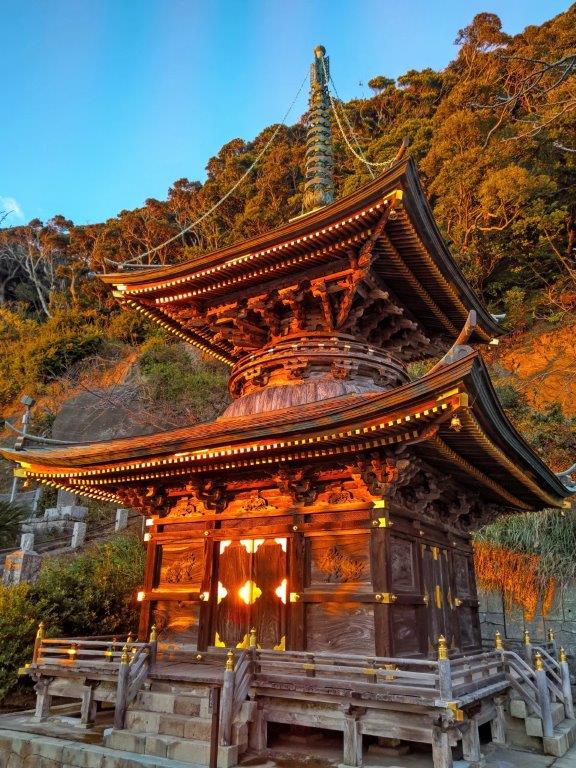
Pagoda at Nago Temple
Oshima island as seen from Sunosaki cape
The largest city by far is Tateyama, located on a wide bay on the western side. From there, the JR Uchibo line curves eastwards and cuts across the peninsula, merging with the JR Sotobo line in Awa-Kamogawa on the eastern side. Minamiboso completely encircles Tateyama and has no major population centers, although inns and hotels can be found along the coastline. Since most sights are spread over a wide area, a rental car is needed when venturing south of the railway line, as bus service is infrequent.
View towards Nokogiriyama from Taibusa cape
Sunosaki cape from hotel Nankaiso
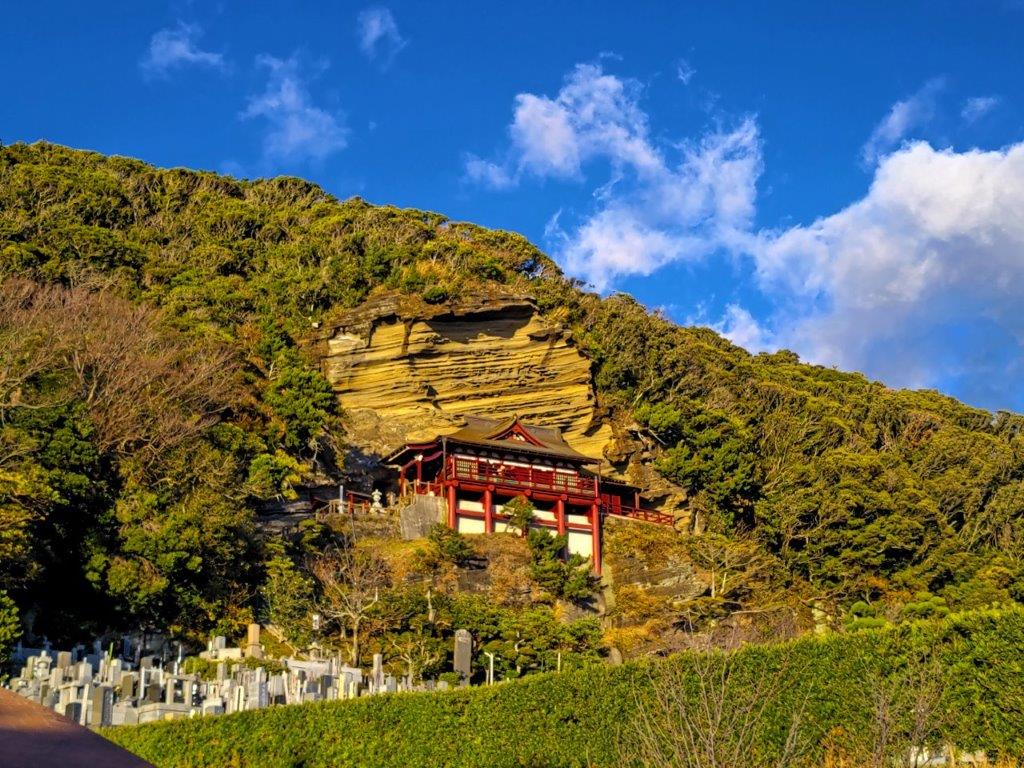
Fortunately, two of the most interesting sights can be reached on foot from Nakofunakata Station, one stop before Tateyama. Gake-Kannon (literally, “Cliff Kannon), also known as Daifuku-ji, is a temple, built under a red hued cliff, especially striking around sunset. It’s worth climbing one of the several staircases up to the small temple building perched directly under the cliff to see the view of the bay from the front viewing platform.
View of Tateyama from the balcony of Daifuku temple
Reaching Daifuki-ji (left) / Sunet at Nago-ji (right)
In the opposite direction is Nago-ji, a temple built on a hillside, and featuring a charming pagoda and another view of Tateyama bay; cherry blossom trees can be seen in spring. The trail to the observation deck higher up was damaged by the 2019 typhoons and is currently closed.
Daifuku temple at Gake-Kannon
Watch a video of Kannon-Gake and Nago-ji
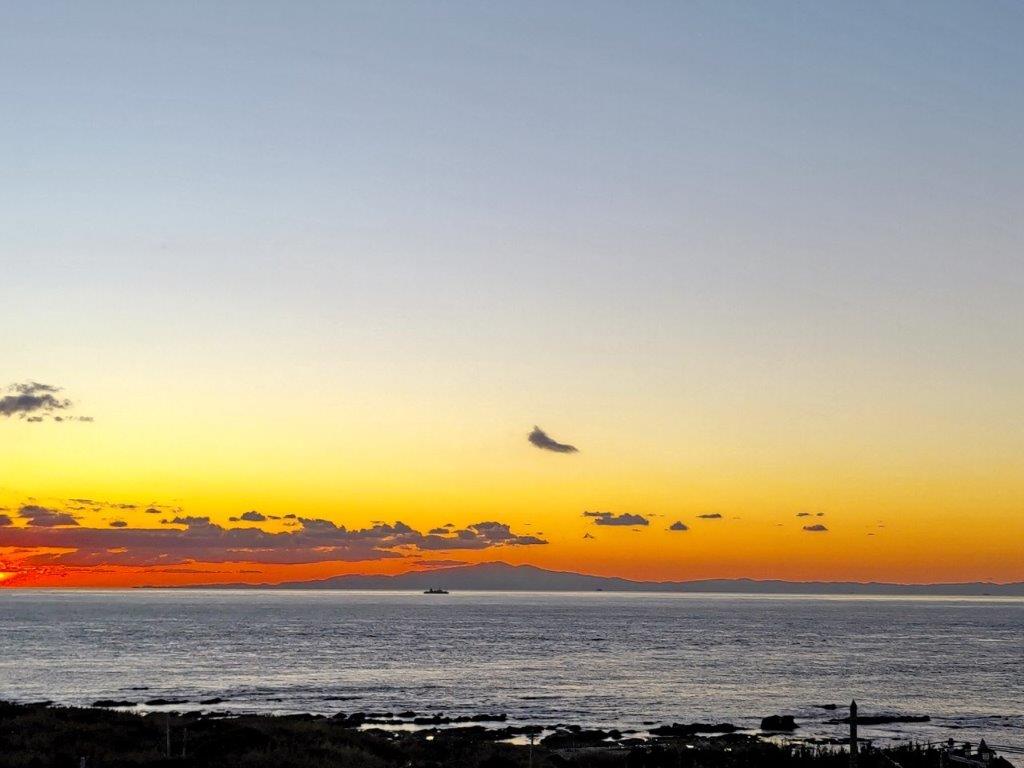
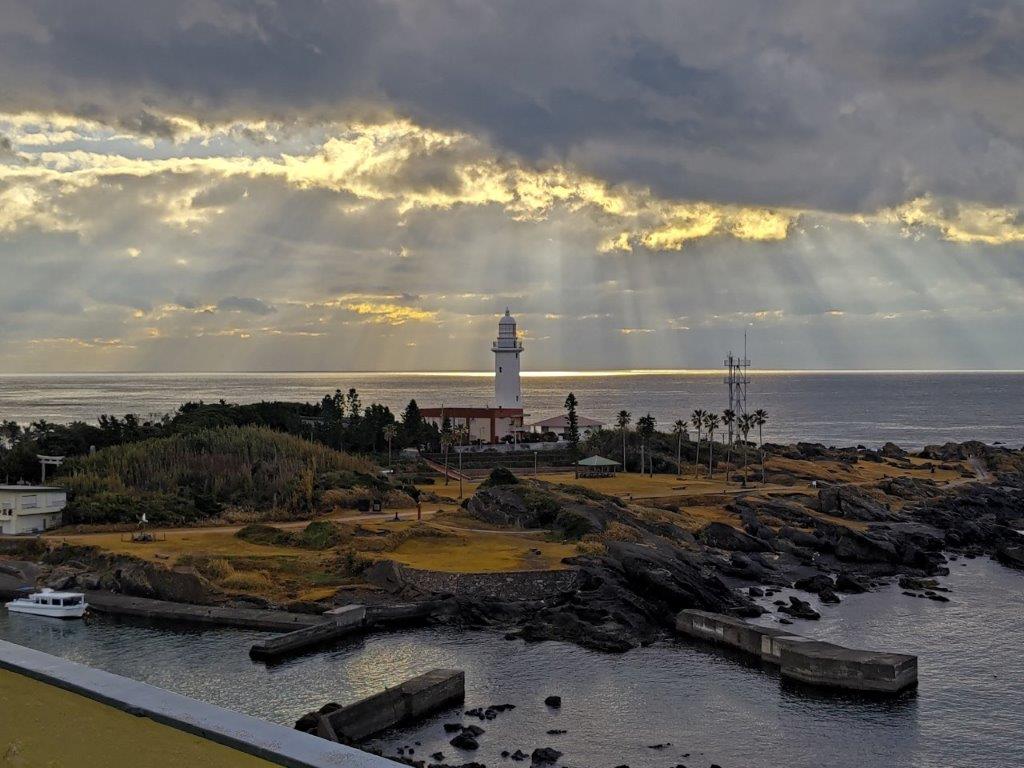
Following the coastline west from Tateyama is Sunosaki lighthouse, about 20 minutes away by car. Over a hundred years old, its main purpose is to indicate the entrance to Tokyo bay. From the viewing area at its base, one can observe Tateyama bay, Mt Fuji, the Izu peninsula and Oshima island; the best views can be had around sunset.
Sunset from Sunosaki lighthouse
Watch a video of Sunosaki lighthouse
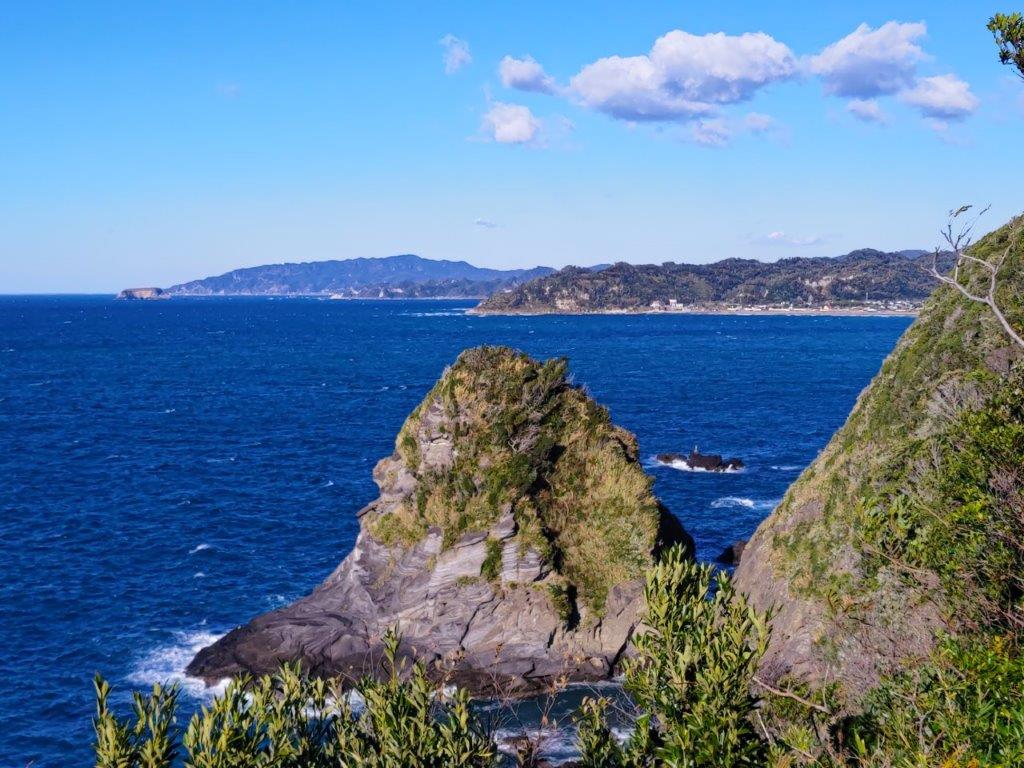
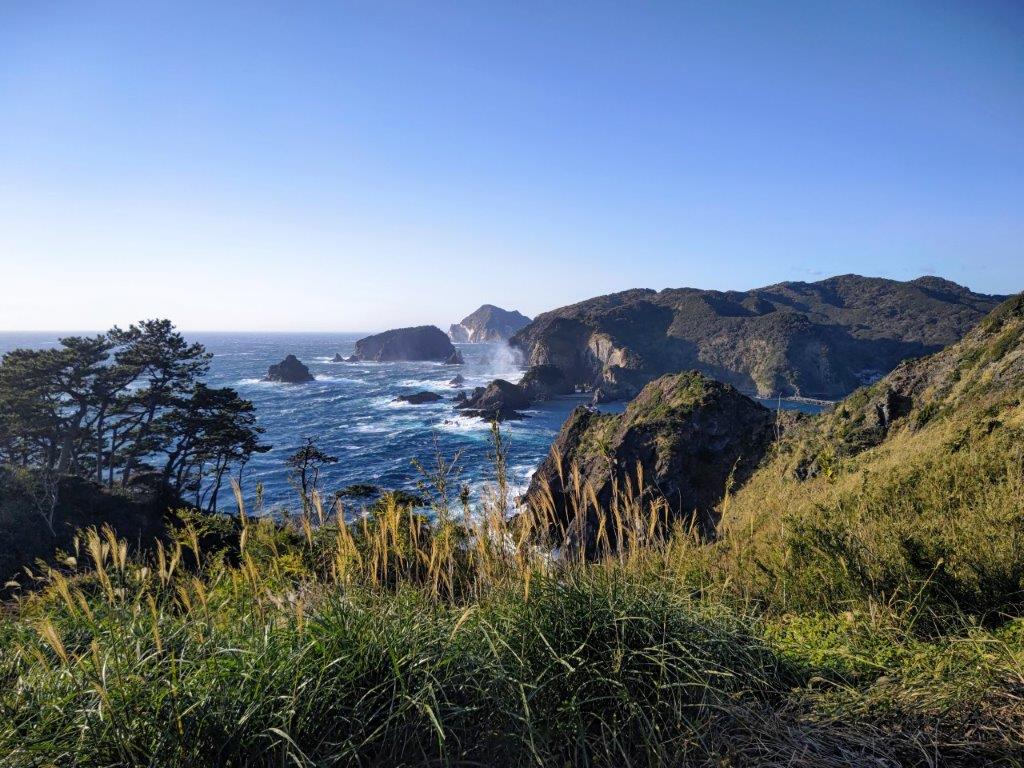
The Taibusa Cape Nature Park in Minamiboso is a great place for a short stroll with oceanic views, less than an hour walk from Tomiura station, two stops north of Tateyama. Starting from the information center next to the parking lot, it takes about an hour to make a loop of the park. On the way, one can check out an observation tower, an observation deck and the ruins of an old fort. From Iwai station, one stop away, is the start of the Kinone Pass hike.
View of Minamiboso from Taibusa Cape
Watch a video of Taibusa cape
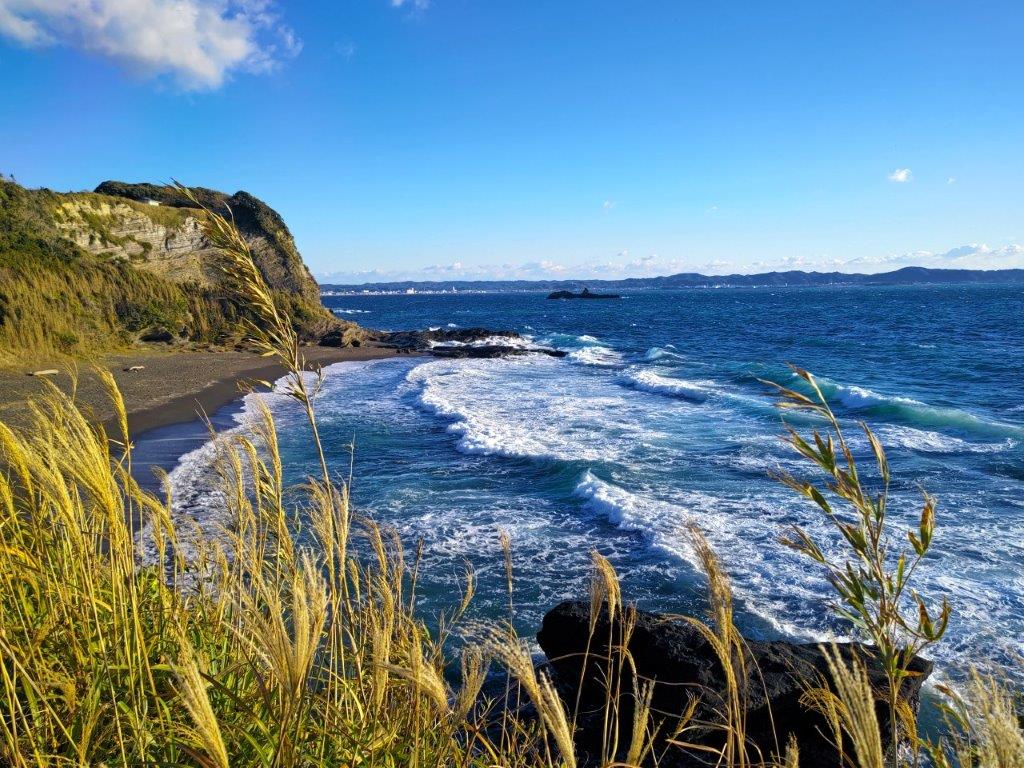
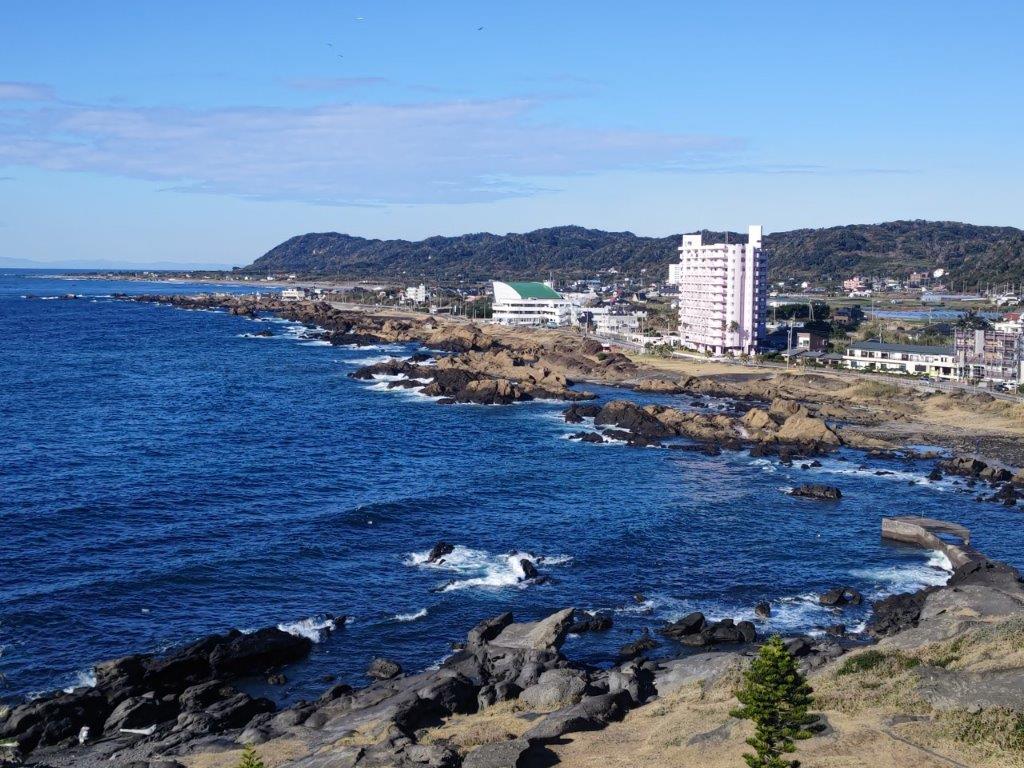
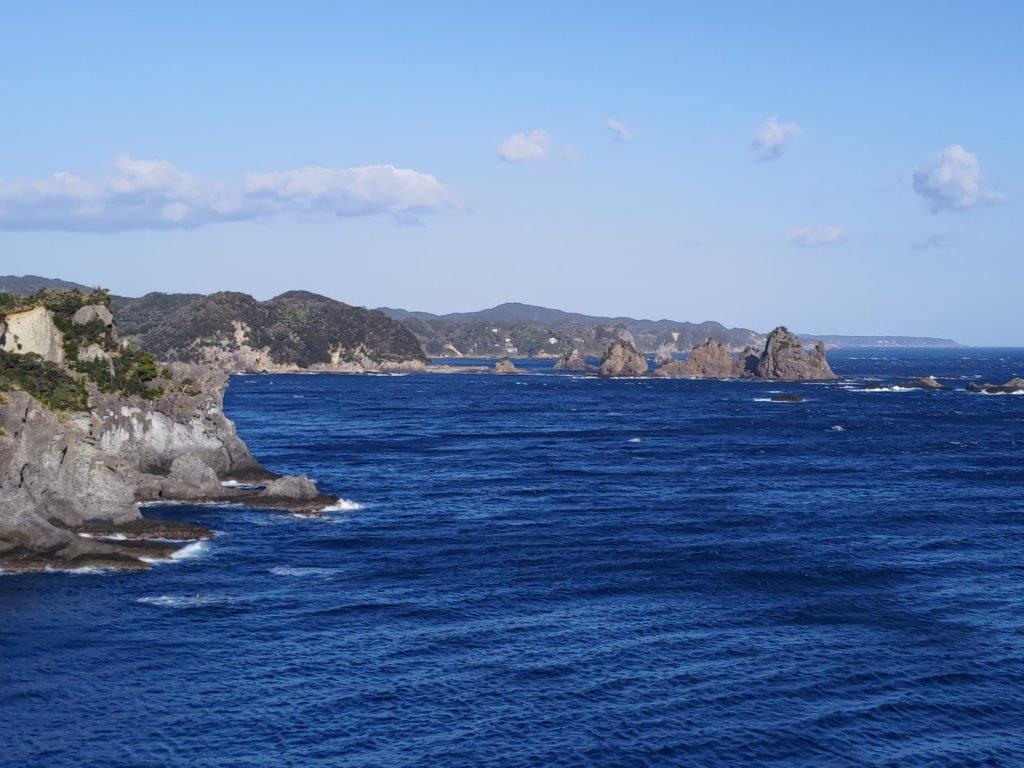
Nojima Cape Lighthouse is situated at the southern tip of the Boso peninsula, a thirty-minute drive from Tateyama, and within the confines of the Minamiboso Quasi-National Park. The main thing to do is to see the view from the top of the lighthouse (a small fee is required); make sure to check out the interesting museum next to the entrance (Japanese only).
View of the coastline from the Nojima lighthouse
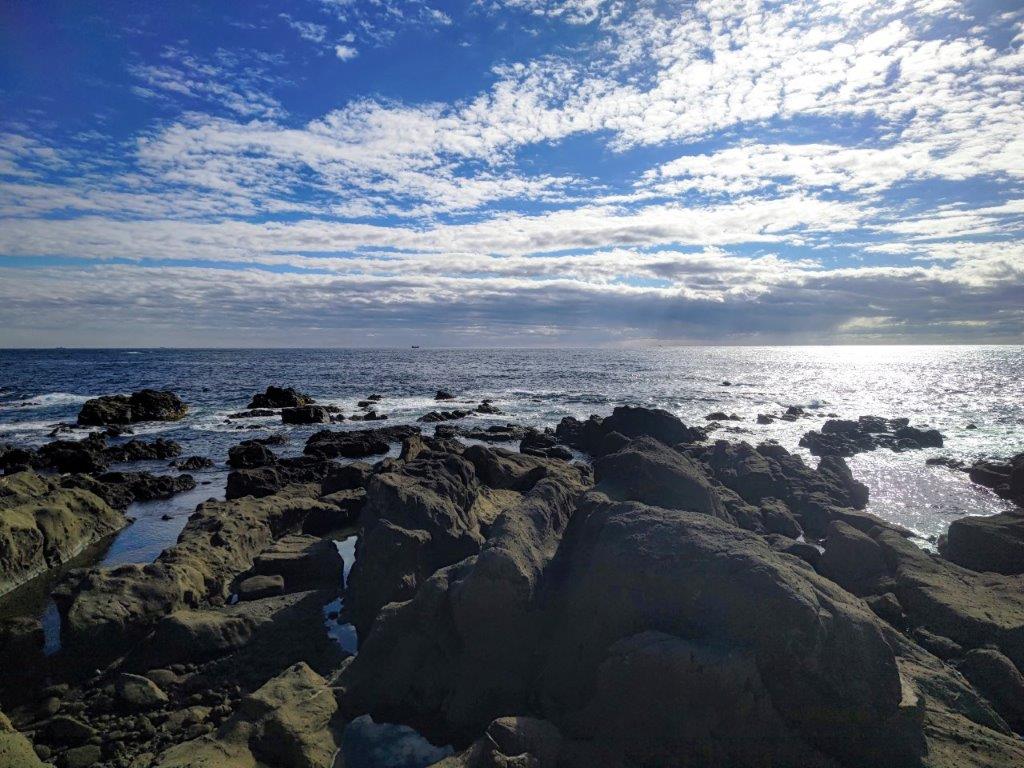
View of the Pacific from the Minamiboso quasi national park
The marker for the southernmost point of the Boso peninsula can be reached via a circular path around the cape: nearby is a white, solitary bench on top of a rock, the perfect place to gaze at the Pacific ocean stretching away into the distance. Following the “Boso flowerline” road for about ten minutes east leads to the start of the hike for Mt Takatsuka.
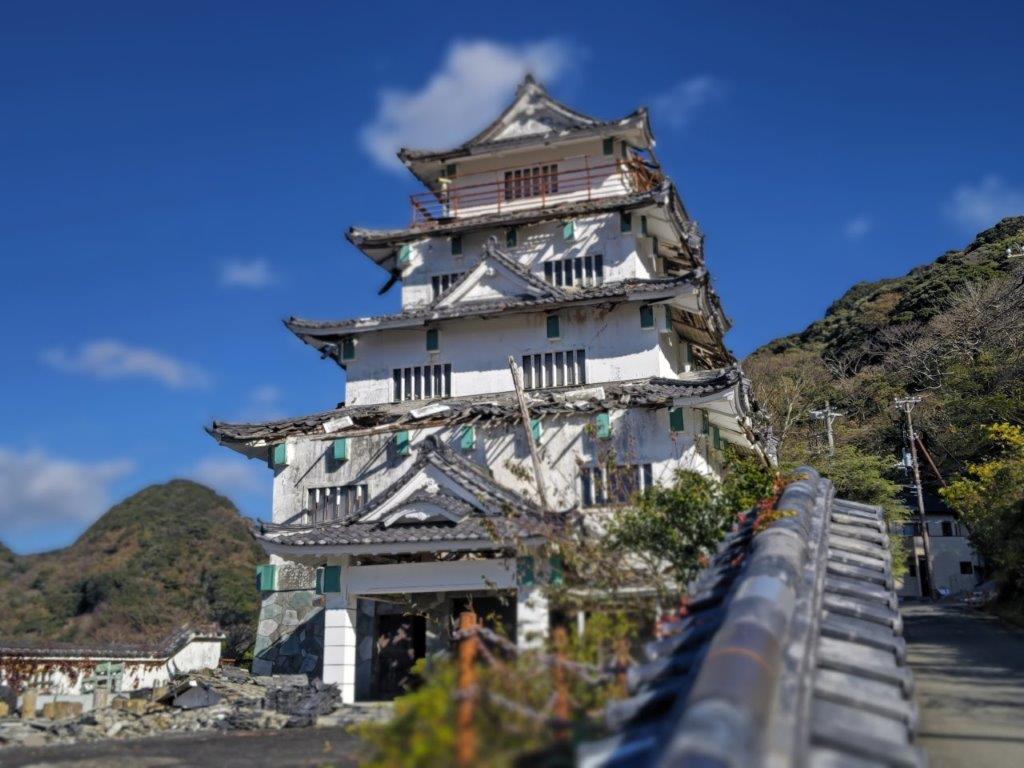
Shimoda is a coastal city in southern Izu that can be visited as an overnight trip from Tokyo. It’s off the beaten track, even for domestic travelers, except in the summer when the beaches are open. It can be reached by train from Tokyo station using the Odoriko limited express (about two and a half hours).
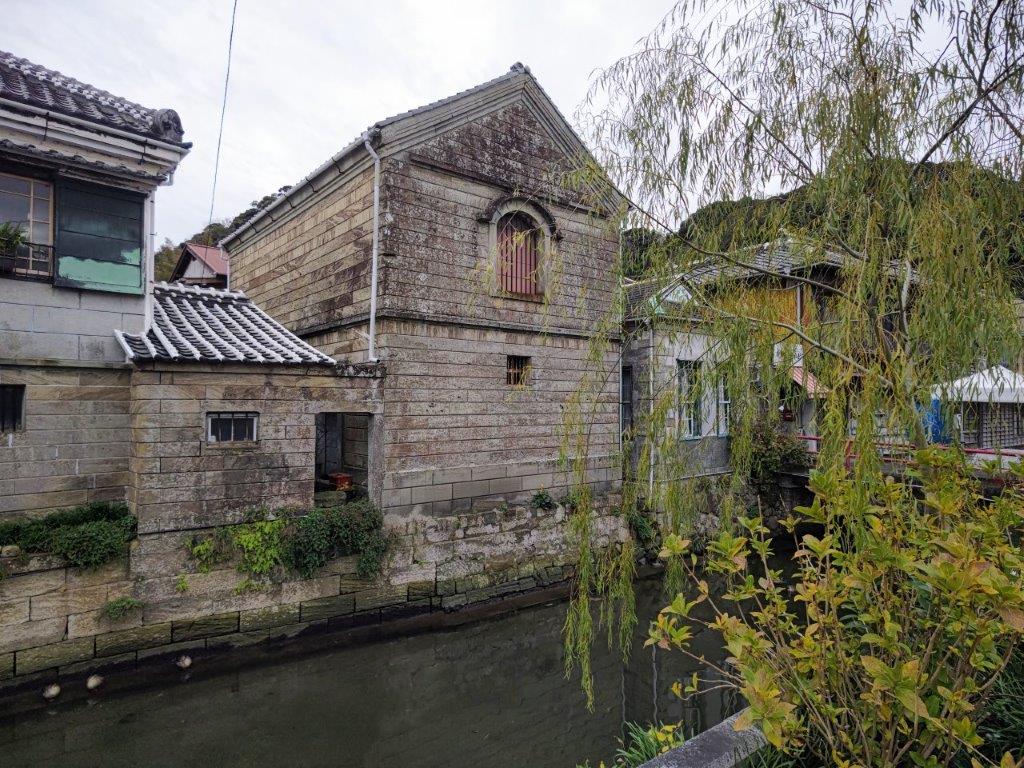
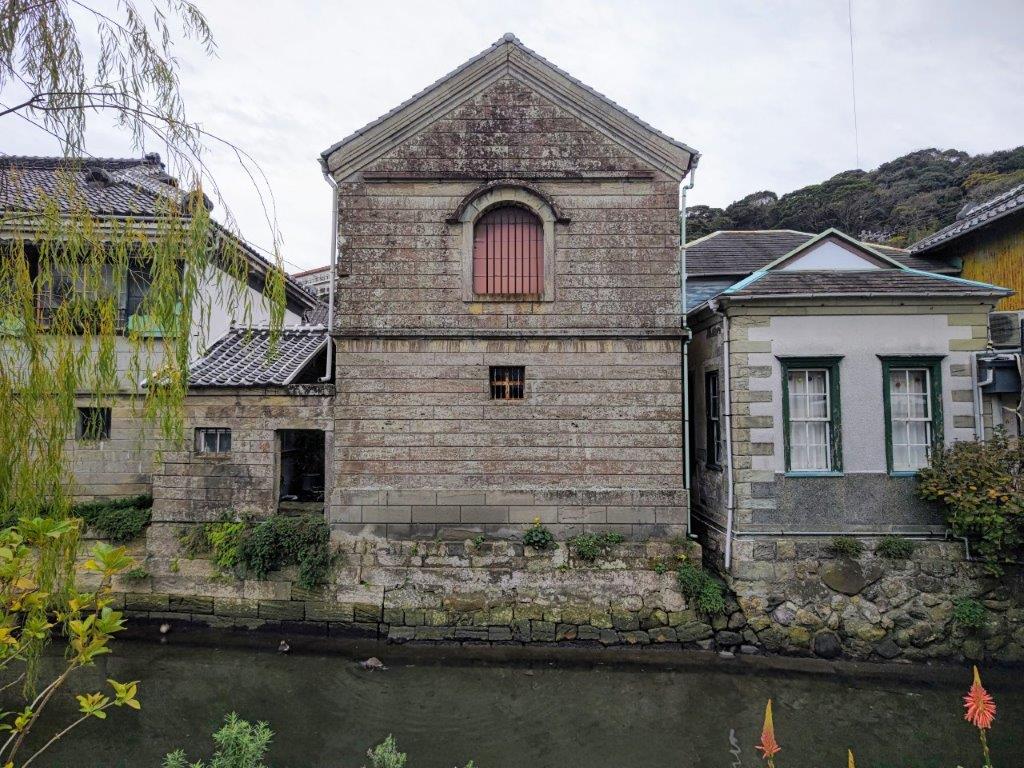
Traditional buildings and weeping willows along the Perry Road
An old store house (“Kura”)
Commodore Perry and his black ships (“Kurofune”) landed there on his second trip to Japan in 1854, and signed a treaty opening the port to American ships. The “Black Ship” has become the main theme for the city. A great place to find out more is the small but interesting MoBS (The Museum of Black Ship) Kurofune museum, where various historical artifacts are on display.
View from the observation deck of Mt Nesugata
View of Shimoda city and Shimoda-Fuji
The road leading to the Museum, called “Perry Road”, follows a narrow canal through a historical neighbourhood that feels quite different from the rest of the city; the weeping willows bring to mind the Gion district in Kyoto. Walking down this street is like traveling back in time and is one of the best-kept secrets of the Tokyo area.
Walking on Irozaki Cape
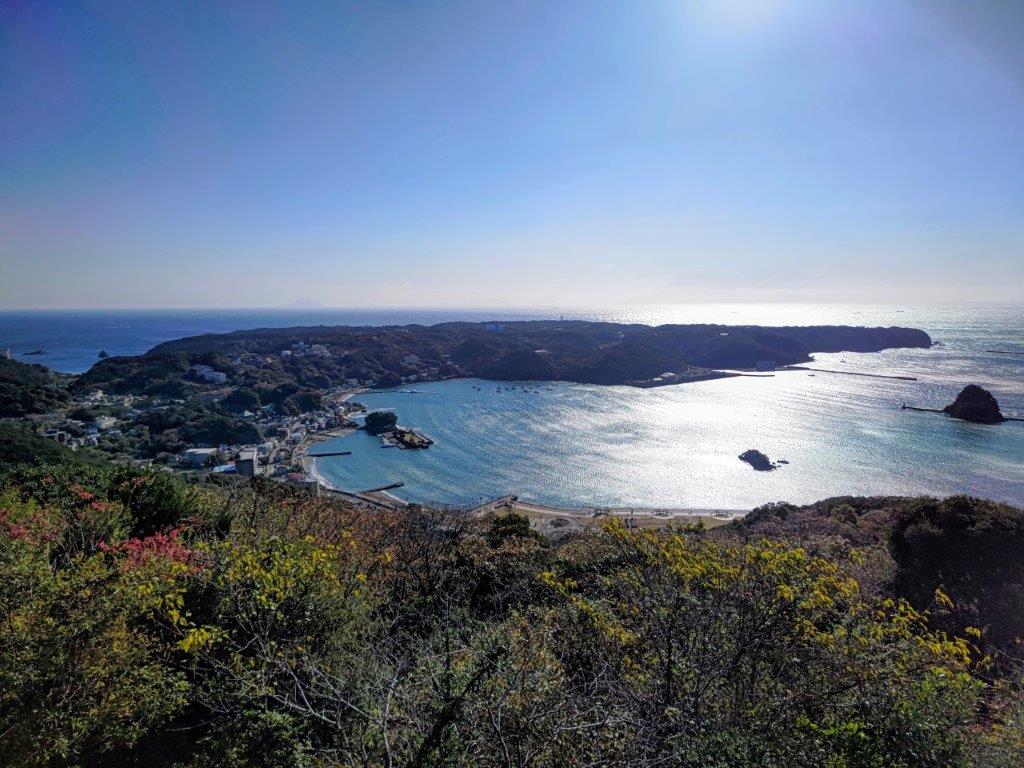
View of the southern Izu shoreline
The highlight of a visit to Shimoda is the ropeway to the top of Mt Nesugata (199 meters, meaning “sleeping figure”). From the observation platform, one can get a view of the bay, Oshima island and the Pacific ocean; this is supposedly where the Black Ships were first spotted. On the other side is a view of Shimoda city and Shimoda-Fuji; through the trees, the white tip of the real Mt Fuji can be seen on a clear day.
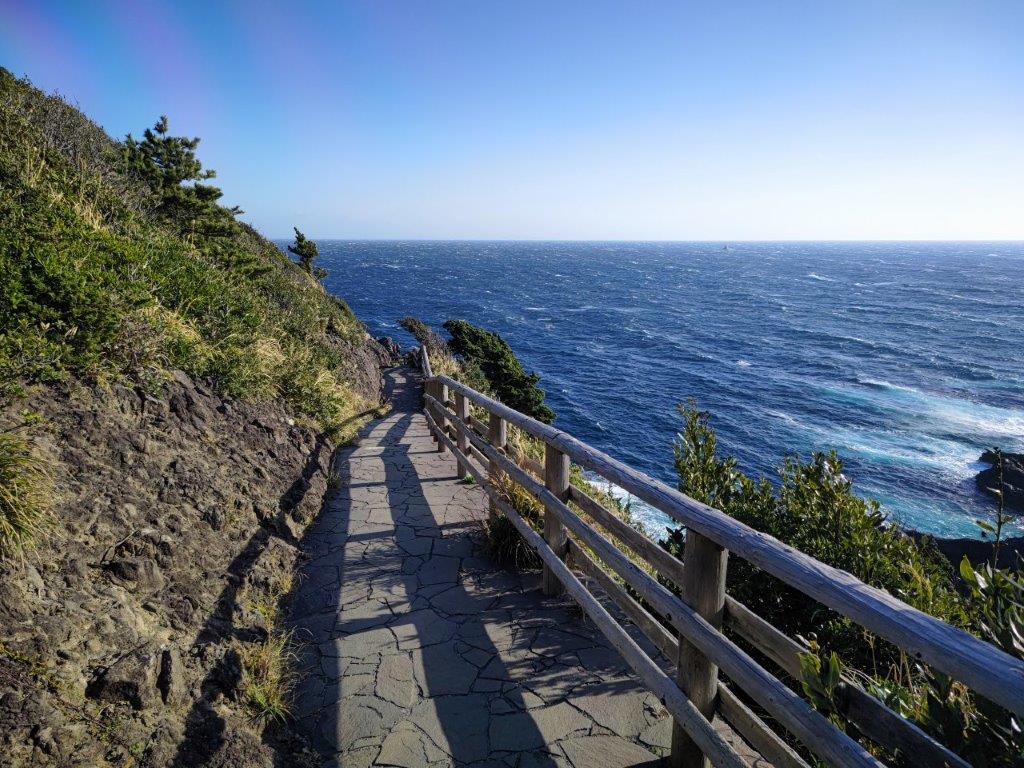
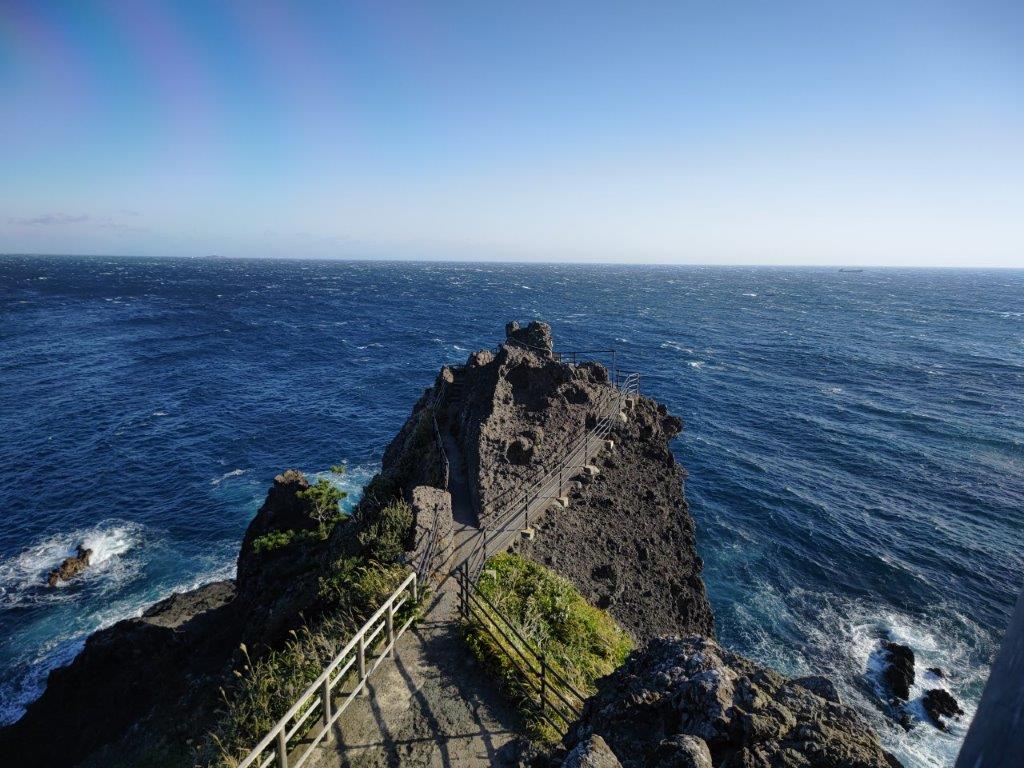
The southernmost tip of the Izu peninsula
View from Cape Aiai
An interesting side trip is to take a bus to Irozaki Cape. One can walk past the lighthouse and the small shrine nestled under the cliffs, to the southernmost point of the Izu peninsula. The sight and sound of the waves crashing on the shoreline is impressive but care must be taken on windy days. A cruise can be done in good weather and it’s possible to explore the coastline further towards western Izu.
Small Worlds is a theme park dedicated to miniatures. It opened in spring 2020, just as Japan shut its borders due to the pandemic, so few tourists have had a chance to visit up to now. It’s located in a nondescript building, 5 minutes on foot from Ariake Tennis-no-mori station on the Yurikamome monorail, so it can be combined with other attractions in Odaiba; since it’s completely inside, it’s perfect for a rainy day in Tokyo.
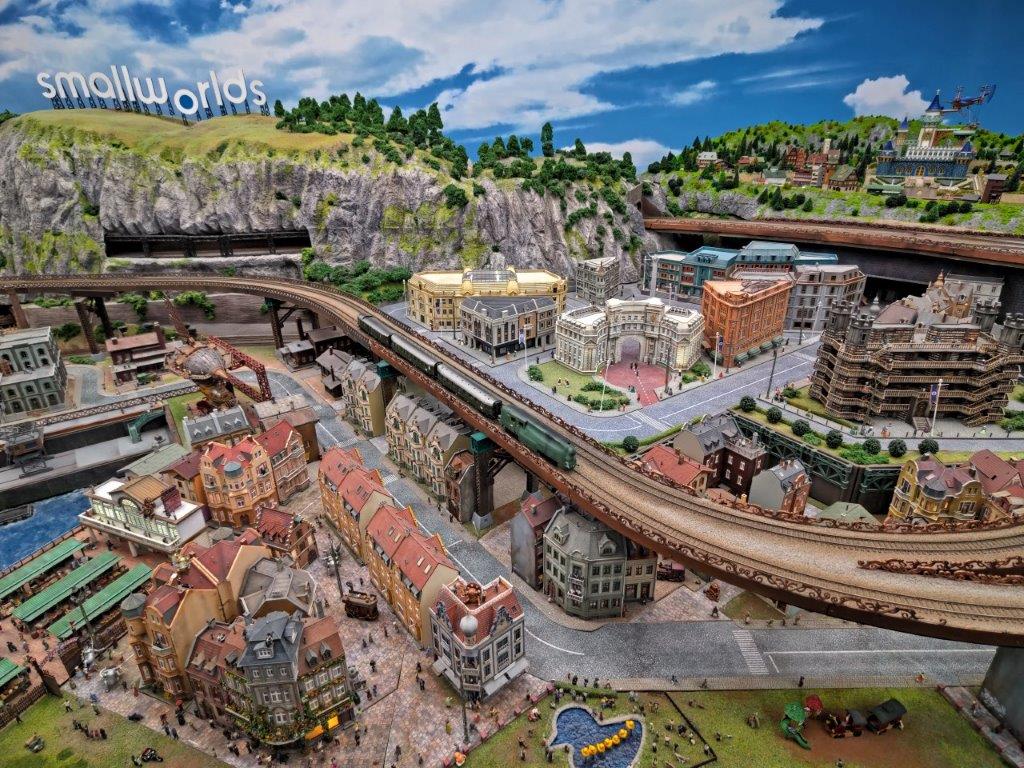
Model train running through the Global Village area
Model map of Small Worlds, to the left of the elevator
I love models and miniatures, and despite the high entrance price (2700 yen), I’ve been there twice, once in December 2022 and again in March 2023, and highly enjoyed both visits. There is so much detail to spot and observe, that one can easily spend two hours there, even though all the displays are just on one floor. Make sure to press the various buttons and then try and see which miniatures suddenly spring into action.
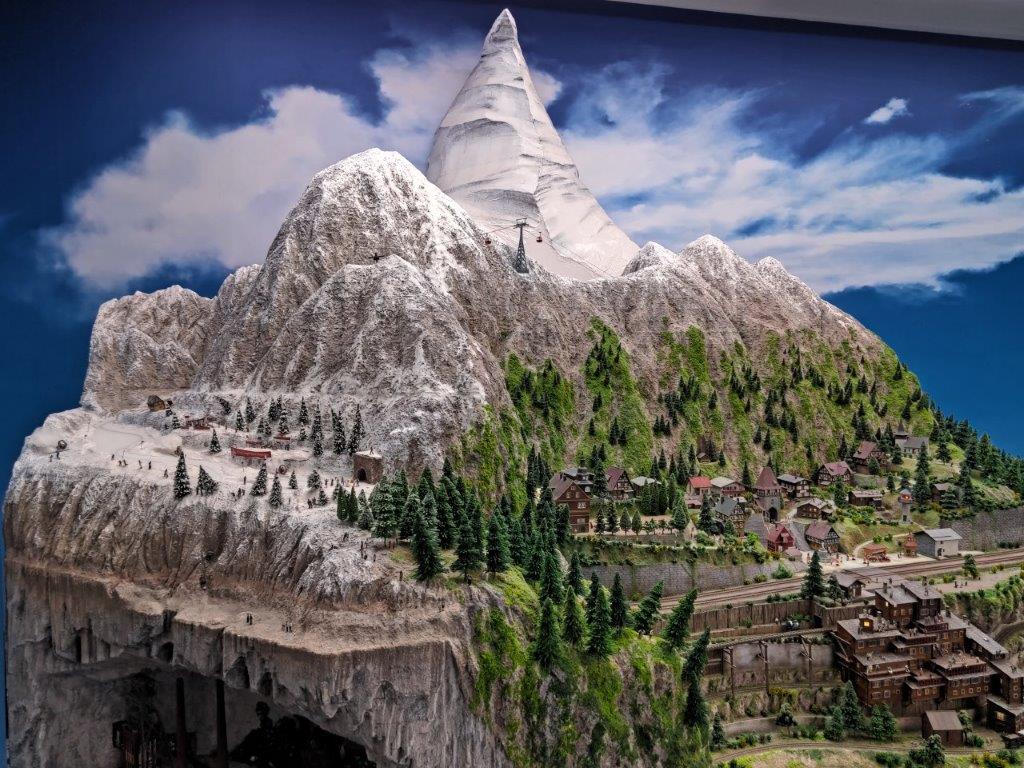
Alpine landscape with a (moving) ropeway and a ski slope
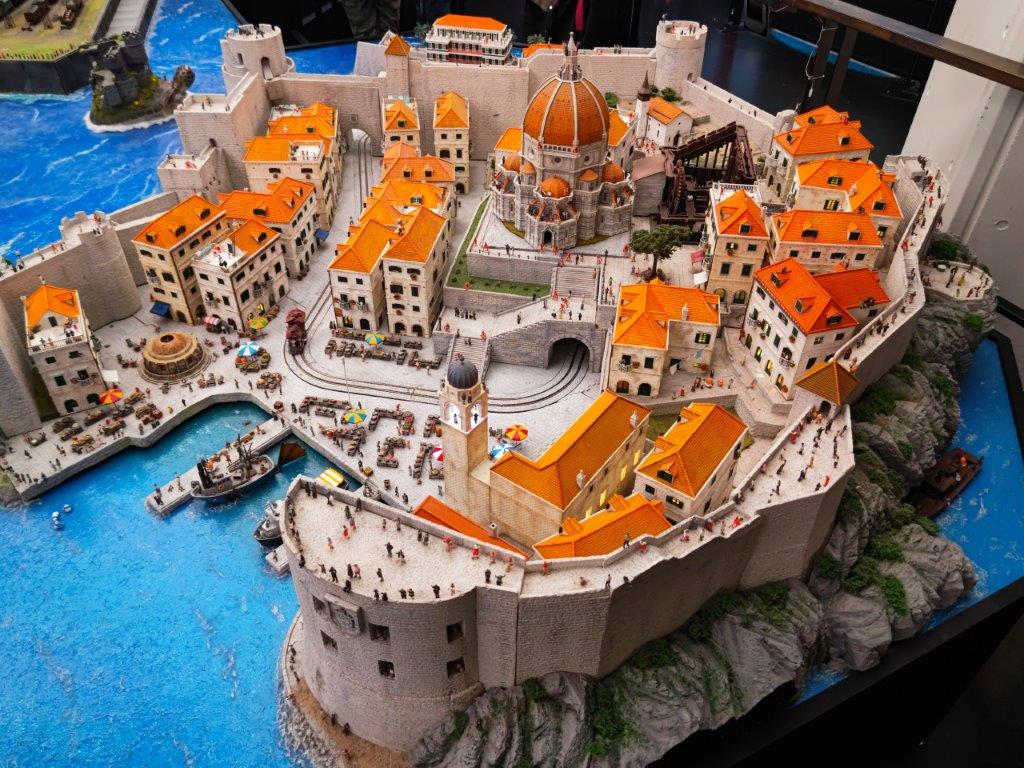
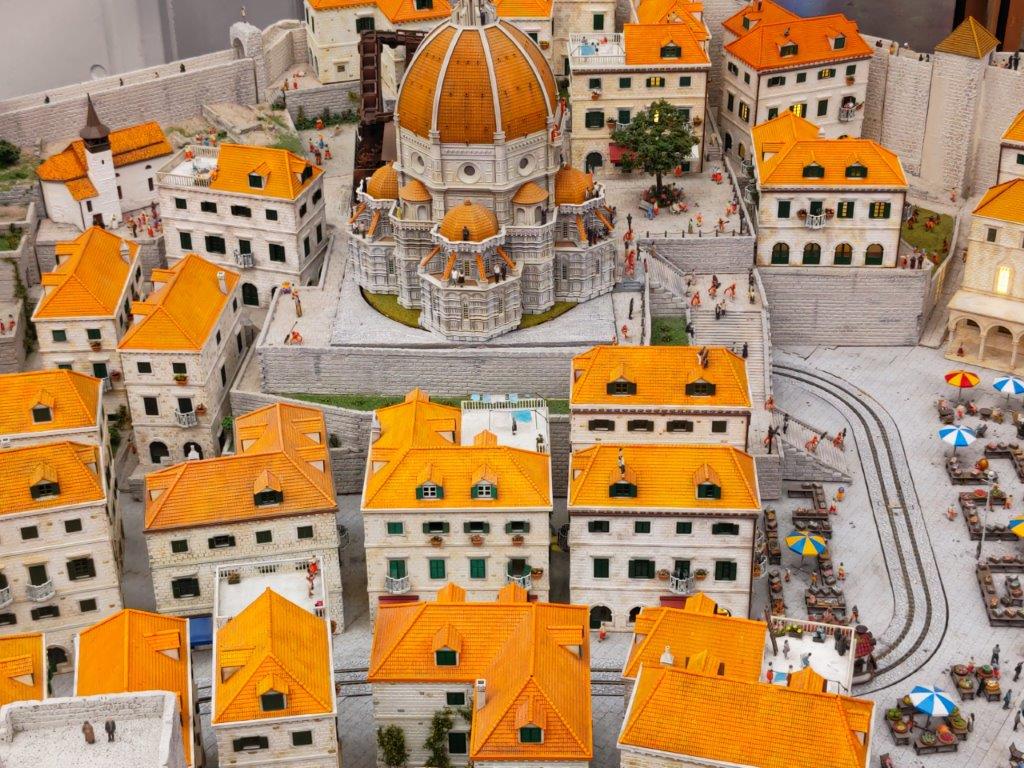
Mediterrean sea fort
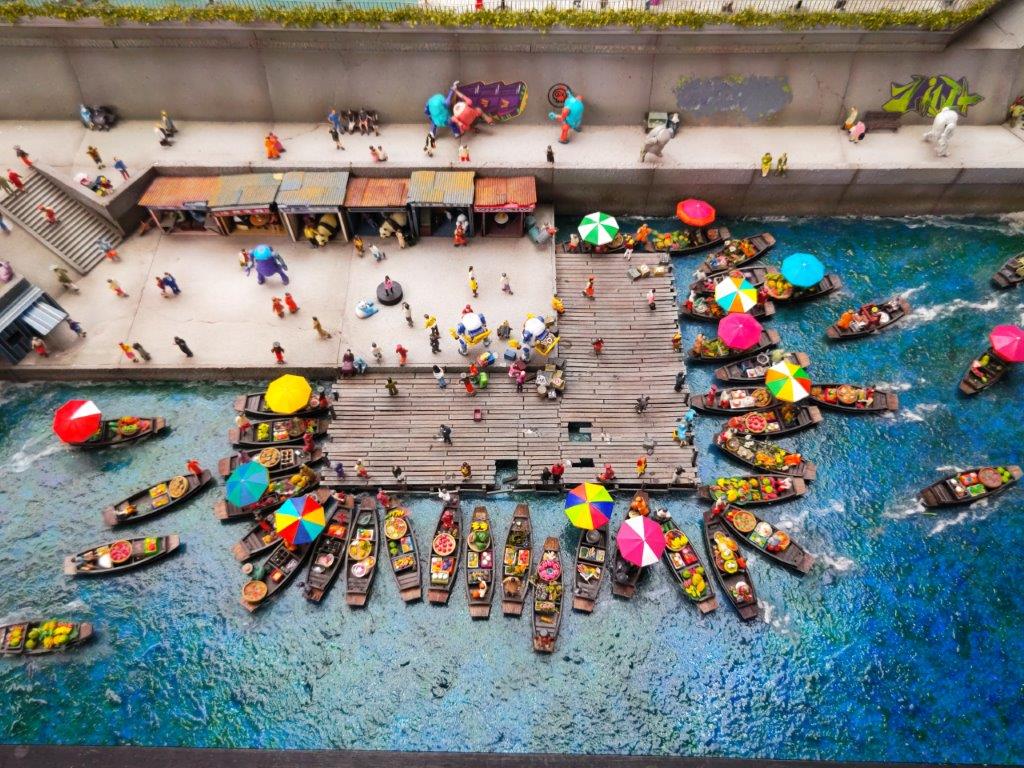
The theme park is divided into 6 areas. The most interesting one is the “Global Village area” featuring towns built in various architectural styles, with model trains running through most of the exhibit. I’d recommending seeing it early in the visit: go left when getting off the escalator on the 3rd floor. It’s just past the “Space Center area”, the 2nd most interesting area: there are several rocket blastoffs throughout the day so make sure to check the schedule.
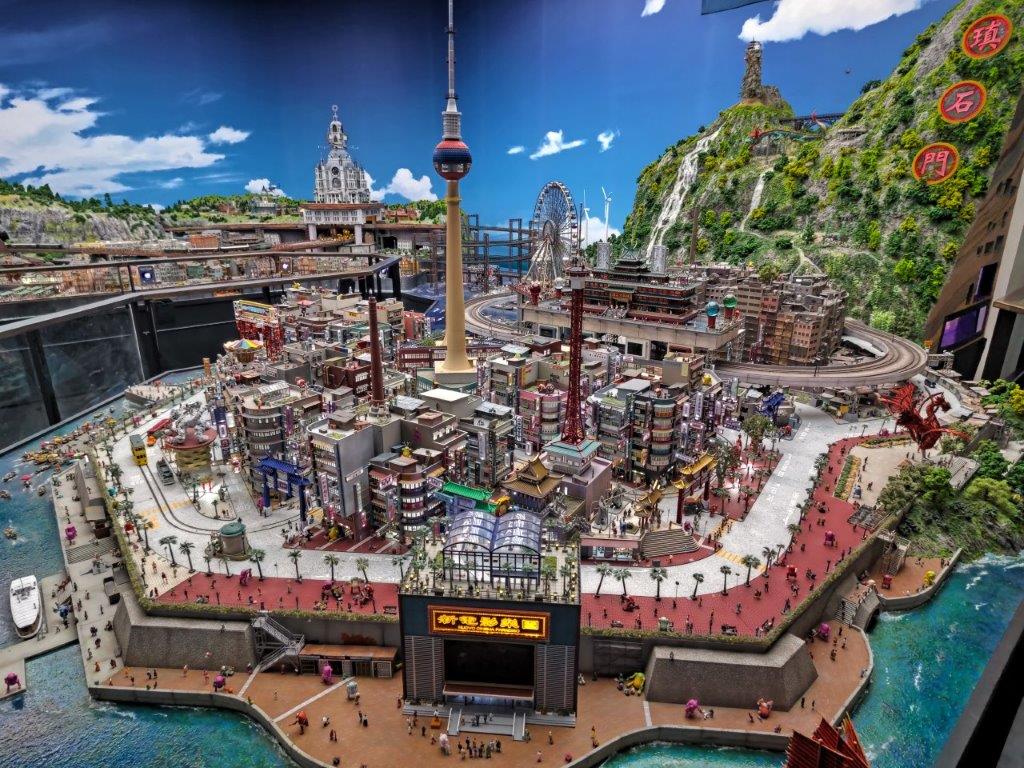
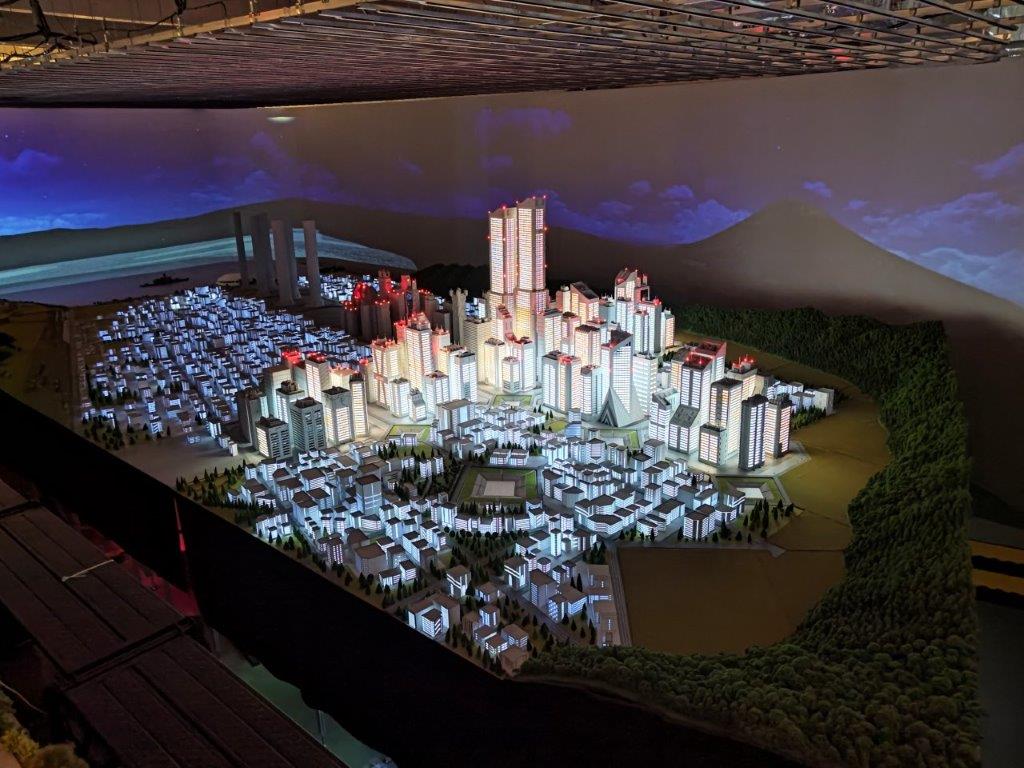
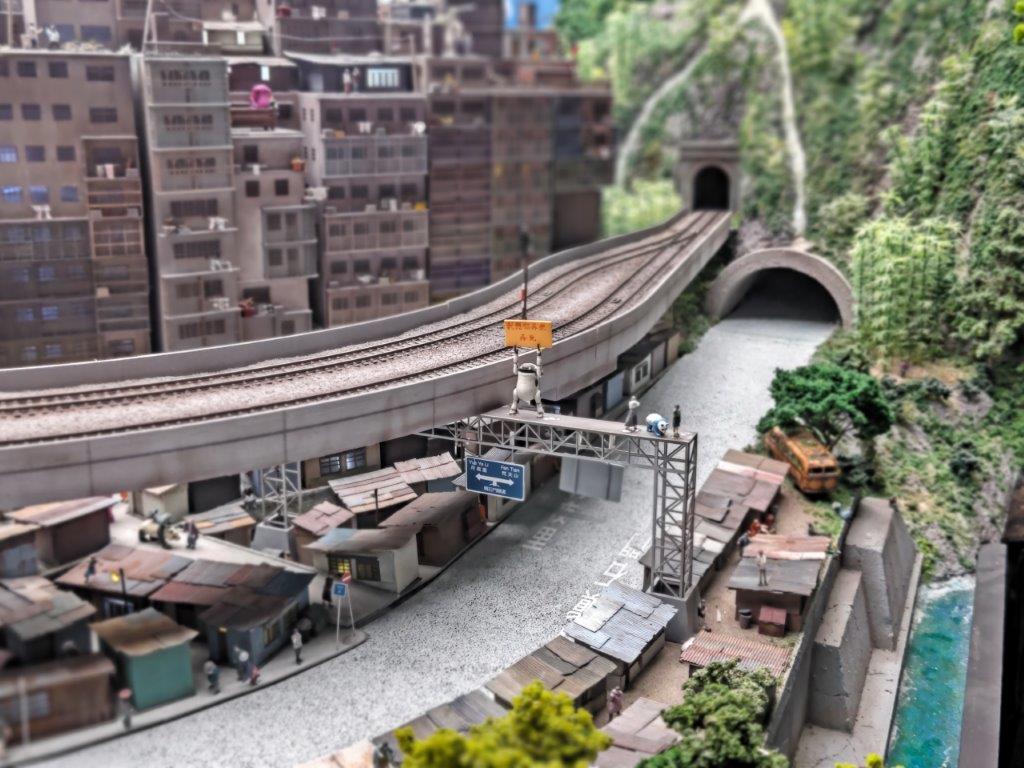
A fictional city modeled on real-life Hong-Kong
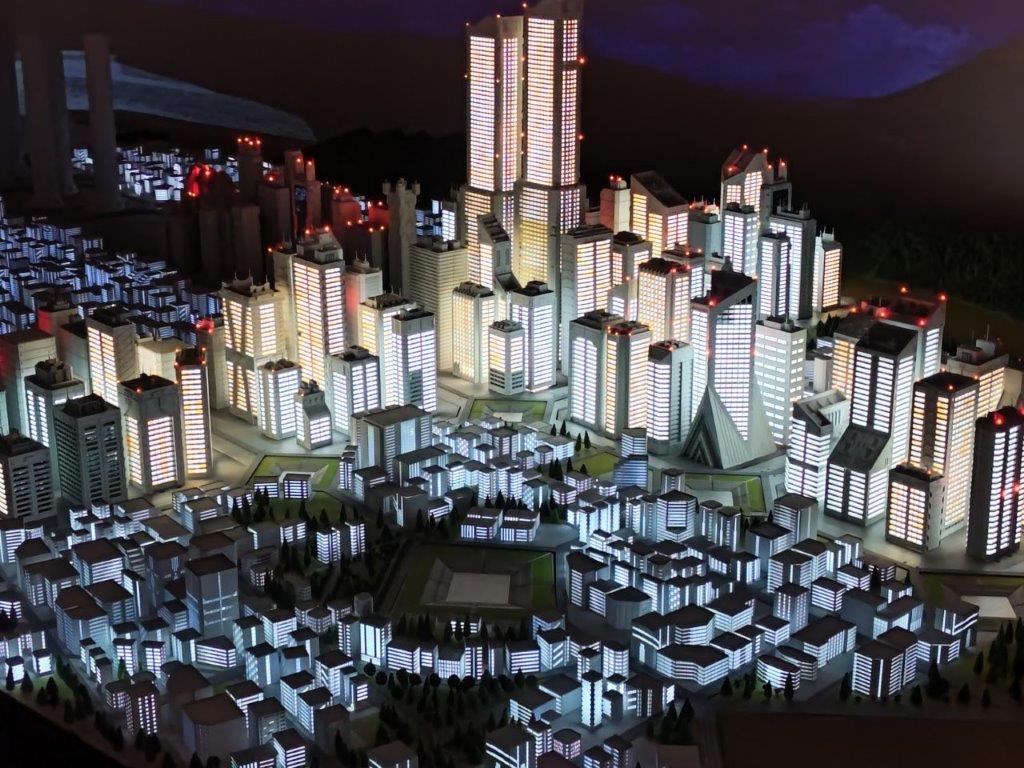
The Sailor Moon city at night
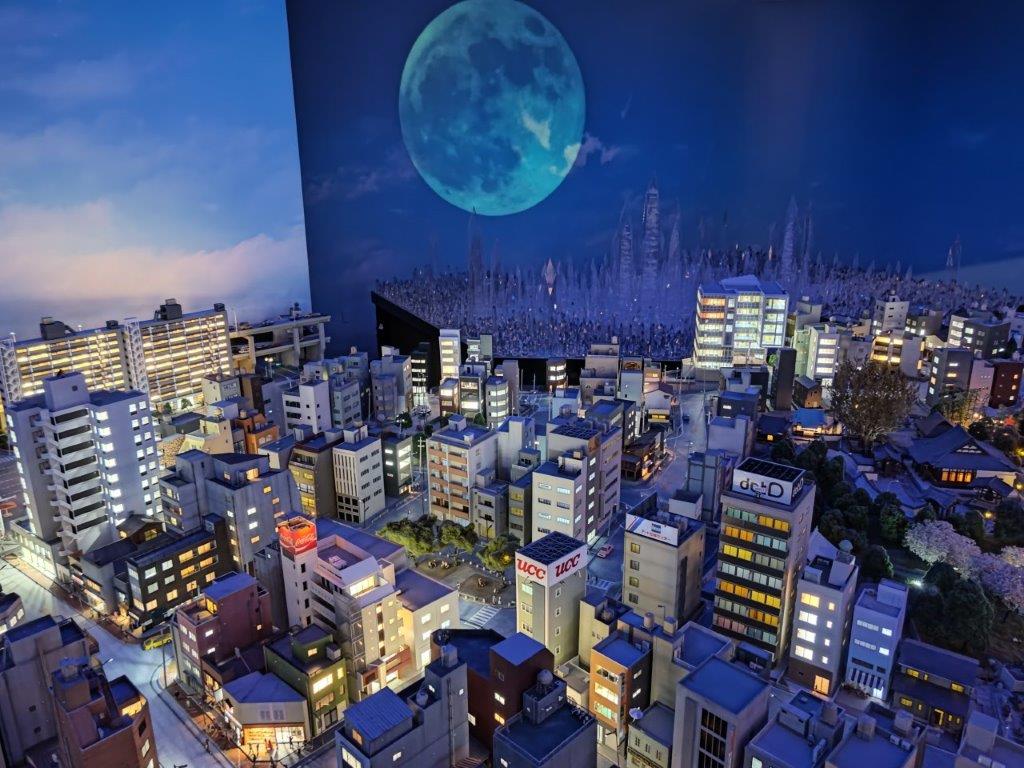
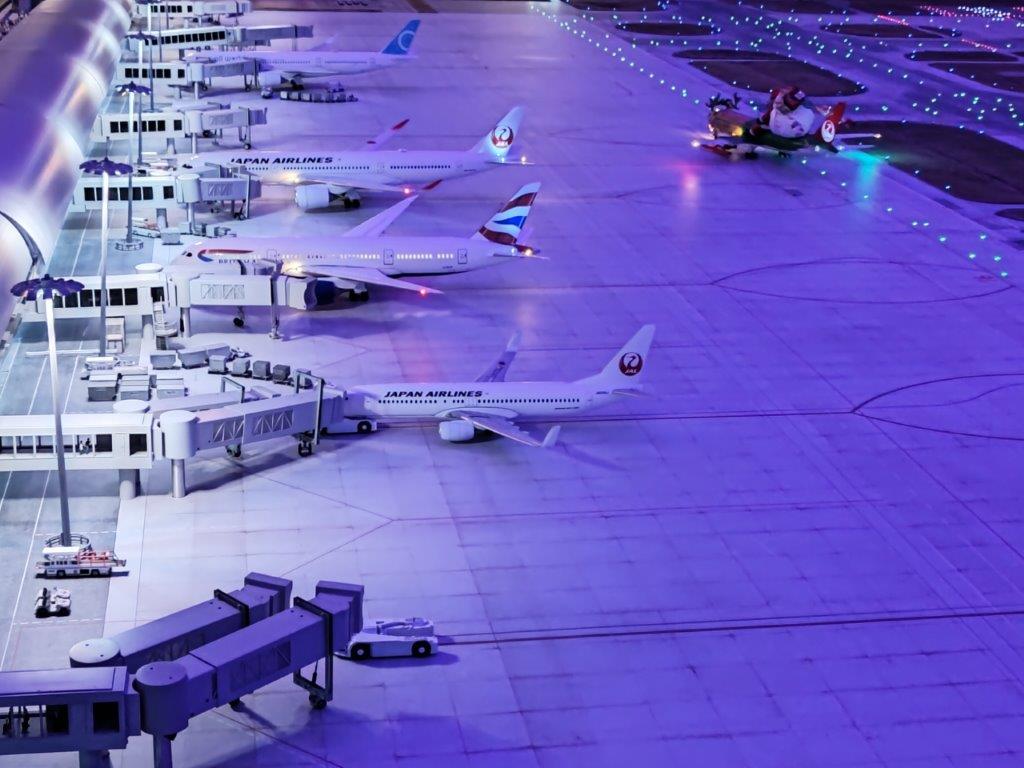
Following the route, the next area is the “Sailor Moon Area”, recreating the Tokyo neighbourhood where the characters of the Sailor Moon animation live. Make sure to hang around for the night performance of Debussy’s ” Clair de Lune” (see videos). The 3rd most interesting area is up next: the “Kansai International Airport Area”. It seems to take up a lot of unnecessary space but the sight of the planes taking off and landing is worth it.
Kansai international airport at dawn
The airport at night
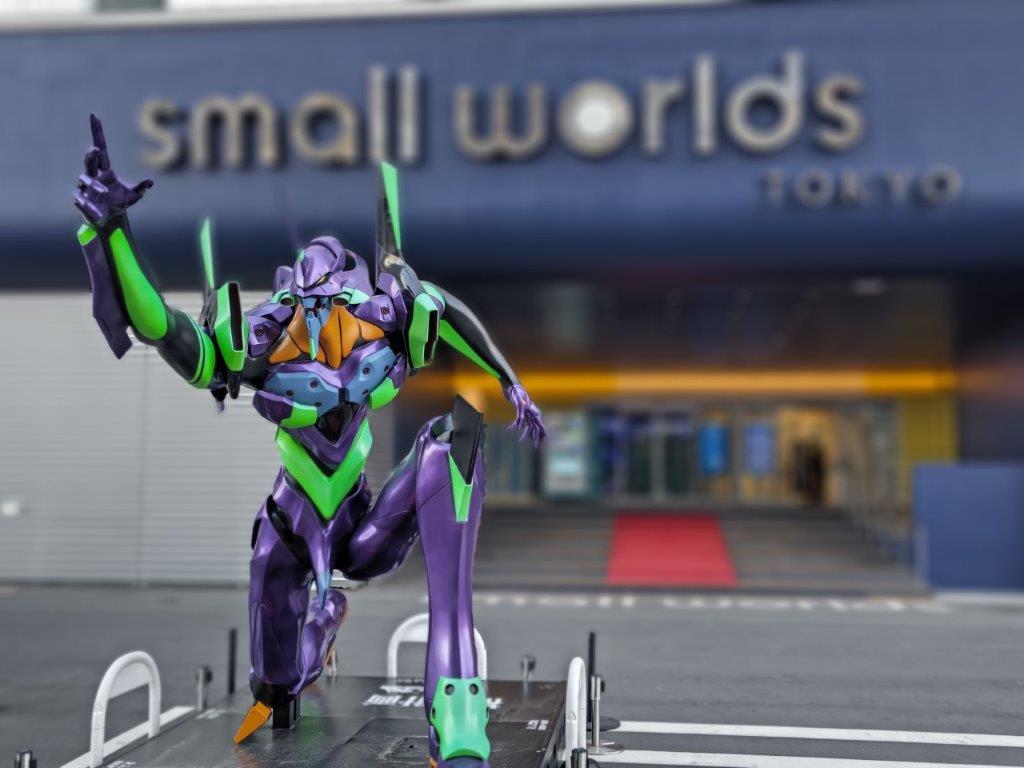
Down a tunnel leading away from the airport is the “Evangelion Cage area”, the least interesting area, where one can see the 3 EVAs from the animation. Hardcore fans of the show might enjoy it but I found it less impressive than the rockets and planes in the other areas. The Small Worlds theme park has several corporate partners which is why there are so many JAL planes at the airport; and also why there are so many hotdog vending cars (another partner is a sausage factory).
At night, Tokyo-III re-emerges from the underground
Various rockets are on display
Further on, one arrives at the “Evangelion Tokyo III area”, a reproduction of the city inhabited by the characters of the animation. The highlight is the city that disappears underground and then re-emerges every day. A key feature of the entire park is that day and night alternate, so one gets to see each display in the daytime and lit up at night; it’s worthwhile circling around twice to get both views of each area.
A seasonal display only for the Christmas season
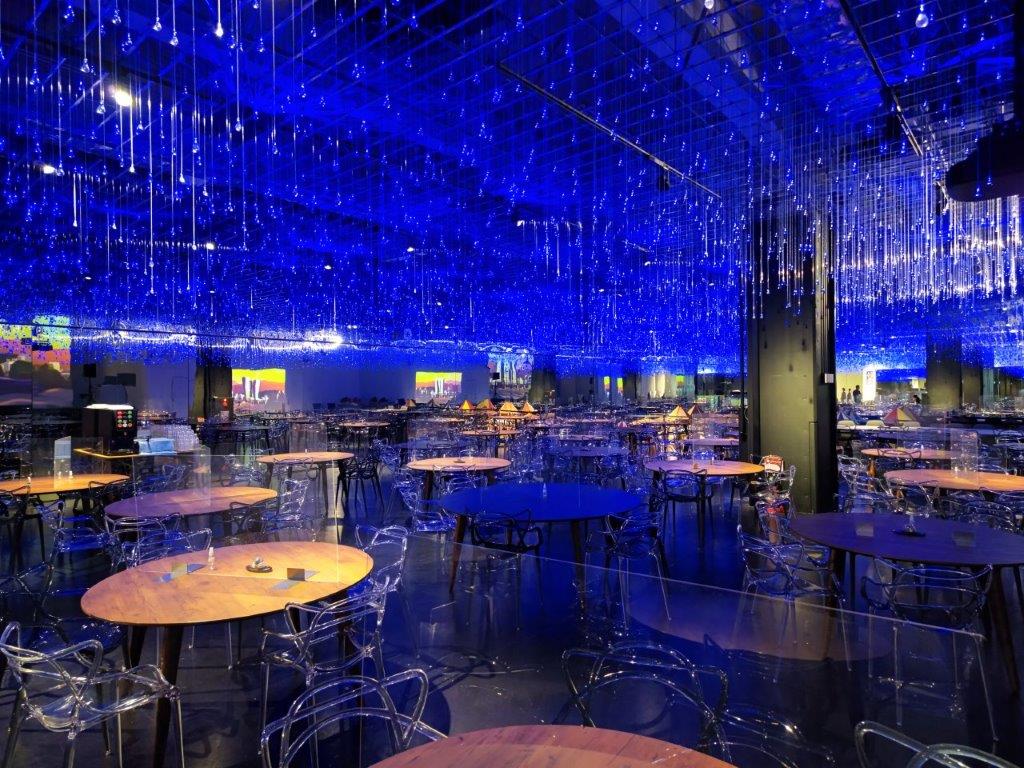
The dazzling “White Art” restaurant on the 2nd floor
After the Evangelion area, it’s possible to loop back to the previous exhibits by going through the workshop area. Both my visits were on weekdays so no workshop activities were being held but there were still many interesting things to see; I could also observe the artists at work. Before leaving, it’s worthwhile checking out the dazzling restaurant on the 2nd floor with its impressive Small Worlds ad playing on loop on a big screen.
See a video of Small Worlds (part I)
See a video of Small Worlds (part I)
See a slideshow of some close-up pictures of Small Worlds
I recently had the opportunity to visit a free temporary exhibition called “Showa Retro Kan” (昭和レトロ館) on the 2nd floor of the Toshima Municipal Showa History Cultural Museum (豊島区立昭和歴史文化記念館) on Tokiwa-So-Doori (トキワ壮通り), about two kilometers west of Mejiro station. I walked there since Mejiro-doori is an interesting street to explore, but took one of the frequent buses back.
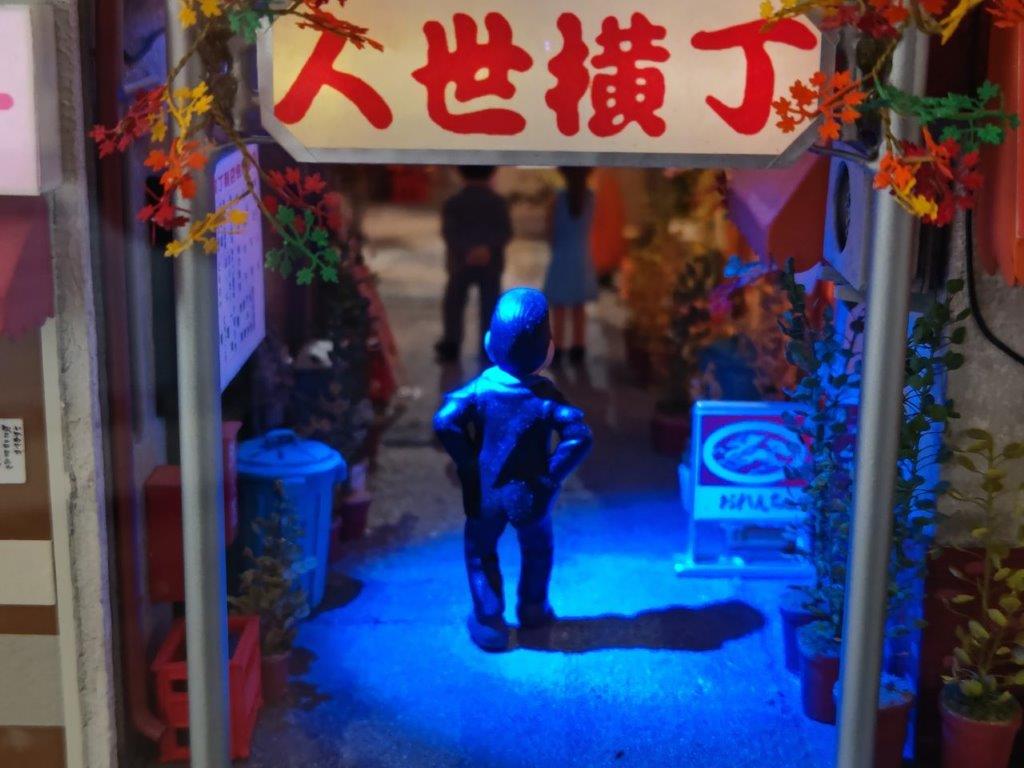
A Showa-era drinking spot near Ikebukuro station
A peek inside a Showa-era room
Tokiwa-so or Tokiwa house (トキワ壮) used to be an apartment building where many famous Japanese manga artists used to live in the 1950s and 1960: Osamu Tezuka stayed there at the beginning of his career, as well as Fujiko Fujio, the team behind Doraemon. Although the original building no longer exists, there are a number of related interesting sights in the area.
Oden food cart on a bridge over the Kanda river
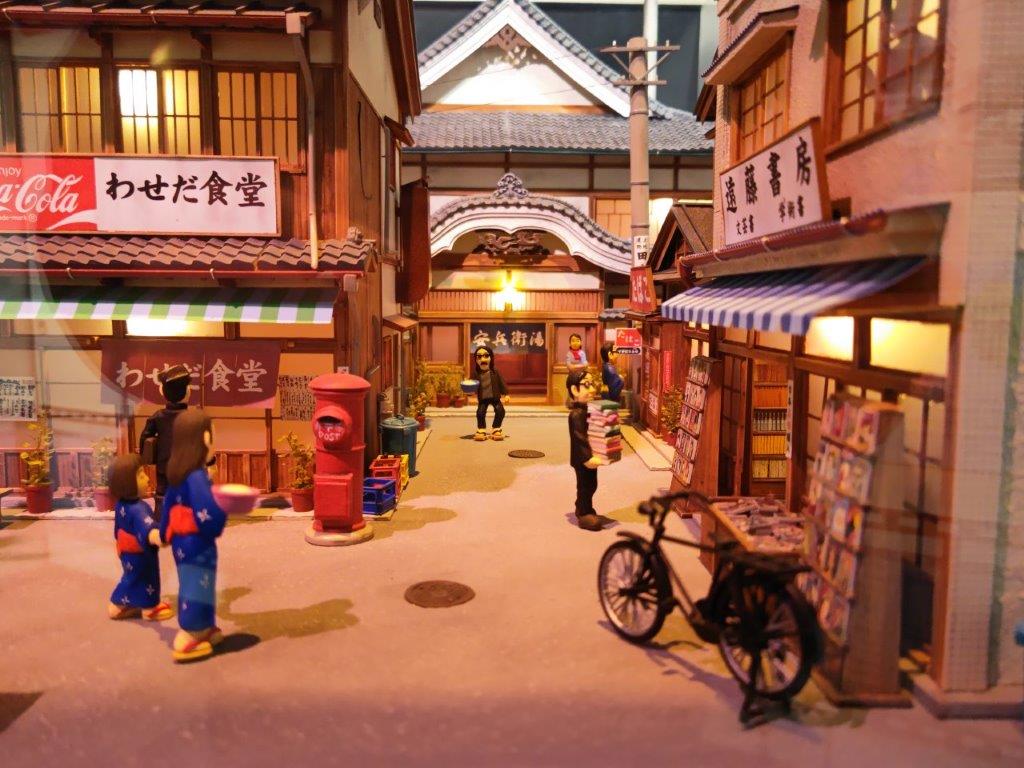
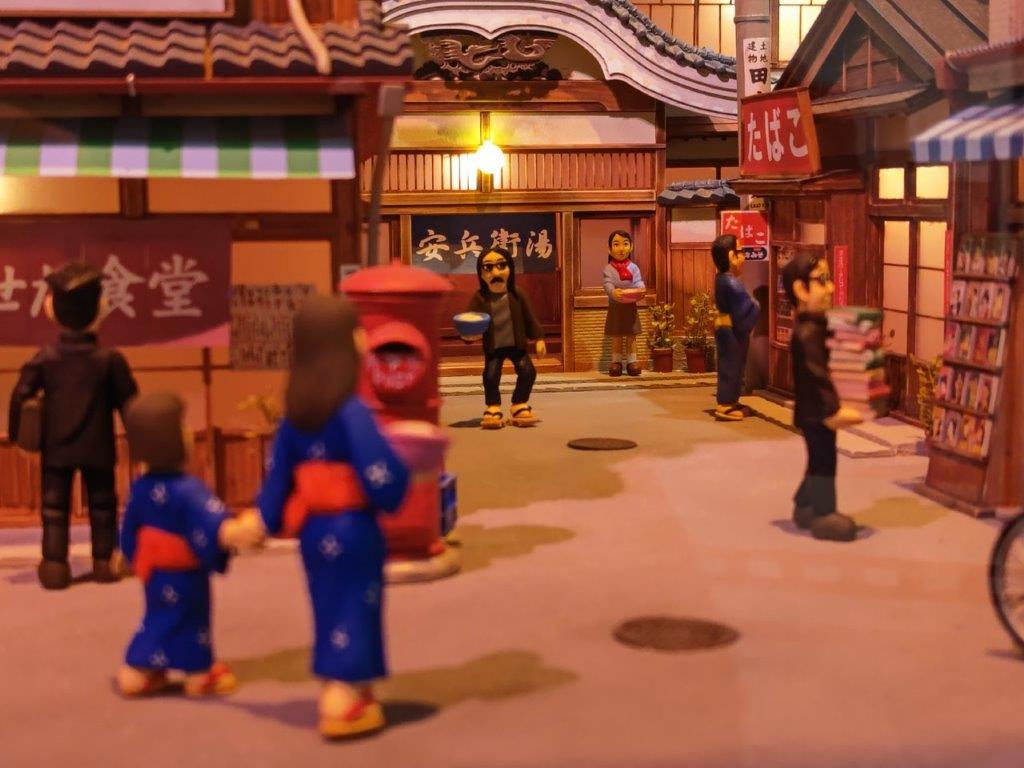
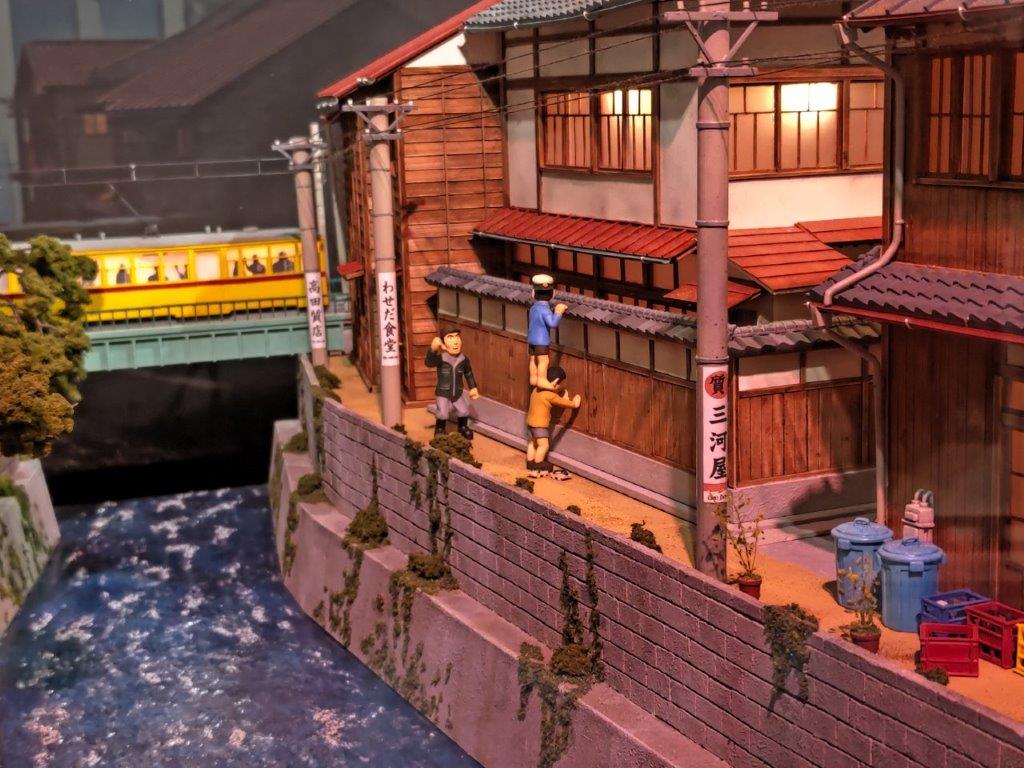
A public bathhouse in the Waseda neighbourhood
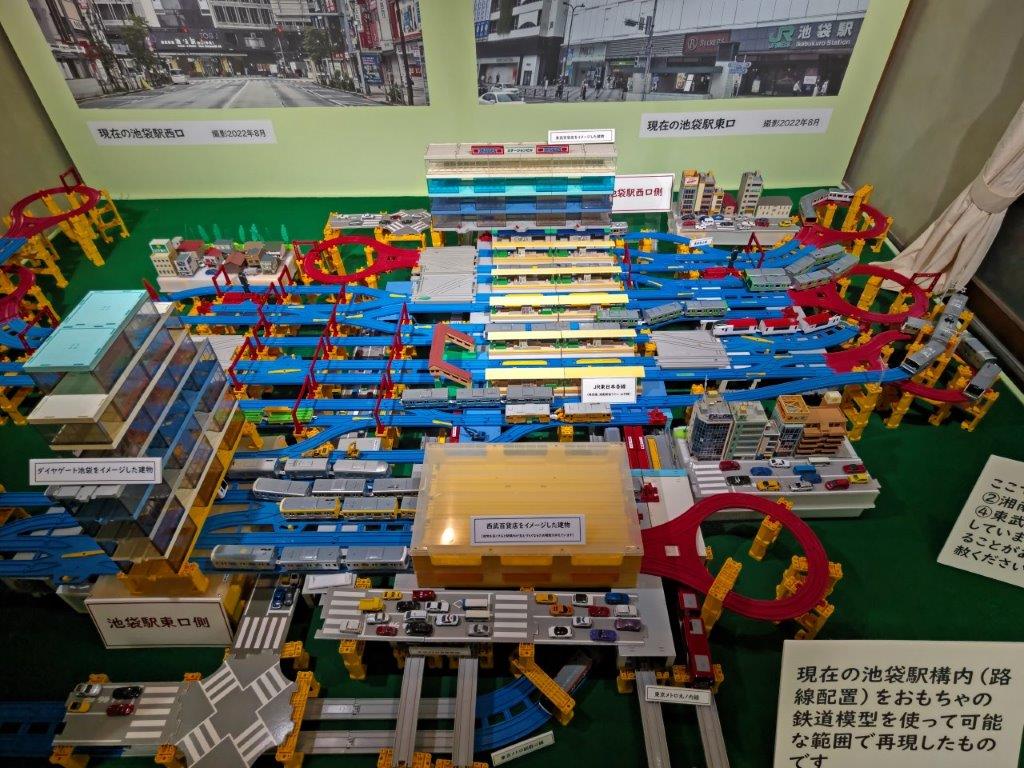
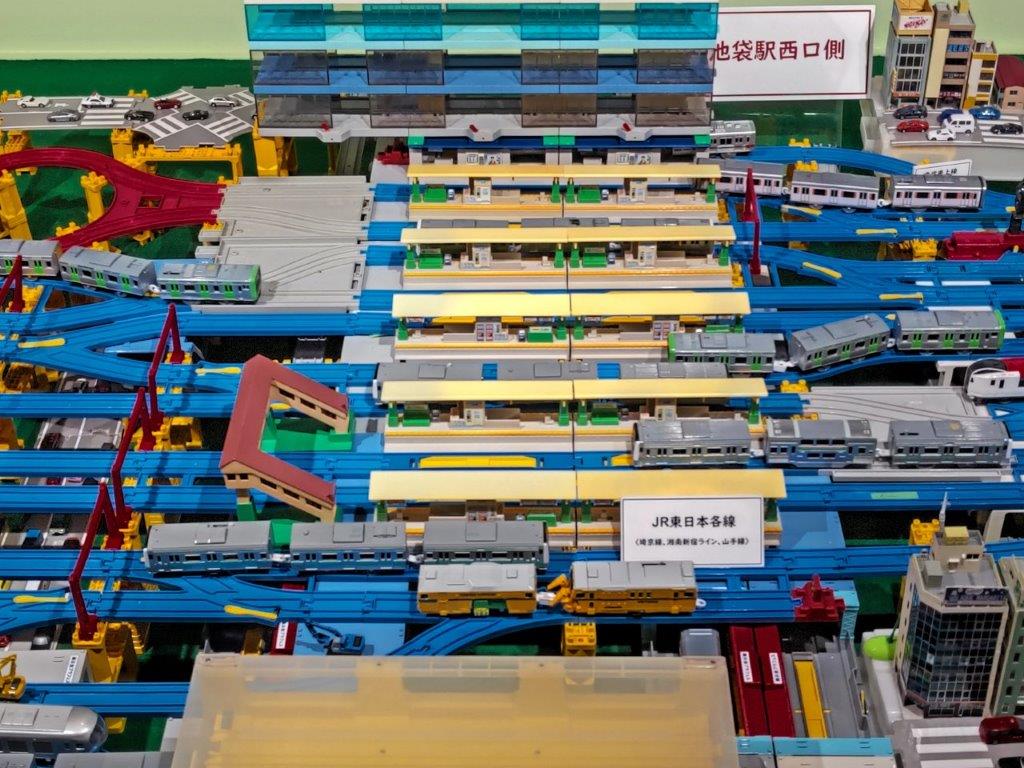
The exhibition is divided into five rooms. The first three have some Showa era photos and room replicas – I had seen similar displays in other museums. However, the fourth room had a toy replica of Ikebukuro station and it was interesting to spot all the different lines that run through one of the busiest stations in the world; also in the same room is a small diorama of what the station looked liked about 100 years ago, when Ikebukuro was mostly fields.
A toy replica of Ikebukuro station
One of the busiest stations in the world
The largest and most interesting room was the last one. It had two larger dioramas: one of “Jinsei-Yokocho” (人生横丁), now renamed to “Mikuni-koji” (美久仁小路), a drinking spot a stones-throw from Sunshine-doori; the other near a sento or public bathhouse in Waseda. I really love miniature models and took my time checking out all the details. The room walls had then and now pictures of various places in Toshima.
Is this one of the residents of Tokiwa House?
Peeping toms…
There are some interesting things to see on the 1st floor as well. A selection of manga that can teach you something; I was familiar with a few of them like Natsuko no Sake and Space Brothers, but I was able to find some new titles to check out. A small shop has some of the manga on sale, although not the ones I wanted. Opposite the shop is probably the cheapest manga cafe in Tokyo: for 500 yen you can spend all day there reading manga (Japanese only).




















 Hiking Around Tokyo
You must be logged in to post a comment.