From the Archives: Tokyo Wide Pass Golden Week 2017

Here are three more hikes that I did in 2017 using the Tokyo Wide pass. For more hikes using the Tokyo Wide Pass, check this blog post: Tokyo Wide Pass Silver Week 2018 Update or search for “Tokyo Wide Pass” on this blog.

Mt Suwa (1549m), Ueno Village, Gunma Prefecture, Thursday May 4

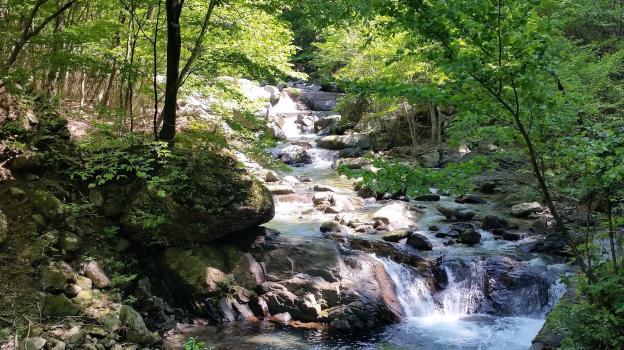
The start of the climb up Mt Suwa is along a small mountain stream

I may have said this before but this mountain probably has the longest access from Tokyo, or at least requires the highest number of different modes of transport. First I used the shinkansen to get to Takasaki. Then I changed to a local train for Shimonita. After that, I hopped onto a minibus, that took me through the mountains by way of a tunnel to the Village of Ueno. Finally I took a taxi, driven by the wife of my minivan driver, to the start of my hike deep deep inside Gunma Prefecture. Amazingly, everything went like clockwork and I was ready to start hiking before 10:30.
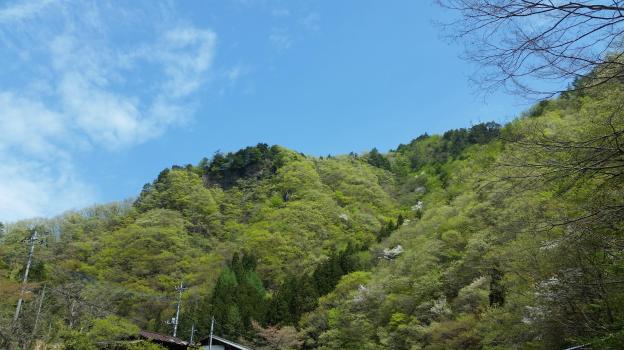
Even though it was already the start of May, the mountainside was dotted with yamazakura

The first part was up along a stream following a steep valley. No sooner had I set out that a yellow-furred Japanese weasel or “itachi” crossed my path, the first time I had ever seen one. After crossing the stream several times on wooden bridges, the path suddenly gotten steeper. I was surrounded by the light green leaves of spring and it was very beautiful. Finally I reached the top of the ridge, and the going got easier.
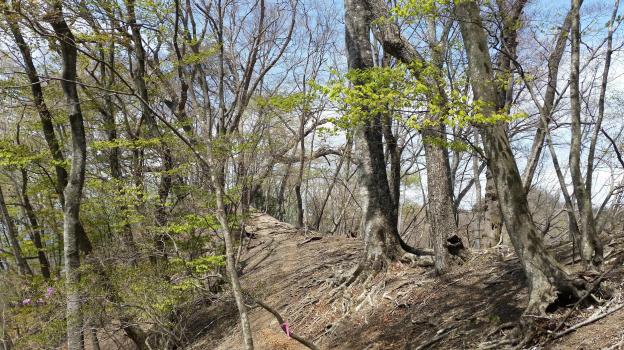
Easy hiking once you reach the ridgeline

Soon I got views of the neighbouring and yet-to-be-climbed Mount Chozuke, as well as the tops of Mt Yatsugatake and Mt Ryokami. Before reaching the top of Mt Suwa 諏訪山, a three-hundred famous mountain in Japan, I had to summit another peak on the way. It turned out to be quite an exciting section – a rocky prominence with steep climbs and drops. The surroundings felt very wild, and it was hard to believe that only a few hours ago I was in Tokyo.

The Rhododendron were in full bloom – Mt Chozuke is in the background

After taking in the great views from the top, I set off for the final part of the hike. I reached the top at 13h30, surrounded by deep forest – I was the only person and it was very quiet and peaceful. I thought it was shame that the path didn’t continue further. The return was along the same way so I hurried back down. There was an option to take a different path further down but it was just too long for a one day trip. After reaching the start of the trail two hours later, I headed to a nearby onsen.
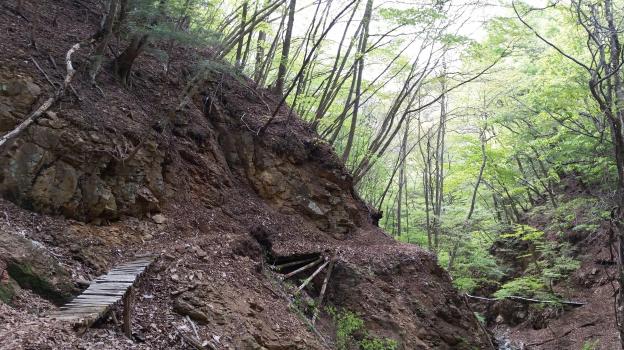
Although the path seemed sketchy at times, it was perfectly safe

After a very quick bath, I started walking back along the road to the bus stop at Ueno Village, one hour away. However before I was halfway there, I was picked up my bus driver from the morning who happened to be passing by in his own car! He dropped me off at the bus stop so I had time to spare before catching the bus back to Shimonita.

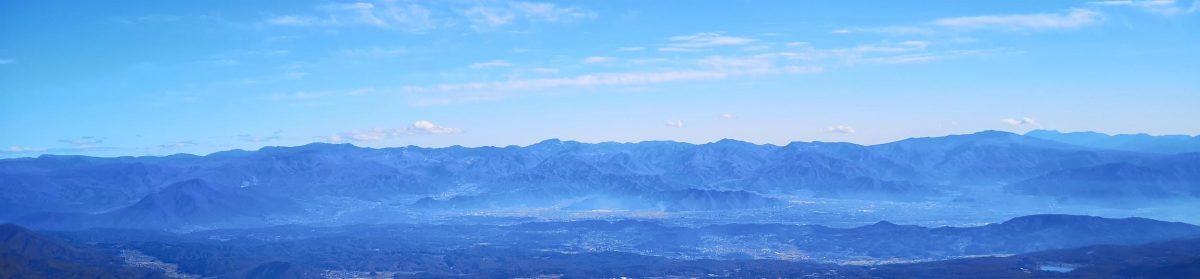
View to the North and Gunma prefecture

Mt Oujou (1123m) & Mt Takama (1342m), Nakanojo Town, Gunma Prefecture, Friday May 5

Mt Oujou, the highest point of my hike

This is an off-the-map hike that I found through Google Maps. I was looking for new ways to use the Tokyo Wide Pass and by checking the mountains near the Agatsuma line and then looking them up on Yamareco, I found that Mt Oujou 王城山 and Mt Takama 高間山, both Gunma 100 famous mountains, could be done together as a day-trip from Tokyo.
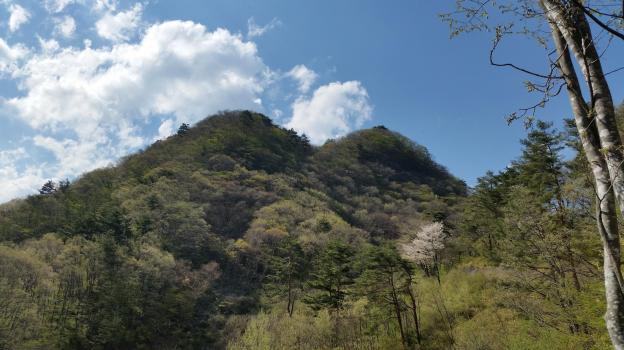
A good view of Mt Oujou on the way back

After getting off at the the tiny but new Kawarayu Onsen station, I made my way across a long bridge above a meandering river far below. According to the signs on the bridge, there is a plan to dam the river and flood the valley to form a lake. Although the projected representation looked nice, I still felt that it was shame to destroy such a picturesque valley. On the other side, I turned left and walked along the road for a bit before taking a road that went straight up the side on the mountain to my right, to the start of the hiking trail.

According to the dam project, the floor of the valley (where the house is) would be flooded

As with Mt Suwa the day before, the mountainsides were dotted with yamazakura, and all around I could enjoy the new green leaves of spring. I reached the top of the first summit of my hike before 12h30, less than two hours after setting out. I had great views of Mt Asama to the south, and Mt Azuma and Mt Shirane-Kusatsu to the West, all still covered in snow. To the West I could also spot the outline of Mt Haruna.
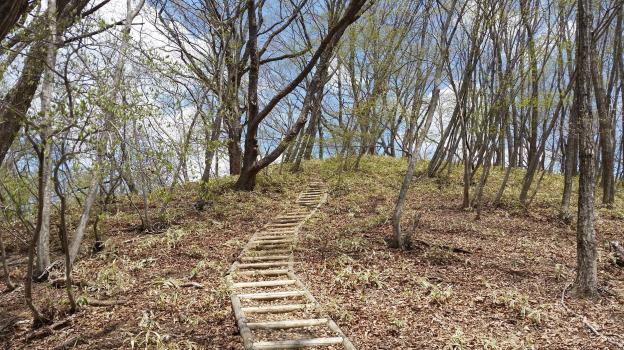
For a Gunma hike, the path was fairly easy to hike

After a short rest I continued along the hiking path. It followed a ridge with steep drops on both sides. I had occasional glimpses of Kusatsu on my left. I saw no else on my hike, and that in itself made it really lovely. Eventually I crossed a road and started up a steep path – the final ascent for the second peak of my hike. The view from the top was less good than the first one but still nice. The clouds had rolled in and it was starting to get cold so I soon headed back the same way I had come.

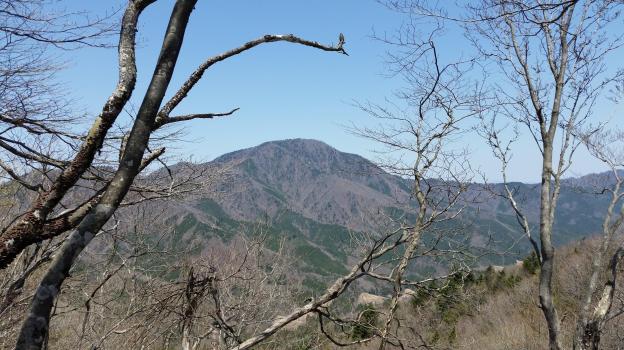
Glimpses of Mt Kusatsu-Shirane through the branches

Most of the return was along the same way, although it was possible to take a small detour to the right at one point. Coming back down, I was able to admire the steep dramatic mountain peaks on the opposite side of the valley. Unfortunately, as far as I know, there are no hiking paths there. After reaching the station, I continued a little further to Kawarayu Hot Spring, about 10 minutes away through a tunnel, a great place to soak before catching a train back to Takasaki and Tokyo.
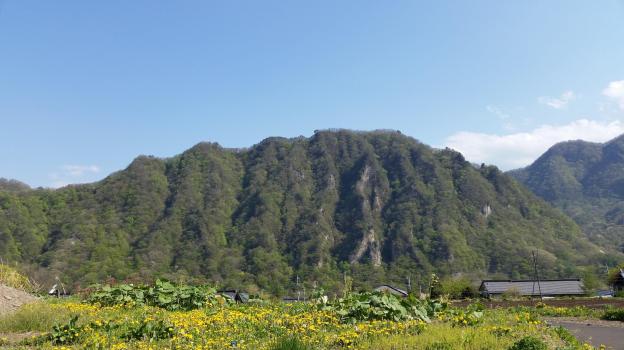
Only locals know a way up this mountain

Mt Azumaya (1341m), Minakami Town, Gunma Prefecture, Saturday May 6
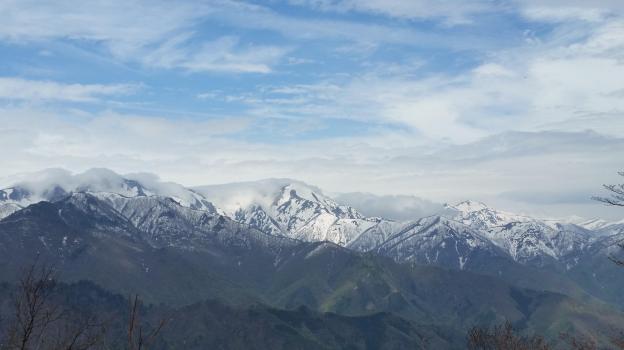
Clouds rolling over the highest points of Tanigawa range

Since the weather seemed to be holding, I dared do a third consecutive hike. Also since it was the day before the last day of Golden Week, I felt the trains coming back wouldn’t be too crowded. Mt Azumaya 吾妻山 is a Kanto hundred famous mountain, just West of Minakami Town in Northern Gunma. As far as I know, there is no public transport to the trailhead, so I had to settle on a short taxi ride from Jomo Kogen Station on the Joetsu Shinkansen.

The taxi dropped me off at the end of the road in an opening in the midst of a dark pine forest. There were no other hikers and the sky was overcast. After a quick breakfast, I set off along the forest road. I soon reached a wide lake, with the main ridge on the opposite side. I opted to walk it clockwise and it turned out to be a lucky decision: I found out later that the other half was obstructed by snow! Despite not being especially high, its closeness to Japan’s snow country meant that the area gets quite a lot of snow in the winter.

Lake at Omine Marshland – the white slightly to the left of the center is Sakura, and the white on the right near the water is snow

After reaching the opposite end of the lake, I started climbing and spotted some Azalea next to the path, a sure sign that spring was on the way. Other that, I didn’t see much spring green in stark contrast to my two previous hikes. However, like the two previous hikes I saw absolutely no one. I did see some “Kamoshika” or Japanese Serows jumping away from me, and I startled a few Japanese pheasants. At one point it started to rain lightly and I started to doubt whether I should have gone on a hike at all.

Long staircase going down and then up the other side

Fortunately the rain soon stopped. After going down a very long metallic staircase and the going up an equally long one on the opposite side, I was confronted with more snow, this time lying across my path. As I walked on the snow, I was amazed that I was doing a snow hike in May at around 1000 meters. Luckily the path was easy to follow. I reached the highest point and a small shrine before noon. There were good views to the East of Minakami Town and yet-to-be-climbed Mt Mitsumine. To the North was the Tanigawa ridgeline still partially covered in snow and clouds.
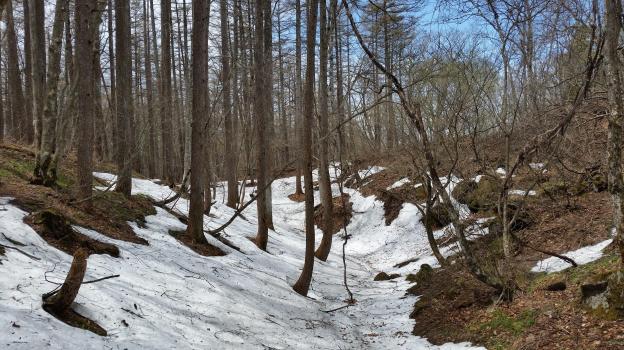
I was surprised to see so much snow on the trail during Golden Week

The weather was improving gradually, and after lunch, I got some better views of Mt Tanigawa and the neighbouring peaks. Unfortunately I couldn’t linger since there was still a long way to go. I started down, continuing North along the ridge. I had some nice views of Mt Hotaka, and finally saw lots of green spring leaves. After descending a long wooden staircase, I reached the bottom of the valley, and turned onto a nice forest road along a river.

By now, the weather was sunny and I was in high spirits. Here I relaxed and somehow managed to miss a turn to the right. Soon the forest road ended, and I had to retrace my steps in order to find the turn. The turn took me across a river and onto a road where I turned left. My plan was to walk all the way to the hidden onsen of Sarugakyo, one hour away. Fortunately the road was quite wide and had sidewalks on the sides. I could still enjoy various kinds of Sakura in full bloom on the way.
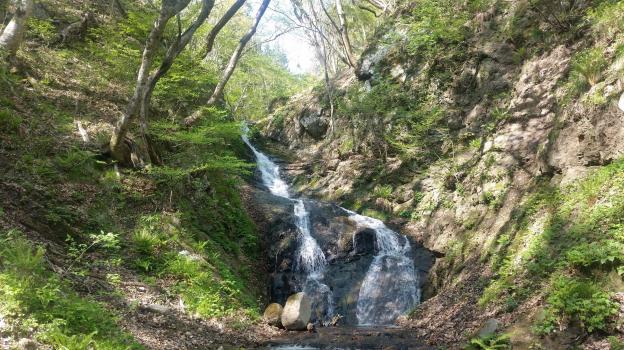
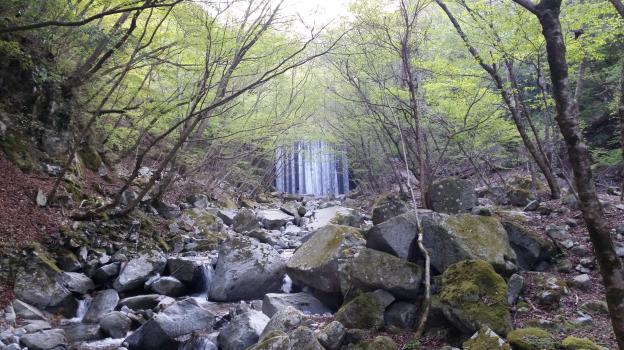
A worthwhile detour – Enmusubi Waterfall

Eventually I took a small hiking trail to the left which ended at the the very nice Yushima Campground alongside a river. I did a short detour to check out a nearby waterfall, then walked up a short road to Sarugakyo Onsen (literally hot spring of the Money Capital). The view of Lake Akaya with a string of Koinobori flags strung across it was quite spectacular. After a nice bath with a view on the lake, I caught a bus back to the Jomo Kogen station, just one hour from the capital of Japan.
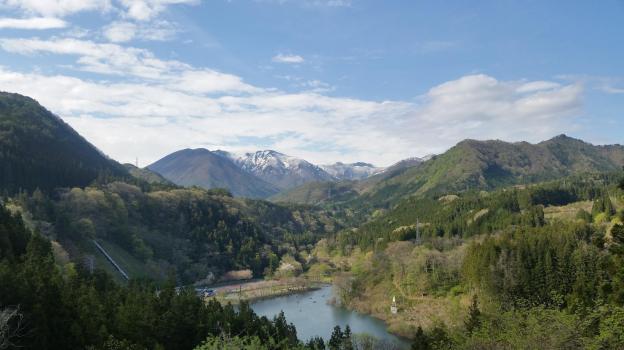
Looking back towards the Tanigawa range

From the Archives: Tokyo Day Hikes April May 2017

Mt Mikasa (1013m), Mt Nekko (1035m), Mt Goto (944m), Mt Kon (933m) & Mt Tanaba (753m), Izu Peninsula, Shizuoka Prefecture, Sunday April 16

The final part of the hike had views galore

A hike of my own creation following the long northward curving ridge opposite Mt Amagi, smack in the center of the Izu Peninsula. If you haven’t hiked Mt Amagi yet, I would recommend that hike first, since this is simply a continuation of that hike. Here, I really appreciated the natural beauty of the Izu portion of the Fuji-Hakone-Izu National Park, and was grateful that I could hike it as a day trip from Tokyo, even though it is over 120 km away from the capital.

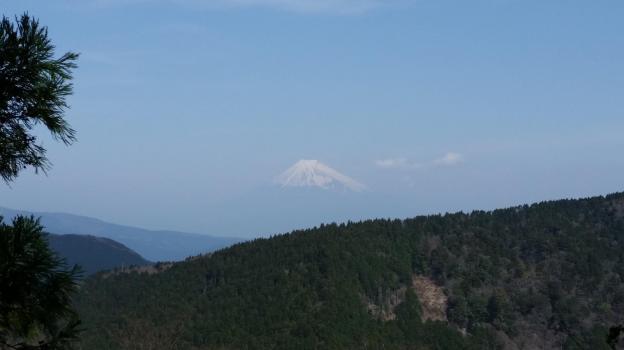
The area between my position and Mt Fuji is not part of the National Park

First I had to get to the Amagi Pass bus stop (650m), a 40-minute bus ride from Shuzenji station at the end of the Izu-Hakone railway. From there it was a short hike to the top of the pass, a place I had passed previously on my descent of Mt Amagi. I turned right along the mostly level path and soon had some good views of snow-covered Fuji to the North, as well as the valley I had previously come through by bus. I soon arrived at Nihonsugi pass (the pass of the two cedar trees). There was a good sign board which included information in English. It’s also worth mentioning that the signs along the way were some of the best I’ve ever seen.

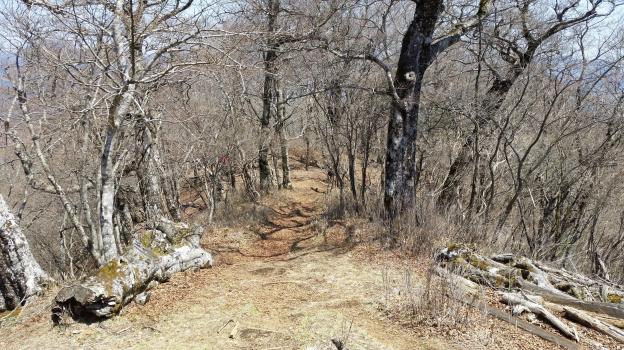
Most of the time the trail looks like this

I knocked off Mt Mikasa 三蓋山, Mt Nekko 猫越岳 and Mt Goto 後藤山 in succession, each peak surrounded by trees. I had occasional glimpses of Mt Fuji, passed a small pond, and saw quite a big toad on the trail, a fairly rare sighting in my experience. It was a beautiful hike during which I saw almost no one. Five hours and a half after setting out, I reached Nishina Pass and the West Izu road at around 2h30. After checking out the great views of Suruga Bay to the West, I turned North and started up another slope, starting to feel a little tired. I was buoyed by the sweeping views since the area is mostly farm pastures, as well as sakura trees in full bloom dotting the sides of the mountains.

Mountain sakura were in full bloom

At this point my hiking path was running parallel to the road, and after a number of passes, I reached the top of Mt Kon 魂の山 just before 4pm. A final effort brought me to Mt Tanaba 棚場山 at the end of the afternoon, just after 5pm, from where it was another hour to a bus stop and my ride back to Shuzenji, a town famous for its hot springs. The hiking path continues all the way to Mt Daruma, but I had already made a visit there the year before.

Spotting any kind of wildlife on a hike is always a source of excitement


Mt Futago (1165m), Ogano Town, Saitama Prefecture, Sunday April 23

This hike mainly follows the entire length of the ridge

This was an exciting hike along a narrow ridge on the border of Saitama and Gunma prefectures, at the edge of the Chichibu mountains, and in the shadow of Mt Ryokami. It had been recommended to me a couple of years before by fellow hikers staying at the Kumotori lodge on New Year’s Eve. The trail looks deceptively short on the map but does require a full day of hiking. Mt Futago 二子山, meaning twin mountain because of its two peaks, can be reached by taking a first bus from Seibu-Chichibu Station, and then changing to a second bus at Ogano Town.

Chichibu as seen from Mt Futago

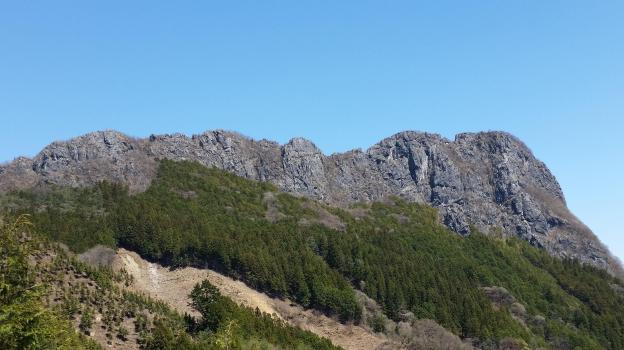
The first part of the hike is along a road. After you finally leave the road for the trail, there are some great views of the rocky double peak of the mountain, which seems quite impossible to reach. Once the path reaches the forested area at the base of the cliffs, it curves left under the rocky walls and finds a way up the Northern end of the mountain. It’s steep and roped but you’ll find yourself on the top ridge in no time. From here it’s important to progress with caution along the mostly level path, since there are drops on both sides. I had to be careful not to get distracted by the amazing views: Mt Ryokami and the other Chichibu mountains to the South, Kanna River valley and the mountains of Western Gunma to the North. On this perfect day, I also got to see the snowy tops of Yatsugatake and Asamayama.

North towards Gunma – the highest point is Mt Akaguna

I eventually reached the western peak where I took a well-deserved lunch break. People were climbing up the North cliff with all the proper equipment. It is at this point that I made a big mistake. After lunch, I continued straight along the ridge. I hadn’t bothered to read the description of the route in my Japanese guidebook (I now do this every time), and I had rushed ahead since I was a little behind schedule. Soon I found myself climbing down successive rocky faces with only thin ledges between them. I am used to the occasional rocky face, but they usually come with ropes, chains and ladders. However, here, there was nothing, just metal bits for attaching ropes.

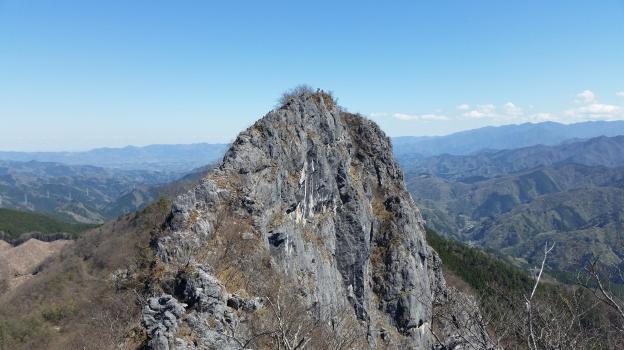
The West Peak of Mt Futago

On one ledge, I had a good look up and down, and realised that I was in the midst of a cliff – this certainly wasn’t the right path. My knees started to shake uncontrollably since any mistake could lead to a fatal fall. At this stage, going back up was as risky as continuing down, so I gulped the remainder of my coffee, and proceeded downwards. I don’t think I have ever been so frightened since I did the “daikiretto” in the North Alps.

I mistakenly took the “advanced” red route instead of the “usual” blue one

Eventually I reached the base of the cliff and a little further the path merged with the path I should have taken. Soon I reached a pass where I left my pack and did a quick round trip to the lower and less impressive eastern summit. There were good views of the Western summit and the cliff I had just hiked down (shivers). After taking in the views, I decided it was time to head down since it was nearly 3pm. The descent down a forested valley was uneventful and I reached the bus stop around 4pm.


Mt Komotsurushi (1379m) & Mt Azegamaru (1293m), Nishi Tanzawa Mountains, Kanagawa Prefecture, Sunday April 30

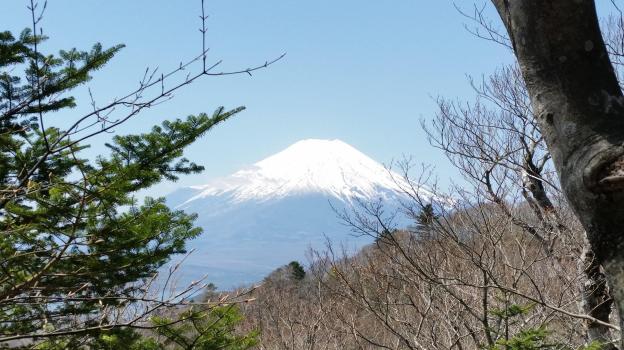
Seeing Mt Fuji is one of joys of hiking in Japan

This was another of my original hikes, and it’s also part of the Tokai hiking trail. I really wanted to walk through the westernmost area of the Tanzawa mountain range, but none of the peaks were featured in my guide book. This is probably because the area is rather difficult to access, despite being half the distance of my previous hike to Izu. The problem lies with the adjacent Doshi valley, which has extremely poor public transport. One needs to take a bus from Sagamiko station and then change to another bus. However the transfer times don’t line up so if you go that way you can’t make it back the same day.

Across Doshi Valley – Mt Shotai

Instead I took what must be the most roundabout route ever to approach the start of the trail – from behind. First I took a train from Shinjuku to Fujisan station via Otsuki. There I caught a bus to Yamanaka lake, where I changed to another bus heading to Doshi village, and finally got off at Yamabushi Pass. Despite the long detour, I was ready to start hiking at 10h30. I was the only person to set off on the trail to the top of the ridge. There I turned left (Northeast) towards the Tanzawa mountains with the Fuji area to my back. In the clear spring weather, I had good views of Mt Fuji along the way as well as Mt Shotai to the North. The trail was easy to hike and I saw no one.

A really easy trail to hike

There were some escape routes to the left down into Doshi valley but since there are hardly any buses running there, they are pretty useless. I soon passed the summit of Mt Komotsurushi 菰釣山 and its nice and clean emergency hut that had just opened for the season at the beginning of April – the visitor book showed some guests had already stayed there. This peaceful and relaxing hike eventually brought me to the top of Mt Azegamaru 畦ヶ丸山 with a nice stone summit marker. There is no view but there is another emergency a little bit before the summit.

A man-made waterfall on the final section of the hike

From there, it was an interesting descent down a rocky river valley with multiple crossings along small wooden bridges to the Nishi Tanzawa nature center. Curiously, the signs changed from the usual white paint on wood, to the unusual black paint on yellow painted metal. They seemed quite new and I’ve never seen such signs anywhere else. At the Nature Center, which I reached shortly before 5pm, I caught a bus back to Shin Matsuda station for a much shorter ride home.


Mt Gangaharasuri (1874m), Otsuki City, Yamanashi Prefecture, Saturday May 20

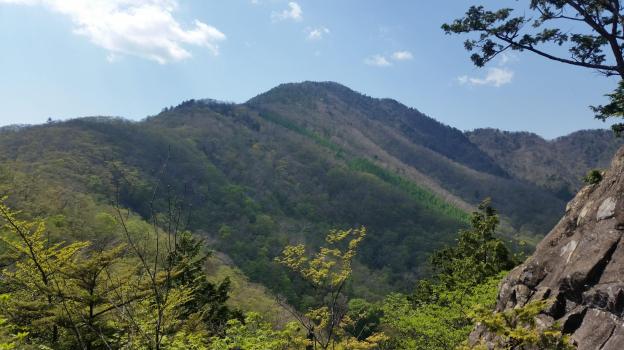
Mt Gangaharasuri as seen from Mt Ubako

This is another summit I had been eyeing for a while but couldn’t figure out how to access it without a car. In the end I saw no other way but to walk for 2 hours along an asphalt road. The starting point was the final stop of the Fujikyu bus from Otsuki station on the Chuo line – I was the sole passenger as usual. The first part was quite pleasant, following a river. Less than an hour out, I passed a taxi coming down the mountain. Only after it disappeared from sight, I realised I could have used it to get to the start of the trail since it would have cost half or less of what it would cost to go from Otsuki station.

A mountain stream in the heart of Yamanashi prefecture

I finally reached the parking area at Otoge pass (1560m) just after 11h30. I took a short break and enjoyed the good views of Mt Fuji. Luckily the summit was only 45 minutes further and 300m higher along a nice hiking trail. The top of Mt Gangaharasuri 雁ヶ腹摺山, located just North of the Chuo Line and West of Otsuki, is one of the 12 viewpoints of Mt Fuji in the Otsuki area. After lunch, I headed down a different path. At first it was pretty steep but soon I emerged at the top of Mt Ubako where there were some good views of the peak I had just descended.

Mt Fuji less clear in the late May haze

After that it was a long descent along a forested ridge during which I met no other hikers – most other people having done the roundtrip from the pass by car. Eventually I went down a short path to the right to join up with a road and a couple of inns. Unfortunately they didn’t allow daytime use of their hot baths, so I walked along the road till the bus stop and got back to Otsuki station where I caught a train home and a shower.